

On July 15, our first day in Bardiya, we met with a group of embroiderers from Thakurbaba Municipality. It was early morning, but the day’s heat had already begun to arrive. The whole group of us – embroiderers Kushma, Kanchan, Nita, and Binita, and our team (Niraj, Ram, Laila, Shuyuan, and myself) sat around a long wooden table under the shade of our homestay’s porch. Our conversation would be situated within a long history of collaboration.
AP has been working with Kushma and Kanchan’s group for the last decade. They began in 2015 with a memorialization project, connected to the group through NEFAD, Ram’s organization. Using a model they’ve implemented with various groups from around the world, AP facilitated an embroidery training and eventual creation of two quilts telling the women’s stories of family members who were disappeared during the conflict. Both quilts became tools for advocacy; one remained in Nepal and was used by NEFAD and the second was exhibited at a UN Summit.
You can read more about the memorial quilts here.
With AP’s help, the group later moved on to tiger designs — embroidery that was used both for quilts as well as bags, an initiative that they hoped would help generate some income. A central deity representing courage and strength in the Tharu culture, the tigers resonated with the women’s stories. In this way the project linked memorialization and storytelling with income generation, new ground for AP.
You can read more about the tiger quilts and bags here and find their most recent designs for sale here.
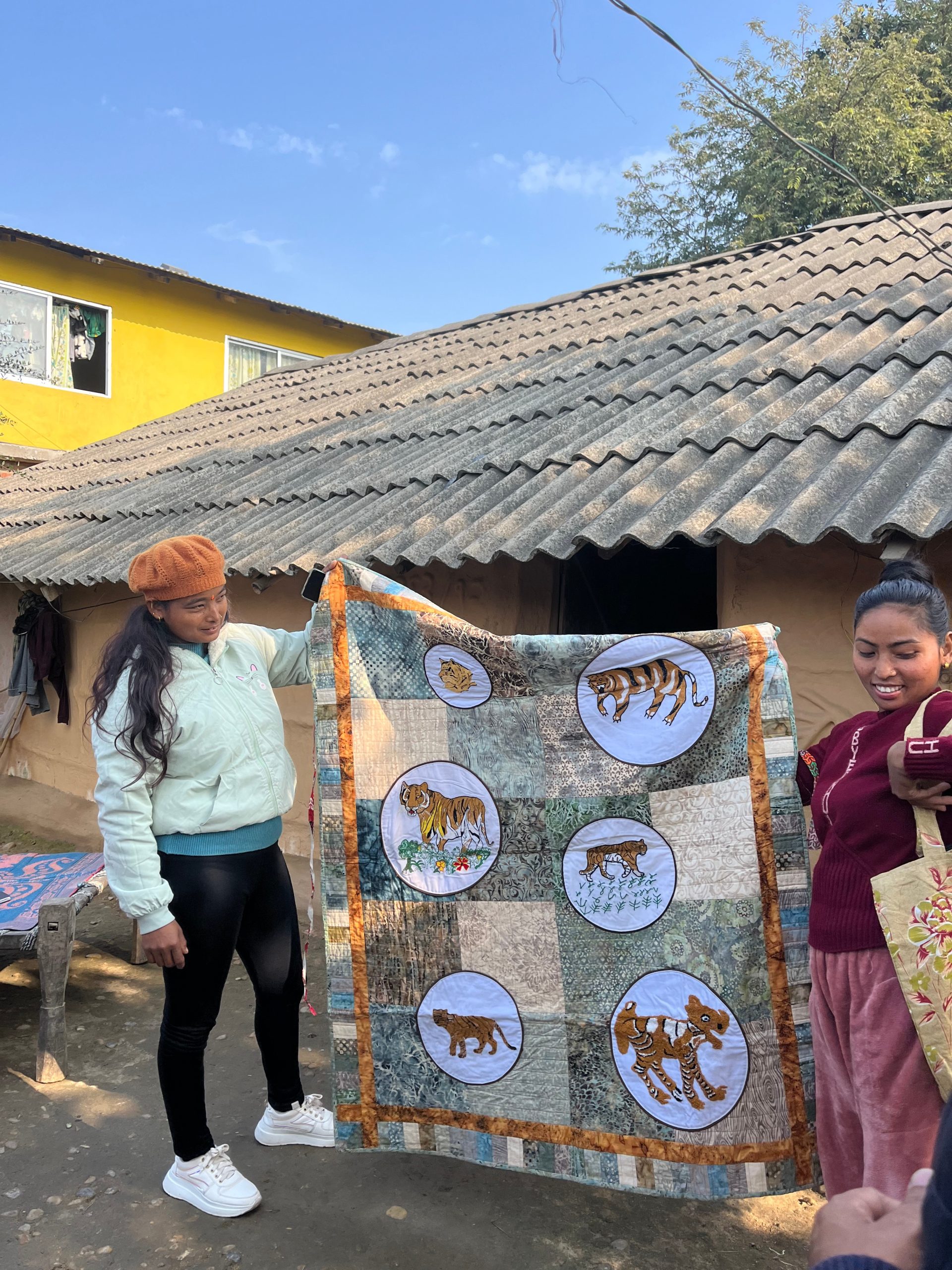
Kanchan and Kushma hold up a tiger quilt to show Laila and my group when we met with them in January
Our meeting this morning was the start of a new project and while our conversation was pragmatic, an atmosphere of excitement couldn’t help but take hold.
“AP is eager to continue working with you,” I began. “It sounds like you all are interested in running another training and we have a couple ideas for projects that could come out of it.”
The four women sat in a line. Kushma wore a white silk scarf with embroidered flowers draped across her chest. Binita sat on the edge, leaning on the arm of Nita’s chair. They shared glances and some words in Tharu. Niraj translated my words and they smiled, nodding and leaning forward. He turned back to me, “Yes, they want to hear.”
I smiled back and nodded, the kind of unspoken communication that awkwardly attempts to make up for the language barrier.
Pulling out a bag, I handed over some tea towels with butterfly designs, the product of a collaboration between Women in Action for Women in Uganda and AP. “This is what we are hoping to do with your festival designs,” I explained, referring to a set of embroidery they had completed earlier this year. “If you run a training with the Tharu Women’s Association, you could ask women to create more of the festival patterns or subjects on another theme and we’d create more tea towels. It’s not guaranteed they’d sell, but we’d do our best.”
Niraj translated and they all nodded.
“The other idea,” I continued, “is a Sister Artists Auction. We ran one with the Ugandan butterfly designs with some success earlier this summer. This is a much longer process, but you’d need to select a theme and produce around 30 pieces of embroidery on that subject. We’d give those to quilters in the US and Canada, AP’s contacts, who would make them into quilts. These would be displayed at the textile museum in DC and then auctioned off online.”
All the while I was talking, they were exchanging small conversation in Tharu, sharing looks, a nod, a smile. Kushma gently stroked Nita’s neck. Binita rested her hand on Nita’s arm. I did not know what was being said, but recognized that intimate form of communication and care shared by groups of women everywhere.
Niraj translated my latest spiel, and a smile spread across Kanchan’s face. She looked at Kushma. Binita leaned in. It was clear they found that idea appealing.
We spent the next half an hour or so fleshing out some details. I scrolled through the latest Sister Artists auction site with them, we threw around some theme ideas, and discussed supplies (we had brought embroidery hoops and thread generously donated by quilters in the US, but new needles were also needed — theirs had become much too dull to produce high quality embroidery.) A training, they explained, couldn’t happen right away. It’s a busy time of year and there isn’t enough interest. But they’d like to get started on the project as a group and they’ll talk with friends. Maybe when others see the work they’re doing, they’ll want to learn, they explained. Then they could organize a training and bring others into the project. For now, they’ll have to start at 4.
That much embroidery is quite the undertaking for a group of four, I worried out loud.
They laughed, looking at one another. Turning to me, Kushma explained, “embroidery is our time to relax.”
Our business-like conversation folded over into small talk as we sipped on milk tea, but eventually we concluded: they’d start brainstorming themes, I’d talk to Iain, our team will look into buying more needles, and, if all goes well, there will be a stack of embroidery for me to take back to the states at the end of September.
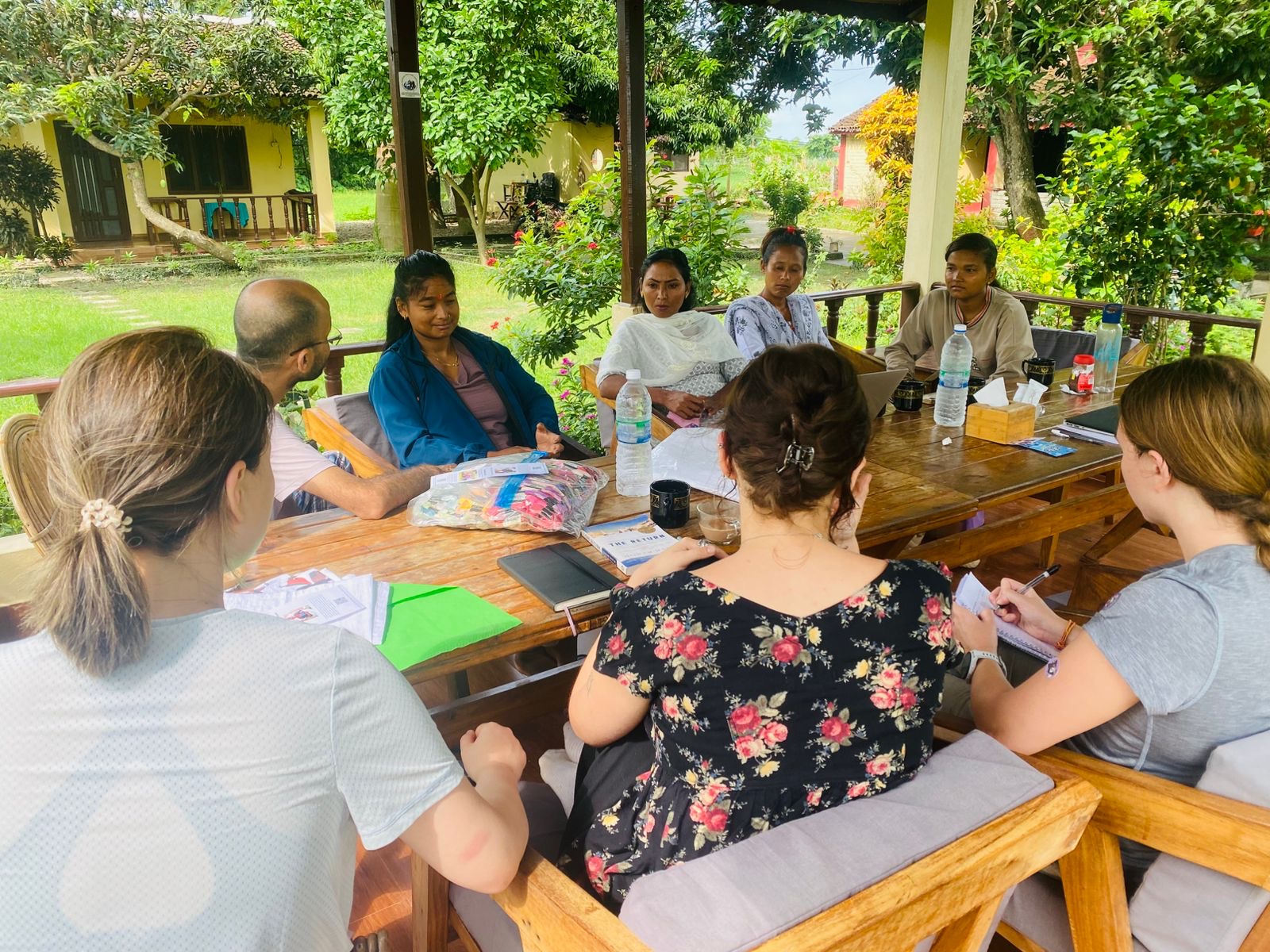
Our group met on the porch of our Bardiya homestay. In the back from left to right: Niraj, Kanchan, Kushma, Nita, Binita. Front from left to right: Shuyuan, Laila, me.
Posted By Emma Cohen
Posted Jul 25th, 2025
2 Comments
Iain Guest
July 26, 2025
Sweet blog Emma! I feel reconnected to these wonderful ladies through your excellent writing. You add the little personal details – the touching, the whispers, the grins, the intimacy – which remind me of how close they are. It’s more than friendship. It’s a shared experience that only family members of the disappeared can truly understand. A part of their identity. I truly hope we.can develop an embroidery project with them and thank you for the nod to our past collaboration with these artists! Five outstanding Peace Fellows have worked with Kushma and her friends since 2016. All have picked up the same vibes as you and come away richer for it.
Shuyuan Zhang
August 3, 2025
Love this glimpse into the meeting. The energy, care, and quiet determination of Kushma, Kanchan, Nita, and Binita really shines through. Excited to see this new embroidery project take shape together!