
Beyond the first year
“Give us back our dignity, our self-reliance, and our hope for a better future.”
64-year-old Ms. Chantava Plodbourie added this demand after a simple request during a side event on victims assistance at this year’s CCM Review Conference. Thirty-three years after a cluster munition took her leg while she was farming, she wants to ask for a wheelchair to give her comfort in her old age. Until now, she has relied on an armcrutch.
At a convention where states discuss hundreds of millions of dollars budgeted for clearance, risk education, and victims assistance, the request seemed overly humble. That humility is the point. Ms. Plodbourie raised seven children, put them all through school, and now cares for her grandchildren while leasing farmland and running a carwash. A wheelchair is the simple entirety of her ask.
Her story highlights a key hole in mine action, made abundantly apparent at this year’s RevCon: emergency support is often available to victims of cluster munitions, but long-term assistance is limited, and sometimes nonexistent. The number one demand of survivors and victims assistance providers all week was for long-term psychosocial, livelihood, and employment support. Beyond the first year’s medical treatment and mobility access, what does the mine action sector owe victims?
What’s possible with long-term support
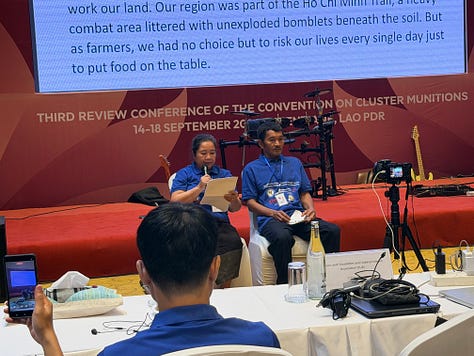
Peter Kim’s work shows what the answer can look like. As a high school student, Mr. Kim lost his sight and both hands in a cluster munition accident. He has since built a career in mine action, working with Humanity and Inclusion’s risk education and victims assistance teams in Northern Laos before co-founding PUA (Persons with Disabilities and Underprivileged Association), which provides livelihood training to help victims reach economic independence.
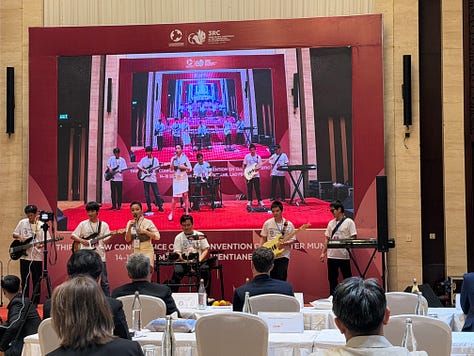
He described his own move from recipient to partner, from dependence to independence, at a side event organized with the Lao NRA and the Embassy of Luxembourg. It closed with a concert by Lao pop star Aruna Thavonsouk and the Diversity, Inclusion and Disability (DID) Group, performing a song written for the Convention: “This is the voice of the victims.” Survivors were not only guests in that room; they were leading it.
It’s hard, and getting harder
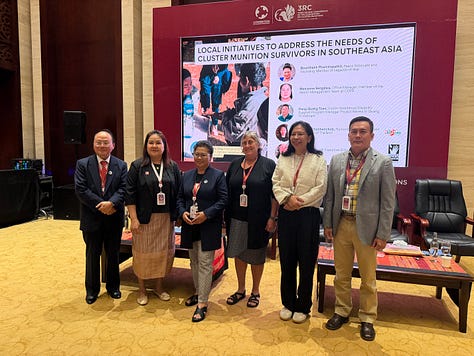
At a later side event on local initiatives for victims assistance, panelists described the road to comprehensive care. “Victims assistance is not only about treating injuries…but a journey to mobility and independence in society,” said Manivone Sengdala of COPE, a local organization providing disability assistance across Laos. Reaching small villages is a key challenge: remote communities are hard for any NGO to reach; rainy seasons and deteriorating roads make it harder. COPE focuses on sustained projects that build support across survivors’ lives, not short-term fixes.
The funding picture is stark. Between 2024 and 2025, the number of victims assistance recipients in Laos dropped by 90%. The United States, the largest funder of humanitarian demining globally, gives over $30 million a year to demining in Laos but designates only $500k to victims assistance.
Susan Hammond, Director of the War Legacies Project (WLP), said even basic outreach is harder than it sounds: “that simple task…is not really that simple.” Victims first need to learn what resources exist (transportation assistance, medical coverage, mobile clinics), and still, “we find that we are going backwards.” She sites the above decline in assistance recipients as a trend for the sector globally.
Today, her organization works to expand funding to include not only victims of cluster munitions but also victims of dioxins, toxic chemical contaminants from the herbicides used during the war. Such use of chemicals like Agent Orange in Laos was classified until WLP’s advocacy in the US
; now, the organization calls on further support and research for their impacts over generations.
The wound the sector hasn’t defined
The impact of dioxins is a growing conversation in Laos, alongside conversations on psychosocial su
pport and generational trauma. Mental health care is often left to village temples, and the stigma attached to it keeps an already underfunded field from reaching survivors.
Bounthanh Phommasathit gave that need a human story. A refugee from the war, she moved to the US from a refugee camp in 1979 with her husband and children, after leaving her family in Laos discreetly, with a single bag, to find a safer home. To her, generational trauma is a wound of war that countries must continue to mend. Ms. Bounthanh does her part in this healing, excelling in the healthcare industry in Ohio while also leading community building efforts for Lao Americans and Southeast Asian cultural communities in the midwest. She’s a leading advocate to the US Congress for continued support to this sector with Legacies of War.
What the sector owes
Panelists at both side events during this year’s CCM called for long-term investment, and for victims assistance funding to increase alongside other prongs of mine action. They also called for a wider definition of victims: caregivers, most often immediate family, support survivors for life, and the mental toll of surviving a war, surviving a cluster bomb accident, living under the constant threat of unexploded remnants, and inheriting a country’s trauma must be accounted.
Ms. Plodbourie asked for a wheelchair. If that feels like too much to ask 33 years on, the sector has set its expectations too low.
Posted By Kendall Silwonuk
Posted Oct 12th, 2026