

As we start our second month of monitoring visits, we’re in a credible position to refine the M&E model. Thanks to the work of Aaron and the GDPU team, it was already solid. We’ve added more specific questions on pupil malaria illness, attempting to roughly gage the success of our malaria prevention training.
We’ve also added a section to record comments by menstruating girls, asking how comfortable they feel using school WASH facilities. Previously, this was covered by a quick question to the headteachers themselves, which we felt was probably adding some bias to our findings!
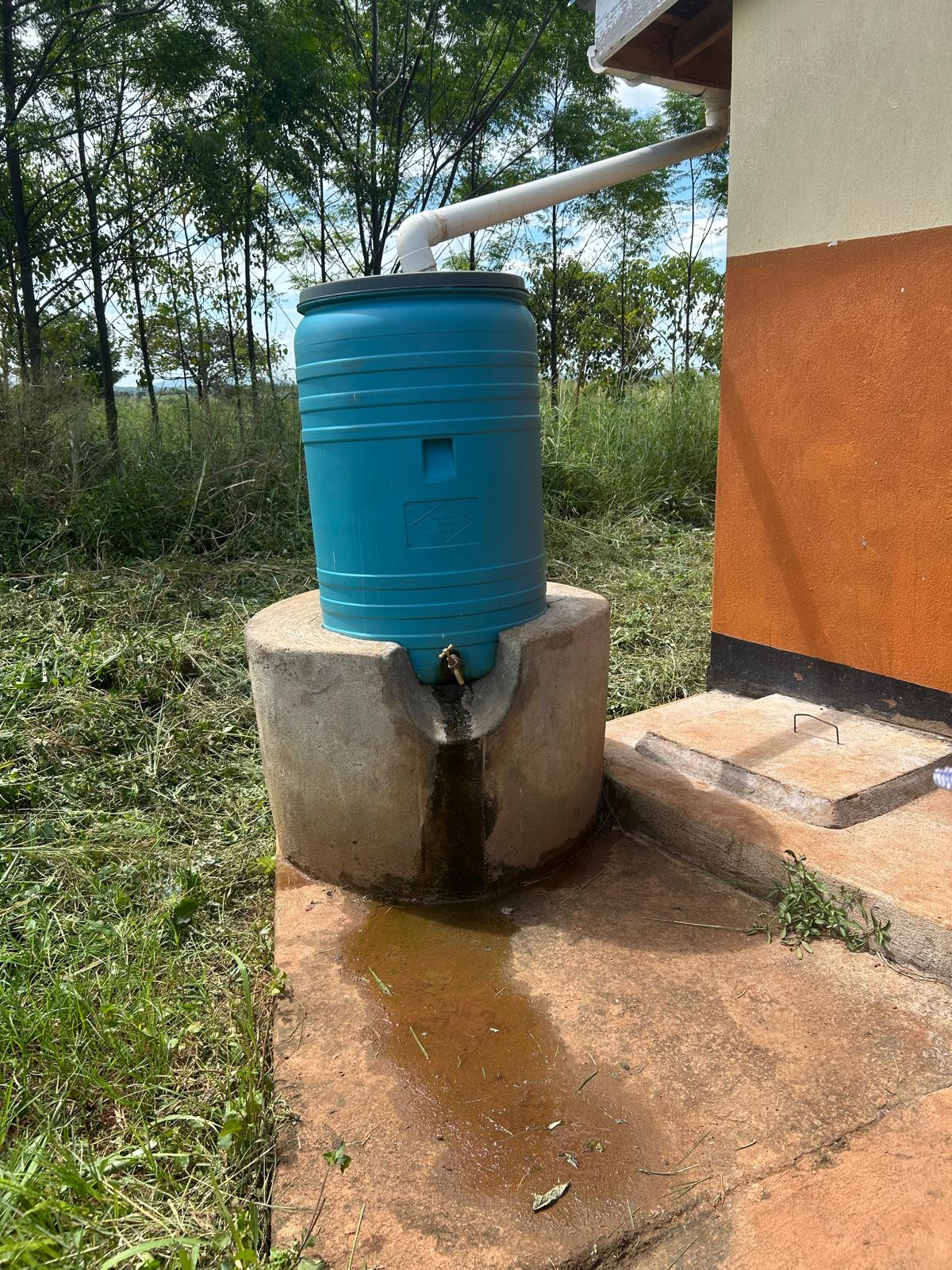
Effective M&E: The water tank at Kulu Opal Primary School. The tap wasn’t operational on our last monitoring visit in September – on our October visit, it was working.
Refining the model is all well and good, but without properly responding to its findings, the model is useless. Our monitoring visit to Kulu Opal Primary School revealed a simple but serious issue: the school had only 20 litres of liquid soap to last the entire term. With over 500 pupils and toilets used around 200 times a day, that’s far from enough. Just through handwashing, they’d need at least 35 litres per term. With their current stock, only about 120 of the 200 children using the toilets daily could wash their hands.
With Covid still prevalent and Mpox outbreaks emerging, the need for well-resourced WASH programmes is more acute than ever. These shortcomings can have devastating impacts for pupils, with knock-on effects suffered in academic attainment, well-being, and enrolment.
So, as our monitoring had highlighted, we needed to make more soap. The seven primary schools under GDPU’s programme should receive 40 litres of liquid soap per term – enough for handwashing and general cleaning. Later in the week, we returned to the GDPU office with Emma and made 120 litres ourselves. 80 litres will be delivered to Awach Primary School, when we do our monitoring visit next week.

Making the soap: mixing Sodium Laureth Sulphate, Cocamidopropyl Betaine, and Methylisothiazolinone – chemicals which don’t sound too safe to breathe in!
You might recall the mantra of my last blog, about M&E being low cost, high value. Indeed, there’s only a small price to pay for sending a monitoring team out, paying for repairs which the visit exposes as necessary, and replenishing basic cleaning supplies.
The same goes for liquid soap. Soap comes in 20 litre jerry cans: the jerry cans themselves cost 15,000 shillings; the materials (sodium hydroxide, glycerine, water, fragrance, colouring agents, etc) cost 25,000 shillings. So, in total, 20 litres of soap costs 40,000 shillings (and some strong arms for mixing!) to make. That means, to pay for the 120 litres of soap we made this week (enough to support a school for one year), it cost only 240,000 shillings – approximately £50. So, the mantra withstands – M&E: low cost, high value. For a relatively tiny investment, the impact on pupil health and attendance is significant.
Our model – after almost two years of careful refinement – is clearly yielding some actionable, tangible insights. Now, our next goal is to expand its reach beyond the seven schools we currently monitor. But with the GDPU team already stretched thin, partnerships will be crucial.

More evidence of good M&E: Kulu Opal toilets looking clean and dry.
So after our Kulu Opal visit, the team met with David, the regional representative for World Vision. World Vision is a humanitarian NGO, pumping over $3 billion annually into global development. Their business in northern Uganda, like GDPU, includes several WASH projects.
World Vision has a unique approach to monitoring: appointing local leaders and NGO representatives to oversee WASH activities within a small ‘cluster’ of 15 households. We talked through GDPU’s WASH success over the last decade: 30 toilets built; 12 Fellows sent; and $80,000 invested. Discussions about our M&E model were positive, and we arranged another meeting to discuss finer details with World Vision’s designated WASH professionals. So stay tuned for more updates!
Impactful spending isn’t always big, ambitious, or sexy. Sometimes, all it takes is some careful thought, thorough monitoring, and a generous sprinkling of sodium hydroxide.
Posted By Alex McDermott
Posted Oct 17th, 2025
1 Comment
Iain Guest
October 18, 2025
Really good, confident blog Alex! Your job – with limited time – is to help Emma and Joe fine-tune ans tweak the monitoring launched this summer. From reading this, I’d say mission accomplished! I particularly like adding feedback from the girls – YES!! So the next essential step is whether and how to work with others, hence your meeting with World Vision. From this we gather that the meeting itself went well. Not surprising – GDPU and WV are deeply committed to the same goal. BUT – I see major differences between the two M and E approaches and this is where you’ll need to find common ground at your next (last) meeting. Looking at the two models, I would say that GDPU’s outside/expert/objective/data collecting model is probably more sustainable and useful to would-be donors. M and E requires independent and credible data and however much we like to engage beneficiaries I don’t think you’ll get that from beneficiaries. So my final advice would be to zero in on that ASAP and see if you can come up with a COMMON M and E that you can offer to donors. If you can achieve that, GDPU can then take it to the district government. I’m sure Joe and Emma have ideas – just make sure you have a clear position before visiting WV. Final suggestion – give the tracker/data collection a thorough dusting over before you leave. By the way, the soap stuff is wonderful – but I don’t see any of the great photos of you and Maddy P with your hands in the slime!! Good work, Alex!!