

I thought I knew my country.
Nepal is home. It is where I was born, where I learned to walk, where my earliest memories were made. But this summer, returning as a Peace Fellow with the Advocacy Project and working alongside the Center for Human Rights and Victims of Violations (CHRV), I have come to understand that there is a profound difference between growing up in a place and actually seeing it.
I was too young to remember the signing of the Comprehensive Peace Accord in 2006. Like most people my age, I inherited the People’s War through stories rather than memory. We learned dates in school. We memorized political milestones and celebrated the birth of the republic. We were taught the sequence- 1950, 1990, 1996, 2006- as if history were a timeline to reproduce on an exam. The disappearances, the torture, the displacement, the ordinary lives interrupted by violence rarely entered the classroom.
Mine is perhaps the first generation to grow up entirely within the aftermath of the conflict, yet no one ever truly explained what that aftermath meant and why it matters to keep it alive. Peace, I have come to realize, is a complicated inheritance.
Even before beginning the fellowship, I found myself immersed in conversations about memory. At Nepal’s Second National Memory Conference, victims, survivors, artists, academics, policymakers, and practitioners came together to imagine what a collective memory space for Nepal might look like. The discussions revolved around archives, memorialization, truth commissions, and the politics of remembering. They were intellectually rich, but I left with an unease I could not yet name.
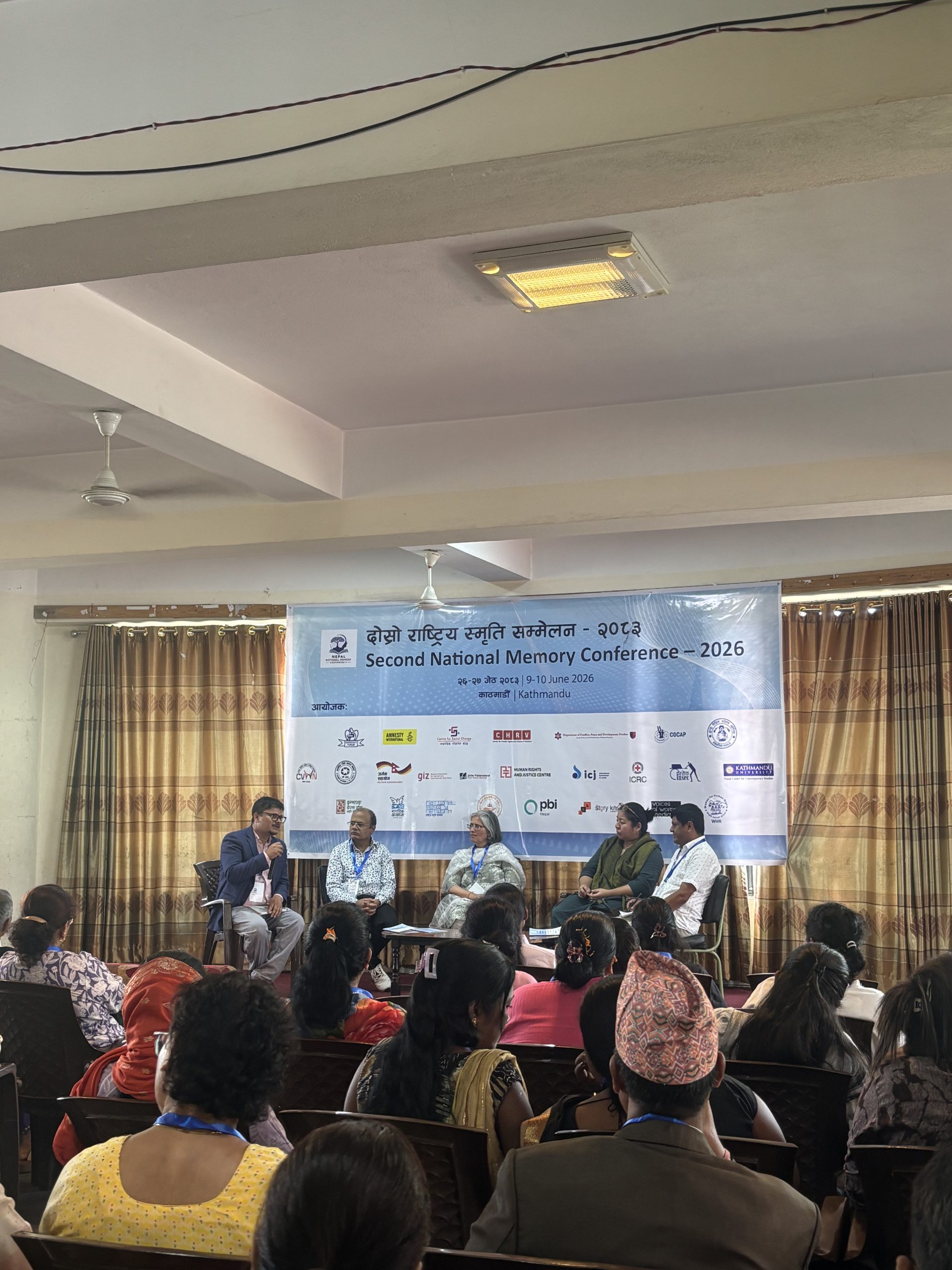
Second National Memory Conference
Memory was being discussed.Only later would I begin to understand what it meant to encounter memory as something lived.
Each morning, my fellow researchers and I made our way to CHRV, where Dr. Ram Bhandari patiently walked us through Nepal’s modern political history, the experiments with constitutional monarchy, the repeated dissolutions of parliament, the decade-long insurgency, and the promises embedded within the Comprehensive Peace Accord.
Ram teaches this history in the careful voice of a scholar. But he is also found inside it. His father, Tej Bahadur Bhandari, was disappeared by state security forces in 2001. More than two decades later, his family still does not know the truth about what happened to him. I often found myself wondering what it costs to teach a periodization that contains your own father. What it means to explain history to a generation that inherited its consequences but not its memory.
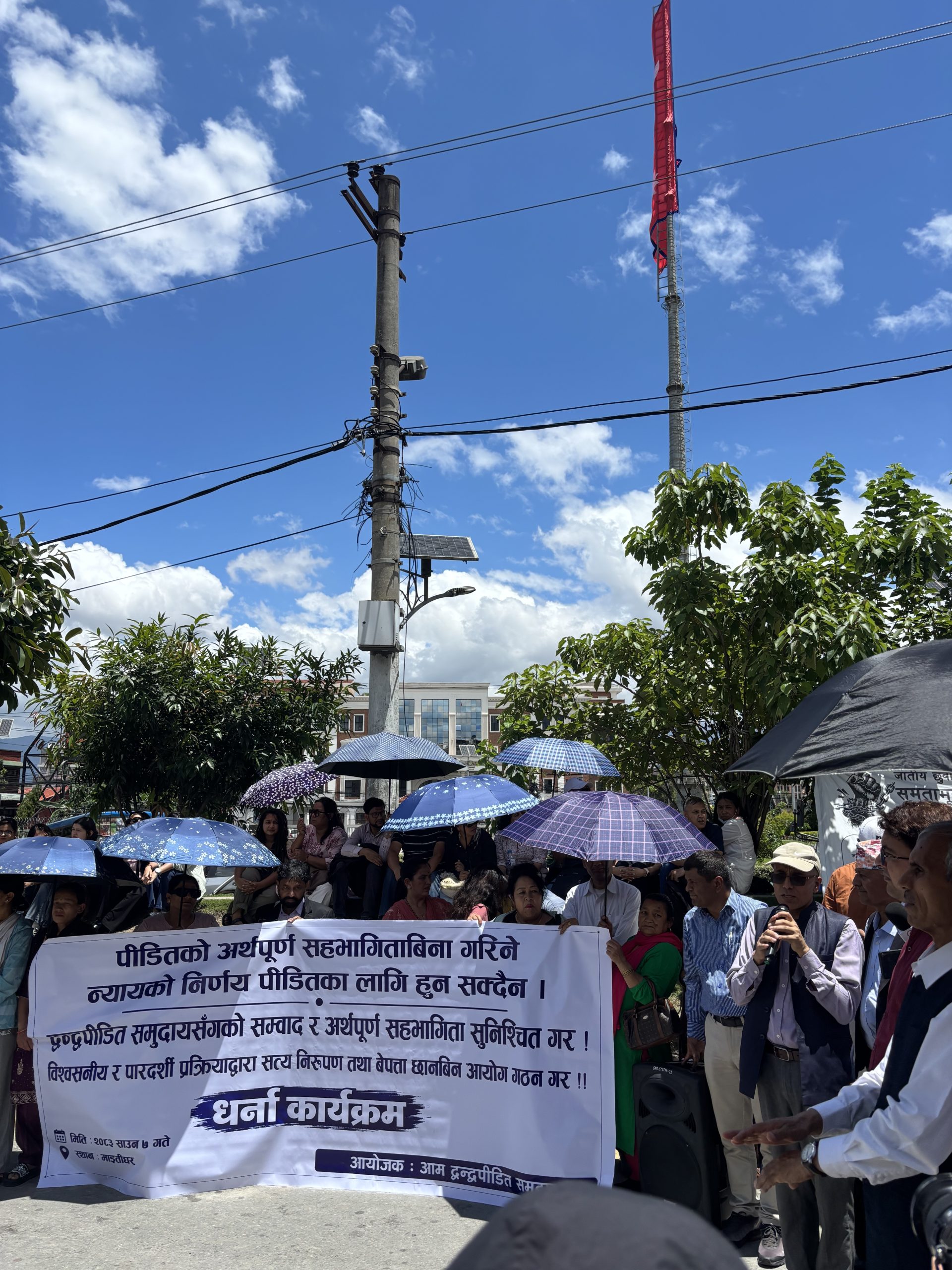
“Ensure dialogue with conflict-affected communities and their meaningful participation!”
On Thursday afternoon, we joined survivors, families of the disappeared, and victims’ organizations gathered at Maitighar Mandala. The immediate issue was familiar to everyone present.
In May, the office bearers of Nepal’s two transitional justice commissions were removed from office. Once again, the chairs stood empty. A recommendation committee was reportedly being assembled to appoint new commissioners, yet survivors’ organizations, who have spent two decades insisting that any transitional justice process must be victim-centered, had been unable to secure a meeting with the government. The protest was about a pattern that is repeating. Commissions are formed. Complaints are collected- more than 60,000 of them. Mandates expire, commissioners leave, governments change but the files remain.
Not a single case has been resolved.
Standing there, I was struck not only by the anger in the crowd, but by its extraordinary restraint. Speaker after speaker possessed a story capable of silencing an entire city. Yet speaker after speaker chose not to tell it. Instead, they spoke about consultation procedures, transparency, public notice requirements, legal obligations, recommendation committees, and institutional independence. I had read countless articles that described victims’ testimony as evidence-something to be collected, categorized, weighed, and transformed into official findings. Standing at Maitighar, I realized that I was witnessing something entirely different.These survivors were no longer waiting to be documented and they were analyzing the state itself.
They were exposing the failures of Nepal’s transitional justice architecture with a clarity and precision that rivaled many academic analyses. Their lived experience is political expertise.
It was here that the question I had carried from the Memory Conference began to answer itself. Who gets to produce knowledge? Over the following days, that question returned in conversations with extraordinary people: Ekraj Bhandari, Maina Karki, Gita Rasaili.
At CHRV, these conversations continued beyond formal sessions. Listening to Ram Bhandari, Ekraj Bhandari, and other members of the team, I became increasingly aware that the people I had initially thought of as “participants” in transitional justice were, in many ways, some of its sharpest analysts. Their conversations rarely lingered only on personal loss. They moved seamlessly between legal frameworks, institutional failures, political negotiations, and the everyday realities of families still searching for truth. Their knowledge had been forged through decades of navigating a process that has repeatedly asked them to testify without truly listening.
That understanding deepened during conversations with Maina Karki and Gita Rasaili.
Rather than offering accounts of the conflict alone, both spoke about what it has meant to live in its aftermath. Their reflections shifted my attention away from transitional justice as a legal process and toward the people who have sustained it for more than two decades despite repeated institutional failures.
Maina spoke candidly about the invisible labor that rarely appears in discussions of justice. She reflected on the years spent organizing communities, navigating patriarchal expectations, caring for family while remaining politically engaged, and continuing to advocate long after media attention had faded. Listening to her, I realized that Nepal’s transitional justice process has relied on forms of labor that institutions neither acknowledge nor measure. While commissions have come and gone, it is survivors- particularly women- who have carried the movement forward through persistence rather than political power.
Gita invited me to look even further back. She spoke about growing up as a Dalit in one of Nepal’s most remote regions, where caste discrimination, poverty, and geographic isolation shaped everyday life long before the People’s War began. Her reflections complicated any understanding of the conflict that ‘begins’ only in 1996. For many marginalized communities, the language of equality resonated because it responded to injustices that already existed. The violence addressed by transitional justice cannot be fully understood without also confronting the structural violence that preceded it.
Together, Maina and Gita challenged the way I had been thinking about justice. They were offering analyses of gender, caste, power, and political participation shaped through decades of lived experience.
What stayed with me most was their description of the labor that makes justice possible but rarely appears in official accounts. Both spoke about the multiple roles women have had to carry long after the conflict formally ended. They are expected to provide for their families, care for children and elderly relatives, navigate the social stigma attached to widowhood and public activism, and continue organizing communities, attending consultations, and advocating for truth and accountability. Justice, for many women, has never been separate from the responsibilities of everyday life.
Most of those killed or disappeared during the conflict were men. Many of those who have spent the last twenty years demanding justice have been women.The state has documented what was taken. It has never fully accounted for what has been required to continue asking. Their stories reminded me of another education I had received long before I entered university. My understanding of justice did not begin with transitional justice theory or international human rights law. It began with the women around me.
My many mothers, and the many women who shaped my childhood, taught me that justice is not an abstract principle reserved for constitutions or courtrooms. It lives in everyday acts of care, in refusing to remain silent when someone has been wronged, and in recognizing another person’s dignity as inseparable from our own.
Maybe this is what coming home has meant. Not returning to the Nepal I remembered, but finally meeting the Nepal that had been carrying its own history all along. A Nepal where memory has survived not because institutions preserved it, but because ordinary people refused to let it disappear. They were never waiting to be asked. They had already been producing the knowledge my generation was only beginning to learn to hear.
Posted By Hanshika Neupane
Posted Jul 27th, 2026
1 Comment
Iain Guest
July 30, 2026
Beautifully written blog, full of wisdom and insights. I’m so pleased you took this approach, Hanshika. The fact that it comes from a Nepali who did not live through the conflict and has not been forced to think through what happened makes it doubly important. It also shows the critical role played by survivors in explaining the cause and impact of conflict TO THEIR OWN PEOPLE. This is one of the messages Ram has been hammering home through the years and he will certainly helped by CHRV. You are so right to pinpoint the importance of women. Most – but not all – of the conflict victims were men and the economic impact on their families of loosing their breadwinners has been disastrous. You will see this when you meet the NEFAD ladies in Bardiya. This is one reason why CHRV’s model of reparations focuses on women. Overall this blog suggests the CHRV experience is giving you a whole new perspective on this critical phase of your country’s history. Thanks and keep up the great work/studying/writing!!