
Sewa, Namaste!
This past week has been such an interesting yet heavy week, and I am ready to unpack it! I will first provide an overview of this week’s activities, which included lectures/discussions with several speakers and a workshop on reparations. The CHRV team heard from several speakers. On Monday, survivor activist Devi Khadka joined us to talk about conflict-related sexual violence (CRSV) and the fight for gender sensitivity within state-led TJ mechanisms. On Tuesday, we held a morning Zoom meeting with Alicia Partnoy, an Argentinian survivor and activist and co-founder of INOVAS, who talked about the international victim movement. Later that afternoon, Lenin Bista, a former child soldier and victim advocate, joined us for a discussion on child soldiers and the recent Supreme Court case. On Wednesday, Surendra KC, the chairperson of the National Network of Disabled Conflict Victims (NNDCV), came to discuss disabled conflict victims’ advocacy. Lastly, on Friday, Pratik Karki, a victim family member and Gen-Z activist, shared his experience on the 2025 Gen-Z uprising, joint advocacy with the victim movement, and the changing political landscape.
I would like to take this week’s blog to reflect on Wednesday’s discussion on Disabled Conflict Victims with Surendra KC. Padma Gurung, also a part of NNDCV, also joined us by helping translate and distribute material. In the beginning section of his session, Surendra showed us these two pictures and asked us to describe what we see.

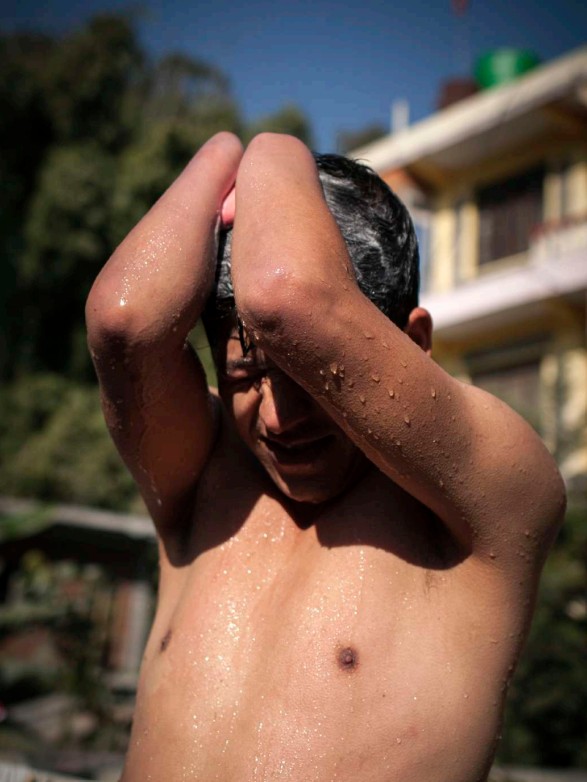
Surendra explained that when he thinks about barriers as a disabled conflict victim, he thinks about these two photos. When comparing both photos, the difference in his hands is clearly visible, but what is not visible is his effort to overcome daily challenges and barriers. Surendra urged us to consider how seemingly easy tasks like rubbing soap over our bodies or picking up the soap bar after dropping it are not as simple for him. Surendra selected this photo and the metaphor of soap falling from his hands to present his everyday struggle. He can show people the loss of his hands, but how can he share his everyday struggles? Some people tell him to just forget about the conflict, but with these everyday struggles, how will victims be able to forget? The conflict and pain that Surendra and so many other victims faced don’t just go away but are a lifelong pain they endure. He later explained that using a prop to relate to and share stories from disabled conflict victims is one model his organization uses to create a platform for memorialization and a method to describe the difficulties of disabled conflict victims.
When asked about government recognition and reparations for different kinds of disability, Surendra acknowledged that it is difficult to design a universal approach. However, he shared his experience on accessibility in Nepal, such as how ATM’s are inaccessible. When we think from the perspective of a disabled conflict victim, it’s difficult to put a card into the ATM for victims who have lost their hands, entering an ATM where there is little room, and even using the machine for blind victims since there isn’t braille. Some people use the excuse that places like historical buildings can’t be changed to be more accessible. There are also layers to accessibility, like a disabled conflict victim wheeling a wheelchair themselves instead of other people helping. Surendra’s experiences raise larger questions about society’s acceptability and how flexible, conscious, and practical we are to designs and the accommodation of others.
After this session, I began to take notice of surroundings through an accessibility lens. Nepal’s sidewalks immediately caught my attention. On my frequent 15-minute walk to a nearby Himalayan Java Cafe, I am required to keep my eyes on the floor ahead of me as a new obstacle appears every 3 feet. These can range from a hole in the floor, ongoing construction that blocks the sidewalk, uneven tiles, and narrowness. In all honesty, it is much easier to walk on the road since it’s flat, but this can be a dangerous alternative for someone hard of seeing or hearing with oncoming traffic. As I walk home from the cafe, I notice that people prefer to walk on the roads. When the CHRV team grabs lunch after a session, sometimes a pole will divide the already narrow sidewalk, and I find myself squeezing between the pole and wall, or, like Leo, I end up on the road dodging motorcycles. When I ride the motorcycles to commute, some drivers ride quickly, and if I see a bump or a steep road ahead, I can prepare myself by adjusting in my seat or gripping tighter to prevent myself from falling off. The ability to hold on for stability is already a privilege. I think about visiting temples and praying in temples. Even just leaving and entering my home, I have to travel through a narrow, uphill gulley that I often slip in when it’s raining. At night, it gets even harder to see.

These pics are from my walk home from the cafe and are only 2 of the many physical barriers on the sidewalk I noticed.
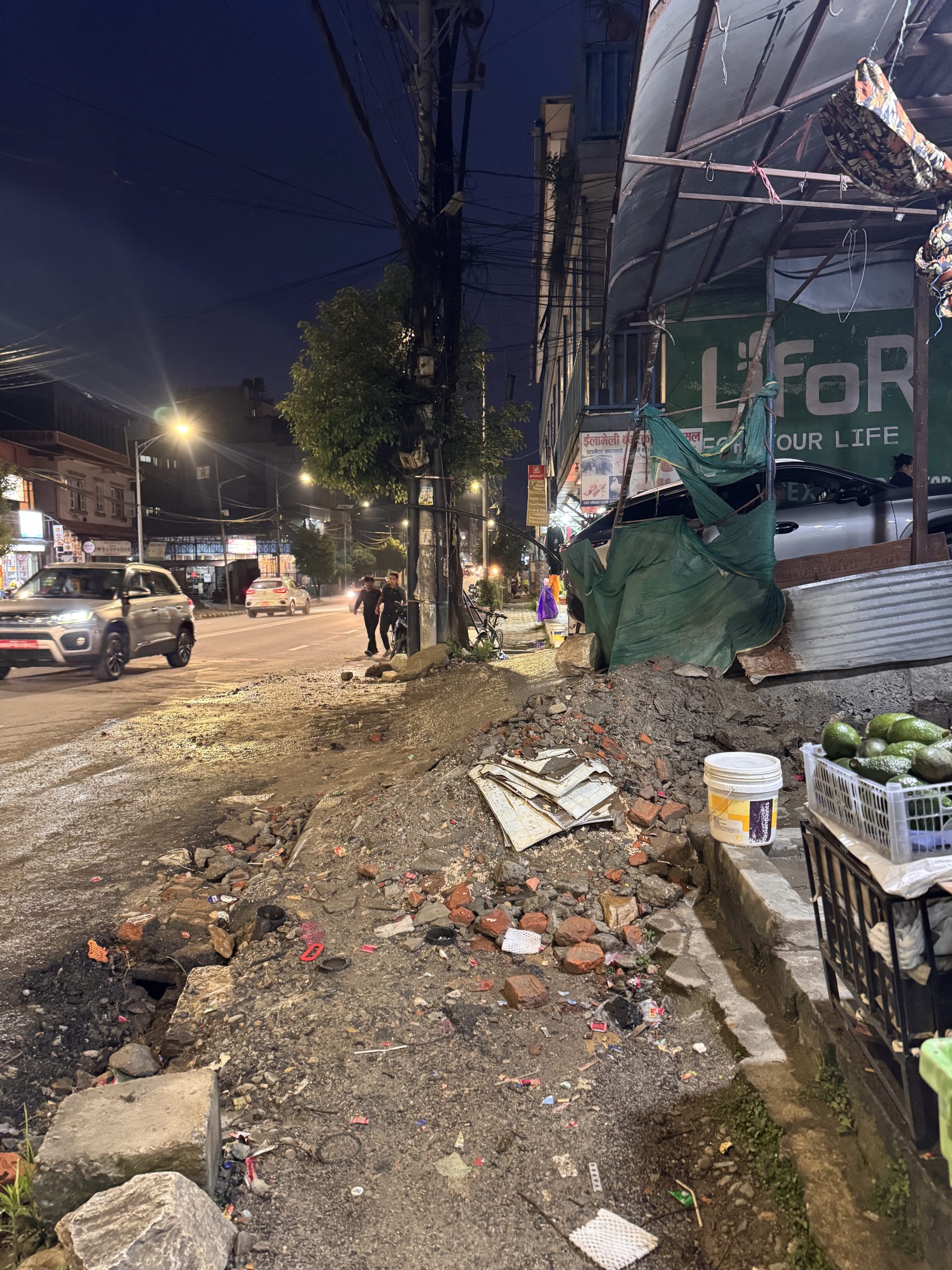

This is the gully to my home in KTM. During the night, there is only a dim light that illuminates the path.
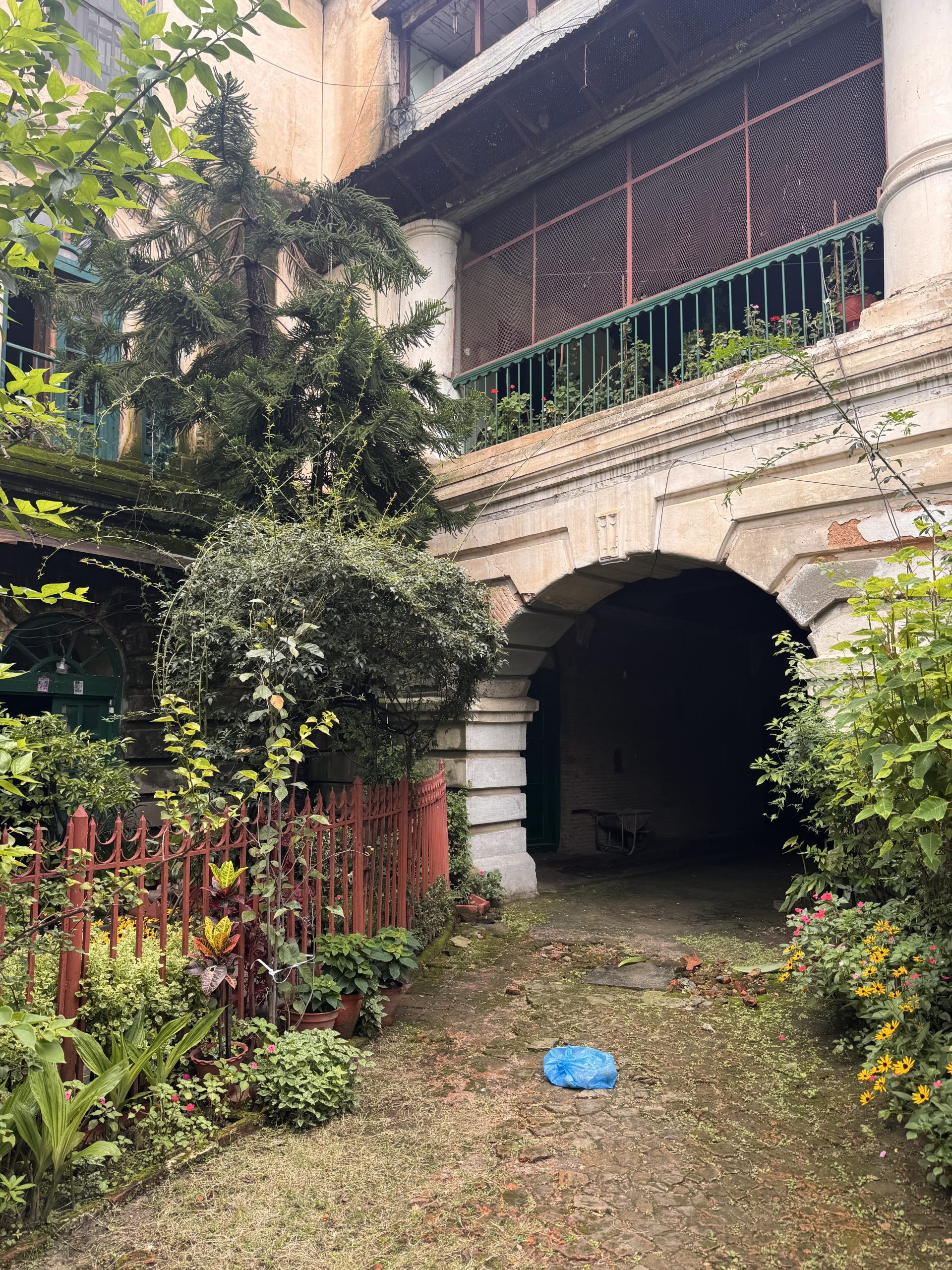
Even the entrance to the CHRV center is something we could consider making more accessible, as the entrance is slippery, there are a lot of stairs, and a lot of doorway threshold things you need to step over. Since we learned about how the center is a historic building that was donated to the school by the Ranas, and since it’s currently undergoing construction, I wonder what the thought process would be on accessibility and if it’s even brought up in conversation? I am further wondering whether accessibility is seen as costly or a basis of good care and design. Are these physical spaces accessible by default, or will we only fix them after someone needs/asks? What assumptions do I hold about what a “normal body” can do? What is “normal?”

This is the beautiful but slippery entrance to the CHRV Center.
It’s easy for me to be critical of a developing country in terms of where it can improve in terms of accessibility, but I think it’s important to be critical and aware of privileges I overlook in my daily life, and this can be a lens applied beyond Nepal. How can Surendra “forget the past,” and how can these disabled conflict victims end their pain/suffering when the environment around them continues to create physical barriers to inclusion? Even moving beyond physical barriers, we must consider non-physical barriers such as digital barriers and access to information. Finally, I want to conclude on how Surendra challenges the common misconception that reparations come in the form of compensation, but for a victim with an amputated leg, how much money would be enough for reparations for their loss? He urges the state to recognize its inability to protect its citizens and that there should be reparations in terms of health and assistance devices.
Please check out Surendra KC’s website https://nndcv.org.np/ for more information on the National Network of Disabled Conflict Victims. You can also find a pdf of “14 Stories – Living Memories of War,” a collection of stories that provides a platform for disabled conflict victims to record their stories and share their courage in the fight for justice.
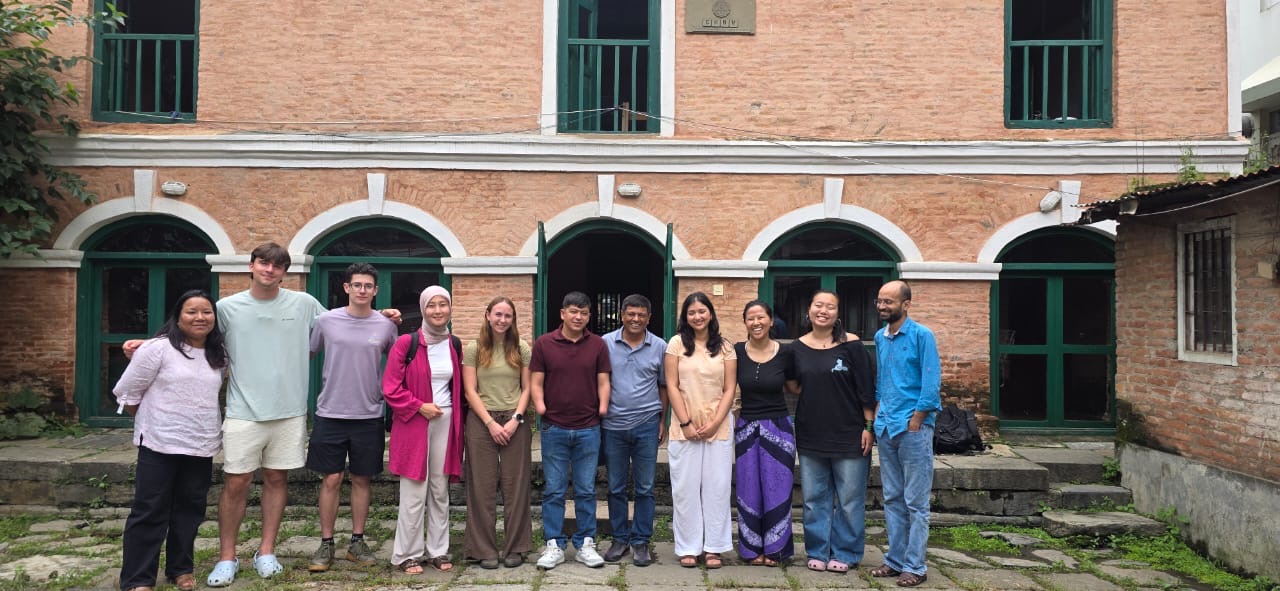
Group photo outside of the center!
Posted By Aayushma Rai
Posted Aug 5th, 2026