

Some journeys begin at the airport. Mine began several weeks earlier, somewhere between a notary’s office, the Vietnamese Embassy in Paris and an endless series of administrative emails. The reason ? An internship contract between France, Vietnam and the US. After numerous appointments, signatures and stamps, I finally found myself standing in the airport chec k-in queue, because, naturally, online check-in had also failed.
I had not slept the night before. I was already tired, but far too excited to rest. After some delays, it was difficult to believe that I was finally leaving.
At the airport, a very kind member of the cabin crew asked me about my journey. I explained that I was travelling to Vietnam for an internship with AEPD, an organisation working with persons with disabilities and families affected by Agent Orange.
When I boarded the plane, I realised that the window seat I had selected had been changed to an aisle seat. I was briefly disappointed, until I discovered that the new seat was in an entirely empty row. It seemed that, after weeks of administrative obstacles, the journey had decided to offer me one small reward.
I thought I would finally sleep. I did not. I was too impatient to arrive.
Discovering Vietnam without a screen
Before travelling, I deliberately avoided researching too much about Vietnam. I prefer discovering a country through its streets, sounds, people and everyday life rather than feeling that I have already seen everything online.
My preparation was therefore very practical: how to obtain an eSIM, how to say “hello” and “thank you,” and what weather to expect. I wanted the rest to be a surprise.
I arrived at Nội Bài International Airport at around six in the morning. During my short stay there, a group of Vietnamese students approached me as part of a school activity. They were practising English by speaking with foreign travellers. One student, who was approximately my age, asked why I was in Vietnam if I was not simply visiting as a tourist. When I mentioned Agent Orange, she did not appear to recognise the term.
Perhaps it was only a translation issue. Perhaps she knew the subject under another name. Still, the conversation stayed with me. It made me wonder how the history of Agent Orange transmitted to younger generations in Vietnam. How much is discussed at school, within families or in public life ? Are some aspects of this legacy becoming less visible as the directly exposed generations grow older?
I do not want to draw broad conclusions from one brief encounter. But it reminded me why stories, memory and testimony matter.
Meeting Mai in Dong Hoi
After 48 hours in Hanoi, I woke up at two in the morning to return to the airport. This time, my destination was Dong Hoi. I landed at around six and waited outside for Mai, a member of the AEPD team.
 A few minutes later, someone tapped me on the shoulder. I turned around and saw a woman with a bright smile. It was Mai. Without thinking too much, I immediately hugged her. Perhaps this came from the habit I developed while living in the Netherlands, where I became more used to greeting people with a hug than with the French kiss on both cheeks or a formal handshake. For a second, I wondered whether I had been too spontaneous. Her warm reaction immediately reassured me.
Mai introduced me to her 11-year-old son, Teddy, who was initially hiding a little behind her. During the taxi ride, however, the conversation quickly became lively. We spoke about the weather, our families, the pronunciation of my name and football. Teddy is an absolute Cristiano Ronaldo fan.
We exchanged family photographs, and the atmosphere felt natural almost immediately. After weeks of uncertainty and travelling, this simple welcome made me feel that I had finally arrived.
Once at the hotel, exhaustion caught up with me. I slept for more than fifteen hours that day.
My first week at AEPD
The following morning, I woke up to the sound of scooter horns. In France, a horn often expresses impatience or irritation. Here, I quickly understood that it is also a language of the road: a way of signalling presence and moving safely through traffic. It was one of the first small cultural differences that made me smile.
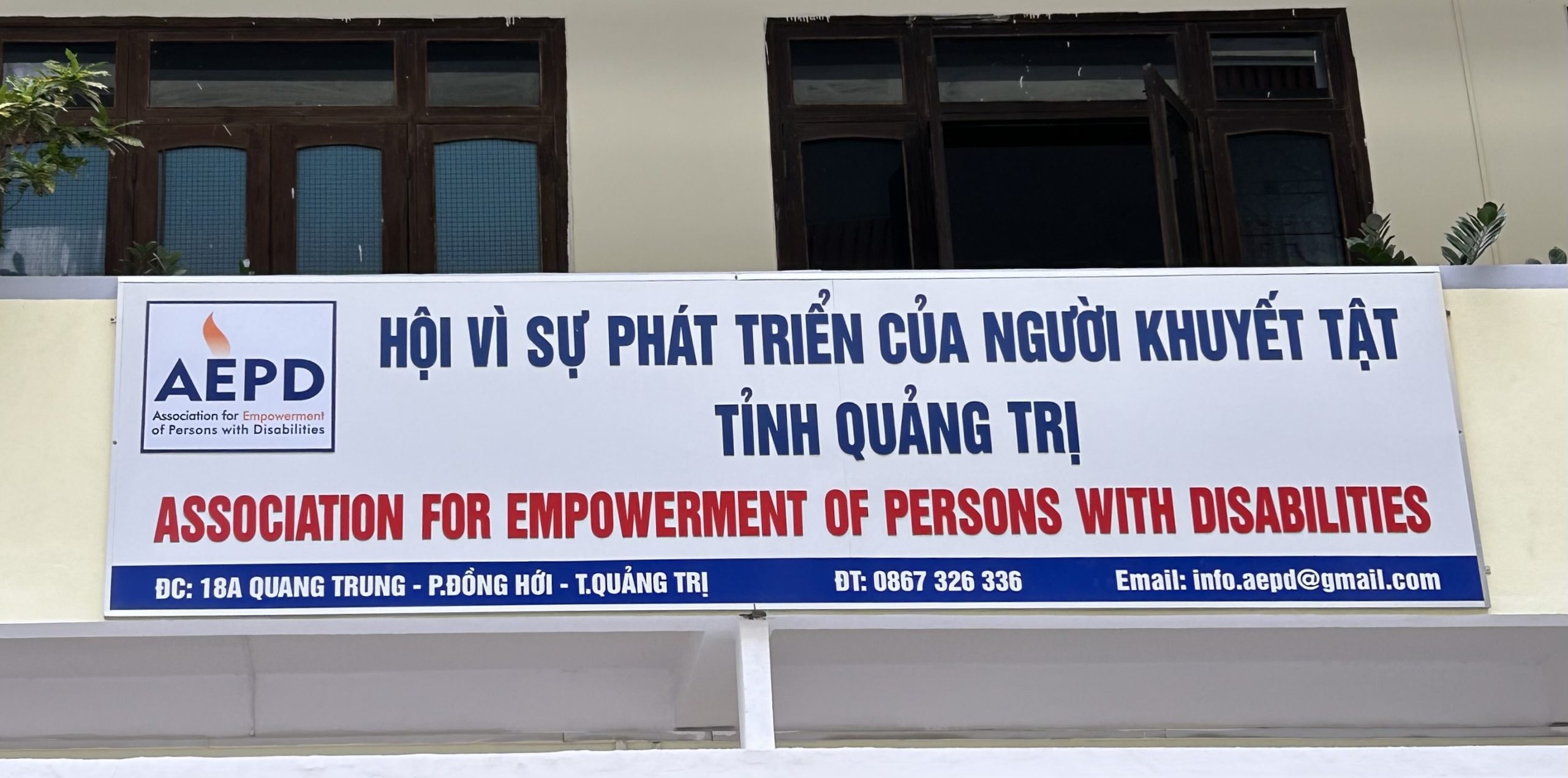
I arrived at AEPD feeling motivated but also unexpectedly shy. Travelling alone across several countries had seemed manageable; introducing myself to an entire new team suddenly felt much more intimidating.
I met Mrs Hao, Mrs Hong and the other members of the organisation. Together, we began defining how I could contribute during the coming weeks.
My work will include meeting families supported by AEPD and The Advocacy Project, listening to their stories and documenting how financial assistance affects their daily lives and future plans. I will also help prepare new family profiles and possible fundraising projects. Other assignments will focus on AEPD’s international visibility, cooperation with VAVA, advocacy concerning Agent Orange and preparation for the Third Review Conference of the Convention on Cluster Munitions in Vientiane.
It is an ambitious programme for a short internship. But I am especially grateful that the work will combine research, communication, advocacy and direct encounters with families.
Listening first
I arrived with a recently completed LLM in Human Rights and academic knowledge about Agent Orange. However, legal and historical research can only explain part of the reality.
A legal case cannot fully describe the daily responsibility of caring for a family member. A policy report cannot show what a livelihood project means to a household with very limited income. Statistics cannot replace the words of people explaining what dignity, independence or security mean in their own lives.
My first responsibility is therefore not to arrive with ready-made conclusions. It is to listen.
Over the next few weeks, I hope to share the work of AEPD, the people I meet and the questions that emerge from these encounters. I also want to write honestly about what surprises me, what challenges my assumptions and what I still do not understand.
This first article began with paperwork, sleepless flights, scooter horns and an unexpected hug at Dong Hoi airport.
The next ones will begin with the families who have agreed to share their stories. I hope you will join me for the rest of the journey !
Clothilde Soenen.
Posted By Clothilde Soenen
Posted Jul 29th, 2026
1 Comment
Iain Guest
July 30, 2026
Bonne arrivee, Clothilde! Such a nice first blog – well written, easy to read, full of humour, and some sharp observations. Interesting that the young Vietnamese did not know about Agent Orange. In Vietnam, as in the US, people are forgetting just how awful the war was, and how much damage it continues to do. Is this a good thing? Should societies be allowed to put the past behind at some point and move on? Who should decide how and when? Are we as foreigners doing the right in advocating on Agent Orange or are we interfering? Interested in your thoughts. I’m glad to read that you have locked away your law books and are collecting your information from real people! Mai seems very nice and or course Hong and Hao will look after you very well. And yes, you can definitely help to prepare us all for the important meeting in Laos on cluster munitions. Look forward to meeting the families through your blogs. I can tell they will be special!