

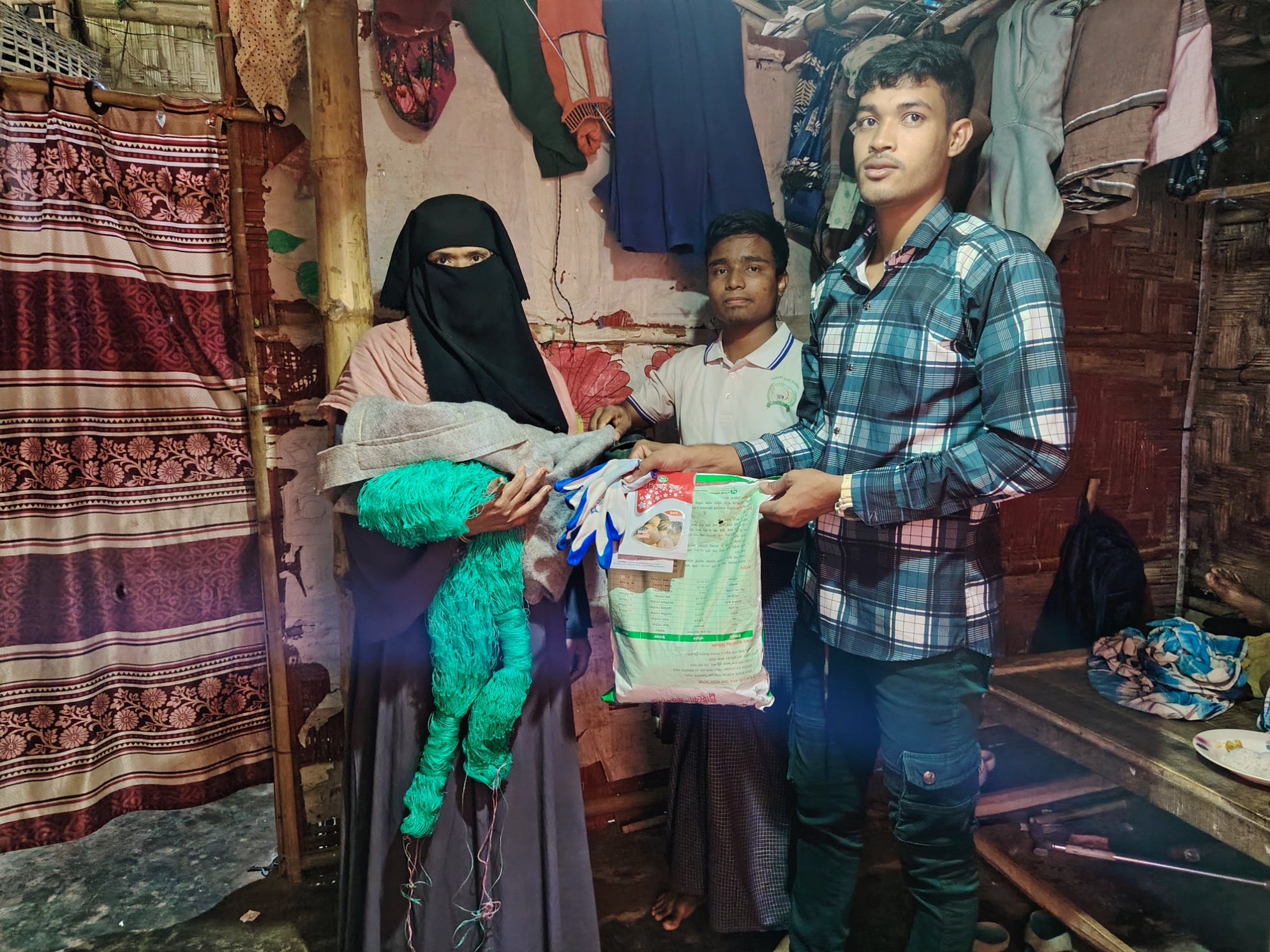
Families receiving seeds and tools for their home gardens.
“This gives us a little control again. If we can grow even a few vegetables, my children will eat better”
– Mother of a family that has received seeds
In the world’s largest refugee settlement, where families struggle daily with shrinking food rations and limited opportunities, even the smallest seed can carry enormous hope.
This week, our team distributed vegetable seeds and home-gardening materials to families across different blocks of the Rohingya refugee camps in Cox’s Bazar. What may seem like a simple activity became, for many people, a powerful moment of dignity, empowerment, and relief.

A Father collects materials that will help him grow fresh food.
Planting More Than Gardens
Each family received a small but complete set of items: Five types of vegetable seeds; Sacks for planting; Bamboo sticks; Watering can; Hand gloves; Netting; Fertilizer
For many mothers and fathers, this was the first time in years they felt they had something they could grow with their own hands.
“This gives us a little control again,” one mother said, holding her seeds carefully. “If we can grow even a few vegetables, my children will eat better.”
In a place where food insecurity is worsening each month, even a small home garden becomes a lifeline.
More Than Nutrition — A Sense of Independence
The Rohingya camps face strict movement restrictions. People are not allowed to work, travel, or access farms or farmland. As a result, the community relies almost entirely on aid aid that has been decreasing over time.
But this simple project does something powerful:
🌱 It gives people a sense of independence in a life where they are allowed to decide almost nothing.
🌱 It reduces hunger, especially for children who rarely get fresh vegetables.
🌱 It supports emotional wellbeing, letting families feel productive, hopeful, and connected to the earth again.
🌱 It restores dignity, reminding people that they are capable and resourceful.
A father told us, “When we fled from Myanmar, we left our farms and everything behind. Today, I feel like I am getting a small part of my life back.”
A Community Moving Forward Together
Our volunteers didn’t just hand out materials they explained how to use each item, discussed planting methods, and encouraged families to share their progress. The camp lanes were filled with excitement, laughter, and gratitude.
This was more than a distribution.
It was a moment of unity.
A reminder that even in severe hardship, the community still has strength, skills, and dreams.

Receiving seeds and materials with a smile!
A Call for Global Attention
This project also highlights a growing crisis: food shortages in the Rohingya camps are becoming dangerously severe.
Families are receiving less food than ever before. Children are showing signs of malnutrition. Parents skip meals so their children can eat. These gardens are a small solution but they show how much families can do if they have even a little support.
What these camps need now is not sympathy alone, but sustained support, investment, and attention from global partners.
Gratitude and Moving Forward
This project was made possible through the support and trust of Iain, whose belief in community-led work turned an idea into real impact in the hands of people who need it most.
We will continue monitoring the gardens, collecting stories, and sharing updates through photos and future blogs because showing real progress matters.
Sometimes hope grows quietly.
Sometimes it fits inside a small packet of seeds.
But inside these camps, hope is growing again one garden at a time.
Posted By Maung Myint
Posted Nov 20th, 2025
1 Comment
Iain Guest
November 26, 2025
Maung – we are delighted to help and hope to see more encouraging reports like this! Please keep us informed at every stage of the project: What land are they planting on? Do they have water? Are the seeds growing? Are they vulnerable to floods? Are they producing food, and what difference does it make? Everything is interesting and we look forwards to following the process along through your blogs and photos. If you can make this work, it could open up many more possibilities. We keep our fingers crossed and wish you all luck!