

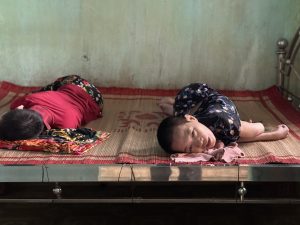
The first thing I notice when I enter Lê Thanh Đức’s home is the stillness of the room. A fan hums in the corner, dispersing the warm summer air. Two women rest on the bed, their bodies curled against the wide frame. One turns her head as we enter, her eyes widening curiously for a moment before shifting into a soft smile. I smile back.
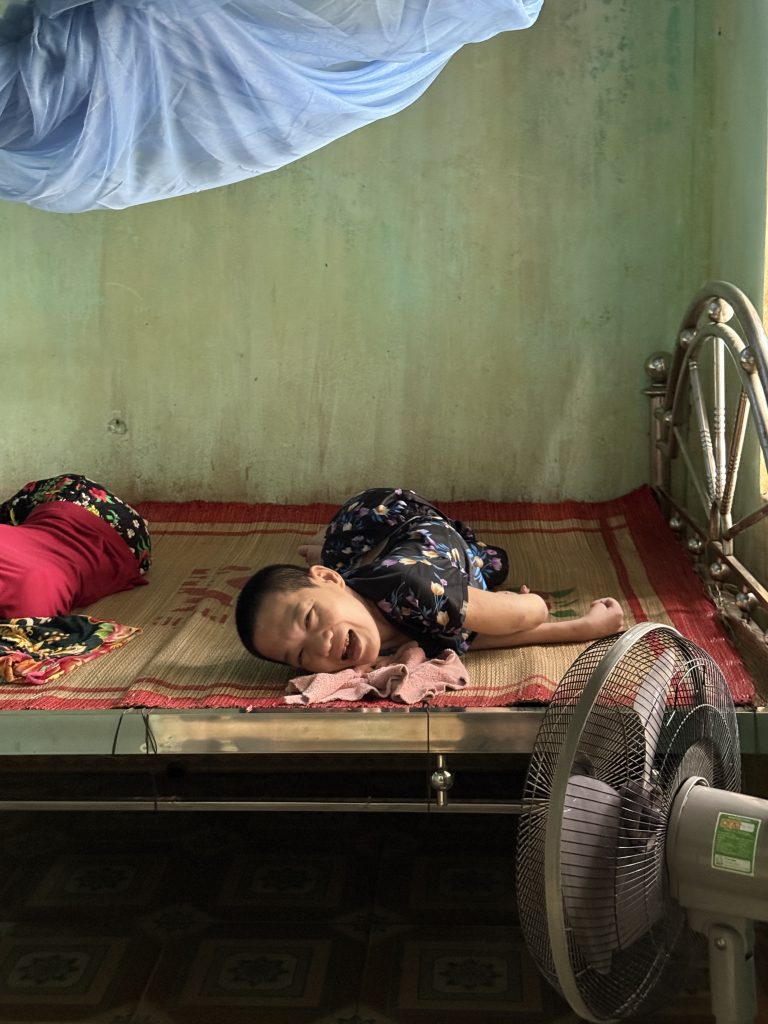
Đức explains that his three daughters, all now in their forties, cannot speak. They communicate through gestures: touching their face when hungry, pressing their stomach when they need the toilet. Over decades, Đức has learned to read these signals. The room carries traces of the routine of their daily lives: the fan positioned just so, the folded cloth by her side, the neatness of the bed. Everything has been arranged with attention.
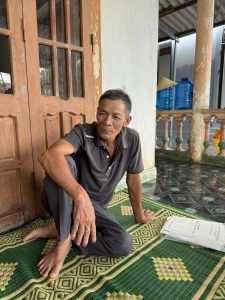
Đức, now 65, was exposed to Agent Orange during the Vietnam War, when he fought in Đà Nẵng in 1974. The remnants of war remain in his own chronic pain and in the intergenerational health effects of his children. He and his wife had six children in all. One died from complications due to Agent Orange. Two are unaffected and now work far from home to support the family. The remaining three daughters live here, with severe physical and intellectual disabilities. They are nonverbal, bed-bound, and experience frequent seizures.
I ask him what his days look like. He tells me they revolve almost entirely around caregiving. He feeds his daughters, bathes them, changes their diapers, washes their clothes. They cannot speak, but the gestures they make communicate enough, and he responds quickly. Because of their seizures, he often sleeps only an hour or two each night. The rhythm of his life is measured in these small cycles of attention.
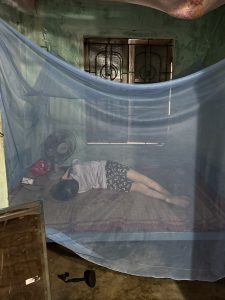
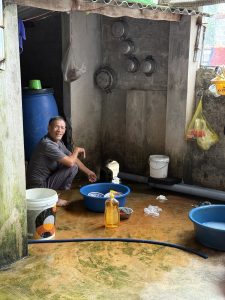
Later, in the yard, I see the same quiet order at work. Dishes soak in a blue basin. Clothes hang in rows along a wire, patterned florals catching what light filters through the overcast sky. These are ordinary details, but here they feel heightened: visible signs of how caregiving fills the day. Đức rises before dawn, he tells us, tending to his daughters one by one.
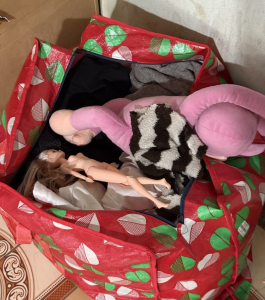
My eyes catch on a red plastic bag slumped against the wall. Inside are dolls, plushies, and a Barbie with tangled hair. Judging by the wear and tear, these toys are clearly played with regularly and beloved. My emotions catch in my throat.
The family’s main income comes from government allowances for Agent Orange victims and war invalids. As a war invalid with an 81% disability rating, Đức receives 10 million VND per month (about $395). His three daughters each receive around 5 million VND (about $200) per month. Even so, it is not enough to cover basic living expenses. Đức tells me that diapers alone cost about 1 million VND (about $40) each month. To manage, he borrowed 300 million VND (about $11,500) from the bank, a debt he is still paying back with interest.
When AEPD and The Advocacy Project first supported Đức in 2016, the traditional livestock model was not realistic given his full-time caregiving role. Instead, he chose to raise chickens and invest in equipment for a small fish sauce business. He continues this work today with the help of a close friend, producing traditional fish sauce at a time when cheaper industrial brands dominate the market. “There is still a lot of opportunity here,” he tells us, hopeful that people will continue to seek out something homemade and authentic.
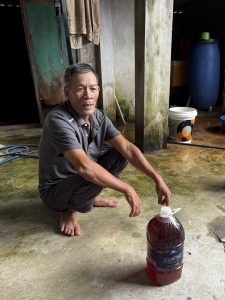
He bottles the sauce in recycled water jugs, prying open the caps for us to smell and taste. Minh and Mai each try a bit, nodding with approval. Đức watches closely, grinning as if the praise confirms what he already knew.
He shows us the chickens, scattering feed into a corner of the yard. They rush toward the grain, wings beating against one another, the flock erupting into sound. Đức laughs, a sudden bright sound that fills the space. He crouches low, eyes crinkled, his face alive in the flurry of movement.
The initial support – $1,138.74 raised by AP and AEPD – was significant and well-matched to his circumstances. Still, listening to Đức, it becomes clear that such one-time funding cannot offset the ongoing weight of caregiving, debt, and the long shadow of Agent Orange. Community support helps, but it does not replace the need for stable, long-term livelihood opportunities.
I keep thinking about the red bag filled with toys and dolls, their plastic limbs and fabric softened from use. I think about how play continues here, embedded into the daily rituals of care.
There is love in the routines: feeding, bathing, lifting, changing. Love not as sentiment but as repetition, a rhythm that holds the family together. I wonder how long such rhythms can be sustained, how love and exhaustion fold into one another, how support rarely reaches the households that need it most.
Here, disability and poverty compound each other. For households like Đức’s, where multiple family members live with severe disabilities, the demands of care require more resources than what has been provided. The severity of care required makes it impossible to take on new income-generating projects without risk of collapse, yet these are the lives most in need of stability. The result is a paradox: the heavier the burden, the less effective the aid.
And still, care persists in the daily repetitions that hold life together: feeding, bathing, cleaning, playing. It is here that the political becomes visible too: how the remnants of war persist in bodies and the environment, into the unpaid labor of families, and the daily rituals of living.
I think of the persistence of care and play, the way love is asked to bear what war and poverty have left behind. It stays unsettled, unfinished, as if the story resists being closed.

Posted By Angie Zheng
Posted Aug 21st, 2025