

I’m so excited to be in Nepal! The team is amazing. We’ve been having a lot of fun together and I’m convinced we’re going to do great work this summer! I am starting with a more serious blog, because one speaker this week really has really got me thinking! Next week, expect a more fun blog, introducing myself and my experiences in the past weeks (I have some good comedic material to work with :).
Our first session of the CHRV summer program was with Ekraj Bhandari, constitutional lawyer and longtime human rights advocate.
Nepal’s constitution is very progressive in Mr. Bhandari’s eyes. He cites its division of state power between federal branches and its three geographic layers—local, provincial, and federal. These structures allow space for the different values and practices of the diverse Nepali people to reside under the same system. He also highlights a constitutional provision giving priority access to education, health and employment to victims and families of human rights abuses in the nation’s past conflicts as a reflection of its inclusivity.
However, today, the structures of power that have grown around this document stray far from its progressive ideation. As of 2026, 11 years after the implementation of the constitution, persistent corruption has prevented victims from receiving their apportioned support.
According to Mr. Bhandari, the flaw is not constitutional. The Supreme Court has consistently ruled in favor of victims. The most recent ruling being in April of this year, removing government power to grant amnesty to human rights violators. Rather, the flaw is in the “individual greed” of government officials who use their positions to accumulate wealth and further their power, whilst ignoring their constitutional duty to remediate human rights violations.
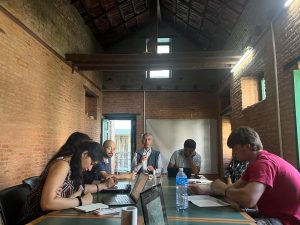 Ekraj Bhandari speaking to our class
Mr. Bhandari compared the situation to President Trump’s current standoff with the American federal court system. For me, this parity contextualized the phenomenon into a system I understand. A sea of examples in American politics began to flood my head. From bipartisan military support for Israel in its genocide to democratic lawmakers voting in favor of fossil fuel expansion, American politicians often vote in misalignment with their constituents when it allows them to reap individual political benefits. It is clear that progressive constitutions struggle to hold representatives accountable because individuals prioritize personal power and wealth over their constitutional obligations.
While Nepal and the United States both share progressive constitutions, the nations have vastly different cultures and value systems. The fact that Nepal and America both experience corruption in a similar way, despite their cultural differences, suggest that systemic corruption in both nations is not a one off, or a unique cultural issue, but rather a far more universal issue central to human tendencies of organization.
In Nepal, the 2025 Gen Z uprising was a direct attack on this form of systemic corruption. So were the global Gen Z protests. In America, the current upward trend of anti-establishment candidates is also in alignment with these global movements against corruption. These movements all directly address the inability of progressive constitutions to uphold their ideals when representatives evade their obligations for personal gain. Once in power, the mission of these coming movements should be to create new systems of accountability to compel our representatives to align with the values of people.
The question of what these new systems could look like will be with me this summer. I’ll keep the blog updated on what I’m thinking & I’d love to hear from the readers 🙂
Posted By Leo Horton
Posted Jul 26th, 2026
1 Comment
Iain Guest
July 26, 2026
Such an interesting first blog, Leo! I like the comparison between Nepal and the US and totally get your core point – that on paper at least both countries are blessed with progressive constitutions that give a lot of authority to the districts/states. So why exactly are they failing? You seem to blame the politicians who “evade their obligations for personal gain.” Or – here in the US – to stay in power. Could it be the two Supreme Courts, which interpret the constitutions, are also part of the problem? The Nepal court is more progressive but does it have as much power as SCOTUS? After reading your blog I’m wondering whether your thesis helps us understand why the struggle for transitional justice remains blocked. What do you think? I’d always assumed that the pushback was coming from military officials who are afraid of being prosecuted. Is this right – or is it corrupt politicians?