

Arriving at the family house, the first thing I noticed was the rice. Hundreds of grains had been spread across a large red tarpaulin in front of the home to dry in the sun. I had never seen this part of the process before and, for a few moments, I watched without really understanding what was happening.
Then a woman slowly made her way towards us.
Slowly is perhaps too gentle a word. Walking was clearly difficult for her. Her movements were careful and painful, and later, when we moved around the house to take photographs, I naturally offered my arm so that she could lean on me.
Her name is Thi Que. She is 76 years old.
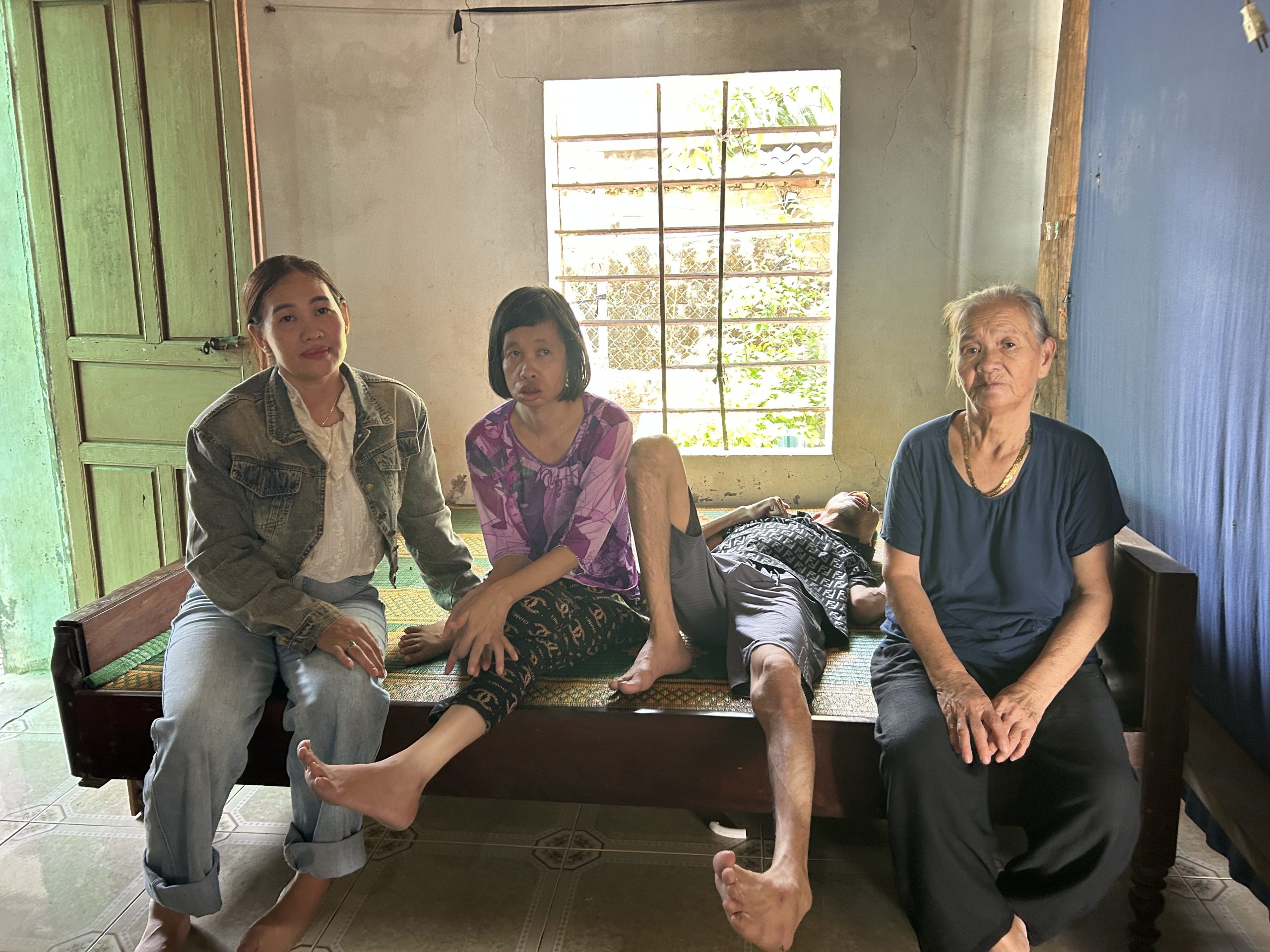
Luyen (the sister caregiver),Phạm Van Linh, Phạm Thi Linh, Thi Que (the mother).
The first thought I wrote in my notebook was one that has followed me during many of these family visits: once again, the person carrying most of the responsibility was the mother.
By the end of the visit, however, I would realise that this story was also about something else. What happens when the caregiver herself begins to need care?
When illness takes away the family’s main source of security
We had barely finished introducing ourselves when Thi Que told us that her husband, Phạm Thất, had died two years earlier at the age of 66.
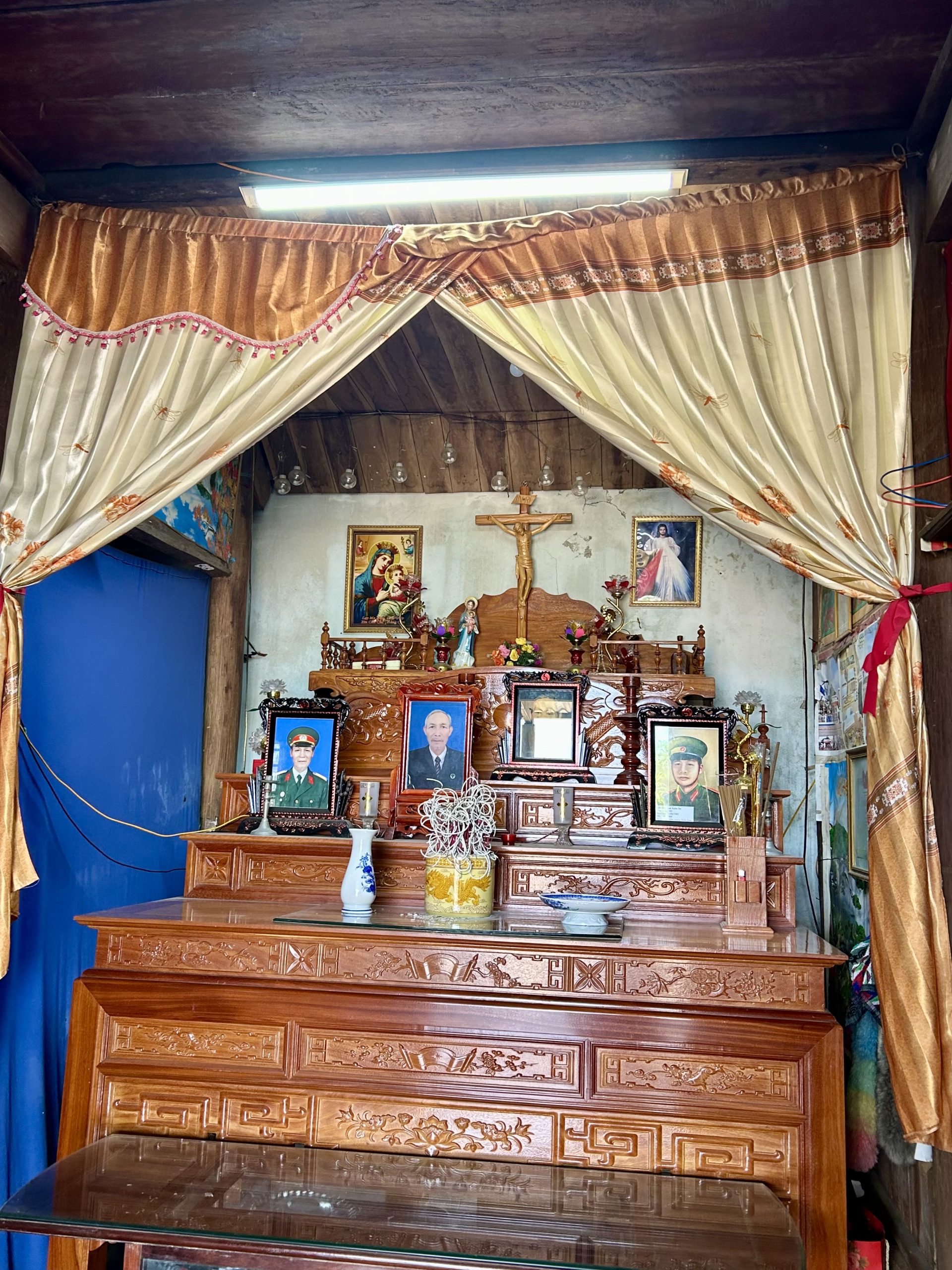
Funerary place dedicated to Phạm Thất.
His death followed a long and painful battle with cancer that had also placed enormous financial pressure on the family. I offered Thi Que my condolences on behalf of The Advocacy Project.
Almost immediately, she began explaining what his illness had cost them. The family had once owned a cow and a calf purchased with support from AEPD and The Advocacy Project. The animals had improved their situation and given them something they could rely on.
But when Phạm Thất became sick, the family sold both animals to help pay for his treatment. Even that was not enough. Thi Que also took out a loan and is still repaying it today. Around VND 2 million remains outstanding.
There was no bitterness when she spoke about selling the cow. On the contrary, she was very clear that the earlier support had improved the family’s quality of life.
But the story also showed something I have heard repeatedly during my time with AEPD: an income-generating asset can provide stability for years and still disappear during a single medical emergency. Before speaking further about money, though, I wanted to understand how the family was doing now.
That was when another woman arrived. Her name was Luyen. She is 46, one of Thi Que and Phạm Thất’s daughters. At that point, I did not yet realise how important she had become to the family.
Living with severe disability and dependence
We first went to see Phạm Thi Linh, the eldest daughter. She is now 48 and is officially recognised as a victim of Agent Orange.
During our conversation, she sometimes cried out loudly. At one point, she came close to me, perhaps trying to understand why a stranger had suddenly appeared in her home. I noticed red patches across her chest that looked like a skin irritation.
Her mother explained that Thi Linh regularly experiences seizures and epilepsy. Her moods can change quickly and she can sometimes become aggressive. Her intellectual disability is severe. She cannot understand much of what is said to her, respond clearly or communicate many of her needs. She never attended school.

Phạm Thi Linh, 48.
Most of her life has therefore been organised around care provided by other people. For many years, those people were her mother and father. Today, that responsibility rests increasingly on her mother and her sister.
Feeding a son whose health is failing
Her younger brother, Phạm Van Linh, is 41. He also experiences seizures and epilepsy, but during the visit I found it easier to see his emotions. At the end, when we went into his room to take photographs, he greeted me with a wide smile.
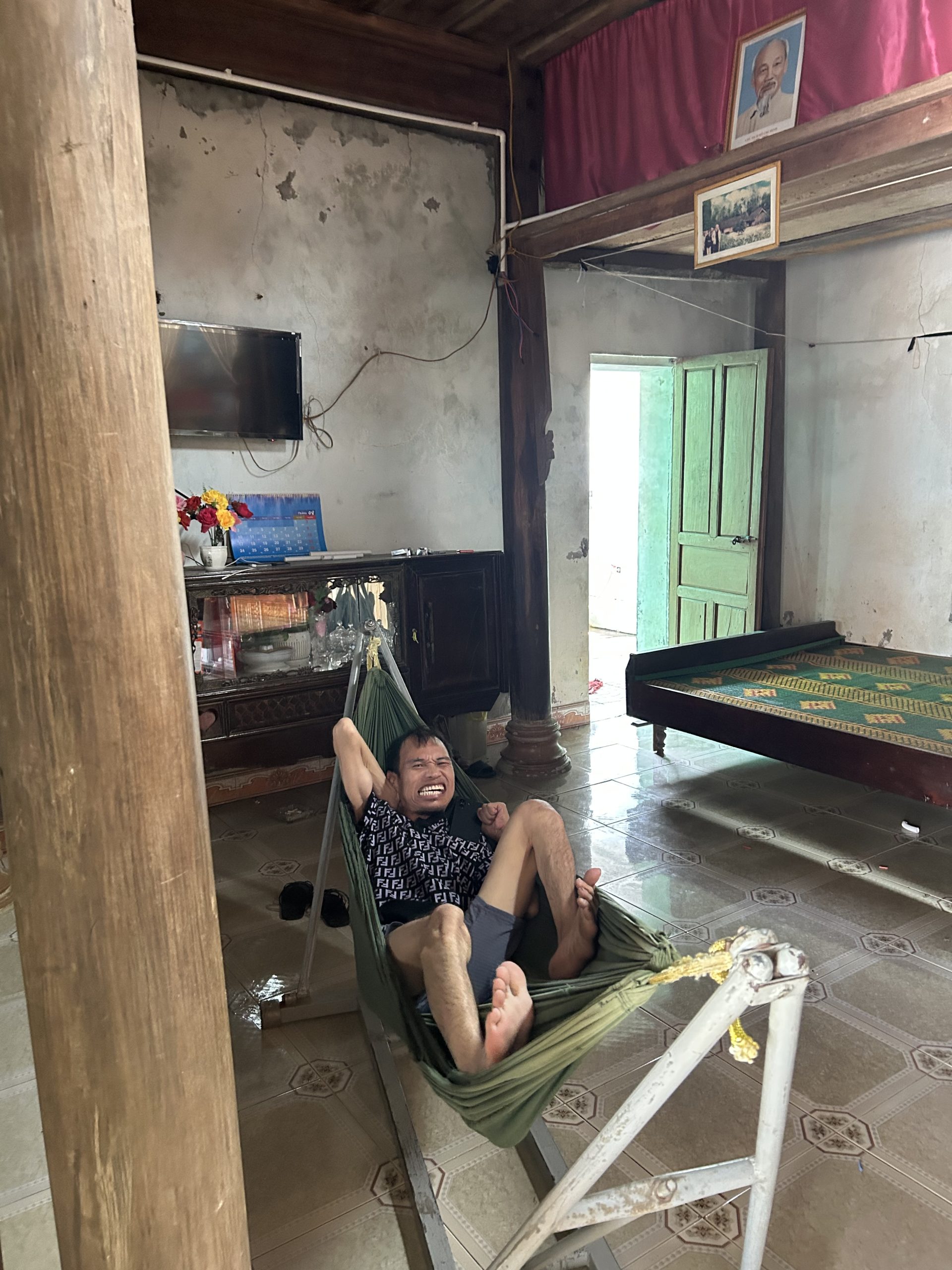
Phạm Van Linh, 41.
His health, however, is more fragile than his sister’s. Thi Que told us that doctors have warned the family that he may have only one or two years left to live.
One of the greatest difficulties is feeding him. Van Linh has severe paralysis affecting his mouth and his ability to swallow. His mother has to position his body carefully before giving him soup or liquids so that he can eat. Even then, feeding him is becoming increasingly difficult.
Thi Que worries that he may eventually need to be hospitalised because he is no longer able to take in enough food. She is particularly afraid that doctors may have to insert a feeding tube.
Day after day, she told us, she sees both of her children becoming physically weaker. There was no dramatic way in which she said it. Perhaps that made it harder to hear.
Caring while her own body weakens
Thi Que continues to cook, clean and care for both children despite her age. But she is not physically well herself.
In 1968, she joined a group responsible for transporting goods and weapons during the war. During one of their missions, the group was bombed. She survived, but says that she has lived ever since with serious circulation and nerve problems in her legs.
Watching her move around the house, it was easy to see how much this affects her today. She walks with difficulty and has to take her time.
Yet there is no real possibility of simply stopping. Her children still need food. They still need medication. Van Linh still needs help swallowing. Thi Linh still needs someone nearby who understands her behaviour.
At 76, Thi Que remains at the centre of their daily lives. And, once again, I found myself thinking about how often this work falls to women. Caregiving is easy to describe as something loving or natural. But it is also work: physical, emotional and often unpaid work.
For decades, Thi Que has organised her life around the needs of her children. Now her body is becoming weaker, but the need for care has not disappeared. It is beginning to move to someone else.
How a limited income is divided
Thi Linh and Van Linh each receive around VND 2.7 million per month in government compensation.
Thi Que is no longer able to work because of her age and physical condition, so the household depends almost entirely on these benefits. Together, the three live on approximately $268 a month.
Thi Que was very direct about where the money goes. Around $13 each month is spent on medication for the two children, including painkillers and tranquillizers. Another portion goes towards repaying the loan taken out during her husband’s illness.
Most of what remains goes towards food. She explained this almost defensively, as though she needed to justify why food takes priority. She wants to cook different things for her children, she said, because she wants them to receive as many nutrients as possible while their bodies continue to weaken.
If anything remains after that, she tries to save it for repairs to the house.
There is rarely much left.
The daughter who quietly takes on more responsibility
By this point, Luyen had been part of almost the entire conversation. Yet she repeatedly seemed to move herself out of the centre of the story.
When I suggested taking a photograph of the family, she quietly stepped away. I called her back. I wanted her in the picture too. Although she is not herself an Agent Orange victim, her role has become increasingly important since her father died.
Before returning to her childhood village, Luyen worked at a centre caring for twelve children with disabilities. Perhaps that is not a coincidence. Growing up alongside Thi Linh and Van Linh seems to have shaped not only her family responsibilities but also the direction of her professional life.
After her father died, everything changed. Luyen left her job and returned to the village so that she could remain close to her mother, brother and sister. She rents a room nearby and now works in the fields.
The rice I had noticed when we first arrived was hers. Later in the visit, I watched her turn the grains carefully across the tarpaulin so that they could continue drying. It was a small task, but by then it looked very different to me. The rice was not simply part of rural life. It was part of the new life Luyen had built around her family’s needs.
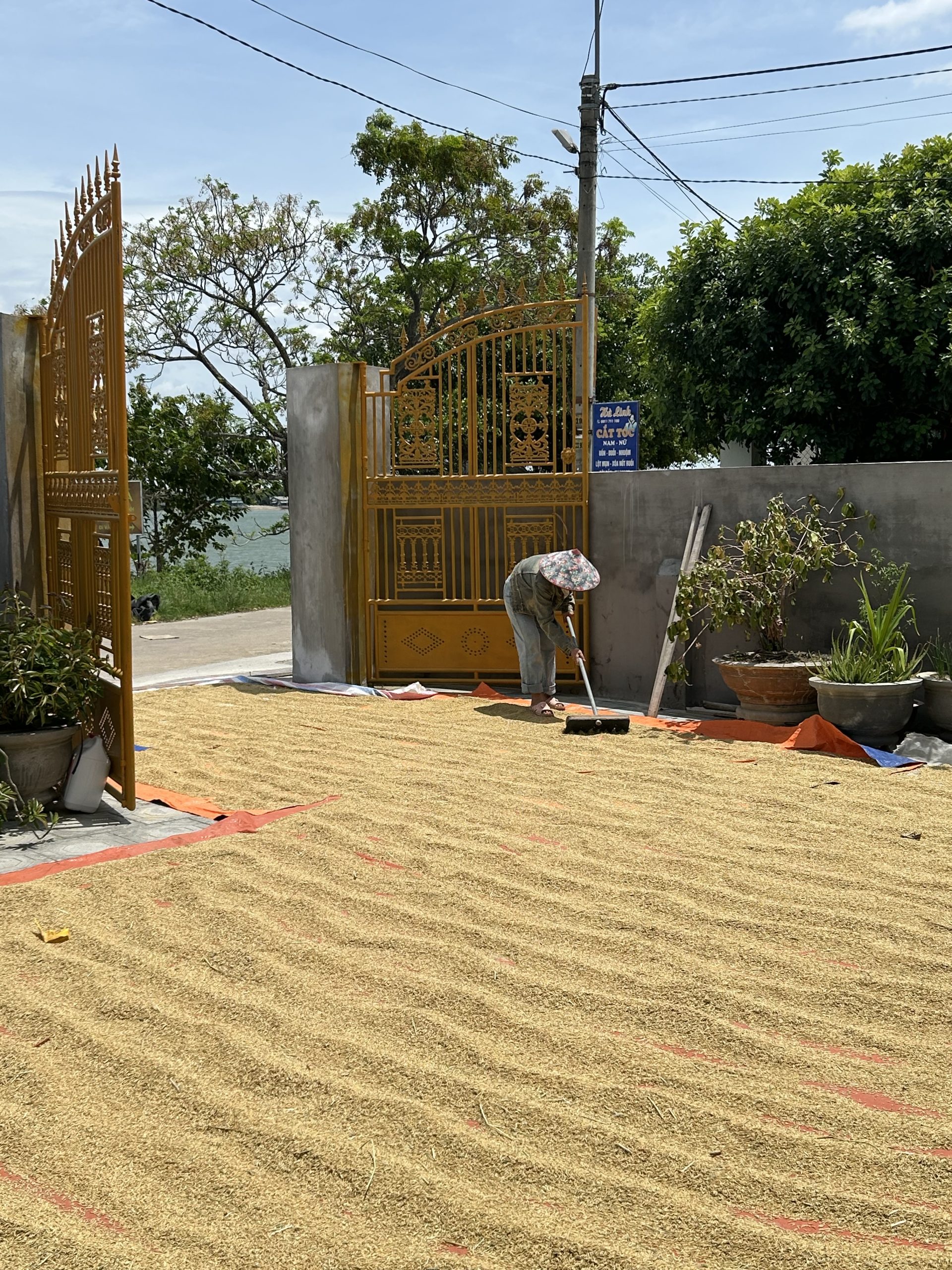
Luyen, turning the rice that was drying on the porch of the house.
When care passes from one woman to another
Thi Que and Phạm Thất have three other children who are in good health and have formed families of their own.
Luyen lived closest. So when her father died and her mother’s burden became heavier, she was the one who came back.
That choice has come with a cost. She left her career and now lives separately from the household she had built with her own husband and two sons.
Her husband works as a mechanic, and together they still have a relatively stable income. Luyen also contributes financially to her mother whenever she can. But her own sons are approaching university age. Their education will cost money too.
Luyen does not describe her return as a sacrifice. She talks about it more practically: her mother needed help, and she was the person who could provide it.
Still, the consequences are clear. Her work changed. Her income changed. Her relationship with her own household changed. Her daily life became organised around the needs of another household.
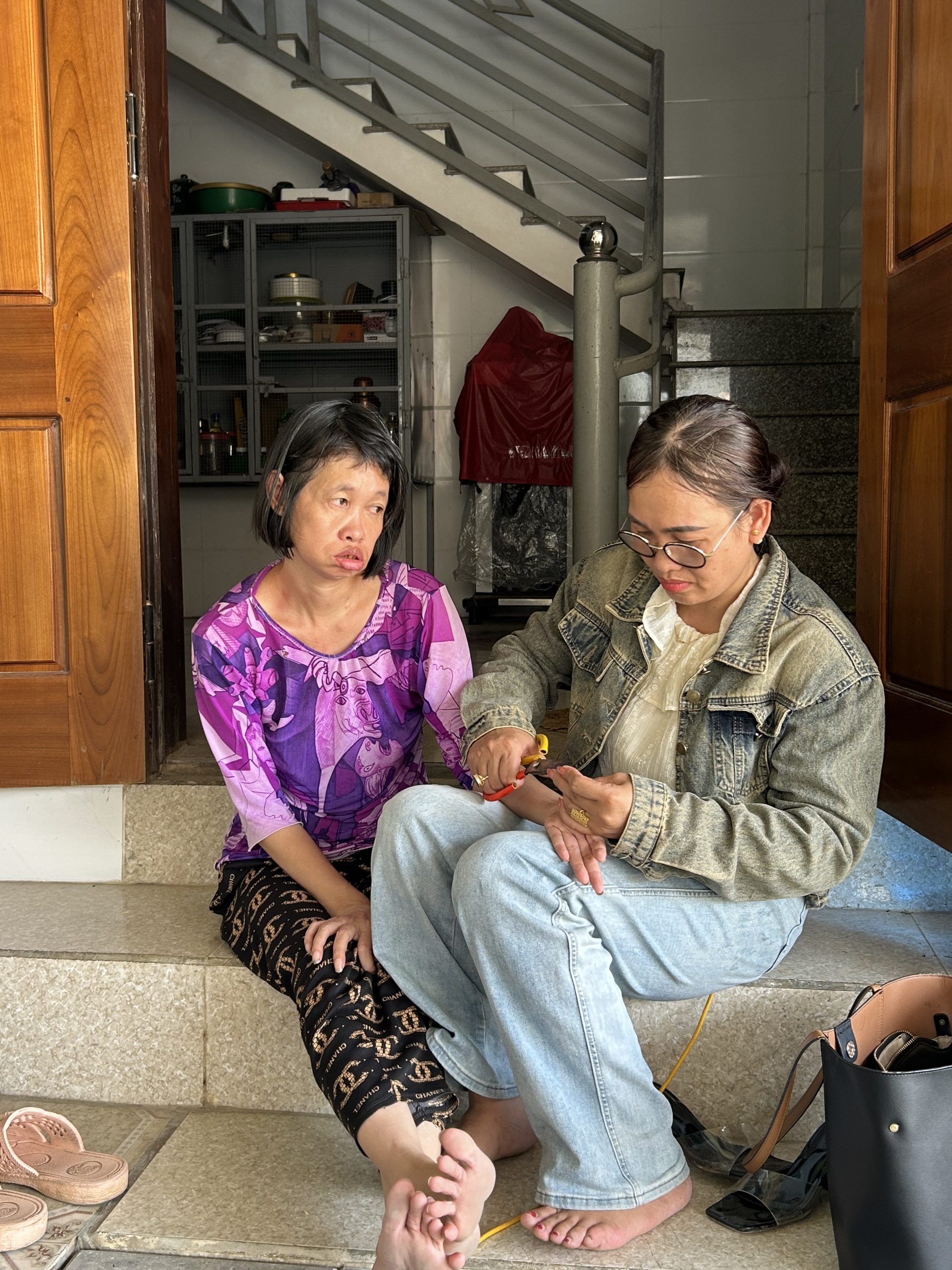
Luyen cutting the nails of Phạm Thi Linh.
The responsibility has not disappeared. It has been redistributed. And it has been redistributed in a very particular way: from one woman to another.
During my visits with AEPD, I have repeatedly seen mothers, wives and daughters become the people expected to absorb the practical consequences of disability. They cook. They feed. They wash. They manage medication. They give up work. They reorganise their lives around someone else’s needs.
Because this work takes place inside the family, it can easily become invisible. Luyen’s return home may appear to be a private family decision. But it also affects her ability to work, earn an income, live with her husband and children and pursue the future she had planned for herself.
Care is essential. But it should not require one person’s rights and opportunities to disappear in order for another person to live with dignity.
Turning personal experience into a wider ambition
Luyen told us that she wants to “break the cycle of poverty.” Those were her words.
Her ambition is eventually to save enough money to create a centre for people with disabilities affected by Agent Orange. She imagines a place where they could receive care and support, and where families like hers would not have to manage everything alone.
Her previous work with children with disabilities makes this dream feel less abstract. She already knows what such care involves.
But she is also realistic. There is a long way to go before she could afford to create anything of that scale. For now, her immediate concerns are much closer to home: helping her mother, supporting her siblings and finding enough money to finish a safer room before the rains arrive.
Her ambition nevertheless points to something larger. People with disabilities need appropriate care, safety and the possibility of living with dignity.
But caregivers have rights too. They need the possibility of working, maintaining their health, living with their own families and imagining a future that is not entirely defined by unpaid care. These rights should not have to compete with each other. Yet when formal support is limited, families are often left to resolve that tension alone.
For decades, Thi Que provided the care. Now, increasingly, Luyen does. The care has always existed. What has often been missing is enough support around the people providing it.
Trying to make the house safe before the floods return
The family’s immediate concern is now the house. Every year, floodwater rises through the property, sometimes reaching more than a metre and a half inside. There are cracks in the structure and the family lives with the constant possibility of flooding.
Local authorities have begun helping them construct a new annex room that could provide a safer space. But the work is not finished. The rainy season is approaching quickly, and Luyen knows that she will have to help her mother find the money needed to complete it.
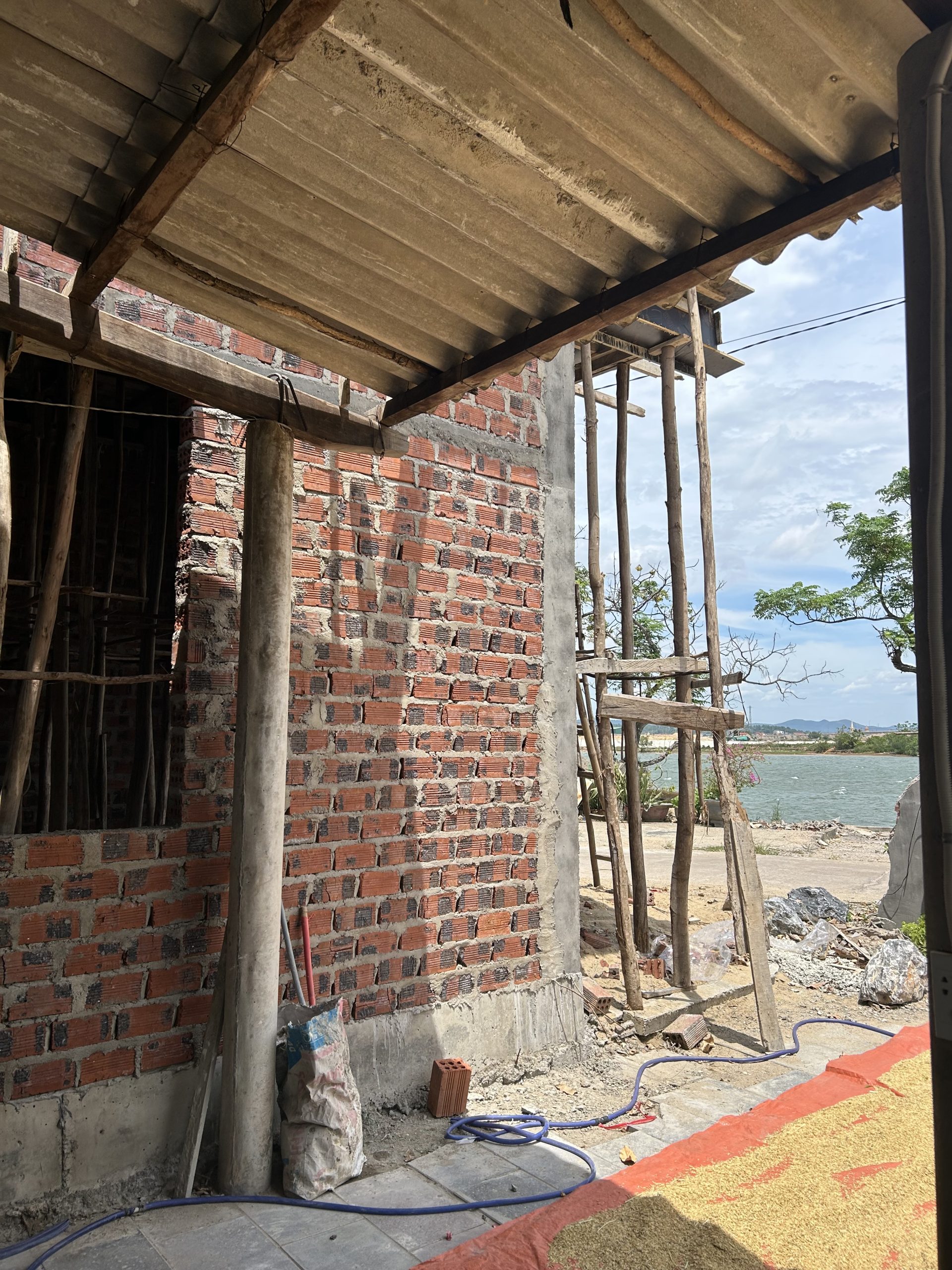
The new annex room in construction.
For this family, the immediate future is measured in practical questions. Will the room be finished in time? Will there be enough money for food and medication? Will Van Linh be able to continue eating without hospital treatment? Who will care for Thi Linh if Thi Que can no longer manage?
These questions do not have simple answers. What has changed is who is increasingly expected to answer them.
The daughter turning the rice
When I think back to the visit, I keep returning to the beginning. The rice drying outside.
I had arrived knowing that this family had already been visited and written about. What stayed with me this time was the present. Thi Que is 76 and can no longer move easily, but she still cooks for her children, manages their medication and helps her son eat.
Luyen has left her job and returned to the village because that care can no longer rest with her mother alone. She does not ask to be praised for coming back. She seems much more comfortable directing attention towards her mother, brother and sister.
But her choices say enough. She left her job. She returned to the village. She lives away from her husband and children. She works the land. And she is slowly taking on responsibilities that her mother carried for decades.
Support from AEPD and The Advocacy Project has already played an important role in this family’s life. The cow and calf helped provide greater financial security until Phạm Thất’s cancer forced the family to sell them to pay for treatment.
Today, their needs have changed. The immediate priority is a safe place to live before the floods return.
But beyond the house is a larger question. Thi Que cannot continue doing everything forever. Luyen knows that. And perhaps this is why the rice outside the house stayed with me. At the beginning of the visit, I saw only grains drying in the sun. By the end, I saw the woman turning them. A daughter who came home because her family needed her.
There is something admirable in that decision. But admiration should not prevent us from asking why women like Luyen are so often the ones expected to make it.
Supporting families affected by Agent Orange therefore means more than supporting the person living with a disability. It also means recognising and supporting the people whose unpaid care makes daily life possible. For this family, that responsibility is slowly passing from mother to daughter. The challenge is to make sure Luyen does not have to carry it alone.
Posted By Clothilde Soenen
Posted Sep 20th, 2026