

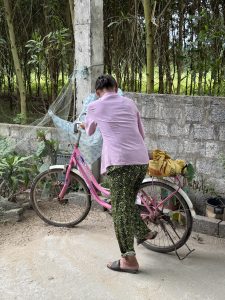
Dương Thị Huề is waiting for us by the roadside in a pink shirt and patterned green trousers, her graying hair pulled into a bun. As the car slows, Mai leans out the window to greet her. Huề smiles, gums showing, then without a word mounts a pink bicycle and sets off ahead of us. From the back seat I watch her small figure move steadily down the road, pedaling with ease. My gaze shifts between the Buddha ornament swaying on the dashboard and Huề’s back, her motion even, unhurried.
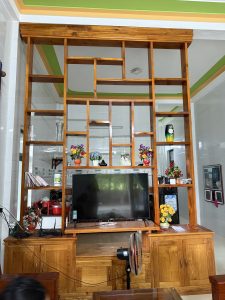
The house appears after the bend. Chickens scatter at the motion of her hand as we climb the steps. Inside, the living room opens wide, the summer air close on our skin. Against the wall a cabinet holds silk flowers, portraits of her children, and a television. The room feels both austere and lived-in. Huề sets out tea and we sit together at the wooden table.

Huề is seventy-one. She was exposed to Agent Orange during her service in Quảng Trị. Of her eight children, four are affected: three daughters and one son. One daughter has passed from complications due to Agent Orange; two live in a social care center. Her son remains nearby, living with severe mental illness and now kidney failure.
For many years, Huề lived with her son together in their old house. His illness was unpredictable. Sometimes he was quiet, but oftentimes he was violent. During his violent episodes, she would sometimes chain him to the wall. She spoke of it as she might any other domestic task, not to dramatize but to account for how she managed. As she grew older, she no longer had the capacity to restrain him; there was little else she could do.
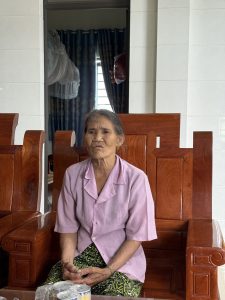
The new house, built with support from AP and from a son working abroad, has changed her days. She lives alone now. Her son stays in the old house. Each morning she cycles to him with food. Often, she admits, he is still violent. She could send him to the center, but she says she wants to care for him herself, while she can. Then her voice drops: she is older now, and less strong. She does not know how much longer this will last. She tells us the support from AP and AEPD has been significant. The house gives her safety, and with it the possibility to continue caring for her son on her own terms.
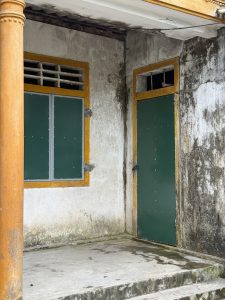
Huề takes us to see her old house, a short bicycle ride away. Her son is not there when we arrive; he has likely gone out to cut grass for the cow. Mai and Minh tell me that the last time AEPD staff visited, he turned violent and hurled something at the outreach worker, resulting in a concussion and forehead injury. At the doorway, I notice the bolts on the frame, metal slid heavy against wood.
A cow rests in the yard, its calf tied beside it. Huề shows them to us, then gathers longan from the trees, handing them to Mai, who exclaims at their sweetness before passing some to me. They carry the taste of summer.
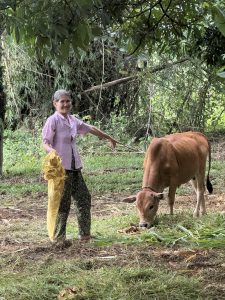
We linger in the yard. Huề feeds the cow, then leads us under the shade of a jackfruit tree. Our driver fetches a ladder to twist the spiny fruit from its branches, while Huề waits below with a yellow sack, ready to catch the heavy drop.
The interview inside had been serious, Huề’s face composed, almost stern. Here in the yard, her expression loosens into laughter. She grins as the fruit drops into her arms and as the afternoon unfolds in small tasks.
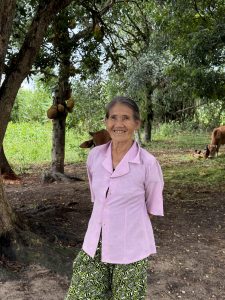

When it is time to leave, Huề takes my hands in hers and rubs them slowly, back and forth. The gesture is tender, almost familial, and for a moment I think of my grandmother. I hold her hands a little longer before letting go. She wishes me health and a bright future; I ask Mai to wish her the same in return. The words pass between us, suspended in translation, and we linger there a little longer with our hands clasped together before we go.

Posted By Angie Zheng
Posted Aug 24th, 2025