

30 August; Kathmandu
Around 5pm, people started to gather. They greeted one another — hands clasped, a pat on the back, a nod. They sat on the curb and stood in the street. Some laughed, others yelled out, two women stood to the side sharing quiet conversation. The mood was difficult to pick up on — there was the joy and casualness of a typical Saturday evening, but also a kind of solemnity.
Several people grabbed what first appeared to be a tarp and began stretching it out across the road. They pointed and gave directions and others joined, raising it up with a pole underneath and pulling ropes at the corners to a tree, light pole, and metal bars of a truck. The fabric rose, revealing a beautiful orange and yellow interior. As more people arrived, a small group started drawing out numbers in chalk underneath the tent — 1,350+. And, as others unveiled a long train of paper, gathering the group into a circle, they lined the chalk numbers with small candles.
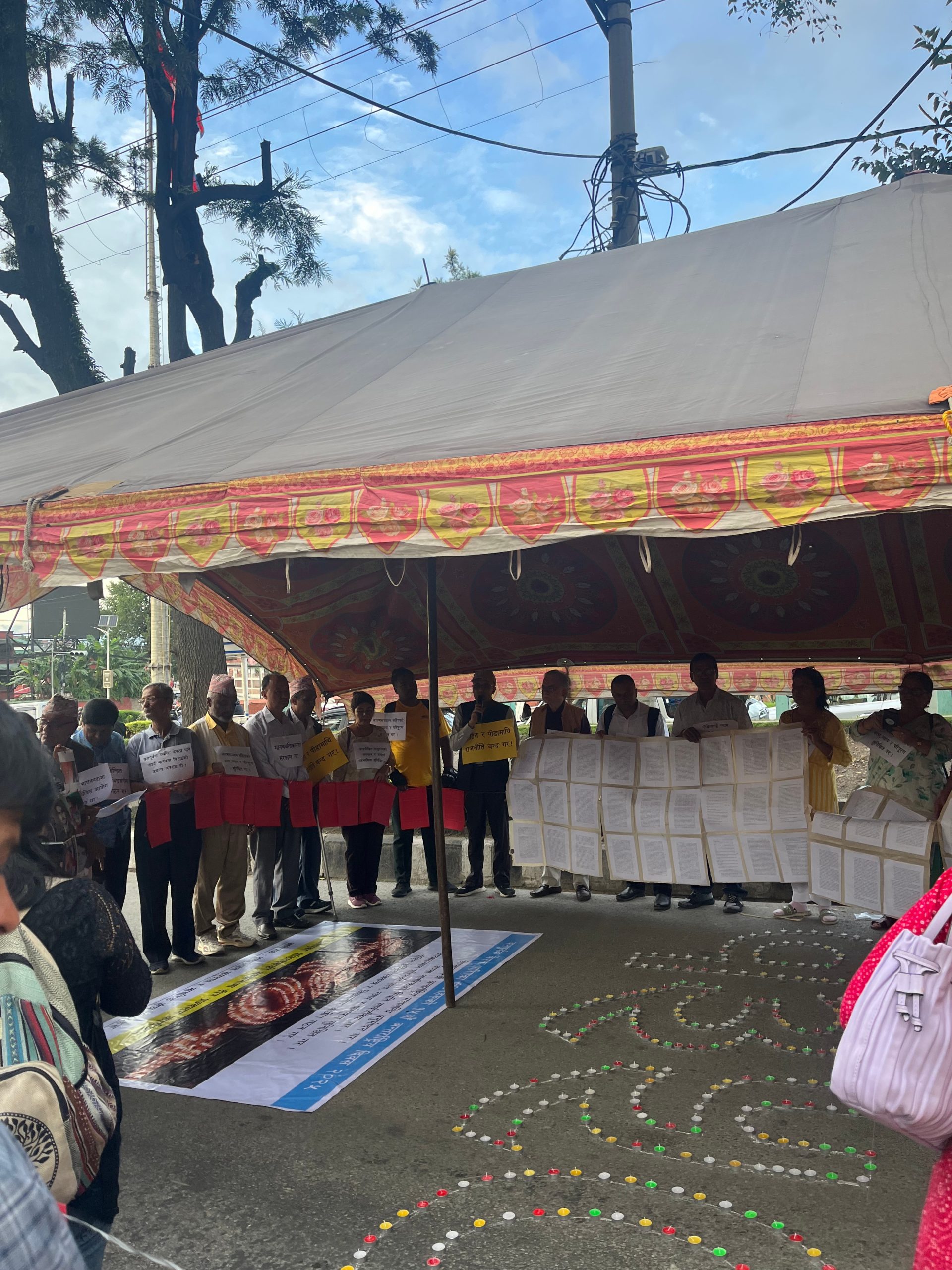
There were around 50 people now, clustered around the outside edge of the tent, their feet making a circle around the 1,350+. They were nearly ready to start. The air was cool, and the rain held off.
Safety pins and white printer paper hosting demands like “Abolish the commissions formed and controlled by political factions” and “Make the status of missing citizens public” were pinned on shirts. Ram grabbed a microphone. The group quieted and he began, “Thank you all for gathering today in honor of August 30, the International Day of the Disappeared.”
“We are also using today as a boycott campaign of the commissions,” he explained. “Therefore, we would like to welcome and thank all those who are participating, including family members, human rights organizations, civil society, and media workers.” He continued, “We are asking questions, and the government is not answering. The state has not been held accountable and has acted dishonestly and deceitfully in the issues raised by the victims.” He touched on the long history of their movement represented in the papers participants held up, reiterated the need for justice for the disappeared, and thanked everyone again before handing the mic to Suman Adhikari.
Friends for the last decade, Suman and Ram met in 2010. Suman’s father was killed by Maoists during the conflict and together he and Ram brought together victims from both sides through the Conflict Victims Common Platform, an initiative they started in 2014. His presence at today’s event is a testament to not only their friendship, but the powerful, cross-boundary alliances that Nepali victims have formed.
In his speech, Suman emphasized that every step in the state led process has been taken without the consultation and participation of victims — a cruel injustice and indication that the government does not intend to realize justice, but rather to protect their own political interests.
When he finished, the mic continued to make its rounds. Human rights advocate Indra Aryal criticized the state’s ongoing betrayal of victims after their decades long struggle for justice; former NHRC commissioner Mohna Ansari spoke about the disingenuous approach top political leaders have always taken to human rights; activist and former chair of Amnesty International Nepal Charan Prasai emphasized the need for a victim-led civil commission. At one point, a Pakistani activist took the mic. Drawing connections between the struggle of Nepali victims and citizens of other Asian countries, she emphasized “we live for the day of a just and lasting peace.” “My heart is also with Gaza,” she added. “With the thousands who have suffered there, the thousands that have died there, and thousands that are suffering today from famine.” In an expression of solidarity she ended, “I give you courage from my country and take courage from yours.”
In all of the speeches, the significance of this Saturday was clear. It was a moment that called upon the community to not only look backwards and remember the disappeared and decades long fight for justice, but to look forward — to mobilize, determine the way, and call to action.
Pulled around the circle of people was a red string hosting papers and images — all 70 pages of the petition victims submitted to the Supreme Court in August, a joint statement released by international human rights organizations, news articles, press statements and position papers spanning the last two decades, a letter to the Prime Minister, and the photographs of family members disappeared by the state. Like the speakers, the papers told a story about the past, and of the future: victims have spent the last two decades fighting for justice, for those that were disappeared, and they will not settle for anything less.
Matches taped to the end of small rods were lit and, crouching down, people began to light the candles of 1,350+ disappeared. As the rods were passed around, little flames went up, flickered out in the wind, and rose again. The day was fading, and a soft orange glow took hold.
As I watched I couldn’t help but reflect on what it takes to remember. In resistance to the erasure of a disappearance and state silence, a candle is lit again and again. It’s a collective effort, the match passed around from person to person. And, in the end, a larger story is illuminated.

Family members, civil society leaders, activists, and community members light candles in honor of the 1,350+ disappeared on August 30
Posted By Emma Cohen
Posted Sep 8th, 2025