

There are visits that stay with you for reasons that are difficult to explain at first. For me, this one began before we had even reached the house.
We stopped at the entrance to a narrow path. At the other end stood a small home, barely holding together. My eyes were immediately drawn to the kitchen. Sheets of corrugated metal leaned against one another at strange angles, and I genuinely wondered what was keeping them in place.
Then I saw two women waiting for us. One was bent forward with age. The other had a wide smile on her face. They were Mi and her daughter Thương.
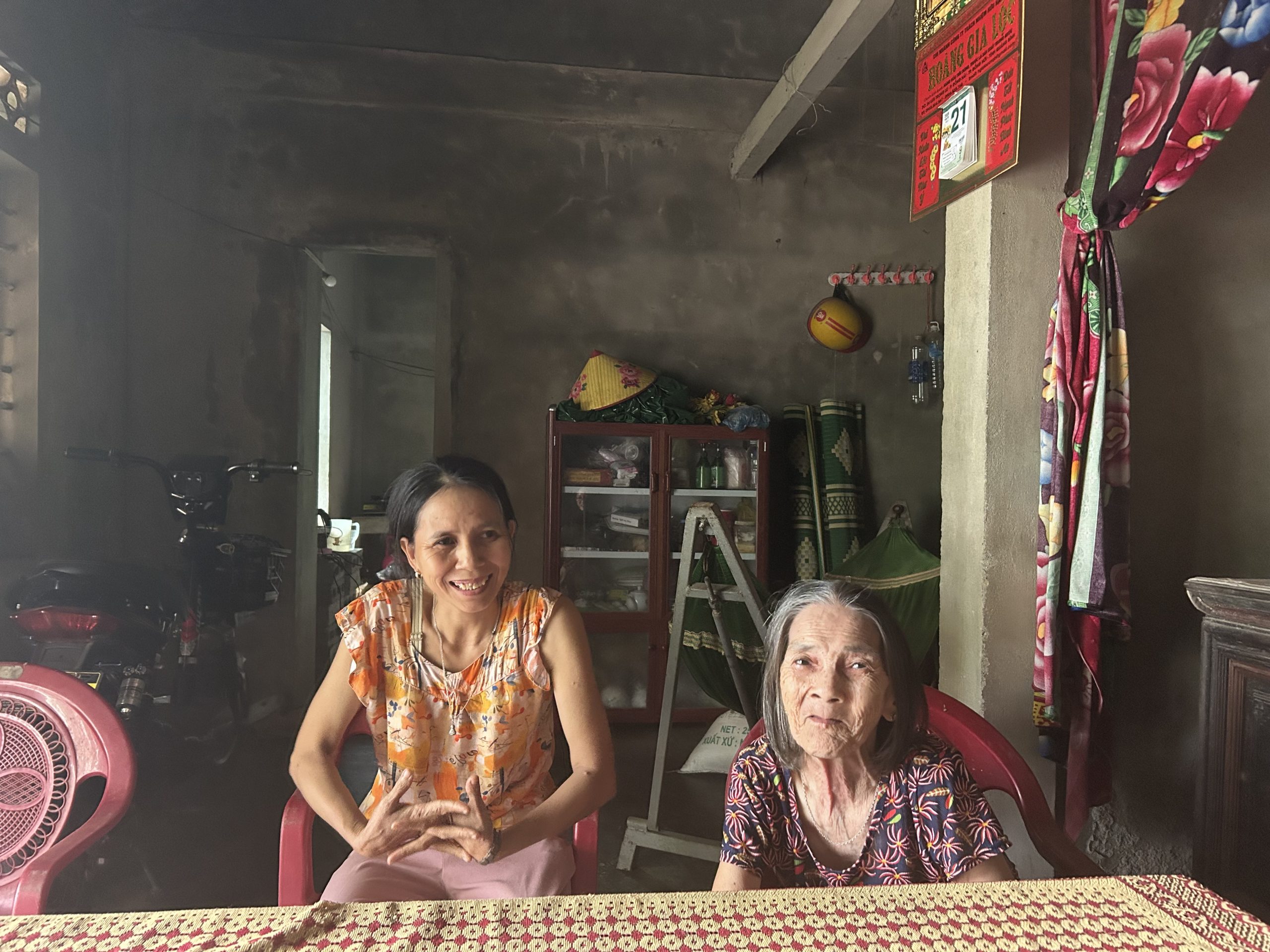
Thương and Mi
One afternoon, while working in the fields, we visited Mi’s family to better understand the situation of a family whose most basic needs remain unresolved.
We stepped inside. The contrast with the bright afternoon outside was immediate. The house was dark, although it was the middle of the day. The walls were blackened by humidity, dust or mould (probably a mixture of all three) and the air carried the unmistakable smell of a damp house.
There were only two rooms: a living area and a bedroom. The furniture was sparse. A small television. A shelf with a few food supplies. Plastic chairs around a table. On another shelf stood a shrine dedicated to a soldier.
At first, conversation was difficult. Mi is 79 and becoming deaf, so everyone gradually began speaking louder. She also sometimes struggled to find her words.
But little by little, a family began to emerge from the conversation. Mi, the grandmother. Thương, her 38-year-old daughter. Hieu, Thương’s 17-year-old son. And another child whom we did not initially realise was missing: Thuong’s four-year-old daughter, Anh, who currently lives with relatives and is expected to remain there until she is older.
It was already clear that this was not simply a household of three people. It was a family organised around absence, care and survival.
A gate that has to be locked
Hieu was nearby while we talked. At first, he appeared calm. Then, almost casually, Thương explained that she sometimes has to lock him inside the gated area at the entrance to the house because otherwise he may run away.
What struck me was not the gate itself, but how normal the gesture seemed to the family. There was no panic. No long explanation. It was simply something they had learned to do.
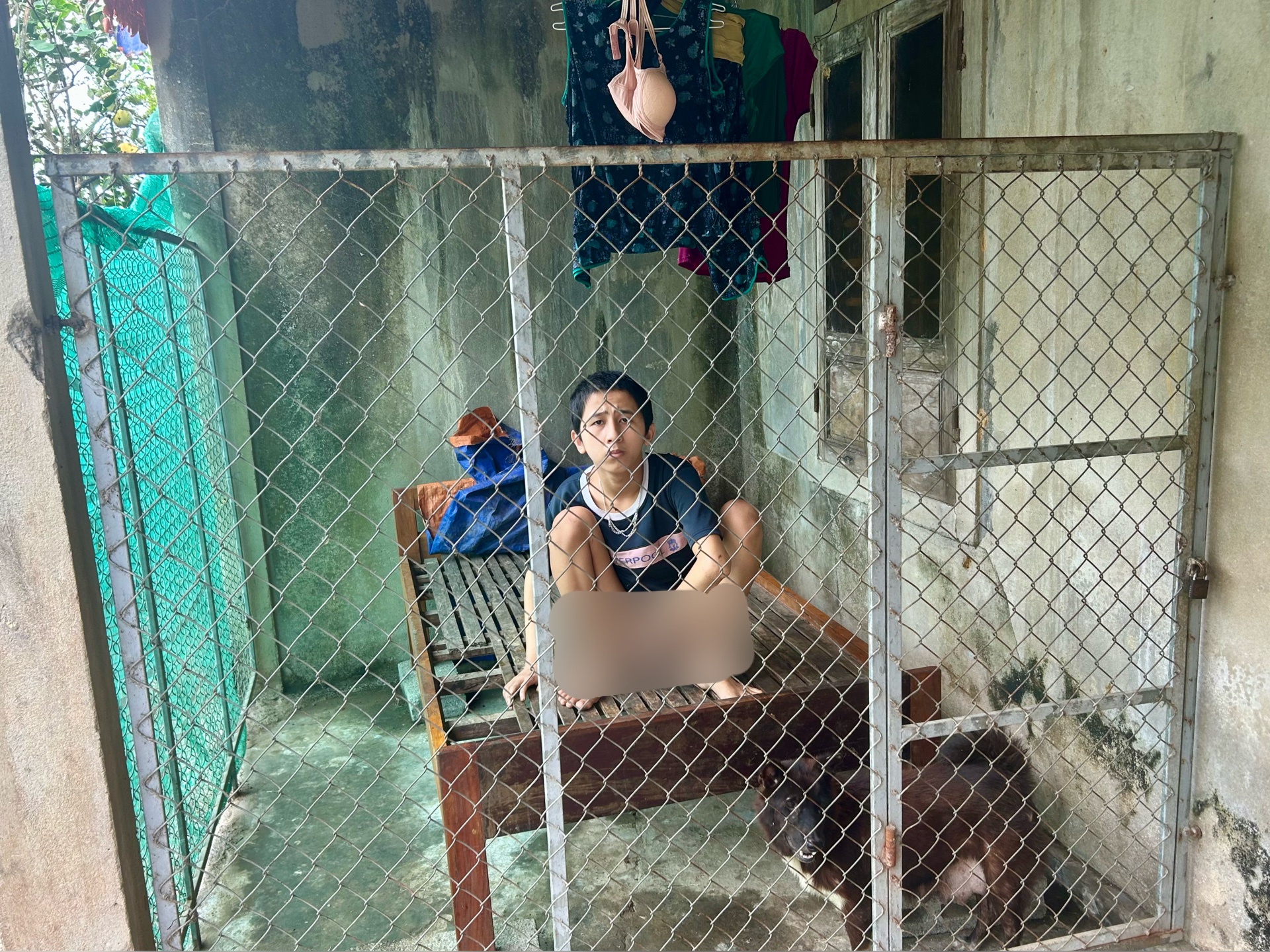
Hieu, 3rd Generation of Agent Orange victims.
Hieu has serious neurological and intellectual disabilities. He does not speak and cannot understand most of what is said to him. He needs help eating, washing and managing almost every part of daily life. He also experiences epileptic seizures and sometimes requires medication. He is completely dependent on his mother and grandmother.
As the grandchild of a person recognised as an Agent Orange victim, Hieu belongs to what is often described as the third generation of affected families. Yet he is not himself officially recognised by the government as an Agent Orange victim.
The distinction may appear administrative. Inside the house, it feels much less abstract. Whatever category appears on official documents, someone still has to feed him. Someone still has to wash him. Someone has to make sure he does not run into danger.
For now, those people are Mi and Thương.
Trying to reconstruct a family history marked by the loss of 4 children
Understanding how Agent Orange entered this family’s history was not straightforward. Mi’s memory has faded with age. Her late husband was a soldier during the war, but she remembers little about where he served or what he may have encountered. There was therefore no neat story of exposure that we could reconstruct.
Instead, we began drawing the family tree. Mi had five pregnancies.
- Her first daughter had a disability affecting her legs and died from a fever at the age of two.
- Her second child was born with disabilities affecting his arms and hands. He died at seven.
- Her third child did not have a disability but later died by suicide following family difficulties.
- Her fourth child is Thương who has an intellectual disability.
- Her fifth pregnancy ended in miscarriage.
As we slowly put these details together, Luu, AEPD’s outreach worker, Hien, who was translating, and I became quieter. Sometimes statistics are easier to absorb than a family tree. Five pregnancies, three children dead, one miscarriage and one surviving daughter with an intellectual disability are much harder to hold at a distance when the person telling you the story is sitting a metre away.
Thương’s story is a story of the enduring pain of Agent Orange.
The person holding everything together
Wanting to move away from the family’s losses for a moment, I asked Mi about her own health. She laughed slightly and said she is often unwell.
What illness? She did not really know. She rarely goes to hospital.
At first, I assumed the reason was simply money. The family has almost none. But as we continued talking, another reason became obvious. If Mi were admitted to hospital, who would look after Thương and Hieu? That question is at the centre of almost everything in this house.
Mi is 79 years old. Her back is severely hunched. Her mobility is limited. Her hearing is deteriorating. Yet she remains the person on whom two other members of the family depend.
Caregiving is often described as something one person provides to another. Here, it feels more like the structure holding the entire household together. And that structure is ageing.
Thương
At first, Thương appeared to follow our conversation easily. She spoke clearly, smiled often and answered questions herself.
Then, gradually, I noticed inconsistencies. She could not remember her own age. She struggled to recall basic details about her young daughter. At times, her attention disappeared suddenly. At others, she laughed unexpectedly, stroked one of the dogs beside her and said things that did not seem connected to the conversation.
Her mother explained that Thương has an intellectual disability. She never attended school and does not currently have paid work.
She told me that she likes cooking. That was easy to believe. While we spoke, she moved naturally around the house and seemed comfortable with familiar domestic tasks. She also clearly loved the dogs. Every time one came near, her expression changed.
But independence requires more than being able to cook or clean. Mi told us about one occasion when she gave Thương VND 300,000 to buy food. Thương left home with the money. She returned without the groceries. She had also lost the money. She simply could not remember what had happened.
Since then, mother and daughter have developed their own system. Thương drives the electric scooter. Mi rides with her and manages the shopping. It is a small arrangement, but I found it strangely moving. Neither woman can fully manage alone. Together, they find a way.
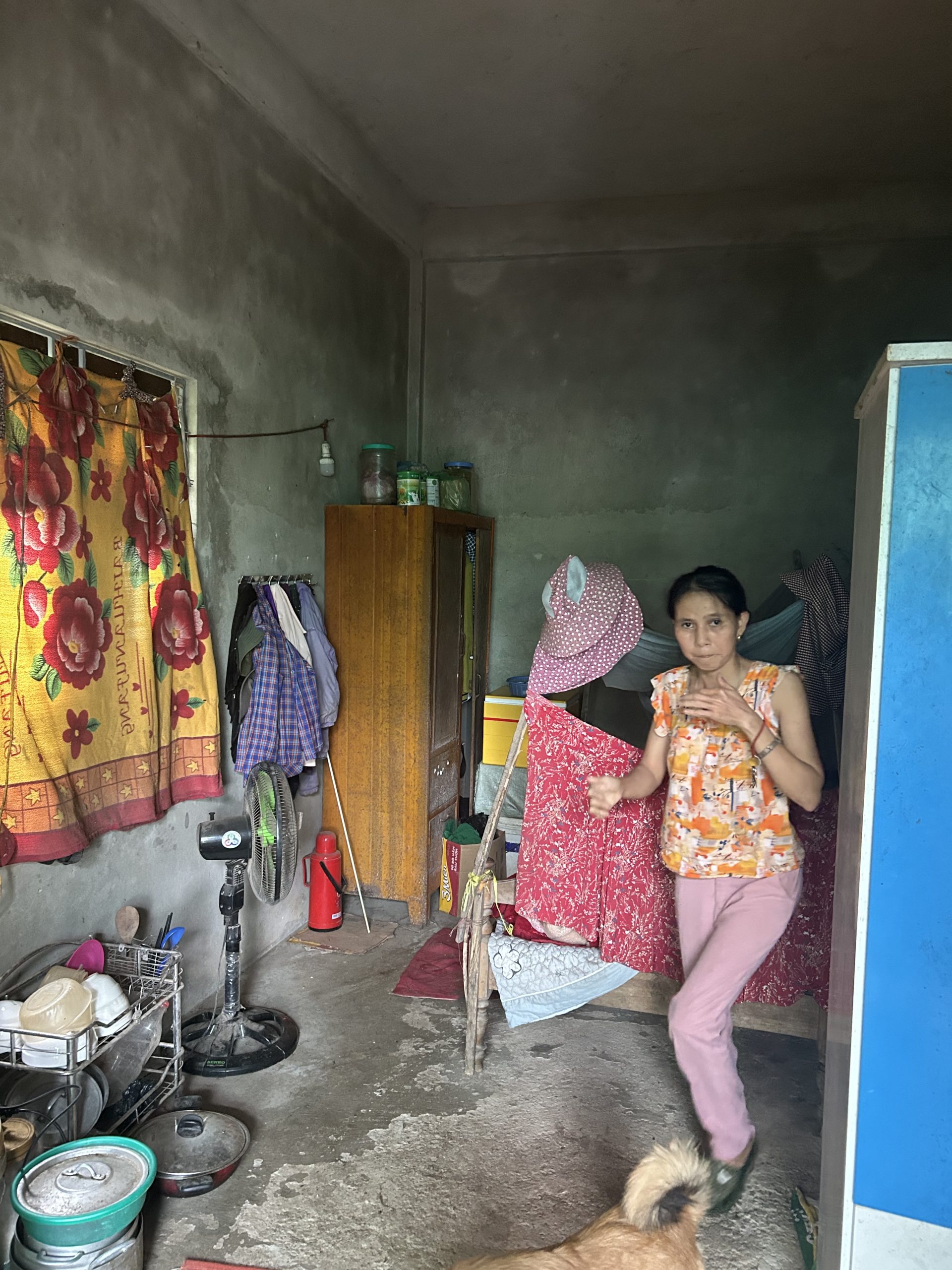
Thương, showing the only bedroom
About 134 dollars a month
No one in the household currently has paid employment. Their income comes almost entirely from government assistance. Together, the family receives around VND 3.5 million per month, which is approximately $134.
The money disappears quickly. Around VND 1 million goes towards kindergarten costs for Thương’s younger daughter. Food costs approximately VND 2.4 million. What remains must cover electricity.
There is no margin.
The family keeps several chickens and chicks, but these are primarily food for the household rather than an income-generating activity.
There are many ways of defining poverty. One of them is perhaps the absence of choices.
When almost every dong is already allocated before the month begins, a medical appointment becomes a financial decision. Repairing a roof becomes something that can wait. Connecting a house to clean water becomes an aspiration. And building a toilet becomes something a 79-year-old woman tries to do herself.
The toilet Mi is trying to build
When I asked Mi what she would change first if the family had enough money, I expected her to mention the roof. Instead, she spoke about water and sanitation. The household currently relies on well water because they cannot afford to connect to the local clean-water network. They also do not have an adequate toilet.
Then she told us what she had been doing. Outside the house, despite her age, her hunched back and her limited mobility, Mi had started trying to build one herself using nothing but a shovel and a small amount of cement.
There was something admirable about her determination, but admiration felt like the wrong response. A woman of 79 should not have to build basic sanitation infrastructure herself because her family cannot afford it.
If more support became available, the family would then like to repair the house. That need is equally visible. The structure is fragile, with cracks and leaks, and the improvised kitchen appears particularly vulnerable to the storms and heavy rains that affect this region.
Looking around the house, it was difficult to imagine how it would withstand a major storm.
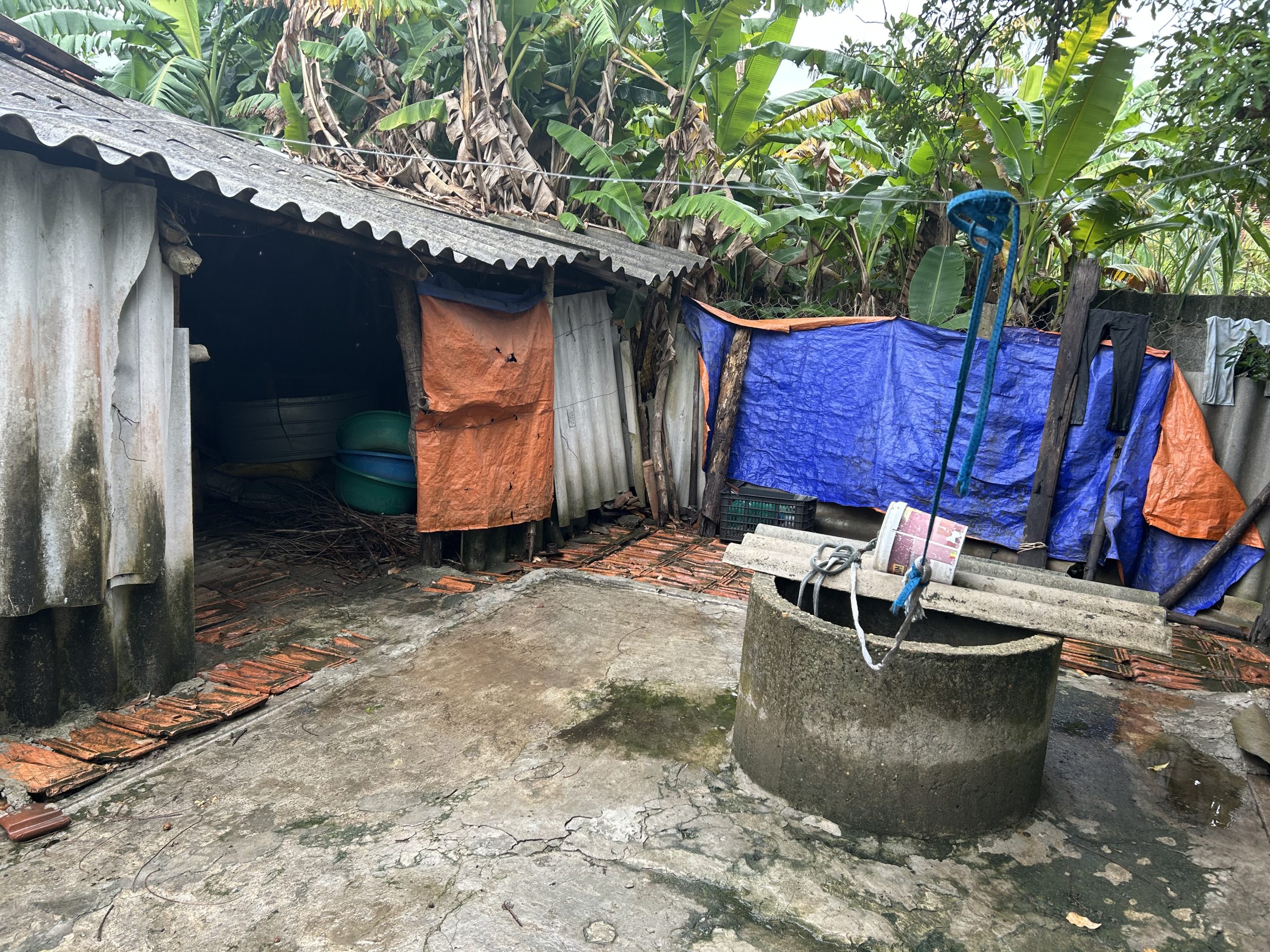
The well and the kitchen
The question Mi cannot answer
Towards the end of our conversation, we spoke about the future. That was when Mi’s worry became clearest. She knows she is getting older. She knows her health is weakening. And she knows Thuong and Hieu cannot live independently.
So what happens when she can no longer care for them? There is currently no obvious answer.
That uncertainty may be the heaviest burden in the house.
For decades, families affected by war, disability and poverty have found ways to adapt. They reorganise responsibilities. They share care. They survive on limited incomes. They develop small systems.
But adaptation has limits. Mi cannot simply decide not to age.
A family still waiting for support
For now, the family is still waiting for support.
AEPD’s assessment identified immediate needs that could make a concrete difference to daily life: access to safe water and sanitation, repairs to the most fragile parts of the house, and support that could reduce the family’s dependence on government assistance.
These are not separate problems. They are all part of the same question: how can this household become safer and more secure while Mi is still able to care for the people who depend on her?
- A safe toilet would mean less physical strain for Mi.
- A stronger house would mean less fear during storms.
- A more stable source of income would create choices where there are currently almost none.
And all of it would give the family a little more time and security to think about the question Mi cannot solve alone: what happens to Thương and Hieu in the future?
Mi has spent much of her life finding ways to care for the people around her. At 79, she should not have to do everything alone.
If you choose to support Mi, Thương and Hieu, your contribution can help AEPD turn this assessment into concrete assistance, and help this family move from simply coping each day toward greater safety, dignity and security.

from the left to the right: Lu’u (outreach worker at AEPD), Hung, Mi and Thương
Posted By Clothilde Soenen
Posted Sep 8th, 2026