

For organisations supporting persons with disabilities, identifying an appropriate form of assistance is only part of the challenge. Support must also respond to the reality of each family, be understood by the people concerned and remain sustainable after a project has formally ended.
At AEPD, outreach workers play a central role in this process. They work alongside the office staff, all as one team.
They connect the organisation with persons with disabilities and their families across local communities. Their work includes identifying needs, assessing possible forms of support, helping families develop plans, coordinating with service providers and following projects over time. Yet their importance cannot be understood only through a list of tasks. The strength of the model lies in who the outreach workers are and in the relationships they are able to build.

A peer-support model
AEPD’s outreach workers are themselves persons with disabilities. Their professional role is therefore closely connected to lived experience and trusted reputation.
Lưu became involved in supporting war victims after surviving a landmine accident as a child (right). He later joined AEPD as an outreach worker. Minh was previously an AEPD beneficiary before becoming part of the team (middle), while Nguyên first participated in a local youth club for persons with disabilities and completed training for field staff before being recruited (left).


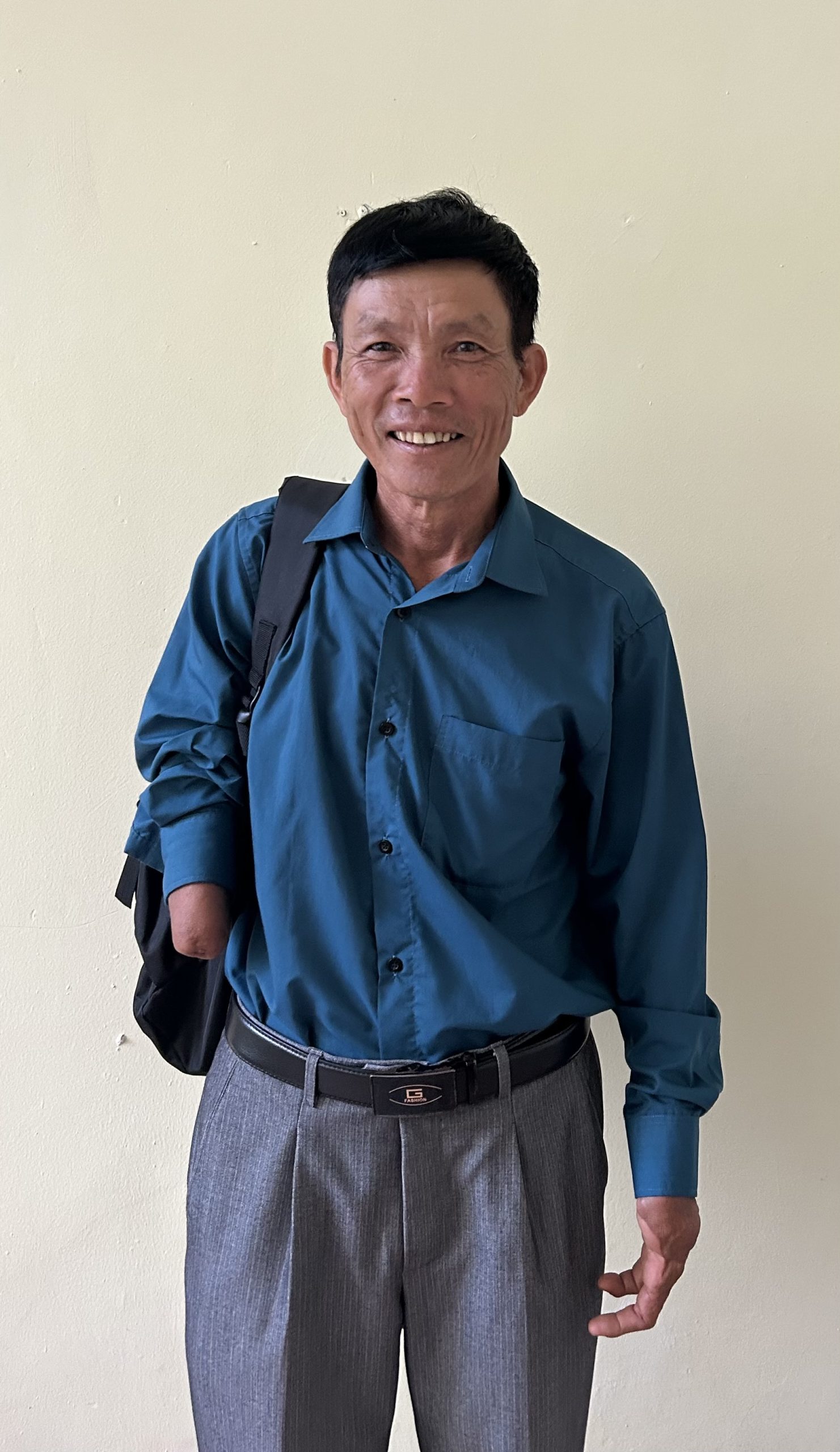
Their personal histories are not presented as substitutes for professional skills. Rather, they strengthen those skills.
Shared experience can reduce the distance that sometimes exists between an organisation and the people it seeks to support. Families may feel more comfortable discussing disability, poverty, dependence, frustration or uncertainty with someone who has also faced barriers related to mobility, access or social participation.
This is the principle of peer support. AEPD defines it as assistance provided by people who have faced similar difficulties and who can encourage others to develop greater confidence and autonomy. Its outreach workers are trained in areas such as active listening, emotional support, planning and the development of individual rehabilitation goals. When AEPD was first set up, the training of outreach workers was supervised by the Centre for International Stabilisation & Recovery (CISR) based at James Madison University in the US. AEPD now organises the training itself.
The result is not simply greater empathy. It can also improve the quality of the information on which support decisions are based.
Understanding the whole family situation
An initial assessment may concern a person with a disability, but outreach workers do not examine disability in isolation. They speak with different family members in order to understand the wider household situation. Depending on the circumstances, discussions may involve parents, caregivers, spouses or children. Where a person has difficulty communicating directly, caregivers may play a particularly important role.
Families are first encouraged to explain their own concerns. These may relate to health, rehabilitation, education, housing, vocational training or income. Outreach workers then help the family identify priorities and consider whether an available project responds to those priorities. This process is important because households rarely face only one difficulty. A family may want to raise animals or cultivate land while also facing mobility barriers, an unsafe home or limited access to services. These needs can compete with one another, and outside organisations may not always understand which issue the family considers most urgent.
AEPD’s approach is advisory rather than directive. Outreach workers explain possible forms of support, but the family remains responsible for its own choices. This reflects the organisation’s broader emphasis on empowerment: support is intended to strengthen decision-making of the families rather than replace it.
Trust as an operational resource
Trust is sometimes described as a positive but intangible feature of community work. In the outreach model, however, it has a practical function.
Accurate assessment depends on families being able to discuss sensitive matters. These may include financial insecurity, difficulties with caregiving, limited knowledge of disability, fear of losing public support or uncertainty about whether a proposed activity can succeed.
Some families may be shy or find it difficult to explain their situation. For example, it can sometimes take 40 trips back and forth just to gain a family’s trust and be able to talk to them. Others may not know the formal name of a disability or understand which services are available. Outreach workers therefore adapt their language, behaviour and communication to each household.
Their own experience can make this process less formal and less intimidating. Conversations may include personal experiences as well as practical questions. This does not remove professional boundaries, but it helps create a relationship in which families are treated as participants rather than passive recipients.
As one observation from the interview summarised it, the work involves providing support, but also becoming trusted companions to families.
From assessment to long-term follow-up
The outreach worker’s role does not end when assistance is approved. Depending on the project, the process may include:
- an initial needs assessment;
- preparation of a support plan with the family;
- identification and evaluation of suppliers;
- assistance with contracts;
- the handover of equipment, animals or other resources;
- regular monitoring;
- a final evaluation and adjustments where necessary.
- A single project may involve at least seven visits, with further follow-up depending on the activity.
In livestock projects, for example, visits may continue every few weeks or months. The outreach workers collectively follow several families each month while also travelling across project areas. This continuity matters.
A livelihood project is not successful merely because animals, equipment or initial funding have been delivered. Families may need further training, clarification, practical advice or changes to the original plan. Outreach workers check whether information has been understood and whether the support remains appropriate.
This approach is consistent with AEPD’s wider livelihood programmes, which combine vocational or business training with access to seed funding, services and local authorities. The stated objective is not short-term assistance alone, but sustainable income, confidence and greater community inclusion.
Visible examples of participation and independence
The outreach workers also represent what inclusion can look like in practice. Their disabilities continue to create challenges. Difficult roads, forest paths, motorcycle travel and the rainy season can make fieldwork more difficult. Yet they remain professional staff members responsible for assessment, planning, coordination and monitoring.
For families, this can have symbolic as well as practical importance.
The outreach workers are not presented as exceptional individuals who have “overcome” disability through determination alone. Their work instead demonstrates what can become possible when persons with disabilities receive training, employment opportunities and the means to participate in their communities.
AEPD describes its field workers as role models who have rebuilt their own lives and can support others in developing personal plans and greater autonomy. This is particularly important in a model based on empowerment. The outreach workers do not simply tell families that independence is possible. Their presence provides visible evidence that persons with disabilities can hold responsibility, make professional decisions and contribute to the development of others.
A model that requires investment
The peer-support model also has limits.
It is time-intensive. Repeated home visits, travel across rural areas and individual follow-up generate costs. Indeed, many families cannot easily reach centralised services because of their location in remote areas and poor conditions.
Its effectiveness also partially depends on close coordination with local authorities, clubs, suppliers and service providers because disability affects health, income, education, housing and social participation at the same time.
Administrative changes may make relationships with local institutions difficult to maintain. Some authorities give greater priority to disability issues than others, and cooperation may vary between communes. In addition, the number of families requiring support can exceed the number of suitable projects available.
These limitations do not weaken the value of the model. They show that meaningful participation cannot be delivered through a single visit or standardised package.
Why the model matters
The importance of AEPD’s outreach workers lies in the combination of professional responsibility and shared experience.
They help transform projects from predefined forms of assistance into individual processes developed with families. They connect local knowledge with organisational resources. They monitor whether support works in practice. Most importantly, they help create conditions in which persons with disabilities and their relatives can speak openly, establish priorities and retain control over decisions affecting their lives.
This makes outreach workers more than a bridge between AEPD and its beneficiaries. They are part of the intervention itself.
The model also demonstrates that persons with disabilities should not be viewed only as recipients of assistance. Their experience and community relationships can help identify families who might otherwise remain invisible, build trust and ensure that support responds to real priorities. By placing peer support at the centre of its work, AEPD turns participation and empowerment into a practical method of community-based support.
Posted By Clothilde Soenen
Posted Sep 6th, 2026