

My first week in Nepal has been a whirlwind of travel, gorgeous views, and new friends. The end of my twenty-two hour journey from D.C. was heralded by the rising sun, shimmering across the field of clouds outside my window seat. As we dove beneath the clouds, I was greeted by my home for the next few weeks. From above, the urban sprawl of Kathmandu, Baktapur, and Lalitpur fills every available pocket of the basin’s 665 square km with pastel reds, blues, and greens. The cities’ organic spread resolves in reaching tendrils, houses and apartments dot winding mountain passes that scale the rim of the valley.
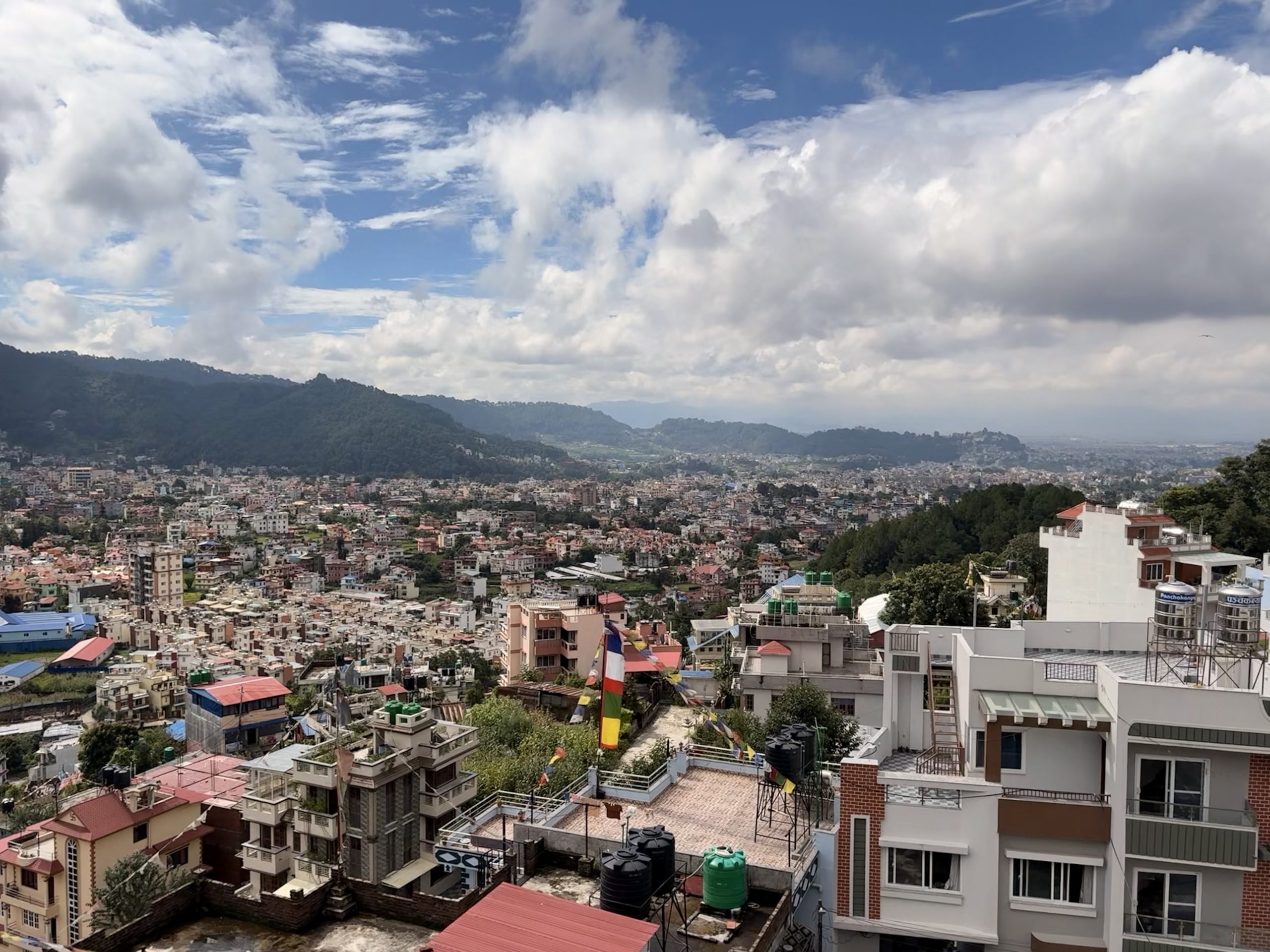
The view of Kathmandu from the rooftop of our homestay
Each morning, a tiny Suzuki clown car weaves through downtown Kathmandu traffic to bring Emma, Leo, and I from our homestay in suburban Budhanilkantha to the Center for Human Rights and Victims of Violations (CHRV). Led by our teacher, Dr. Ram Bhandari, the CHRV is devoted to the study, documentation, and advancement of Nepal’s survivor movements. Our first lesson, a broad background of Nepal’s history from 1950 onward, felt like drinking from a firehose.
Nepal has a long and complicated past of political repression and socioeconomic inequality, punctuated by periods of societal transformation and upheaval against monarchism, marginalization, exclusion, and corruption. Brought on by extended episodes of mass protest, Nepal weakened the role of its monarchy twice, becoming a constitutional monarchy or ‘democracy under the king’ from 1959-1960 and 1990-2005. In both cases, the ruling monarch dissolved parliament, ending these periods of (flawed) democracy in a return to stifling royal tyranny. Between 1996 and 2006, the country was racked with violence as the Communist Party of Nepal (Maoist) led a guerrilla uprising against the state, attacking police outposts, banks, government sites, and civilian targets. Both state counterinsurgents and Maoist rebels themselves were responsible for widespread and horrific human rights abuses, including over 1,300 enforced disappearances.
Tej Bahadur Bhandari, a beloved teacher, community leader, and Ram’s father, was disappeared by state forces in 2001. Over 25 years later and 20 years after the conclusion of the conflict and the dissolution of the monarchy, Ram is still in the dark. Ram and his family, like the vast majority of survivors and families of the disappeared, are still waiting for information about the fate of their loved ones and justice that the government has consistently failed to dispense. Like Ram, this injustice spurred other survivors and their families to demonstrate for transitional justice, resulting in a robust and diverse survivor movement that engages the government in court, in bureaucratic offices, and in street protests.
This Wednesday, we attended one such protest. Unprotected by the sunscreen I had left at home, I stood under a blistering sun that left me grotesquely scorched. In front of me, a group of activists wisely protested under a canopy of umbrellas. On this day, the protest centred another instance of betrayal by the government. Multiple Truth and Reconciliation Commissions have been established to investigate human rights abuses during the Civil War. In each installment, the Commissions were disbanded without resolving a single case. After Gen-Z-led anti-corruption protests set fire to government buildings and ousted disgraced prime minister Sharma Oli in the summer of 2025, a new government and parliament was formed, headed by former rapper and mayor of Kathmandu, Balendra Shah. The survivors’ movement saw this transformation as a window of opportunity, hoping that justice could be moved forward under a fresh government, unencumbered by corruption and historical complicity in the human rights violations of the civil war. Unfortunately, it seems that this is not the case. Balen and members of his government have repeatedly denied requests to meet with leaders of the survivors’ movement, and rumors abound that a recommendation committee is being assembled to form a new version of the Truth and Reconciliation Commission, without the representation of victims and survivors themselves.
I was struck by the selflessness of the protestors as they made their case. The speakers spent very little time discussing their own horrific experiences in the Civil War, their suffering was implicit. Instead, speaker after speaker denounced the betrayal of the government as a barrier to the collective, emphasizing the need for transitional justice processes to be completed properly and transparently for society to move forward.
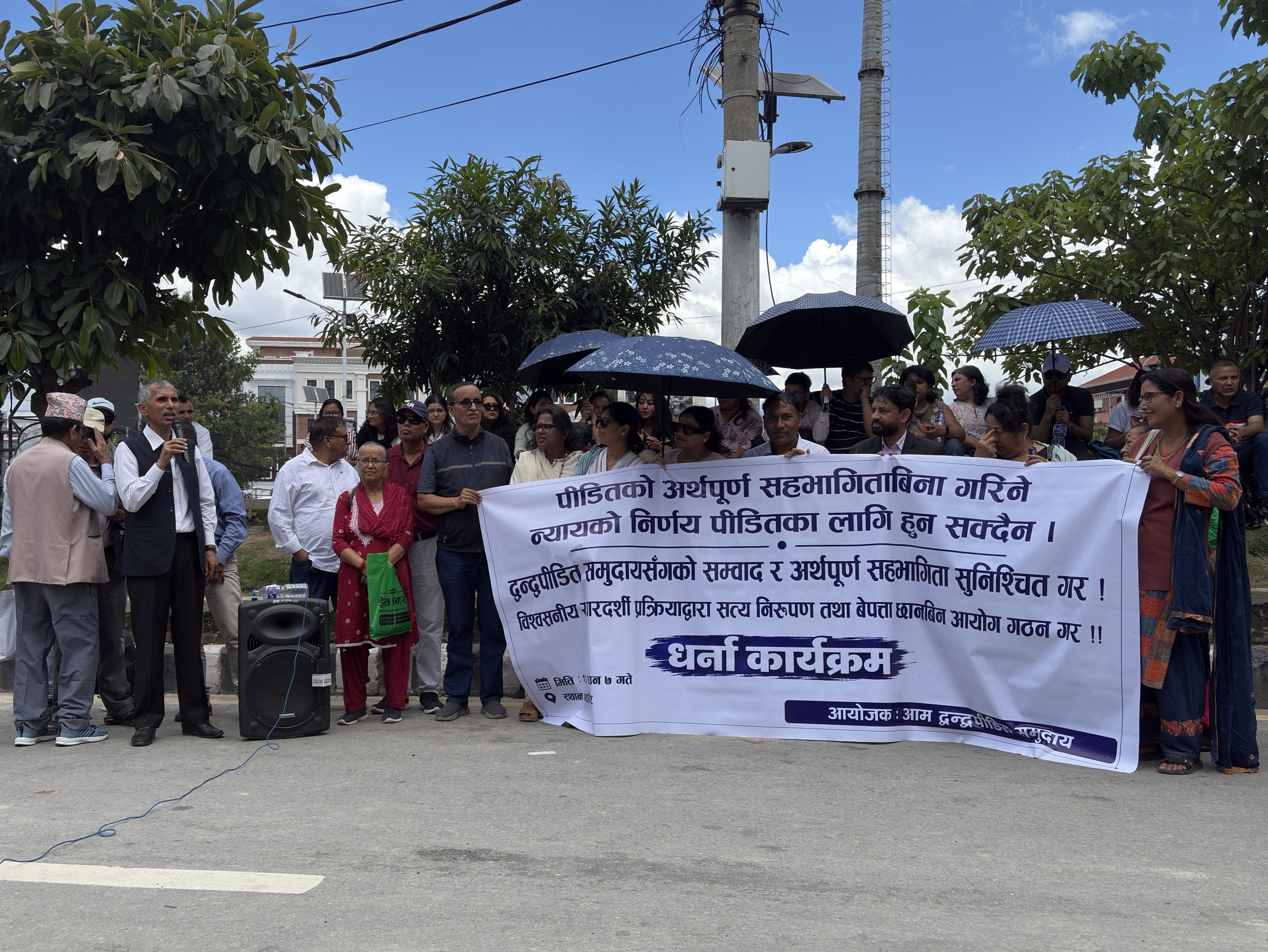
Survivors’ Movement Street Protest
That night, I rode home on my first motorbike taxi, one of the more terrifying experiences of the trip thus far. Ten minutes into our journey, it began to rain. Hard. Gritting my teeth and anchoring myself by gripping my cabbie’s waist (I was later informed that this was inappropriate and not the custom), I reflected on Nepal’s sprint from monarchy to democracy and back, its descent into civil war and its reemergence as a republic, the chaos of the 2015 earthquake and reconstruction, its youth movement that toppled the government, and the hope and disappointment swirling around its new administration. I wondered if Nepal would ever reach a standstill. In the midst of my dizzy contemplation, I heard my motorcycle driver shouting at me over the din of the pounding rain and repeated honking. He asked me if I had a rainjacket and pulled over to let me put it on.
After our stop, we struck up a conversation, only hearing each other’s every third word amid the noise of the road and the rushing wind. I told Ashok about the program I was involved in and about my impressions of the situation. I asked him about the Gen-Z protests and he shared his experience with me. A few of his friends were involved in the street protests and he knew of people who had been shot. He described the feeling of optimism and renewal his colleagues had felt when Oli was removed, and the growing disappointment they harbored as the new government revealed its flaws. He told me the Gen-Z movement increasingly disavowed the new government, and the hope for a meaningful change was waning. He also told me that he is studying to improve his skills as a graphic designer, working as a mototaxi driver by night as a side hustle. As he dropped me off, I thanked him for the ride and the conversation, wishing him good luck with his graphic design career.
For better or worse, it appears that Nepal is never at a standstill, remaining constantly in motion. Where repression and turmoil is present, the spectre of political uprising bubbles beneath the surface. Until justice and truth is achieved, the survivor’s movement will remain vigilant. Regardless of the hardships and disappointments endured, Nepalis continue to work towards a better situation.
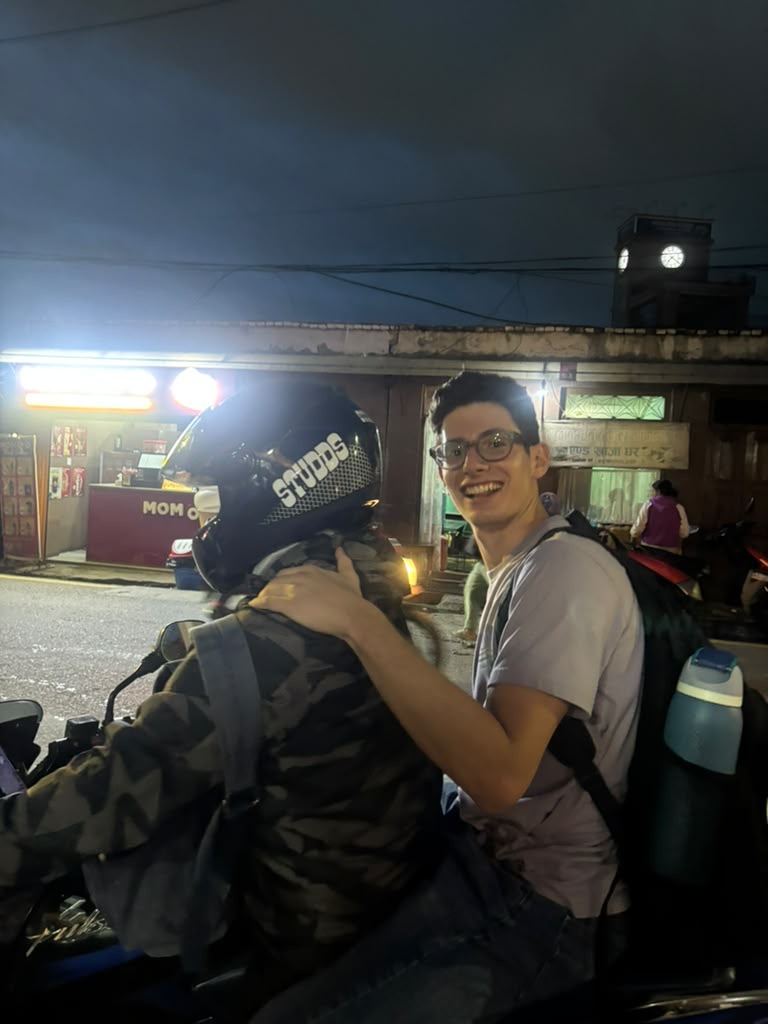
Ashok and I before we hit it off in the rain
Posted By Joe Finkelstein
Posted Jul 26th, 2026
4 Comments
Leo Horton
July 26, 2026
Amazing blog bro! I have also experienced many young people who feel disillusioned by Balen’s government. It is sad to see, but hopefully this growing public want for accountability will push politics in the right direction.
PS. Keep applying that aloe. Our pain is only temporary 🙂
Iain Guest
July 26, 2026
Joe, this is a fantastic first blog. You’ve really nailed the history and you “get” the first and most important feature of the survivor movement – people like Ram are motivated and will NOT give up. However, it’s incredibly disappointing to hear that the new government may not consult with survivors in nominating commissioners. I find this difficult to comprehend. Anyway, you will keep us in the loop. You’ve set the bar high with this first blog and I’m hoping you can use your remaining blogs to dig deep and explore some new approaches, as well as critique the course! Photos are good, but PLEASE wear a helmet when traveling on any kind of motorbike! Oh, and one editing suggestion – make your paragraphs a bit shorter. Definitely one of the best opening blogs I have read in a long time. Well done Joe!
Aayushma Rai
July 27, 2026
Such an awesome read, Joe! I loved your observation on how speakers chose to emphasize the government’s betrayal rather than their individual experiences. This makes me wonder about the reasoning behind this choice (Ram sir has mentioned that there are many familiar faces at these protests). I also loved hearing about your interaction with Ashok. You are inspiring me to initiate more meaningful and intentional conversations during my ordinary exchanges! Can’t wait to read your next blog post :))
Chhime Sherpa
August 2, 2026
you are right Joe. Change is the only constant… though in Nepal from time to time we get whiplash