

“Do not forget us”: two sisters living with the legacy of Agent Orange

Bong and Huyen, two sisters part of the second generation of Agent Orange’s victims.
I thought my first real conversation with Bong and Huyen would take place around a table, probably with a translator sitting between us and a list of carefully prepared questions in my notebook. Instead, it began at the market.
A few minutes earlier, when we arrived at their family home, three women had been sitting in a circle peeling lotus seeds. Two children were playing behind them. As soon as they noticed us, everyone stood up. Chairs appeared, then glasses of water, homemade tea prepared with dried lotus shoots and fruit from the garden. I was meant to be the visitor, but within a few seconds, they had made me feel as though they were the ones responsible for taking care of me.
The mother of the family, Chuong, was missing. She had been taken to hospital the previous night, and her husband, Ban, was still with her. The atmosphere could therefore have been tense or uncomfortable. Yet the family welcomed us with an ease that made it difficult to remain formal for very long.
Because the local market was about to close, we went together to buy vegetables, shrimp, meat and a watermelon for lunch.
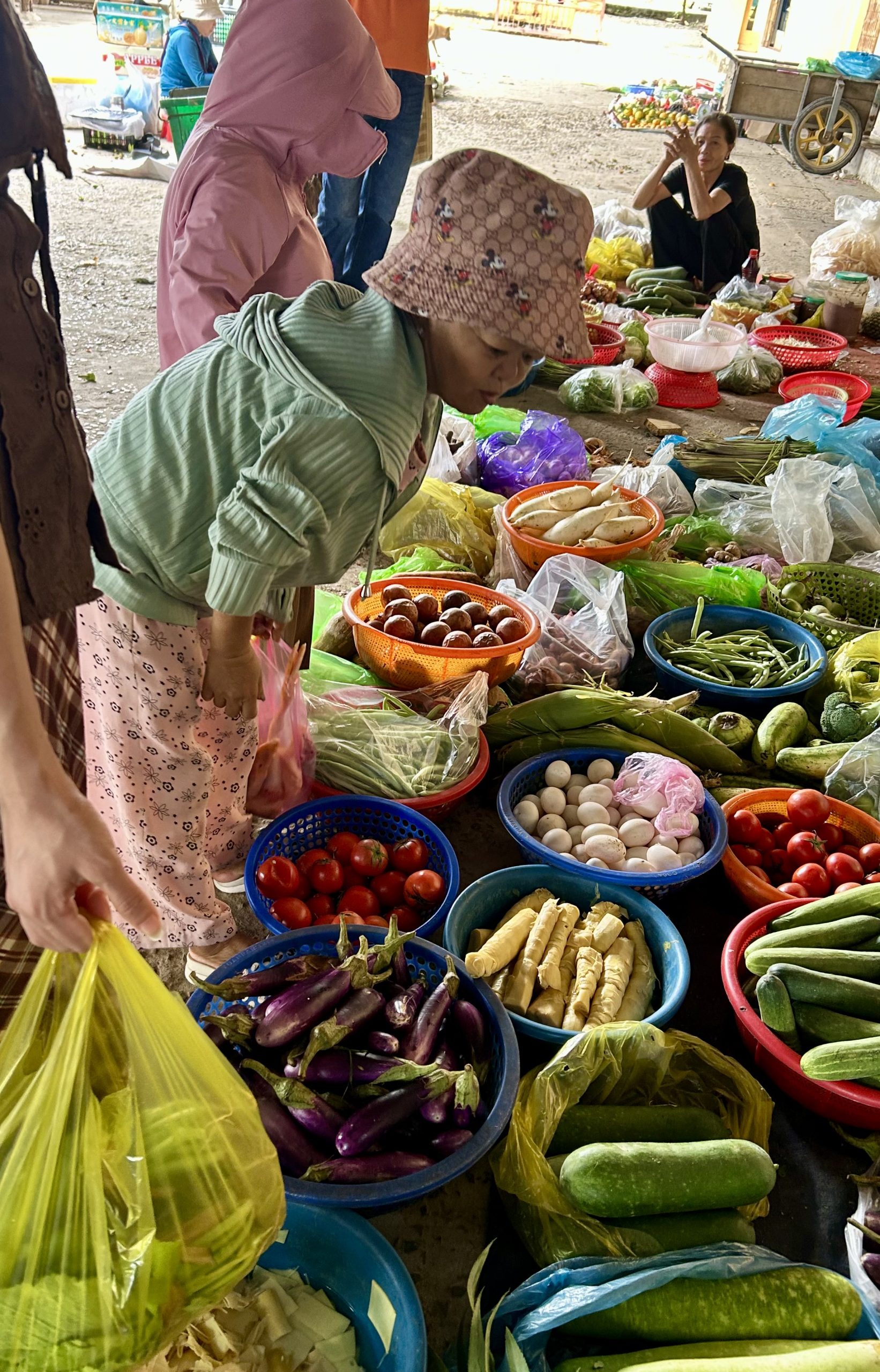
Bong choosing the vegetables for the lunch at the market of the village.
At first, I began asking Bong and Huyen about their daily routine. Their typical day begins at five in the morning. They prepare food for the pigs, peel lotus seeds, cook, collect vegetables and then return to the seeds. In the evening, Bong helps her daughter with her homework, while Huyen relaxes a bit. Bong told me that she loves cooking. Huyen smiled when she spoke about playing with her niece.
They were simple questions, but they worked. On the way back from the market, both sisters were speaking more freely. I had the feeling that walking between vegetable stalls and choosing lunch together had done more to build trust than any formal interview could have done.
I did not yet know that, a few hours later, we would speak about war, the death of a child, disability, school, poverty and the fear of what will happen when their parents are no longer there. For the moment, we were carrying the groceries home.
Perhaps that is the difficulty of understanding Agent Orange from a distance. It is often presented through dates, military operations, scientific studies and legal disputes. Inside one family home in Quang Binh, however, its legacy is found in much more ordinary things: work beginning before sunrise, a child who could not safely travel to school, parents who spent decades caring for their children, and a fragile roof that everyone worries about when the rain begins.
A conversation that changed the atmosphere
When we returned, the father, Ban, had come back from the hospital. While Bong and her sister Hao began preparing lunch, we sat with him and spoke about Chuong, his wife.
In 1971, she served in a volunteer force during the war. Her work involved transporting food, supplies and sometimes injured soldiers. On one occasion, she hid in a forest with her group to avoid the US forces. According to the family, Agent Orange had been sprayed over the area. At the time, Chuong did not see anything falling from the sky.
She and the others did not even know what Agent Orange was. That detail stayed with me. Exposure is easy to imagine when it is immediate and visible. It is much harder to understand when it happens through air, soil, water, food or animals, and when the consequences may only appear years later. This mainly concerns specific areas and the government is trying to clean them.
Over time, Chuong developed several health problems, including osteoarthritis, low blood pressure, stomach problems and a thyroid nodule. During a government campaign to identify people affected by Agent Orange in 2005, she and two of her daughters, Bong and Huyen, were examined and officially recognised as victims.
Then Ban began speaking about their first child. He died at the age of nine after serious neurological and developmental problems. The conversation had already become emotional, but at that moment the eldest daughter named Bich, who had been listening quietly from a distance, came closer and sat with us. She had tears in her eyes.
The family understands disabilities and recurring health problems of their children as part of the intergenerational legacy of Chuong’s exposure to Agent Orange. Bong and Huyen are now 48 and 34, but both have growth disabilities that give them a much younger physical appearance and contribute to pain and mobility difficulties. Two other sisters, Bich and Hwo, also suffer from physical weakness or pain, although no official causal link with Agent Orange has been established.
I had prepared questions about Agent Orange. What I had not prepared for was the way one question could suddenly open an entire family history.
The work behind survival
Ban spent much of his life working away from home in construction. Sometimes, he wanted to quit and return to help Chuong with the five children. She always persuaded him to continue because the family needed the income. He smiled when he remembered those conversations.
Then his expression changed again. At work, he received rice for lunch. Instead of eating all of it, he saved part of it until the end of the month so that he could bring it home to his children. At one point, he even left Vietnam for two years to work in Iraq.
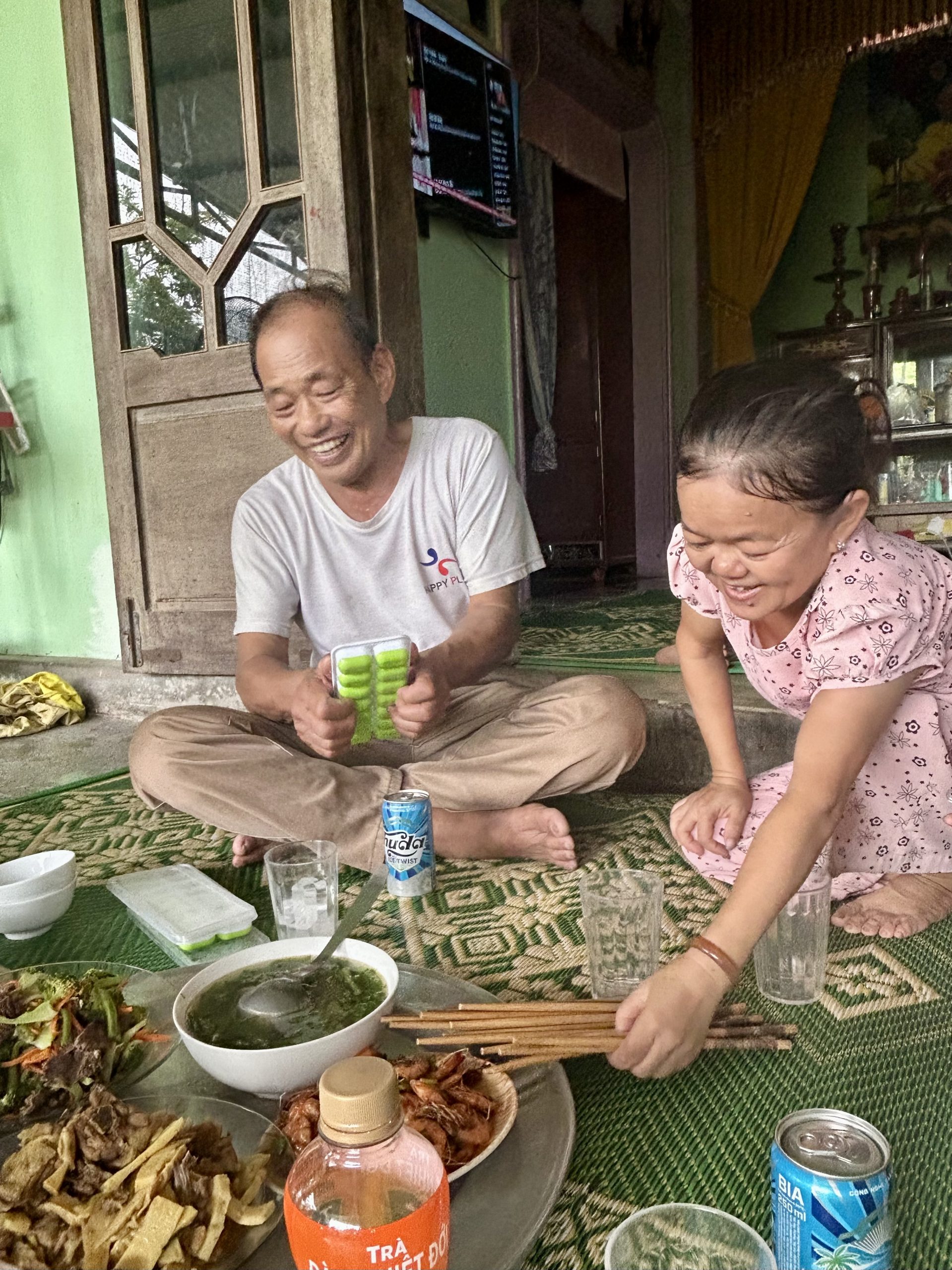
Ban (the father) and Bong
Meanwhile, Chuong managed almost everything at home: the children, the cooking, the cleaning, the farming and her own health problems. Her eldest daughter Bich explained that she had already begun helping in the fields at the age of three. Sometimes, the family had to share one sweet potato as a meal.
Agent Orange remains present in the daily labour created by its consequences. There is visible work: cooking, washing, farming and earning money. Then there is less visible work: helping someone move, accompanying relatives to medical appointments, managing pain, worrying about the next flood and wondering who will provide care in the future. For this family, caregiving has not been a temporary response. It has shaped several decades of their lives.
Huyen’s own version of the story
Later, Huyen, the youngest of the six children, joined us. Her father began explaining that she had stopped attending school because other children mocked her appearance. Huyen immediately disagreed.
Not completely, but enough to make it clear that she wanted to tell the story in her own way. She had been mocked because of her height and her childlike appearance. She remembered feeling ashamed and insecure. But she also remembered a close friend and a teacher who tried to help her.
The main problem, she said, was practical. She travelled to school by bicycle, but because of her physical condition, she often fell. She had no adapted chair and no specific educational support. Eventually, continuing became too dangerous. She stopped attending school at the age of six.
During the day, while her mother and sisters worked in the fields, she was often alone. She learned to read and write at home, sometimes by herself and sometimes with help from her sisters.
This is where the language of human rights becomes very concrete. The right to education does not mean only being allowed to enter a classroom. It also requires the conditions that make attendance possible: safe transport, adapted equipment and appropriate support. Huyen was not excluded by one formal decision. She was excluded by the accumulation of things that were missing.
Two dollars a day and three pigs
After the conversation became especially heavy, it felt right to move back towards the present. Bong and Huyen have peeled lotus seeds for a neighbour since 2021. Together, they can prepare around 1.5 kilograms per day and earn approximately two dollars.
Watching them work was impressive. Their hands moved so quickly that each seed seemed to be finished almost before I had understood the gesture. The work is repetitive and seasonal, but it is one of the few activities adapted to their physical abilities.

Huyen peeling lotus seeds.
This year, after AEPD assessed the family’s needs, support from the Advocacy Project helped them begin raising pigs. They received training, built a shelter and acquired three pigs.
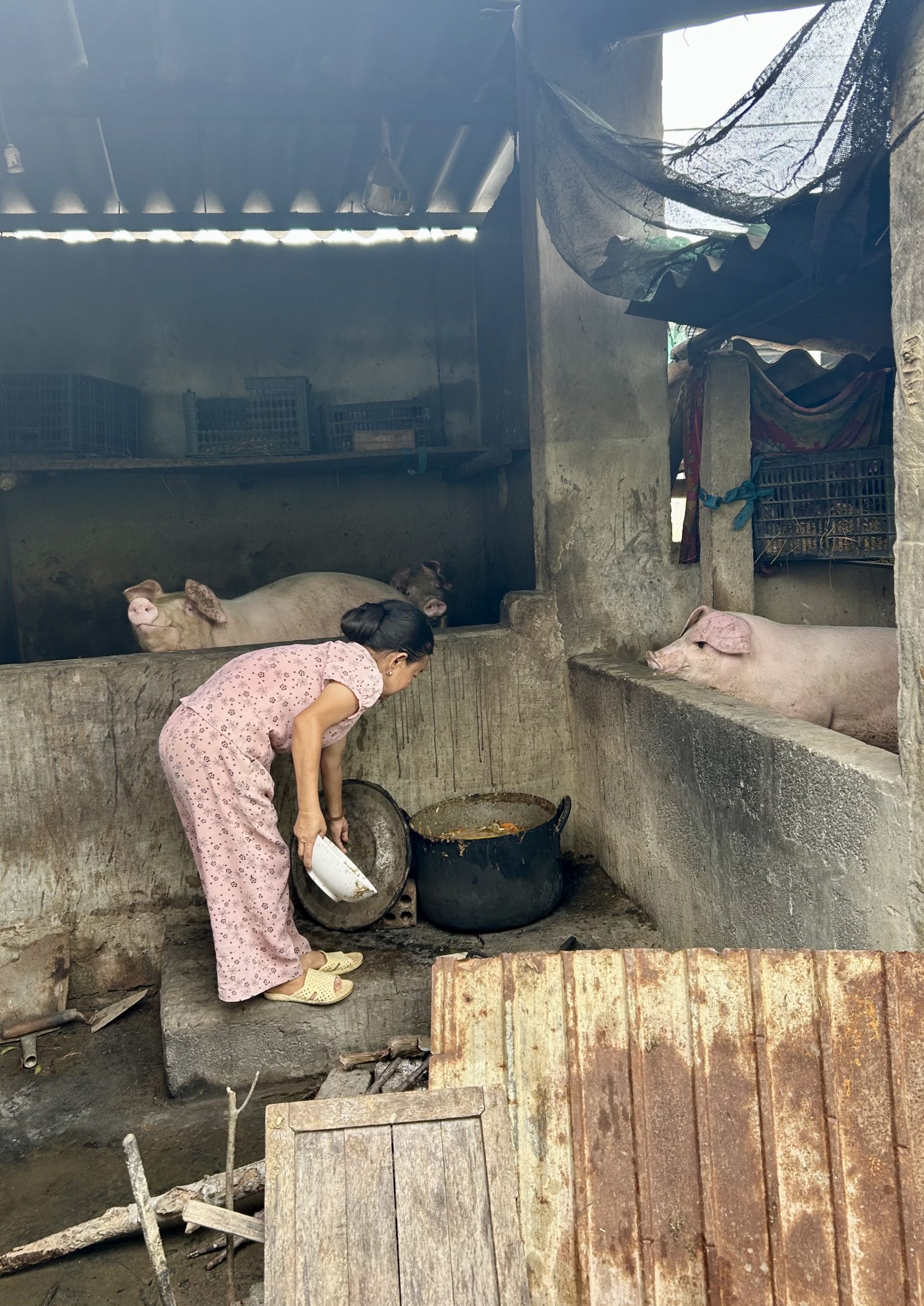
Bong feeding the pigs.
After lunch, Bong took us to collect wild water spinach for the pigs. She stepped into the pond, held onto vines and cut the plants with a small machete. She now takes primary responsibility for feeding the animals and cleaning their shelter.
She hopes to sell the pigs once they are large enough. The money would first support daily expenses and her daughter’s education since she is a single mom. If anything remains after the flooding season, the family may buy more pigs.
Bong was careful not to describe the project as a miracle solution. It is her first time raising pigs, and her health may make the work harder over time. Still, it gives her the possibility to earn, plan and make decisions.
The roof everyone thinks about
When I asked Huyen about her hopes for the future, I expected her to speak about work or health. Her first answer was the house. The house was built in 1994 and has become increasingly fragile. Part of the roof once collapsed while the family was sleeping. Although it was repaired, the house still leaks during Quang Binh’s rainy season, when strong winds and flooding affect the region. The family sometimes climbs onto the roof when water begins to enter.
Everyone agreed that repairing the house is the most urgent need. The answer said a lot about the way insecurity works. It is difficult to think about independence, education or long-term plans when the first concern is whether the house will survive the next storm.
“Do not forget us”
Before leaving, I asked whether there was one message they wanted me to share. Bich, the eldest sister, answered first. She hoped that victims of Agent Orange would receive greater recognition and stronger legal protection.
Bong agreed. She said she hoped they would not be forgotten.
At that moment, Huyen was quietly packing fruit from the garden for us. It felt almost strange. They had welcomed us, fed us, answered difficult questions and shared memories that were clearly painful. Yet she was the one preparing a gift. I hugged her before leaving.
The consequences of war do not end when the fighting stops. They continue through bodies, family responsibilities, missed years of education, unsafe homes and fears passed from parents to children.
For this family, Agent Orange is not only part of the past. It is present in the work that begins every morning, in the care they continue to provide, in the house they hope to repair and in one simple request: do not forget us.

Clothilde Soenen
Posted By Clothilde Soenen
Posted Aug 5th, 2026