

Thakurbaba Municipality, Bardiya District
Laxmi Chaudhary rocks her three-month old son against her chest with gentle hands. Every now and again, she caresses his baby feet, tugging lightly on his tiny toes, as if to make sure they’re still there.
Sarita Thapa sits beside Laxmi on a bench. She’s slight, with narrow facial features and a delicately sloped nose. She leans forward, shoulders curled outwards. Her feet rest underneath the bench, positioned behind her. In this way, she is almost birdlike; her body is preparing to take flight.
It’s a particularly sweaty day in Bardiya. Our team has come to Thakurbaba Municipality’s psychosocial counseling center to gain some insight into the mental health needs of conflict affected persons in the area. Laxmi and Sarita, both counselors at the center, agreed to meet with us for an interview, despite the heavy heat. I open my notebook and uncap my pink gel pen, ready to listen.
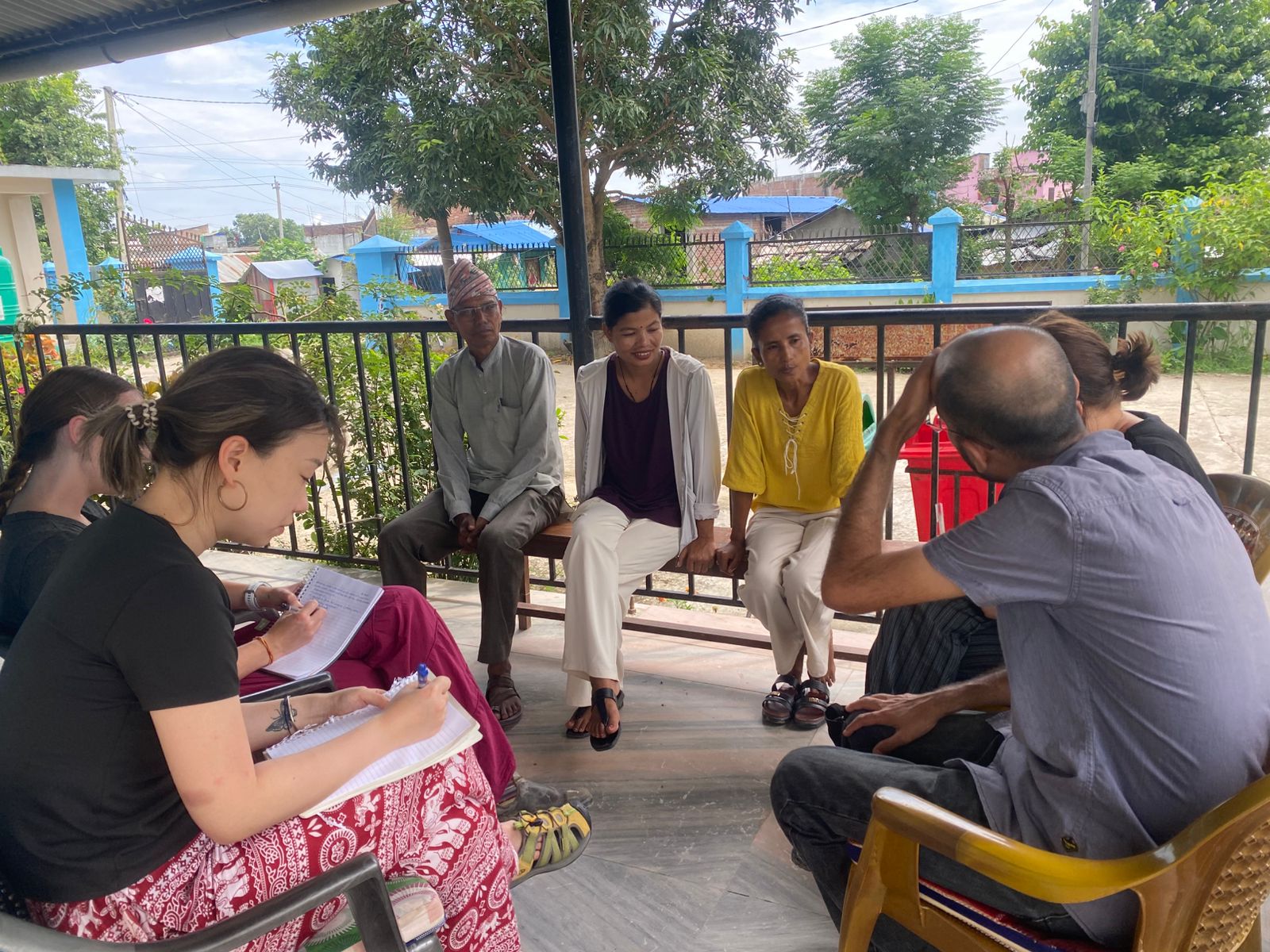
Our team meeting with (from left to right) Dhaniram Tharu, Laxmi Chaudhary, and Sarita Thapa
—
Some (albeit lengthy) context is necessary here. Thakurbaba was one of the most acutely affected regions during the People’s War; fifty-two people were disappeared from the municipality, the second highest concentration of disappearances in the country. Countless others endured torture and sexual violence from state forces. This is no coincidence—58.6% percent of people in the municipality identify as Tharu, an indigenous group to Nepal’s western Terai region. Again, this is not unprecedented. Tharu people have endured a long history of state suppression; in the 1960s, following a US backed Malaria eradication program in the Terai, many Tharu families were violently forced from their land so non-Tharu migrants from the hills could settle there. Newly landless, Tharu people were forced into bonded labor agreements (Kumaiya) with higher-caste feudal landlords in order to receive some food and shelter. Decades of this state-sponsored disenfranchisement imposed poverty, undereducation, and material dispossession onto Tharu people.
Nepal’s new 1990 constitution affirmed the right to equal protection under law of all people—religion, race, caste, and sex irrespective—in a complete reversal of the 1854 muluki ain state code, which legitimized caste discrimination at all levels of Nepali society. For the most part though, these constitutional principles were materially significant in name only. As scholar Arjun Guneratne puts it, “one cannot treat as equal people who are not in fact equal.” It takes a lot more to abolish structural inequality than abstract legal principle; each component part of material subjugation must be disassembled (particularly agrarian landholding relations) and reconstrued equitably, a task the Nepali state has yet to comprehensively attempt.
In 1996, the Communist Party of Nepal (CPN-M) presented their 40 point demands to the Nepali federal government endorsing a “new socio-economic system and state” opposed to class, caste, and gender exploitation. CPN-M communicated that, if the demands remained unaddressed, revolutionary war would be waged in Nepal. The meat of these demands (anti-capitalism, anti-racism, social justice, state reform) appealed to massive amounts of Nepalis, Tharu people among them, whose livelihoods were being appropriated by class and caste elites for financial gain and hierarchical reification.
Indeed, many Tharus fought on behalf of the Maoists during the People’s War. Others did not, and were involved solely in ongoing Tharu land and civil rights movements. Still others engaged in both. Either way, the Maoist and Tharu rights movements became blurred to state security forces and landowning castes that dominated state institutions. Any Tharu advocating for human rights, access to education, what have you, was then at risk for being labelled a Maoist insurgent or “terrorist.” They were made targets. The human cost of such an association was catastrophic, and disproportionately ruinous to Tharu communities in the western Tarai. UN-OHCHR estimates identify 85% of those disappeared over the war as Tharu; in Bardiya District only, 1,200 Tharu lost their lives to the conflict. This amounts to around 10% of conflict fatalities, a gross overrepresentation for an ethnic group that numbers only 6.2% of Nepal’s total population.
In the wake of the conflict, despite a new constitution and multiple attempts at truth commissions, all 58,052 officially registered cases of extrajudicial killings, torture, rape, enforced disappearance, and displacement remain unresolved. The social transformation fought for by Maoist cadres has yet to be realized, especially for those already suffering against structural violence. Their communities will never wholly recover from the rampant brutality of the conflict.
Our team wants to know what is being done to staunch these wounds, especially at the local level. What do communities most affected by conflict brutality need to heal? How are people at the grassroots organizing to fill those gaps left by the government? Who is doing this work? What do they need?
—
We sit on the center’s covered porch. Toddlers flit in and out of the center’s front door, shrieking with giggles as their mothers attempt to shepherd them back inside. Ostensibly, Take Your Kid to Work day is convention here. Dhaniram Tharu, another counselor and former BASE-Nepal program coordinator, joins Sarita and Laxmi on the porch now. His face is wrought and serious, but softens at the sight of the children’s mischief. He wiggles his hand at them in acknowledgement. I see you.
Dhaniram tells us that the counseling center was established as a partnership between Thakurbaba Municipality and the NGO Center for Mental Health and Counseling, Nepal (CMC-Nepal). Previously, its services were only available to conflict victims, but it has since expanded to anyone in the municipality who needs care. Doctors are available to consult with and prescribe medication to those with mental health conditions. Otherwise, it’s counselors like Sarita and Laxmi who go door-to-door visiting with conflict victims and listening to their stories.
Due to civil society group lobbying from organizations like Bhagiram Chaudhary’s Conflict Victims Committee (CVC), the municipality has allotted enough funds to the center for all counseling to be free of charge. Sarita says that they’ve been able to provide care to 65 conflict victim families, who bear impossibly heavy burdens. Disappeared husbands, children, sexual violence. Social stigma is particularly weighty for women with disappeared husbands, especially around festival times. Daily family economics are another challenge. A free health facility like the counseling center is not yet commonplace for conflict victims, something that Sarita, Dhaniram, and Laxmi all agree must change.
Dhaniram was abducted by state security forces in 2001 for his Tharu land rights work with BASE-Nepal. While detained, he was tortured so brutally that he developed a severe heart condition and needed immediate heart surgery upon his release.
“I still have to take heart medication because of the torture,” he relays. “I must pay for it myself.”
Dhaniram’s monthly blood tests, medication, and annual trips to Kathmandu for checkups aren’t cheap. In Bardiya, he says his meds run him about 70 to 80 USD. In Kathmandu, that skyrockets to 500 USD.
Shuyuan asks him if he ever received funds from the federal government to cover his health and health-related travel expenses.
He shrugs.
“Because of the 2008 Supreme Court writ judgement allotting reimbursement funds to conflict victims, I was entitled to 8,000 USD. I didn’t get all of it though, because I burned my medical records to prevent the state detaining me again.”
The burning of medical documents was common practice among some conflict victims who endured state violence. Suffering health conditions without federal assistance meant anonymity, a status preferable to further torture.
Dhaniram received around 3,000 USD from the federal government for his heart problems, and 250 USD in compensation for detention.
At this point in the interview, he rises; there is work to attend to. Sarita, Laxmi, and Laxmi’s baby remain. The baby sleeps, soundly.
“Do you have any suggestions for a name? We haven’t decided yet,” asks Laxmi with a bright smile. Her front teeth are gapped. She rocks her son.
In 2002, Laxmi’s brother, Shiriram Tharu, was abducted and killed by Maoist soldiers. He was only 22 years old, a day laborer in a different district. The soldiers claimed to need his help with something late in the night. In the morning, neighbors found his body in pieces. Shiriram left two young children behind him. Laxmi, as the only daughter in the family, helped raise them. She herself was only six years old.
“Only four of my six brothers are still alive, and my mother already has passed away,” she says later, matter of factly. “Justice must be given now to victims of such conflict violence, while they are still here.”
Laxmi has worked with the counseling center for the past two and a half years; she says it brings her great happiness to console conflict victims when they are distressed.
Shuyuan turns to Sarita now, and asks her what she thinks the community needs.
Without hesitation, Sarita speaks. “People in this community need the right to live.”
Her words hit my heart.
She continues, detailing the necessity of economic reparations for conflict affected families (“You can’t fight legal battles with the state on an empty stomach”), free health facilities, job quotas, and, most significantly, the swift delivery of truth to victim families.
“Families are getting very old and may die before they see justice, when it’s their right to receive justice before they pass,” Sarita insists. “You can’t take away the pain of my mother’s generation. Justice wouldn’t mean as much for me as it would for my mother.”
Sarita’s father was disappeared by state forces in 1999. He wasn’t involved with the CPN-M, but with a different communist party. For all intents and purposes though, he was a “simple farmer.” One day, he set out to check on his farmland near the river, which had flooded. He never returned.
“We would have looked for him immediately, had my mother not been detained for ten days,” Sarita recollects. “She was terribly tortured. Her feet were electrocuted.”
At the time, Sarita was 14 years old, the middle child. Her youngest brother was three. She and her siblings begged community members to help them look for their parents, but were consistently turned away. Neighbors blamed the children for their father’s apparent Maoist affiliation; to assist them would be to risk harm upon their own families.
“They didn’t let us into their homes,” Sarita says.
She bristles, then moves on. “Our education was ruined. I was only able to finish my secondary education in 2006, after the war. I was very motivated to study, though. I missed first division marks by one point!” She raises a single finger in emphasis, smiling widely now at the memory of her prowess.
Sarita Thapa is a well-known name in Bardiya, and beyond. After completing her schooling, she dedicated her career to conflict activism: the CVC, the Tharu Women’s Upliftment Center, the NGO Story Kitchen. She represented conflict victim interests at her Village Development Council, juggling the needs of five separate municipalities at a time, sometimes for 12 hour shifts. For the past five years, she’s been counseling conflict victims from across Thakurbaba, all the while remaining a prominent face in the survivor’s movement.
Sarita’s drive is simple: to act as a safe space for other conflict affected persons to share their stories. “So many people have no one,” she reflects. “Before counseling, people felt purposeless and insignificant. Now, they want to live.”
Sarita shifts her weight on the bench. She tilts her head towards me, purses her lips.
This bird of a woman. She hasn’t mentioned her own pain once.
“I am so proud to be able to listen to them,” she says.
She looks it.
Dhaniram returns to the porch, a fistful of forms in hand. Administrative stuff, by the looks of it. Sarita accepts the papers from him; she snaps pictures of them, scribbles in the margins. Clearly, they have work to get to.
Our team begins to rise, closing notebooks and packing up bags. Laxmi interrupts us.
“Thank you for speaking with us,” she says warmly. “You are all so pretty, and your tone has been very pleasant.”
Us girls giggle, and I blush.
“No no, thank you for taking the time to share your stories with us,” I insist to the two counselors, hoping that my sincerity survives Niraj’s translation.
Laxmi and Sarita share a knowing look. Laxmi’s baby wakes; his big baby eyes open and close in a slow and certain rhythm, like the wide mouth of a fish.
“We are always the ones talking to others, listening to others,” says Laximi, hoisting her son onto her hip as she stands. “But mostly, we don’t have anyone to talk to.”
—
Programs like Thakurbaba Municipality’s counseling center are necessary beyond words. The atrocities perpetrated during the People’s War are not some relic of the past to be remembered. They are lived, every day, still, in absence of the brothers and fathers that went to work and never returned; in the silences of elders who’ve resigned themselves to enduring injustice; in the adults who’ve always been adults, their childhoods stolen from them by war and loss.
How can wounds shared by whole communities heal? I have been turning over this question in my mind since that blistering day we spent with the Thakurbaba counselors. There are no easy answers. It starts, though, with accessibility. Free remedial health programs are a basic reparation to communities who bear the worst human costs of the war, not to mention decades of underinvestment and government exploitation.
Healing continues with sharing the hurt. Community support opens up avenues for restorative connection, affirming the collectivity of both pain and the hope for better. Each conflict trauma shared is a conflict trauma acknowledged. Only with this widespread recognition, bolstered by federal and local governments, can communities begin to find some peace.
Posted By Laila Azmy
Posted Jul 28th, 2025
2 Comments
Julia Holladay
August 4, 2025
Laila, this was such an insightful blog. Your storytelling is so poignant and I felt like I was good friends with Sarita and Laxmi by the end of the meeting. I think it’s appropriate that your reflections on collective come on the heals of a visit to a psychosocial counseling center. This blog is a very real reminder of the deep wounds that conflict has on communities, but also of the human spirit to find healing and justice. Keep up the great work.
Iain Guest
August 5, 2025
Deep, profound, intelligent and immensely moving. Thanks for this incredible profile of the wounds of Thakurbaba, Laila. If Bardiya District was Ground Zero for the disappearances, this blog helps to place Thakurbaba at the epicenter and adds yet another layer to our understanding of the human cost of the conflict. Also your blogs – together with the fine blogs of Shuyuan and Emma – will give visiting students fantastic background and something that they too can aim for in their own writing. Well done, Laila!