

This is my third visit to Nepal. I first arrived in January of 2025 as a student researcher with the University Network of Human Rights, then that following summer as a fellow with the Advocacy Project. Now I am here as the Director of Programs for the Center for Human Rights and Victims of Violations (CHRV) — the organization we set up last year. And yet, I find that in so many ways, I am still a student.
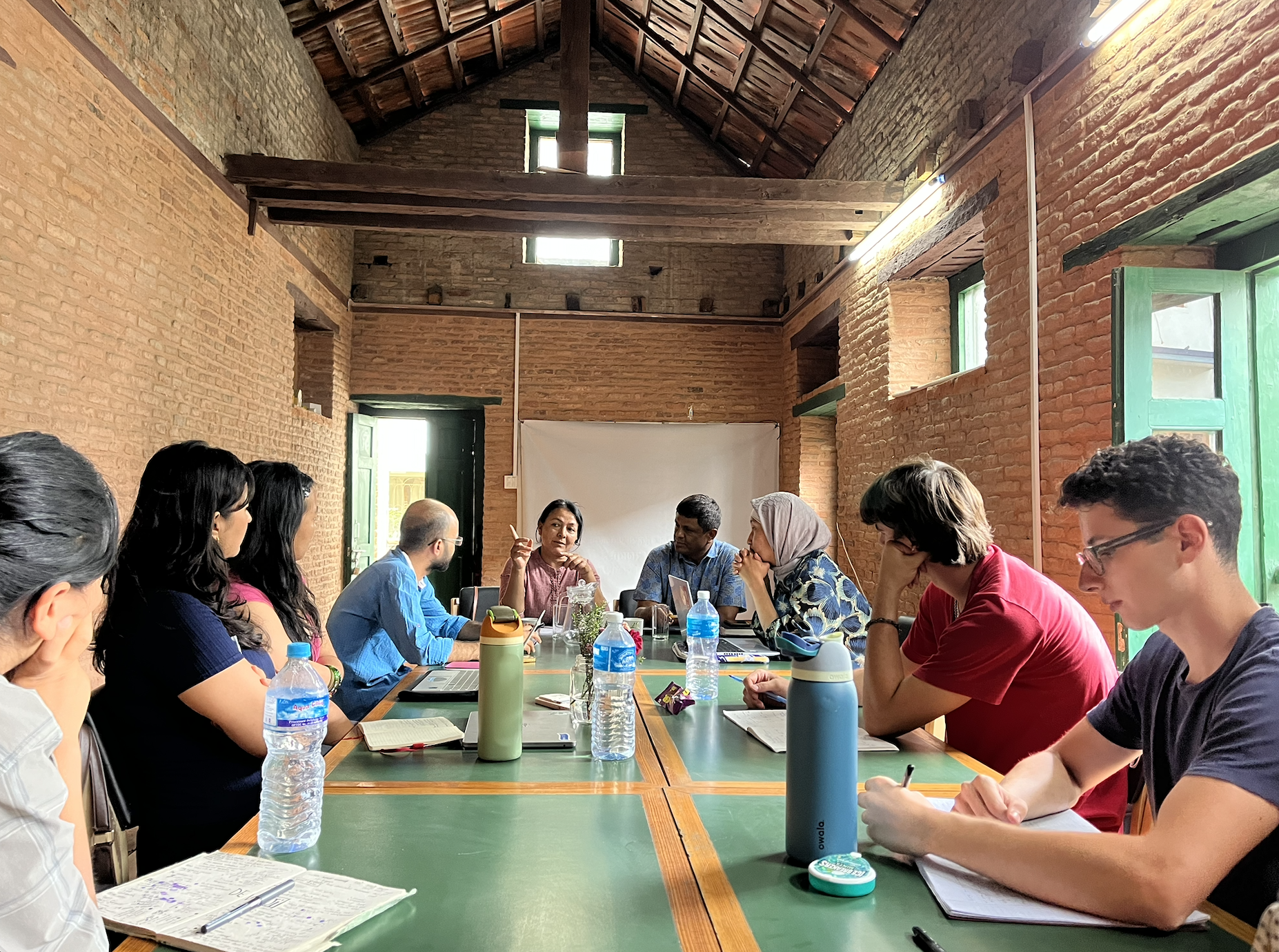
Ram, Niraj, and I were joined by six students this July, kicking off our first summer program at the Center. So far, it has been an incredible experience. The classroom space we visited last year is now full. The curriculum we’ve been developing is being put to use. The students whom I met at university info sessions are here learning, reflecting, and asking critical questions. They, and the victims and survivors whom we meet with as a group, are challenging me to think harder about many issues.
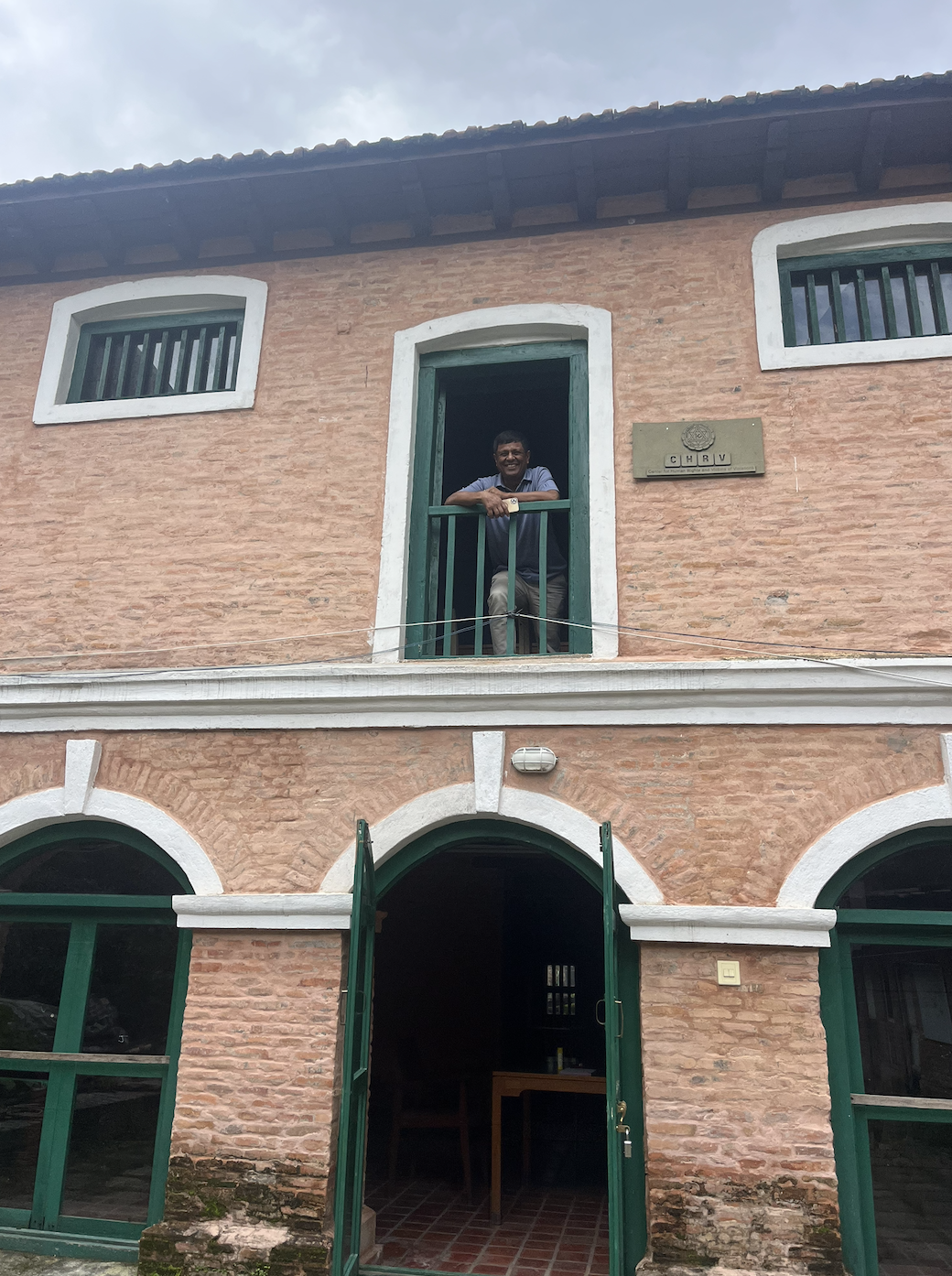
Ram leans out the window of our center
This past Monday I hosted an informal processing session for the students over lunch. The first two weeks of the program covered several heavy topics and more reflection was needed.
A discussion about positionality in our work came up. I agreed with the students that this was an essential consideration. “As an outsider…” I began. “What use does that term have?” one student replied. “What does it mean to be an outsider?” I had so absorbed this framework of insider/outsider from my own education that I wasn’t prepared to interrogate it. What is its value? I suppose it refers to where one’s knowledge of a particular context comes from — from within the context or outside of it — and taking that into consideration shapes how you listen. The student challenged me. “The term outsider prevents an understanding of the ways in which you are implicated.” She had a point. By framing myself as an outsider could I be obscuring the ways in which I am entangled? Because, despite how far away Americans often think Nepal is, there were real connections with the US in terms of military assistance and political influence during the conflict that enabled the violations (it’s no coincidence that Nepal passed a Terrorist and Disruptive Activities (Control and Punishment) Act in 2001), not to mention the ways in which our global systems shape all of our realities. I suppose we are all always insiders and outsiders. I thought of what advocate Sunder Oli told me last year. “The world is a global village, justice is everyone’s responsibility.”
“I have been thinking a lot about what it means to be a victim,” another student said, “who defines it?” Lenin Bista, former child soldier and now legal and political activist, joined us in class the previous week. Sharing a bit about his own story, he told the group, “I didn’t know if I was a victim or a perpetrator.” His comment came up in our discussion Monday. “I suppose he was both,” one student said. Victimhood is not clear cut. And we, as humans, are always multi-dimensional. But the power of Nepal’s struggle for justice comes from the fact that victims and survivors have defined for themselves what it means to be a victim; they have claimed it, shaped the categories, and created a political identity around it. I am reminded of Makau Mutua’s piece: grassroots human rights here completely rejects the savages, victims, and saviors framework he so heavily criticizes.

Students speaking with Lenin Bista after class
That’s why we are running this program. In order to change the field of human rights, we have to begin with its students. The six who have joined us are learning from people on the ground in Nepal; the lens from which they will engage in future work is being shaped here, not solely in Western classrooms.
Ram and I have talked much about decolonizing the academic human rights space. Our students engage with this also. A discussion about the international transitional justice framework on Thursday turned into a conversation about the use for these kinds of frameworks and then a reflection on how, and whether they should be taught in a course like this. “Do you have to construct in order to deconstruct?” one student asked.
What is meant by transitional justice? It is a question I have found the students, and as a result, myself coming back to. The field emerged in the late 80s and early 90s as states in Latin America and Eastern Europe were transitioning from military dictatorships to democracies, but has since expanded to apply to post-conflict societies. It has been shaped, as many things are, by Western academics, lawyers, and other experts, but it is also the product of victims’ and survivors’ demands and civil society organizing. At its core, it is about questions — after a situation of mass human rights violations, how does a society heal, ensure accountability, provide justice, address root causes, transform institutions, and build sustainable peace? There is a roadmap — truth, justice, reparations, and guarantees of non-recurrence — but as for how exactly to go about these things, the field only really answers that it should be holistic, context-specific, and victim-centered. But, as the students and I discussed, each of these is not clear cut. Take victim-centered, for example. No group of victims and survivors is monolithic. There are varying and sometimes conflicting demands. As we have heard from victims and survivors in Nepal, there are many visions for what justice looks like. Where do you begin? Whose call do you answer?
Survivor advocate Devi Khadka described her vision for justice for conflict related sexual violence survivors, outlining three components: “self-justice, social justice, and legal justice”
And what is to be made of the term “transitional justice?” A student, Ram, and I were discussing over tea and Ram quoted a friend of his, Argentinian activist Alicia Partnoy: “when you give birth, there is no transition. It is transformation.” The terminology shapes one’s understanding of what is possible. Ram has taken to using “transformative transitional justice.”
But in this return to Nepal, I am continuing to learn not just about transitional justice, or transformative transitional justice, but also, more broadly about movement building and solidarity. There is much inspiration to take from Nepali victims’ and survivors’ organizing and I often think about applications for other social movements. In the global struggle for justice, there is tremendous work to be done and as Alicia Partnoy told our class in her visit, “there are no recipes for survival.”
Posted By Emma Cohen
Posted Aug 6th, 2026