

At six in the morning, I learned that I would be visiting Duong Thi An’s family. The taxi was leaving at 7:45, which gave me just enough time to read the articles written by previous Peace Fellows. The last visit I could find was from 2019.
Six years had passed. By the time we arrived, I had the strange feeling of already knowing the family through photographs. I tried to recognise the faces I had seen on my screen that morning. Except for Huong, I struggled.
There was a simple reason. The family had changed.
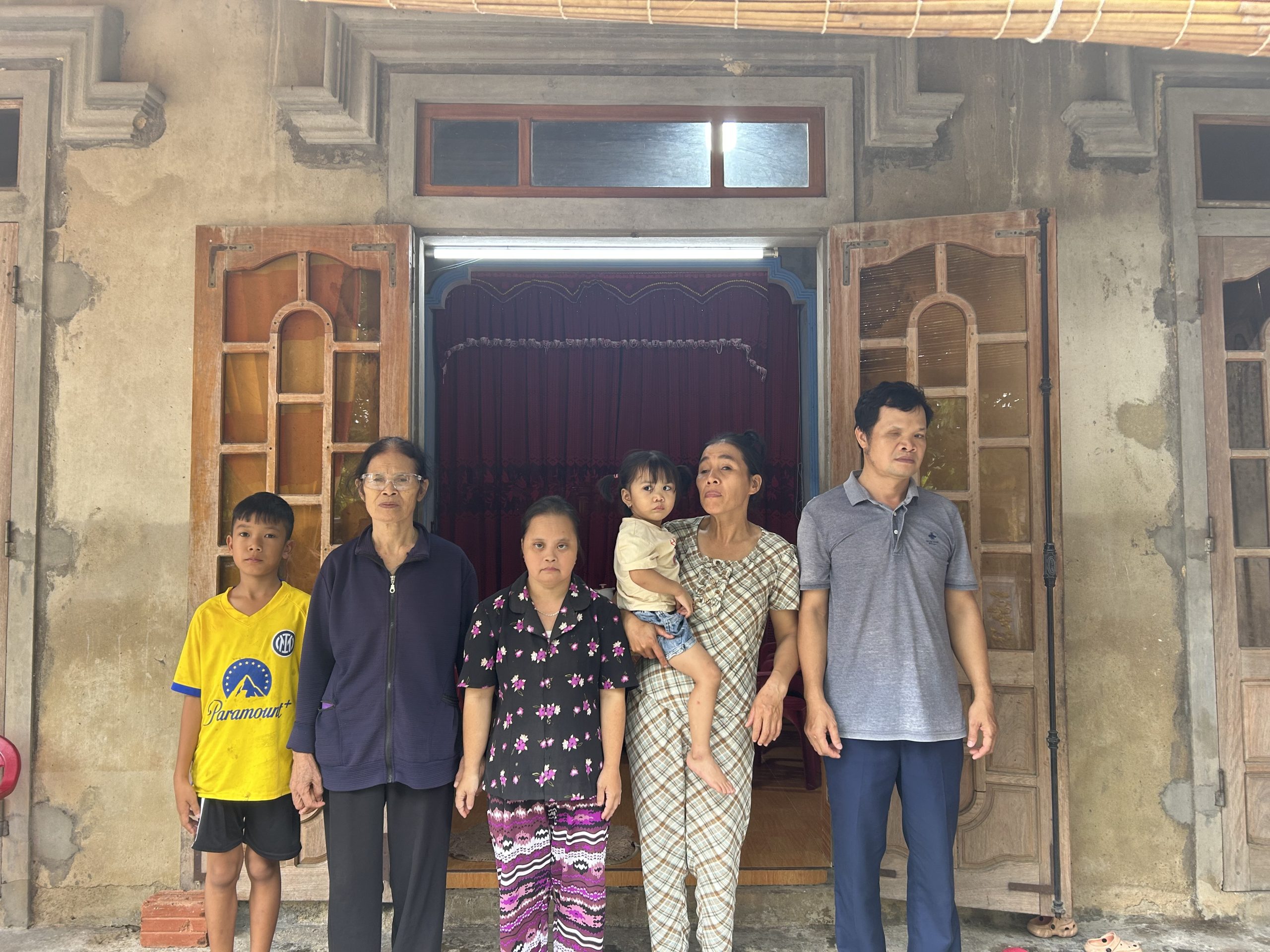
From the left to the right: grand children of An, An, Hoa (daughter of An), Hang (daughter of Huong), Huong’s wife and Huong.
A new generation
One of the first surprises was learning that Huong had married in 2022. He and his wife now have a three-year-old daughter, Hang. She had obviously not appeared in any of the previous photographs.
Hang immediately made herself noticed. She was moving around, playing and making plenty of noise to attract attention. She seemed full of life.
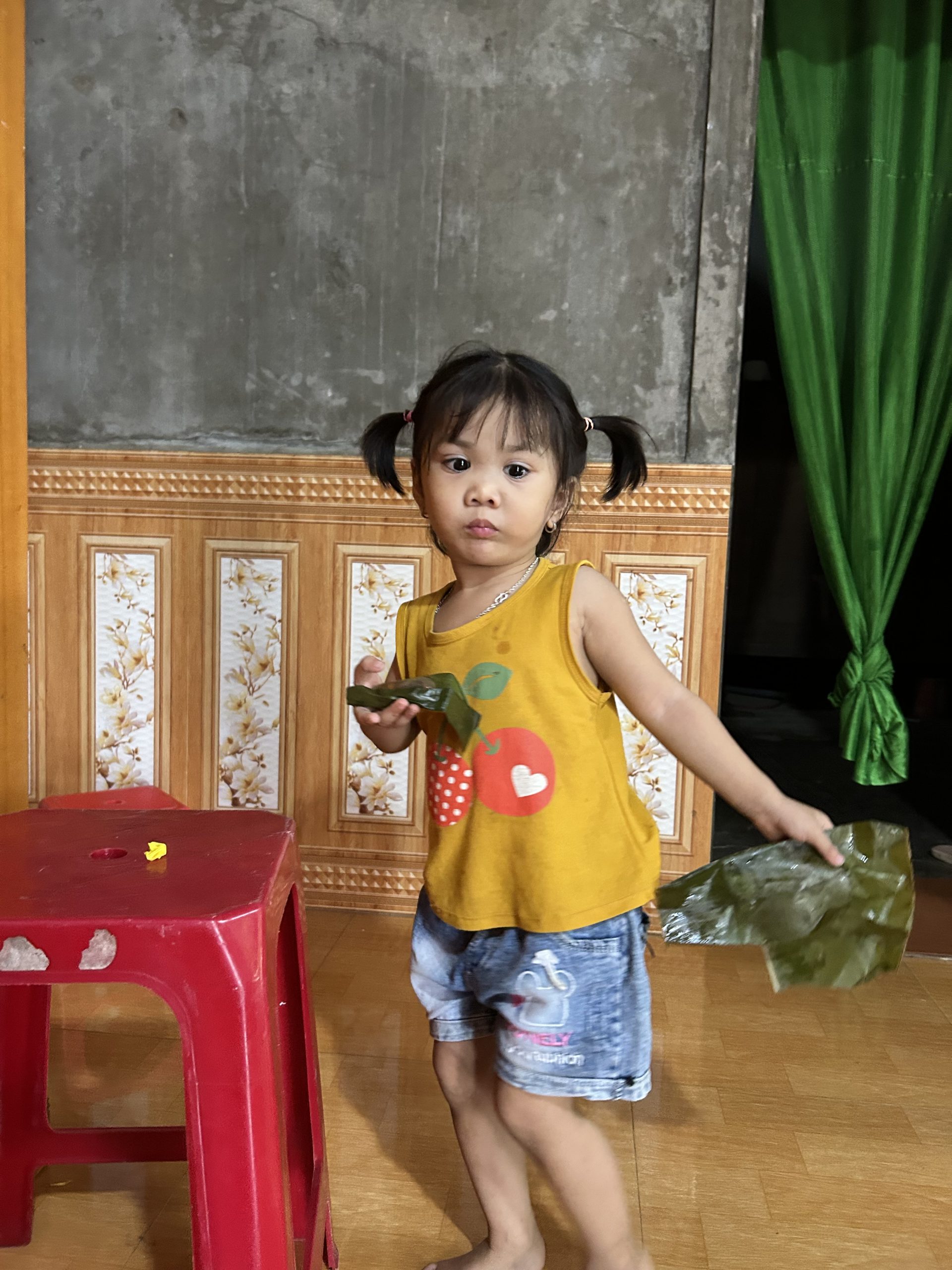
Hang, daughter of Huong, holding bánh lọc (the food speciality of the region the family cooked for us).
But her first years have already involved serious health problems. According to the family, she was born with a heart valve defect and a cleft palate that made feeding extremely difficult. During the first 18 days of her life, she had to be taken to hospital in Hue and fed through a gastric tube.
When she was around one year old, an American-supported programme helped her receive surgery. The operation was successful. Today, she can eat pureed porridge and drink milk, although her family remains very attentive to her health.
Because Hang is the granddaughter of a family already affected by Agent Orange-related disability, her condition raises questions that have followed this family for decades. But she is not officially recognised by the Vietnamese government as an Agent Orange victim, since third-generation descendants are not covered by the current recognition system.
Her medical expenses are instead partly covered through social insurance. For a family already spending heavily on healthcare, that distinction matters.
Huong’s health has not improved
Huong is now 36. When he was last profiled several years ago, he was already losing his sight and considering surgery. That surgery has still not happened.
He continues taking medication to manage the pain and severe headaches caused by his remaining eye. Sometimes the pain becomes so intense that he has to lie in the dark because light makes it worse. He also experiences dizziness.
His vision remains extremely limited. At around three metres, he can still distinguish some shapes. Beyond that, everything becomes blurred.
And yet, during this visit, I also saw another side of Huong. A small massage practice now stands directly beside the family home. He was visibly proud to show it to us.

An and Huong explaining their lives.
An is getting weaker
Not every change since 2019 has been positive. Duong Thi An’s health has deteriorated.
Her liver disease remains, and the family says she has since developed mitral valve prolapse, heart failure and type 2 diabetes. She has also undergone eye surgery, although her vision remains poor.
Her body is becoming weaker. But her responsibilities have not disappeared with her health. An spends most of her time at home now because she is no longer strong enough to work outside.
She remains the main caregiver for her daughter Hoa. Hoa, now 45, was lying on the bed for most of our visit. Her family explained that she still cannot communicate clearly and needs help with eating and personal hygiene. She also experiences frequent fevers.
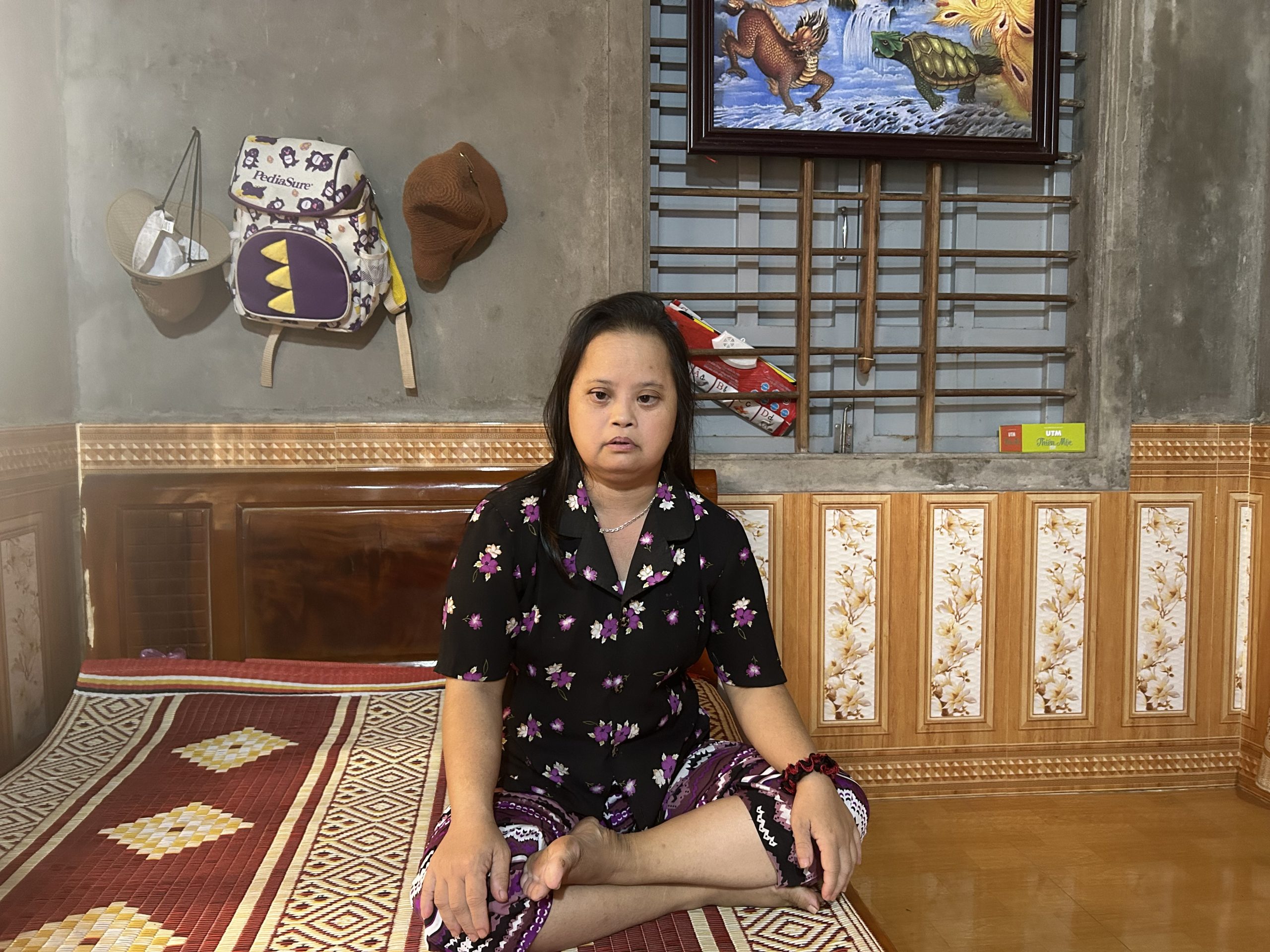
Hoa, daughter of Duong Thi An.
During the visit, she appeared withdrawn and quiet. What has not changed is her dependence on her mother. An continues to help her with the most basic parts of daily life.
There is some reassurance about the future. Huong and his wife have agreed that they will care for Hoa if An is no longer able to do so.
Unlike some other ageing caregivers I have met during my time with AEPD, An therefore does not seem overwhelmed by uncertainty about who will eventually take over. But she understands something else very clearly. Soon, she may become the one who needs care.
When care begins to shift
This reversal is becoming increasingly visible in many of the families I have visited.
For decades, parents organise their lives around children with disabilities. They cook. They wash. They manage medication. They find money for treatment. They accompany them to hospital. And they rarely describe this work as anything unusual. It is simply what a parent does.
But ageing changes the balance.
An is still caring for Hoa while managing several serious health conditions of her own. The question is no longer only how long she can continue. It is also who will support her as her own health declines.
Care does not disappear when one generation grows older. It shifts.
For this household, more responsibility will increasingly fall on Huong and his wife, who are already managing work, a young child with significant medical needs, and Huong’s own disability.
That raises a broader question I have encountered repeatedly during these visits: whether the people providing care have enough support themselves.
When an income-generating asset becomes emergency money
AEPD and The Advocacy Project have supported this family before. In 2017, a Peace Fellow raised money and AEPD helped the family acquire livestock as a livelihood investment. For years, the animals strengthened the household’s economic situation.
But eventually, health needs overtook that investment. Because of An’s declining health, difficult weather conditions and mounting medical costs, the family decided to sell the buffalo and calf for around VND 20 million, approximately $765.
The sale solved an immediate problem. But it also removed one of the family’s sources of long-term security.
Their vulnerability became even clearer during one rainy season, when floodwater rose above one metre and killed all of their pigs. Later, the head monk of a nearby pagoda gave the family a female calf.
Today, agricultural work rests mainly with Huong’s wife. An stays home. Hoa cannot work. And Huong is trying to build something of his own.
Building a future through the massage business
Despite his limited eyesight and chronic pain, Huong has created a small massage practice directly beside the family home.
The practice has two rooms and three treatment spaces, and he has even invested in a sauna. Those improvements were possible thanks to a bank loan. For now, he works alone.

Annex of the house where Huong is exercising his massage activity.
When there are many customers, his wife helps him while also taking care of the fields and the chickens. The business currently brings in around VND 2 million in profit each month, approximately $76.
That is still modest compared with the family’s needs. Medical expenses alone amount to at least VND 6 million per month, around $230.
But Huong clearly sees the practice as something he can build. He hopes to attract more customers and eventually hire an assistant so that he can serve more people and earn a more stable income.
When he spoke about the business, his energy changed. He seemed proud not only because it generated income, but because it was something of his own.
For someone living with severe visual impairment and recurring headaches, the massage practice represents more than money. It allows him to work despite his disability. It gives him a degree of independence.
And, as his mother grows older, it may become increasingly important for the whole family. Huong is no longer only the son receiving support. He is also a husband, a father, a small business owner and someone who will increasingly help carry the family’s responsibilities.
Progress, but never in a straight line
There have been visible improvements since the last visit. The family now has a toilet inside the house. That may sound like a small change.
It is not.For a household affected by disability, illness and mobility difficulties, adequate sanitation directly affects dignity and quality of life.
But the family has not been able to save as much as they once hoped. Every improvement has competed with another medical expense.
This is perhaps one of the clearest lessons from returning to a family several years later. Progress is rarely linear. A buffalo can create income. A small business can grow. A toilet can be built.
But chronic illness and disability continue to generate costs. One gain can quickly be absorbed by the next emergency.
A house showing its age
The family’s next major concern is the house. Cracks have begun appearing in the walls. They worry that the structure is becoming less durable. This is especially serious in a region where flooding is not an abstract risk.
The family has already experienced water rising above one metre during the rainy season. They would like to build another room and make the house safer.
For a family that includes visual impairment, disability, chronic illness and a three-year-old child, housing is not simply a question of comfort. It is part of their safety. A home that cannot withstand extreme weather creates additional risks for people who may struggle to evacuate quickly or independently.
Six years later
Before leaving, we spoke about the family’s hopes.
They want the house to remain safe. They want Hang’s health to improve. They want to keep meeting the family’s medical expenses. And Huong wants his business to succeed.
Compared with the photographs I had studied early that morning, the family had clearly changed. There was a new wife. A new child. A new business. A toilet inside the house.
But there were also new illnesses, new medical costs and new responsibilities.
Six years is long enough for a family to make progress. It is also long enough for bodies to become weaker and care needs to grow.
Perhaps this is why long-term victim assistance matters. Support cannot respond only to one moment in a family’s life. Needs evolve. Children grow up. Parents age. New generations are born. And a family that once needed livestock may later need healthcare, safer housing, support for a business or help caring for an ageing parent.
Just as we were preparing to leave, An and her daughter-in-law stopped us. They had prepared bánh lọc that morning, the chewy tapioca and shrimp dumplings typical of this region, and insisted that we take some with us, along with fruit from their garden.
There was far too much. We shared as much as we could over lunch with the AEPD team and still ended up carrying portions home. It was a generous ending to a visit that had mostly been about limits.
And perhaps an important reminder. Families like An’s are often described through what they lack: money, health, security or recognition.
But that is never the whole story. Six years after the last visit, this family is still adapting, still working and still making plans. What they need is not for those efforts to be replaced. It is enough support to give those efforts a real chance to succeed.
Posted By Clothilde Soenen
Posted Sep 12th, 2026