
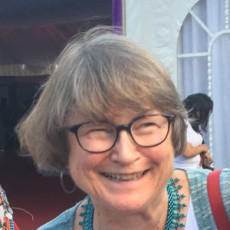

The group gathered for a photo once our job was done. Clockwisefrom upper left: Wazhma, Tahera, Guljan, Fatima, Homaira, Farida, Frista, and Bobbi
Seven years ago I made my first trip as embroidery trainer for The Advocacy Project, going to Nepal to work with women who had lost loved ones to the disappearances. They told their stories through embroidery and, together, we crafted two quilts to be used to advocate for justice. Since that first trip, I’ve also traveled to Africa three times to work with groups of marginalized women on similar projects. The quilts we create help to raise awareness of the tragedies they’ve endured but also show their strength and determination.
And so this year, in the week before Christmas, I took off once again. This time, I flew to Toronto, Canada at the request of the Afghanistan Human Rights and Democracy Organization (AHRDO – www.AHRDO.org ) and the Advocacy Project (AP – www.advocacynet.org ) to spend a week with survivors of the Taliban’s war against women in Afghanistan. AHRDO’s mission is to document truth, preserve memory, and pursue justice, goals which align well with AP’s vision.
AHRDO enlisted the women and took care of organizing the training. My job was to help the women tell their stories through embroidery which would then be incorporated into a quilt to be used for awareness and advocacy. I had led similar trainings for AP with women in Nepal, Uganda and Kenya. This would be AP’s 45th stitching project since 2007. https://www.advocacynet.org/quilts-by-topic/
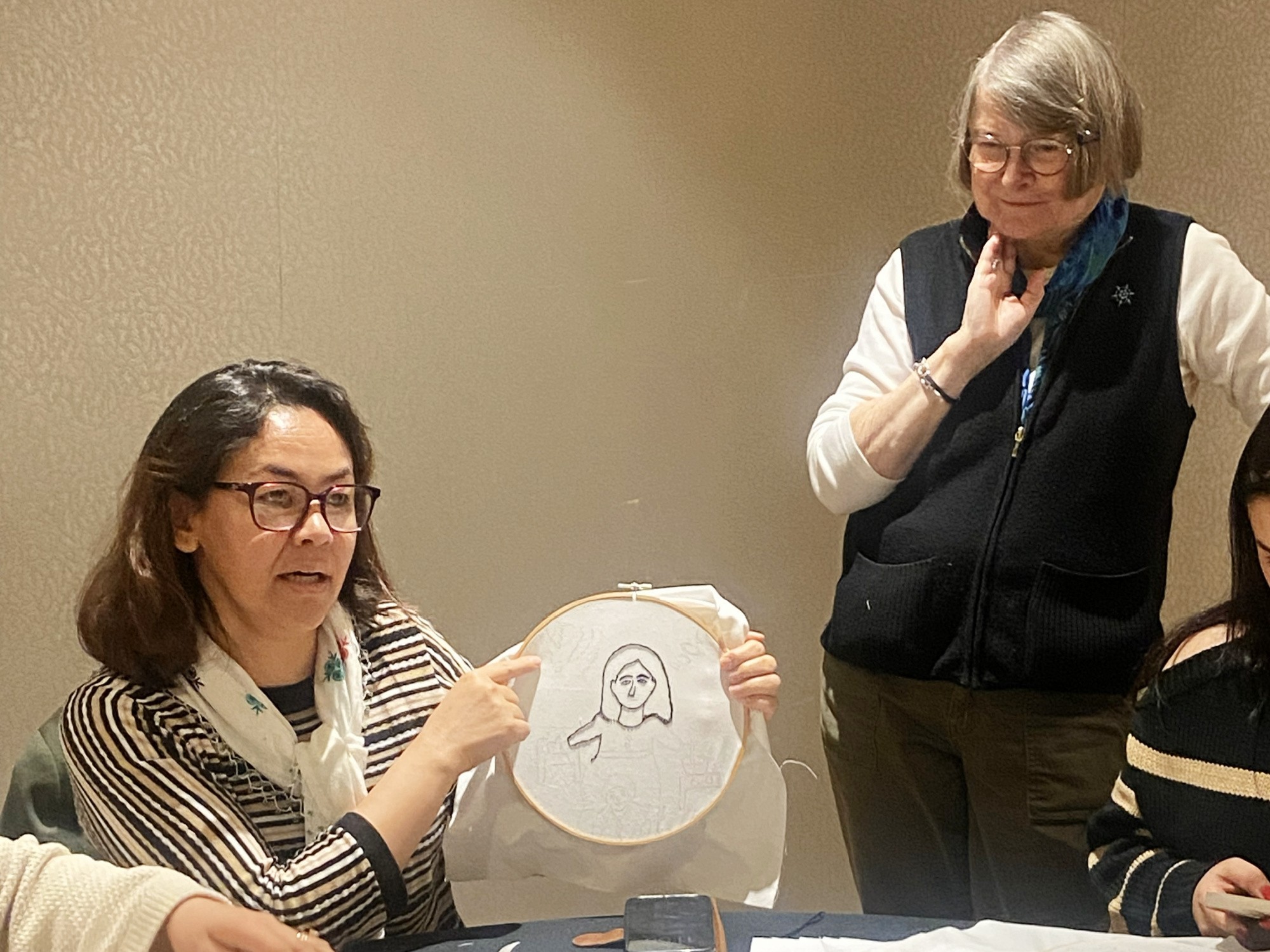
Guljan’s block is off to a nice start!
As each woman entered the room that Monday morning, she greeted me with a smile and a warm handshake. Farida was wearing a stylish suit and her makeup was flawless. Her daughter, Homaira, appeared to be a typical western twenty-something. Frishta bounded into the room, laughing already. Others came more quietly but each walked in with openness and curiosity.
As the days of training passed, I had the opportunity to talk with each of the nine women and hear how they had found themselves in Canada. The stories were all different but all the same. Fear, loss, confusion, and sadness. In spite of outward appearances, all were in mourning.
Niki asked if she could share a short film she wrote, directed and starred in. It was called, The Silence of a Girl and presented one young woman’s choice after losing control of her own life as the Taliban closed girls’ schools and returned to strict suppression of women and girls. Facing a hastily arranged marriage to a man she didn’t know and unable to accept a life without personal freedom, she took her life on her wedding day.
In the room there were tears and nods as others silently acknowledged what they had just seen. They were ready now to share their own stories. They talked and sketched and revised and consulted with one another. Ideas were transferred to fabric and these stories of horror and loss began to take shape with needle and thread.

Fatima dreams of education back in Afghanistan!
* Farida had been a prominent television journalist, traveling to research her stories and presenting them with polish and confidence. She said, “I loved my job and now I am just zero.”
* Homaira was in university, studying journalism with plans to follow in her mother’s footsteps. She said that path is no longer open to her. Her block shows her blindfolded and silenced.
* Frishta recalled the claustrophobia of having to put on the burka. “I couldn’t breathe! I would throw the awful thing into a corner and step on it.”
* Guljan, a Ph.D. and professor in Afghanistan, chose to show her current life – wife, mother, cook, English student – while still dreaming of her former life in education. Her husband, also a university professor, now drives a truck to support the family.
* Tahera’s block shows brave women in prison who take the extraordinary step of continuing their protest for women’s rights and demanding freedom.
* The desire for resuming education, which was suddenly denied to them, was the theme of a number of blocks.
Perhaps though, the most painful block was Wazhma’s (photo below). She showed a mother offering her daughter for sale because crushing poverty offered no other solution.
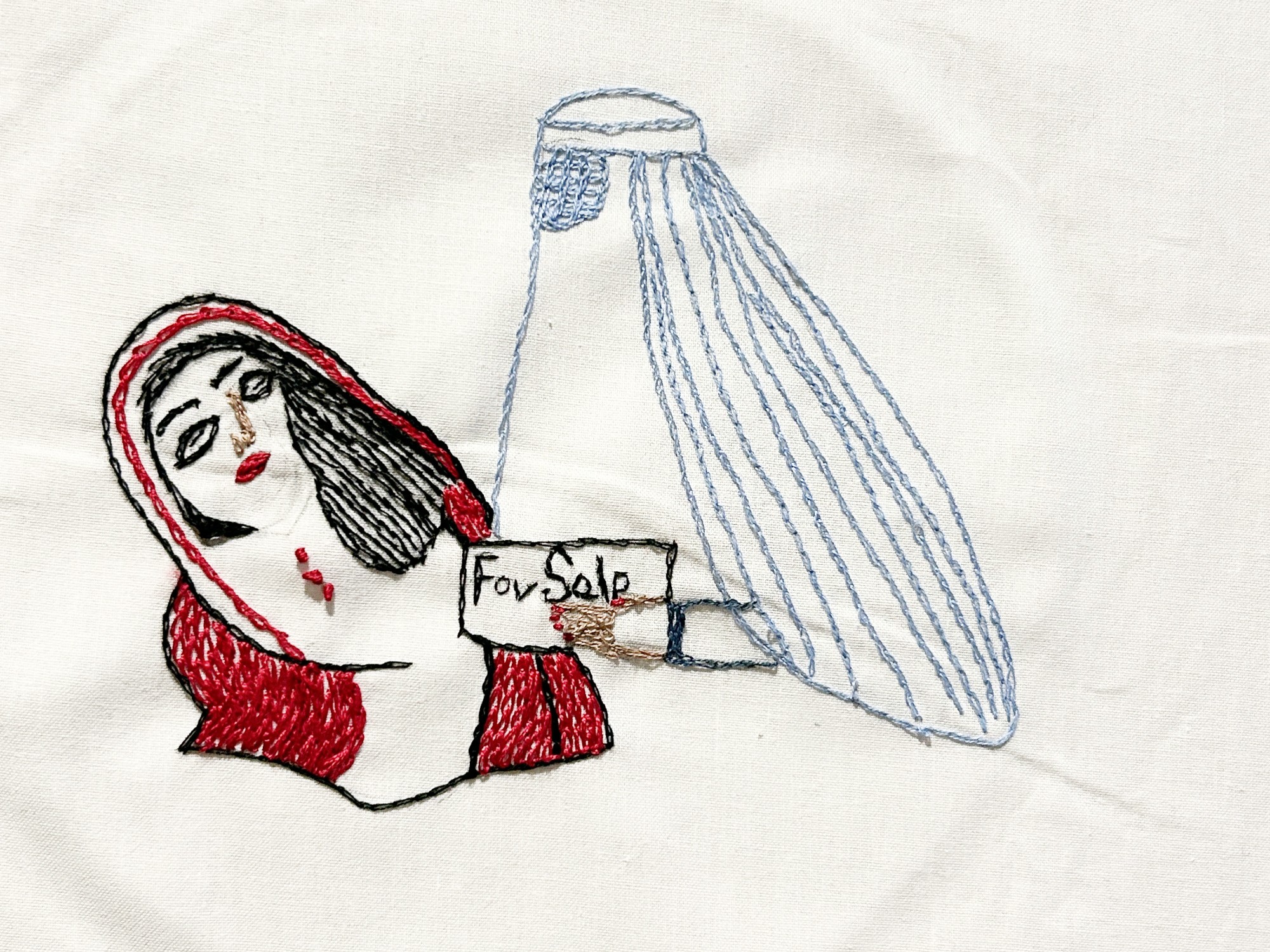
Wazhma’s block shows a mother offering her daughter for sale.
The beauty of telling stories through embroidery is that it is slow, it takes time and care. As the women stitched, they talked to each other. At first, they talked about the needlework itself, previous experience with stitching, colors to use, whether to use one stitch or another. But then the important discussions took over: Do we have friends in common? Did you leave family behind? Who did you lose? They encouraged each other, in their stitching and in the struggles of adapting to a new and foreign life.
At the end of our four days and the completion of nine beautiful embroidered blocks, it was possible to see a change in the participants, however slight. They had told some of their stories, they had been listened to, and they had found new friends with shared experiences. Contact information was shared, plans were made to continue embroidering more of their stories with a focus on what the future might be, and laughter was in great supply. There seemed to be a new resolve to take charge of their situation and move toward what they want.
As the outsider, I found two things in particular that confirmed this resolve. The first was the stated desire of every single participant to be able to return to Afghanistan one day and rebuild the lives that had been stolen from them – and the belief that this would happen.
The second thing was the desire, shared with me privately by a number of the women, to find a way that they could help the women and girls still in Afghanistan, primarily through helping them to continue their education. They understand the importance of education and the difference it can make.
We had a final debrief of the training and, for the first time, were able to introduce to the embroiderers the quilter who would be putting their blocks into an advocacy quilt. Janet presented some ideas and asked for feedback and suggestions which the ladies happily provided.
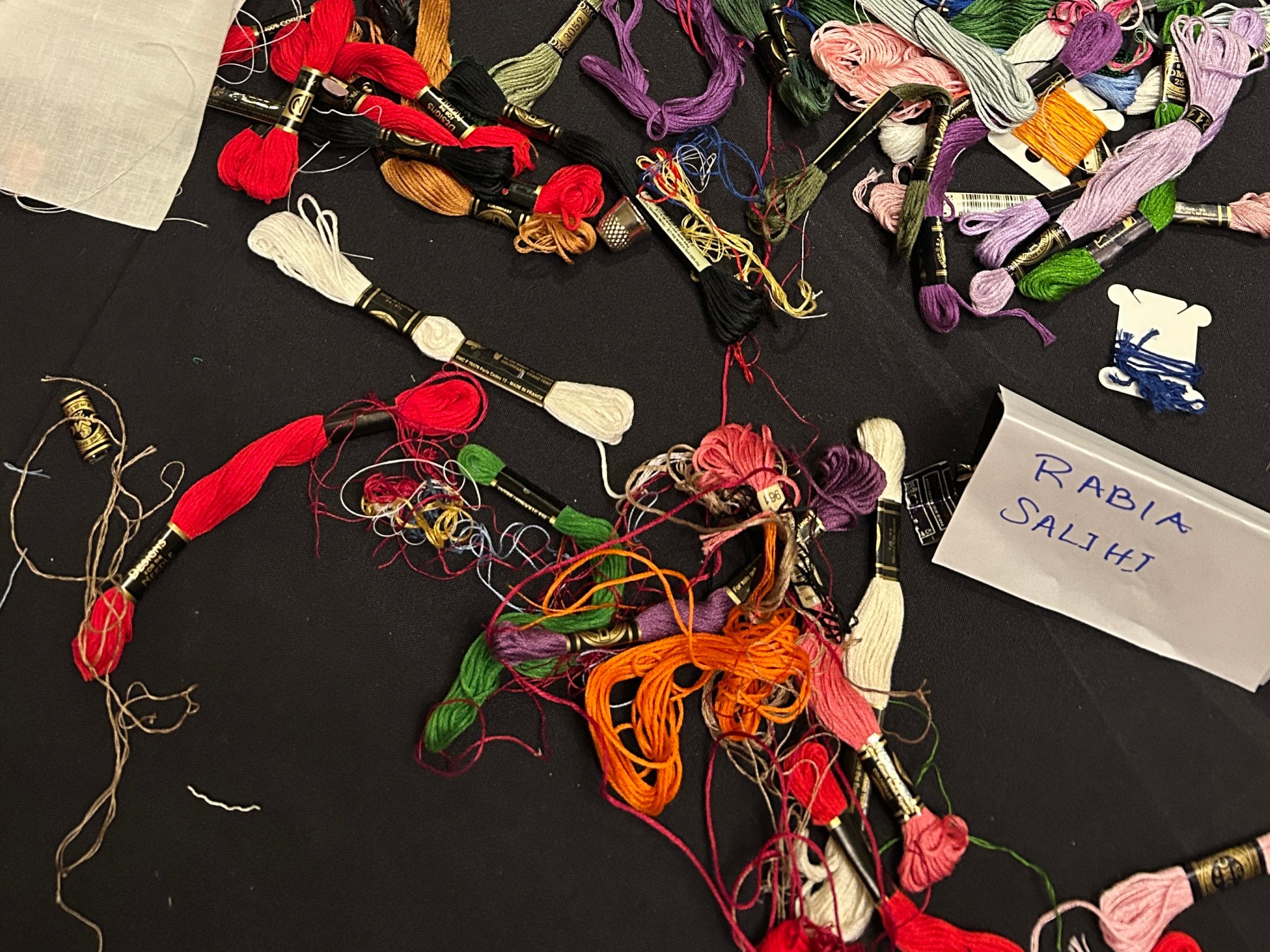
Tools of our (quilting) trade!
They also had suggestions for further training, including Frishta’s suggestion to include music breaks. Noted! One participant thanked AHRDO and AP for providing a much needed “mental” break for them and others agreed.
As the women left, they seemed satisfied and happy. The polite introductory handshakes of Monday morning were replaced by long, heartfelt hugs and beautiful smiles. The training had been a success on many levels. I hope our time together and the friendships that have been established will encourage these women to use their strength and passion to press for the justice they deserve. My experience tells me that it can definitely happen.

Meeting with Janet, a member of the Toronto Quilt Guide who has agreed to assemble the stories into an advocacy quilt. We are excited to see what she will come up with!
*
Posted By Barbara Fitzsimmons
Posted Jan 14th, 2026