
The schoolyard at Awach Central Primary School transformed into a vibrant science and livelihood laboratory, when our team from Gulu Disabled Persons Union (GDPU) conducted an intensive, hands-on liquid soap-making training for the pupils. In this contemporary rural school where bright, dust-kicked courtyards meet clay-brick classrooms, the gap between theoretical health education and practical life skills was instantly bridged. For these learners, sanitation is not an abstract concept found in a textbook; it is a daily struggle against tight school budgets that frequently leave handwashing jerrycans empty. By converting students from passive consumers into active producers, the training directly targets the root causes of school absenteeism: preventable hygiene-related illnesses. As our facilitator noted during the opening session, “When a child knows how to make soap, sanitation stops being a luxury or a chore dictated by teachers; it becomes a personal right they can create with their own two hands.”

GDPU opened the training by highlighting the importance of hygiene and empowering learners to lead school sanitation now that they will be able to manufacture their own handwashing soap.
Before entering the production phase, the facilitators established a comprehensive foundation focused heavily on workshop safety, chemical literacy, and the daily importance of school sanitation. Pupils gathered in the shade, learning the strict ground rules of handling chemical concentrates, including the mandatory use of protective masks and gloves to prevent skin or respiratory irritation, the critical order of chemical introduction, and the absolute necessity of adult supervision. The facilitators demystified the raw ingredients, explaining how surfactants clean, how industrial salt builds body, and how specific additives create an appealing lather, color, and fragrance. This essential briefing ensured that the children respected the chemistry behind the process, fully understanding the “why” before diving into the physical creation of the product.

School health club members and learners proactively mastered the chemical compositions, ingredient requirements, and critical safety measures essential for secure liquid soap production.
With safety protocols locked in, the pupils were divided into inclusive, collaborative working groups where every child regardless of physical ability was assigned a vital role in a strict, step-by-step manufacturing sequence. First, the learners carefully measured and dissolved the primary surfactant base into clean water, stirring patiently until the thick paste transformed into a clear, uniform liquid. Next, industrial salt was gradually introduced, requiring the pupils to rotate mixing duties and maintain a steady, single-direction stir to build thickness beautifully without creating lumps. Once the base achieved the perfect viscosity, foam boosters and stabilizers were incorporated to ensure longevity, immediately followed by the gradual blending of a vibrant colorant and a fresh fragrance. Finally, the completed mixture was covered and left to settle, allowing the surface foam to dissipate into a clear, premium, market-ready liquid soap.
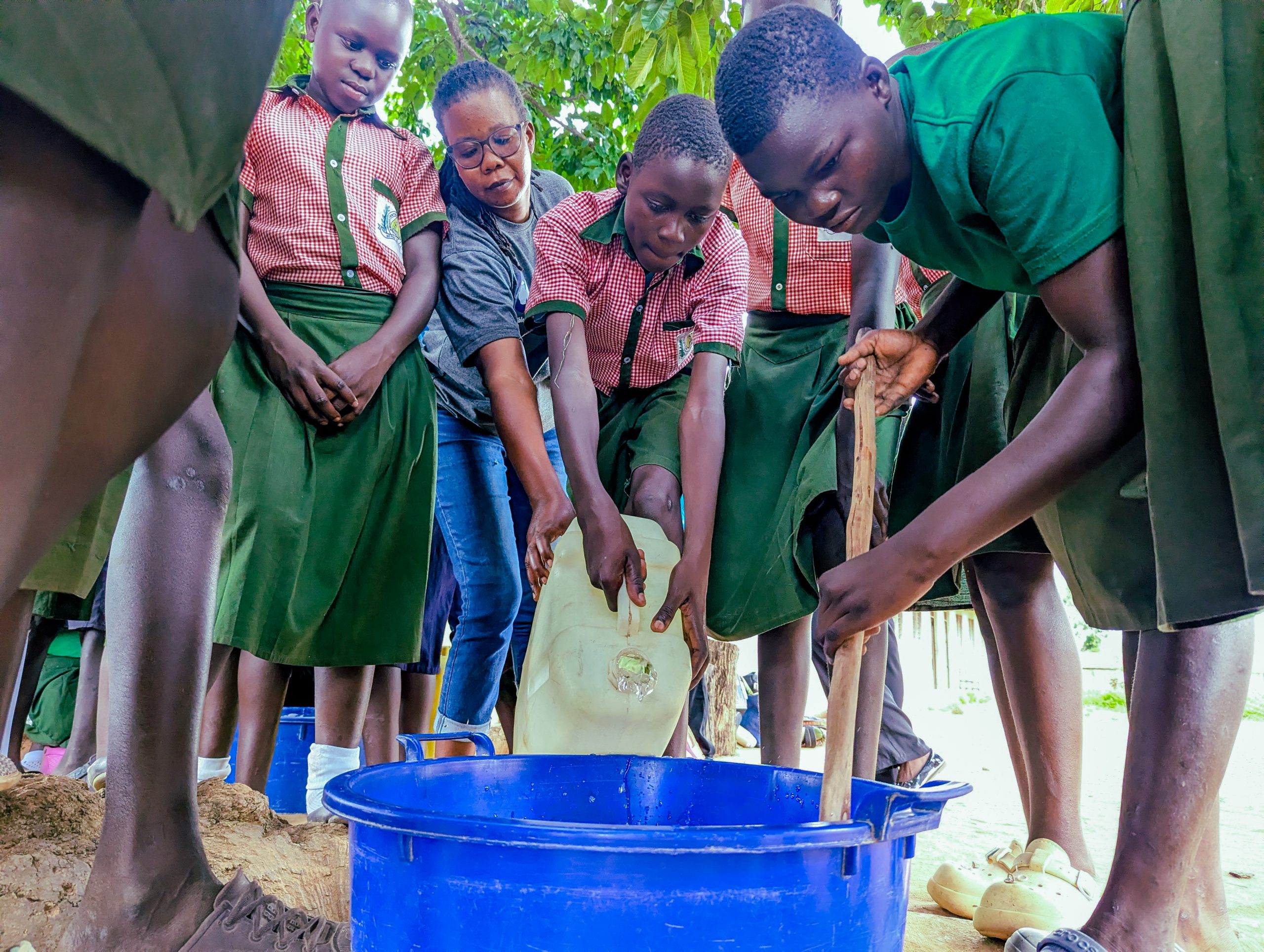
Transitioning seamlessly from instruction to action, the learners immediately put their theoretical safety and chemical knowledge to the test through a hands-on, step-by-step practical mixing session.
The atmosphere during the practical mixing session was electric, filled with pride and immediate breakthroughs in social inclusion as children cheered each other on through the physical tasks. One of the quietest pupils in the class, a young boy who frequently kept to himself due to a physical disability, took his turn at the mixing container and watched the solution beautifully coalesce under his command. Cheered on enthusiastically by his peers, his face lit up with a massive grin as he shouted, “Look! It’s turning into real soap!” In these collaborative mixing groups, social labels and physical limitations completely vanished, replaced entirely by a unified team holding buckets, tracking measurements, and sharing the heavy stirring duties.
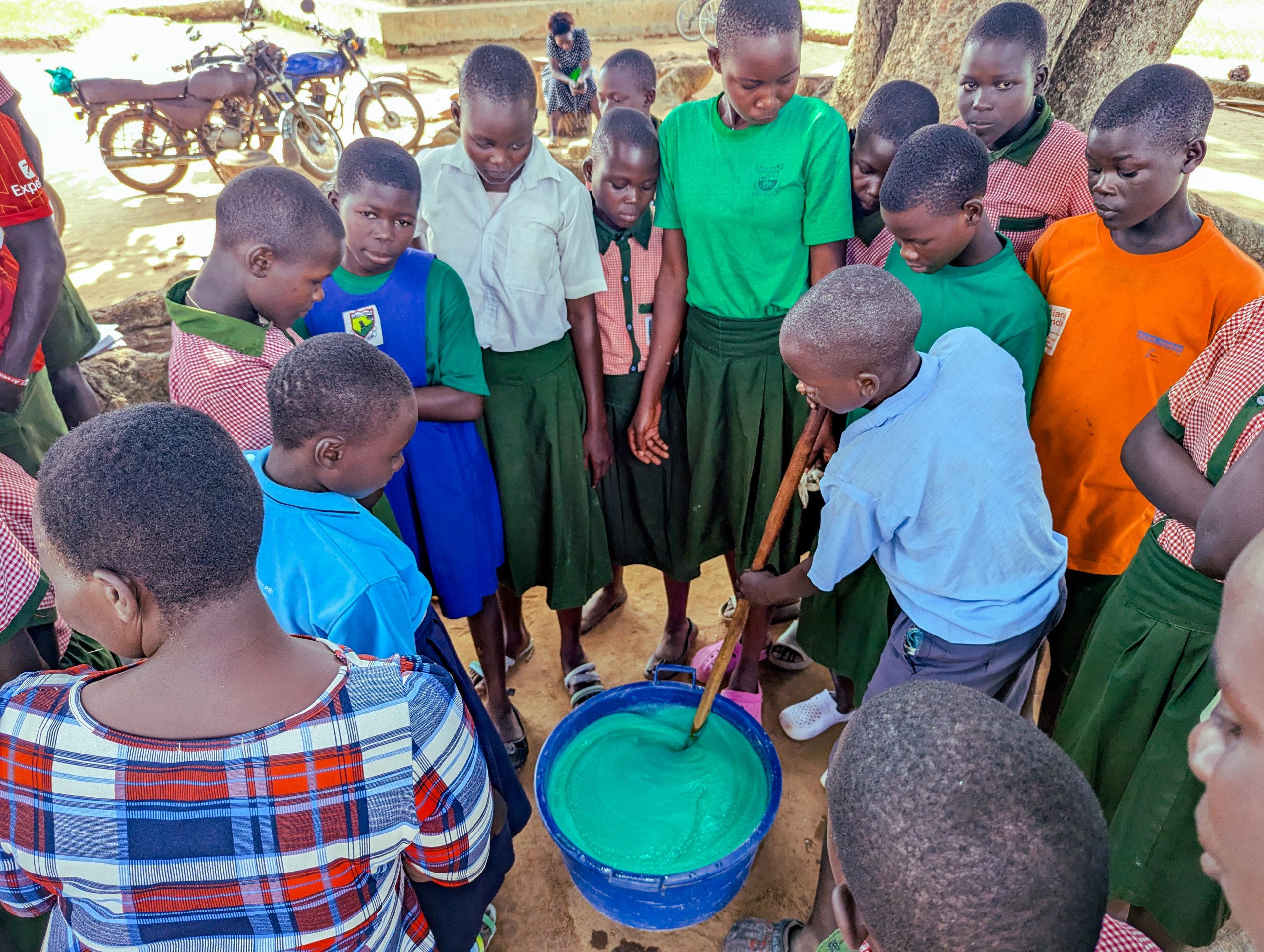
Under GDPU guidance and in the presence of their teachers, the learners successfully produced their own high-quality handwashing soap.
What truly ignited, however, was a profound cultural shift that completely rewrote the school’s daily routines. Overnight, the standard, reluctant practice of rinsing hands with plain water evaporated; the learners suddenly took fierce ownership of the handwashing stations, treating the rich, green lather they created as a badge of collective pride. This newfound obsession with hygiene quickly spilled over into the general environment, turning what used to be a forced weekend chore into a competitive, energetic daily ritual. Equipped with their own high-performance detergent, teams of pupils voluntarily scrubbed down the clay-brick classrooms and swept the compound, transforming the once-neglected corners of the school into spaces that smelled fresh and looked spotless. Yet, as the final bottles were capped and the sun dipped below the Gulu horizon, a sudden, intense huddle formed among the older pupils, their voices low and sharp as they looked at the gleaming, transformed compound, realizing that this radical wave of cleanliness was just the first phase of a much bigger, unwritten transformation they were quietly plotting for the entire community.
Posted By OKWIR JOSEPH JOHNS
Posted Jun 18th, 2026
3 Comments
Atim Patience
June 18, 2026
This is truly inspiring to read. Lasting change goes beyond providing resources, it happens when communities take ownership and embrace practices that improve their wellbeing. It’s inspiring to see meaningful work creating positive impact in Awach Central. Wishing the team continued success as they empower communities and shape a healthier, brighter future.
Emma Badach
June 23, 2026
Great post Joe! The work and trainings that you are doing are appear to be paying off, thank you for sharing! This is definitely a useful way to target preventable hygiene-related illnesses.
Iain Guest
July 2, 2026
Great blog, Joe! GDPU has been making your own soap since the pandemic and Emma has become very good at it! Now, instead of giving or selling soap to schools, you’re helping the schools to make their own soap. This will save money and also improve hygiene. And of course, as you so nicely write, students will love making thick, gooey, messy, sticky soap!! How could they not? Great writing and very nice photos!! Keep it up…