

This weekend, I tagged along with Ram and Emma to attend a special screening of the documentary “Devi”. The film follows Devi Khadka, a survivors leader and former Maoist cadre. As she puts it in the film, Devi joined the revolution as a “soldier fighting patriarchy.” While the Maoist revolution was successful, the societal transformation it espoused was left incomplete. Now, Devi continues to fight against the culture of impunity that allows her rapists and countless other perpetrators of conflict related sexual violence (CRSV) to walk free. Almost a month ago, Devi graciously came to the CHRV to share her experiences advocating for herself and for other survivors of CRSV.
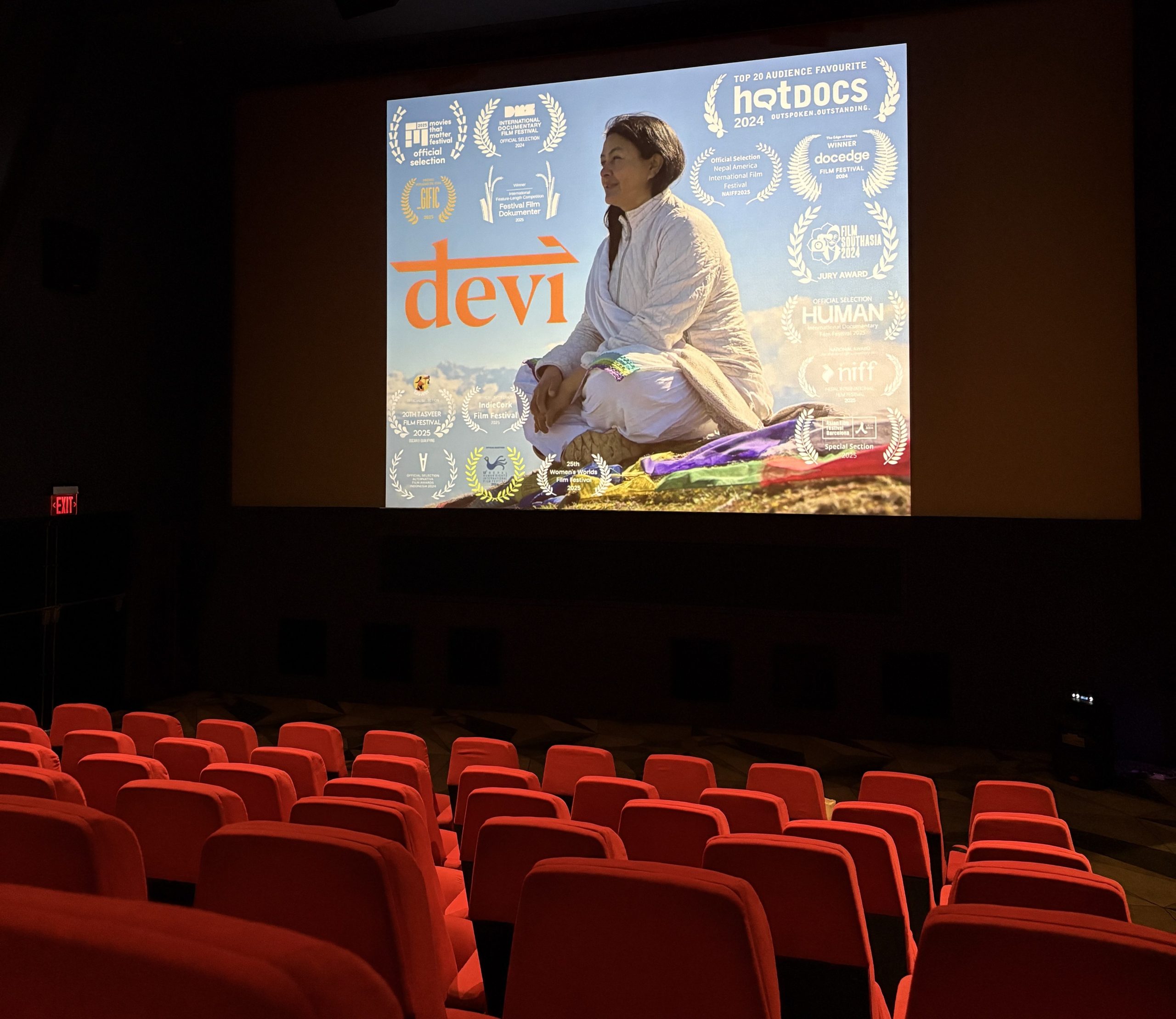
The poster for “Devi” before seats began to fill
The modern survivors movement is a network of communities and groups affected by different forms of abuses during and after the conflict, all self-advocating. Disabled victims, former child soldiers, families of the disappeared, survivors of CRSV, and other groups make up a collaborative fabric of activism. Compared to the others, the CRSV movement is relatively new. While she started organizing in 2021, Devi founded the first dedicated CRSV survivors’ organization, The Aparajit Foundation, in 2023. The foundation is named for the Sanskrit word for “Undefeated”.
The reason that this movement developed so recently is directly tied to the perception and status of CRSV in Nepal. Due to the strong stigma surrounding survivors of sexual violence, as well as the often invisible nature of trauma associated with CRSV, survivors have an extremely difficult time claiming victimhood and run an enormous social risk by doing so. Many women keep their trauma entirely secret for fear of retribution or stigma. For me, one of the most heart-wrenching moments in the documentary was a group of women sharing their experiences. One woman fought through tears to explain that she had married far away from her village after experiencing violent sexual abuse, only for her husband to abandon her while she was two months pregnant upon discovering that she had been raped. After speaking out, Devi herself only stopped receiving death threats once she publicly forgave her rapists.
While civil society organizations with positive intentions had previously emphasized the need to address unreported and unresolved cases, Devi emphasized that they did so completely without the voices and experience of CRSV survivors themselves, leading to their revictimization. The path to self-advocacy wasn’t easy either. Standing outside of the documentary screening and casually chewing on popcorn, Devi explained to Emma and I that she wouldn’t be watching the film. Instead, she would wait outside the theater and come in for a Q&A at the documentary’s conclusion. After her initial period of mental instability after her abuse, Devi became sick again when continuing her advocacy, watching her own documentary four times at screenings in the process. I can’t imagine how challenging it was to hear herself speak the details of her trauma over speakers. She was advised by her doctor not to watch the documentary anymore.

A group photo before the screening (Devi pictured in a lovely scarf)
This retraumatization is a persistent reality of the advocacy Devi and others have devoted their lives to. At the same time, it is a path towards healing. Devi described justice in three indispensable steps: self justice, social justice, and legal justice. Self justice is to move beyond the cycle of guilt and self-blaming that many survivors experience, largely due to taboo and social stigma. For the last couple years, 25 members of the Aparajit foundation have studied counseling psychology in order to better support other members of their community and hopefully alleviate some of their psychosomatic symptoms.
Members of the foundation have supported each other in political and legal battles for justice as well. In 2024, the Truth and Reconciliation Commission had recorded over 60,000 cases. Of these, under 1% (314) were CRSV cases. This miniscule number does not accurately represent the prevalence of sexual violence during the civil war, which was endemic on both sides of the conflict. Instead, it indicates that reporting of these cases was paralyzed by the impact of stigma and poor efforts by the TRC to accommodate CRSV survivors. The Aparajit Foundation’s conservative preliminary estimate was that at least five times this number had gone unreported.
After the lobbying efforts of CRSV survivors in multiple installations of parliament, the third amendment to the TRC act was enacted in 2024, reopening a pathway for CRSV cases to be submitted to the TRC. In typical foot-dragging fashion, the TRC opened this pathway as only a three month window for new cases to be submitted. This timeframe, of course, is hopelessly inadequate for survivors who may not be aware of the proceedings, have internet access, or have a means of transportation to Kathmandu and the flexibility to uproot their lives to do so. The survivors saw this as a government attempt to do the absolute minimum, barely meeting their new legal obligations before labeling the process permanently concluded.
Devi and the Aparajit Foundation rose to the challenge. 300 members of the Foundation were trained to collect testimonies. Many of them sold livestock and traveled at their own expense in order to find and register as many CRSV survivors’ cases as possible. In just a 3 month period, they collected 3,809 additional testimonies to submit to the commission.
The cards have been particularly stacked against CRSV survivors. Social stigmatization, the state’s repeated lack of acknowledgement, and a lack of psychosocial support for their trauma all served as obstacles to healing and advocacy. Regardless, Devi’s foundation and the CRSV survivors movement have taken it upon themselves to pursue justice, embodying the spirit of the Undefeated. It is all but guaranteed that many CRSV cases remain unregistered with the TRC. Those who have registered their cases have seen negligible progress towards their resolution. However, the CRSV movement grows increasingly capable, determined to get better at supporting each other in the process.
Posted By Joe Finkelstein
Posted Aug 26th, 2026