

For much of the past week, I was forced to fracture my own coalition, tearing myself from my classmates at the CHRV in order to attend a different project under the tutelage of my Wesleyan University professors. The Wesleyan program took a wider view of the current TJ landscape and legal/development approaches, comprising discussions with survivors of the Civil War as well as international actors at the United Nations Development Programme (UNDP), leaders of the Gen-Z uprising, and the secretary of the Truth and Reconciliation Commission, at a truly blistering pace. While I was sad to leave my CHRV friends for a week, I was placated by the fact that Ram and Niraj would be coming with me, helping to secure meetings with stakeholders, translate our discussions, and help us process each day’s developments.
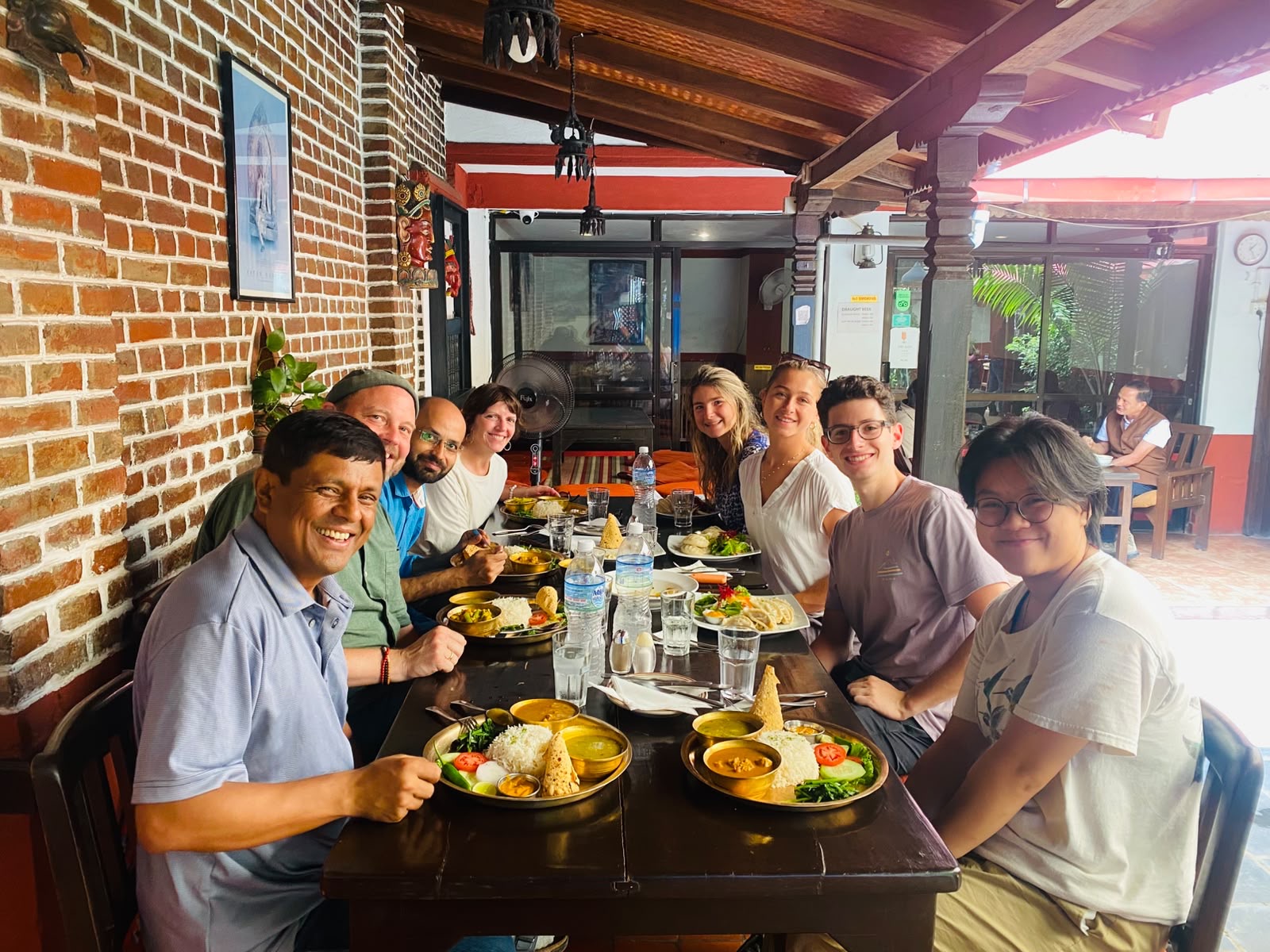
The Wesleyan Group chatting over some dal bhat thali. The first of many such meetings.
The CHRV program, led by Ram Bhandari, proudly takes a survivor-centered approach, emphasizing discussions with survivors’ leaders and historical examinations of other transitional justice processes throughout the world. We’ve talked to numerous survivor advocates who, over many years of struggle and determination, have built the courage to recount their harrowing experiences during the conflict. These survivors have painted vivid images of the atrocities they endured during the civil war and of the ongoing struggles that persist in its wake. They’ve also allowed me to grasp my own inherent limits. Namely, I will never truly understand what it is to live these experiences and their impacts, regardless of how many reports I pore over or survivors I learn from.
I don’t think this should be viewed as a failure of empathy or an indictment of international human rights work; human rights lawyers, development actors, and international NGOs all have the potential to create enormous positive impact. Instead, this fact begs an obvious conclusion: that any transitional justice process must be survivor-led and survivor-centric to have any chance at success in the eyes of the communities it claims to work for. However, over the past two weeks of discussion, the most persistent and resonant critique of the transitional justice process in Nepal is the persistent exclusion of survivors themselves.
In a way, speaking exclusively with survivors in my first week at the CHRV was a utopian glimpse of what a successful transitional justice truth-telling process could look like. My week with the Wesleyan group, led by professors Sonnenberg and DeRemer, allowed me to view in practice what I had learned at the CHRV: that the TJ process and broader Nepali activism does not center survivors. Though we had many fantastic discussions that I am unable to do justice in a single blog post, I’d like to highlight a vignette adjacent to this point, in the form of our roundtable discussion with many of the leaders of Nepal’s Gen-Z movement.
While deeming it a “social media revolution” is a mischaracterization, social media played a key role in the Gen-Z movement, allowing the uprising to bubble without official leaders, entirely decentralized. One Gen-Z rep explained that the final date for the protests was announced online, from a source that is still unclear. As the protests escalated, parliament and palaces burned, protestors were gunned down in the streets, and the Oli government was ousted. Despite the decentralized nature of the protests themselves, activists emerged after its conclusion, eager to continue their advocacy and seize the momentum of the movement as political avatars of its mandate.
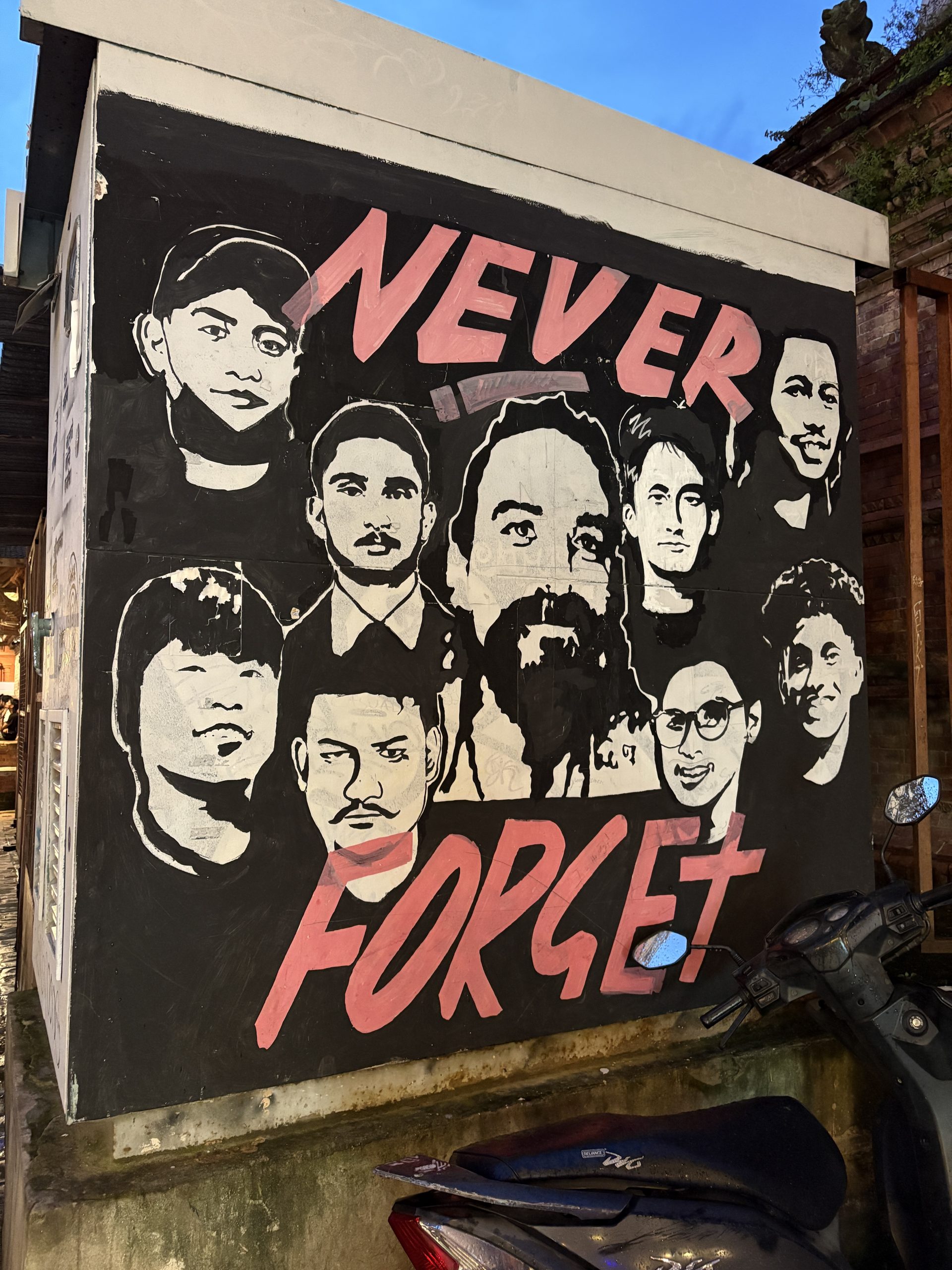
A tribute to the Gen-Z martyrs who were killed by security forces during the street protests.
I don’t mean to suggest that the direct object of the Gen-Z movement should be to address the legacy of the civil war, or that survivors of the civil war should be at its helm. But, my limited understanding of the Gen-Z uprising revealed obvious parallels and commonalities between the root causes of both periods of upheaval. Thus, I expected our discussion with the Gen-Z leaders to reveal a vibrant coalition of youth advocates and survivors’ advocates, united by common grievances and a mutual desire to craft a more just society. As it turns out, this vision of mine was ill-informed.
Many of the Gen-Z activists voiced similar understandings of their movement’s root causes: unequal access to justice, a lack of government accountability, extensive political corruption, and political capture of wealth (see: the #nepobaby trend on social media). Many of these points overlap neatly with the grievances that led to Nepal’s people’s war. As I sat listening to their accounts, the gears began to turn in my head. Could a broad coalition of Gen-Z and survivors’ advocates be what it takes to kickstart the dormant TJ commissions and curtail government impunity? It seemed logical, almost obvious.

Street graffiti of a smiling Bhairav Aryal, a famous Nepali satirist who often wrote about political corruption and inequality, as well as Kafkaesque bureaucracy. Aryal died by suicide in 1976. The text beneath reads: “Be happy.”
I later learned that while the survivors movement often exhibits solidarity for the Gen-Z movement, this relationship is rarely bilateral, and a far cry from an active partnership. Furthermore, the Gen-Z movement itself has fractured along political lines. The broad mandate of anticorruption is too vague to support a single comprehensive vision of societal transformation. As I sat at the round table of Gen-Z leaders, I began to observe a hint of venom that permeated their otherwise friendly interactions.
Some speakers were communists, others favored capitalist economic development before social reform, others seemed to idealize a form of social democracy. I later learned that one of the subgroups was royalist. Though our discussion focused on background details of both the uprising and the Nepali Civil war, disagreements abounded. After our meeting, Ram informed me that had it not been for the efforts of his friend Lenin, a survivor and Gen-Z leader, these up and coming 20-somethings would never even be in a room with each other.
It was naive of me to expect that such a nascent political force would display the same united front that took survivors over twenty years to achieve, or even to draw a parallel between a movement for regime change and a survivors movement for social justice. However, I find it disheartening that members of the Gen-Z movement seem to view the survivors and their ongoing struggles as either a concluded chapter of Nepal’s history, or a group not worth learning from. This movement is still young, and I have hopes that a united front will rise above individual political aspirations to carry forth the objectives that all protestors agreed on.
I don’t know that I even have a coherent point or insight to conclude this blog with. The more questions I ask, the more confused I become. The deeper we dig on any political coalition or ideology, the more fissures present themselves. Tune in next time for when I figure out Nepal and solve all of the problems single-handedly.
Just kidding.
Posted By Joe Finkelstein
Posted Aug 17th, 2026