

We had already passed the house once. Actually maybe even twice. Minh, the outreach worker with whom I am currently working to meet the new beneficiary families, was trying to recognise the right road while we moved slowly between small houses and fields. A few minutes later, he announced that we had to turn back with a huge smile. I took a picture of him at that exact moment, partly because I was beginning to recognise this as a familiar part of our field visits.
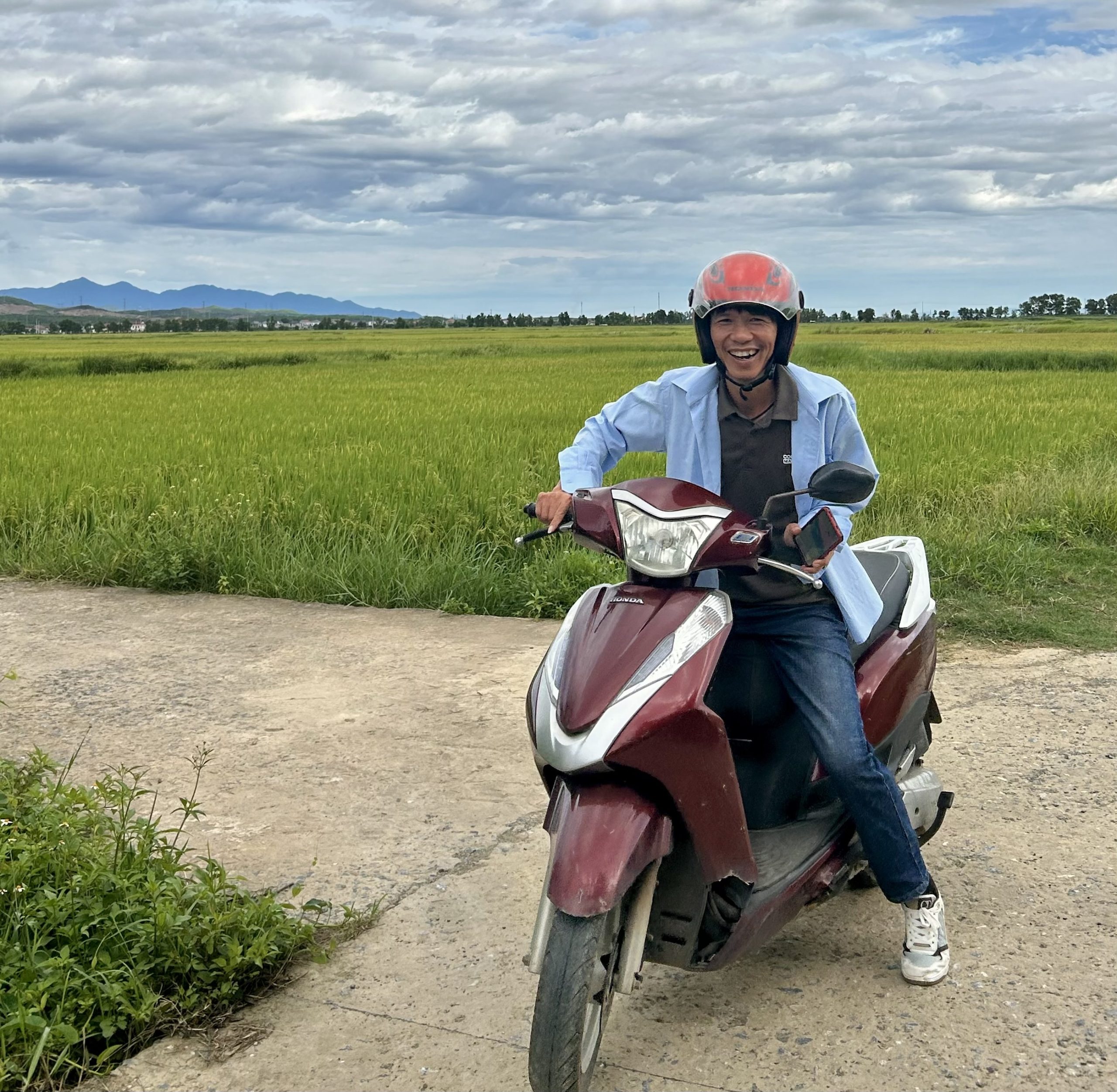
Minh, outreach worker at AEPD.
When we finally arrived, the house looked simple. The walls were unfinished, three main rooms opened onto a corridor, and a small kitchen stood partly outside. Someone was already waiting for us in a wheelchair. This was Thach.
Hien, my translator, began introducing me to the family. There was Thach, the father, a former soldier. His wife was sitting nearby. Their youngest daughter, Cuc, was inside the house. And then there was Duong, their son. It took me longer to understand that he was also the person holding much of the family’s life together.

Cuc, her mother, Thach and Duong
I had already noticed how tired everyone looked. Not the tiredness of one difficult day, but something deeper. The kind of exhaustion that seems to settle into a face when illness, money and responsibility have stopped being temporary problems and have become part of everyday life. As we spoke, the reasons slowly became clearer.
A family shaped by illness
Thach served in the Vietnamese army between 1970 and 1975, both as a soldier and in logistical support. He remembers seeing aircraft spraying the area where his unit was based. He described the products as odorless and colourful: purple, green and orange. At the time, he believed they were simply herbicides being used to destroy vegetation and make it more difficult for soldiers to hide in forests and caves.
Thach was horrified by the scene of desolation and death that engulfed the natural environment. He recounted how the aircraft continued to spray the chemical until not a single living tree remained in the forest. He did not know what the long-term consequences might be
Years later, Thach developed serious health problems. Today, he suffers from neurological disorders, chronic muscle pain and osteoarthritis. He can no longer walk and uses a wheelchair. The pain cannot simply be treated and forgotten. He depends on painkillers to manage it.
His youngest daughter, Cuc, now 31, has significant congenital disabilities and is bedridden since her birth. She has been officially recognised as a victim of Agent Orange exposure.
The family’s eldest son also lived with severe physical and intellectual disabilities before dying at the age of 23.
And then there is Thach’s wife. She has lung cancer and pulmonary tuberculosis. Her illness has changed the balance of the entire household. For years, she had been one of its main caregivers. Now she needs care herself. That change is one of the most difficult parts of the family’s story.
When the caregiver becomes the one who needs care
For most of their lives, Thach and his wife were farmers.
When their first child was born with severe disabilities, they did not understand why. When Cuc was later born with similar needs, they suddenly found themselves caring for two children with significant disabilities while trying to earn enough money for the family to survive.
There was no possibility of simply stopping work. They needed food. They needed a home. They needed to pay for medical care. So they worked.
For years, caregiving and earning an income existed in constant tension: if they stayed home, they could provide care but not earn money; if they worked, they could earn money but had to leave the people who needed them.
Until 2001, the family did not even have a permanent house of their own and lived in accommodation provided by the commune. Eventually, their children grew older, but the need for care did not disappear. Neither did the illnesses.
For a long time, Thach’s wife continued caring for Cuc while also managing the household.
Then cancer entered the family. And suddenly the woman who had spent decades caring for others was no longer physically able to do everything she had always done.
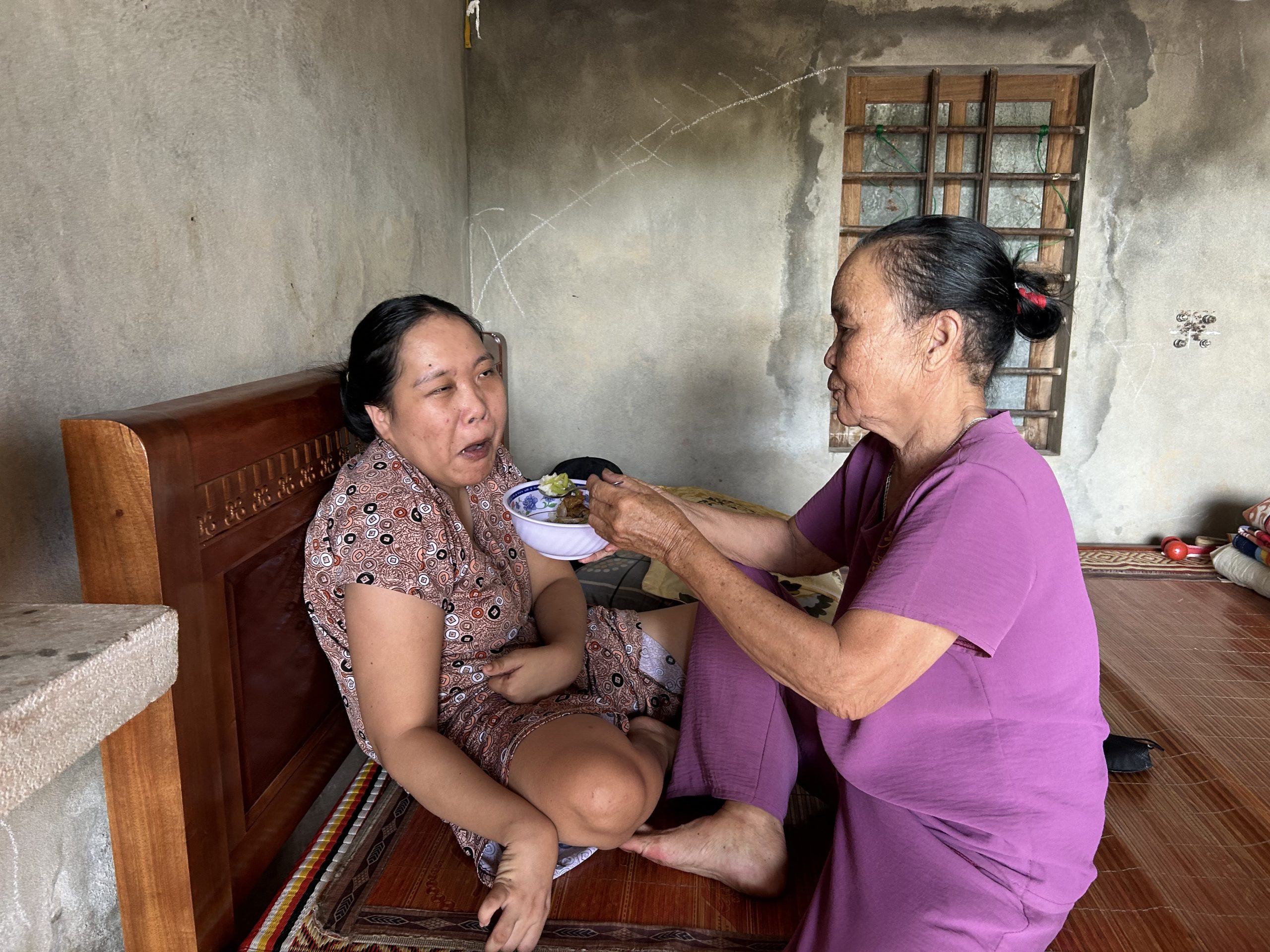
Cuc (victim of Agent Orange) and her mother during the lunch time.
Someone else had to step in. That person was Duong.
The job he had to leave
Until recently, Duong had a very different life. He worked as a restaurant manager and was able to send around one to two million Vietnamese Dong home to support his family. He had a job, an income and plans of his own.
In January 2026, he came home. His mother’s health had deteriorated, and the family began travelling from Dong Hoi to Hue and eventually Hanoi trying to find suitable treatment.
Someone had to accompany her. Someone also had to remain available for his father, who cannot walk, and Cuc, who cannot care for herself. Duong eventually left his job completely.
It was not presented to me as a dramatic decision. He spoke about it quietly, almost as though there had never really been a choice to make. His family needed him. So he came home.
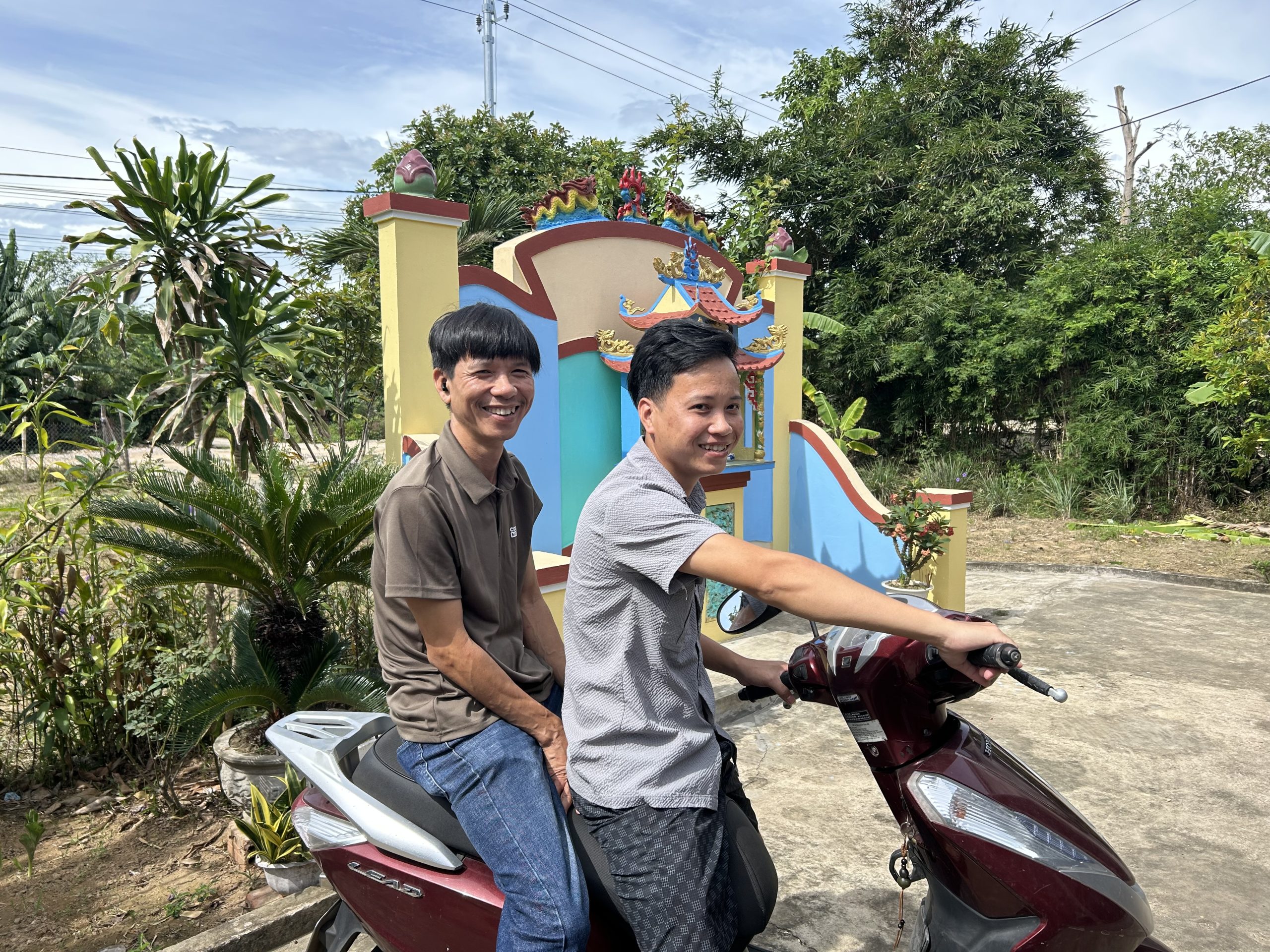
Minh and Duong, who was happy to ride the scooter to go to the market.
Since then, his life has been organised around the needs of others. When his mother has treatment in Dong Hoi, Duong accompanies her to hospital. While they are away, usually for a week per month, his older brother comes back to stay with Thach and Cuc.
Care has become a system of constant substitution. If one person leaves, another must arrive. If one person becomes ill, somebody else must reorganise their life. And there is very little room for anything to go wrong.
The cost of caring
The financial pressure has become particularly severe during the past few months. The family told me that medication alone can cost around 15 million Vietnamese Dong each month (around $575).
For the first month, they used their savings. The following month, people in the commune organised a collection and gave the family 12 million dong. The month after that, a relative contributed another 10 million.
But these are temporary solutions to a problem that returns every month. There is no clear plan for what happens when those sources of support disappear.
When we discussed this, Thach explained that if the family no longer has enough money, he will reduce what they spend on his painkillers so that his wife can continue receiving treatment.
I remember that sentence particularly clearly. There was something deeply loving in it, but also something uncomfortable.
A family should not have to decide whose pain can be tolerated because there is not enough money to treat everyone. Behind every figure in a household budget, there is a choice. Medicine for one person. Transport to hospital for another. Food. Water. Care.
And sometimes somebody has to give something up.
The invisible work
Caregiving is easy to describe as a list of tasks.
- Helping someone move.
- Preparing food.
- Accompanying someone to hospital.
- Cleaning.
- Managing medication.
- Watching over someone who cannot safely remain alone.
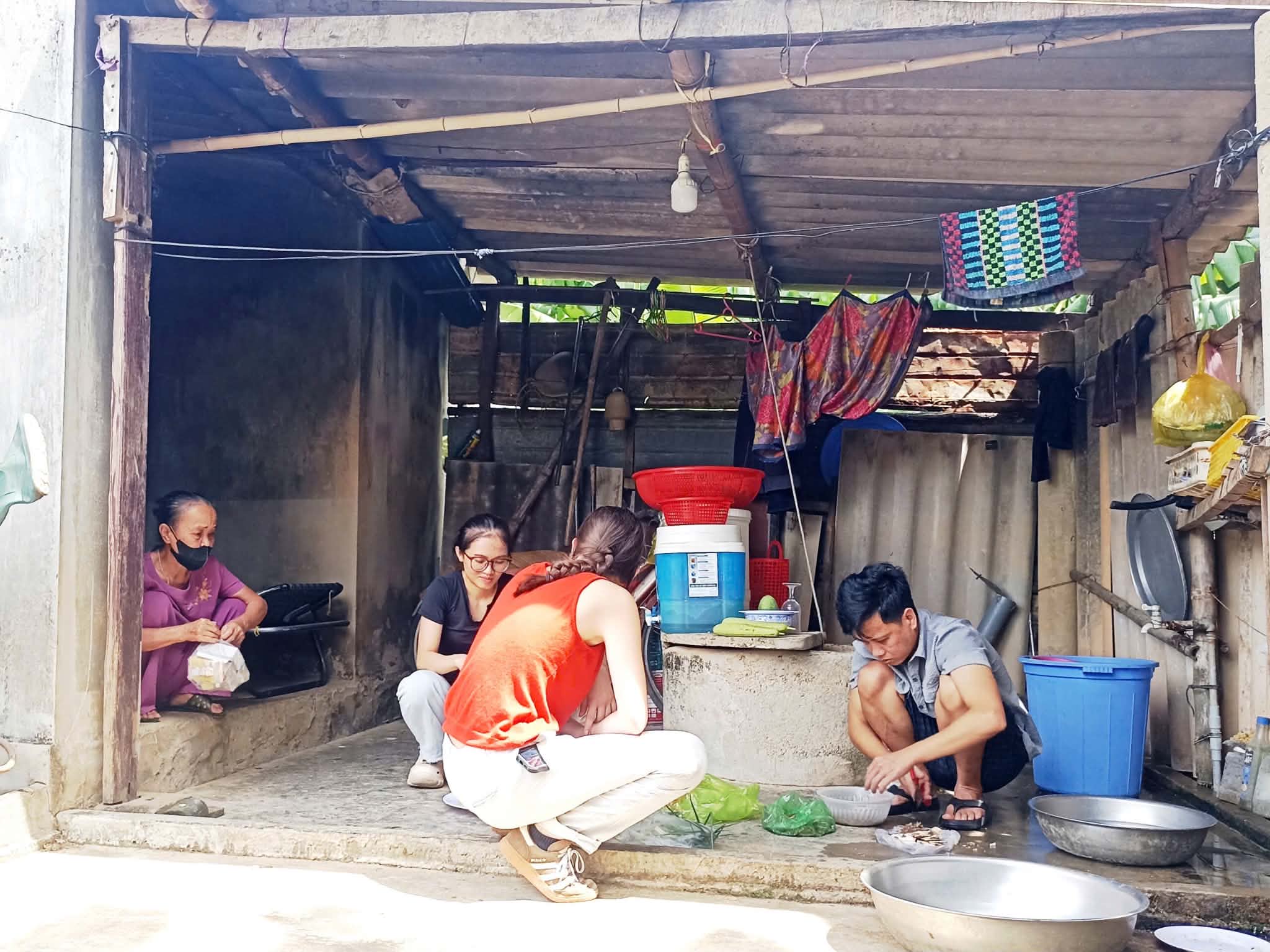
Hien, me and Duong preparing the meals in the kitchen.
(Meals are deeply social, and helping to prepare them can also be a way of entering, however briefly, into the rhythm of family life. In a household where so much revolves around care, that moment in the kitchen felt especially significant: ordinary, warm and deeply human.)
But spending time with the family made me realise how incomplete that description is. There is another kind of work that is much harder to measure.
It is remembering appointments. Thinking about money. Wondering what will happen next month. Listening when someone is frightened. Making sure someone is not alone. Changing your plans because another person’s condition has changed. And carrying the constant knowledge that if you stop, even temporarily, someone you love may suffer.
Duong told me he was exhausted. He said it simply. There was no attempt to make his situation sound heroic.
He had already been hospitalised himself several times because of stomach problems. On one occasion, he left the hospital before doctors recommended it because his mother’s condition had deteriorated and he felt he needed to return home. Even his own health had become something that could be postponed.
That may be one of the most difficult aspects of caregiving: the person providing care can slowly disappear behind the needs of everyone else.
“I feel like a burden”
Later, we sat beside Cuc. She smiles easily. Her vocabulary is limited, but she can communicate when she is happy, hungry or sad. She likes television and especially music.
While we were speaking, her mother sat beside her and gently stroked her leg. It was obvious how close they were.
When I asked who mainly takes care of Cuc now, her mother began to cry. She told us how grateful she was that Duong had returned home.
But gratitude was not the only feeling. She felt guilty. She knew that her son had left his job. She knew that his own plans had been interrupted. She knew that he was tired. And she felt responsible for it. She said that sometimes she imagined how much easier his life might be if she were no longer there.
It was one of those moments when an interview stops feeling like an interview. I hugged her almost without thinking.
Then I looked towards the next room. Thach was sitting alone in his wheelchair. He was crying too. There was nothing useful left to ask.
A future waiting outside the house
After the conversation became too emotional, we decided to go outside with Duong. AEPD and the Advocacy Project had recently helped the family acquire a calf. This project is the most suitable to Duong after evaluation of the outreach workers. It is something Duong can manage while remaining close enough to the house to care for his family.
He already knew something about raising livestock from his childhood. AEPD helped the family find a seller and provided guidance on diseases and animal care. Duong built the shelter himself. The plan is to raise the calf until it becomes a cow, eventually allowing the family to generate some income.

Duong explaining us his project with the calf.
When we reached the shelter, I had just enough time to take one photograph before the calf suddenly started charging towards us. The four of us ran.
Minh, Hien, Duong and I ended up escaping through tall grass and cow pats before finally reaching safety. Then everyone started laughing. After such a difficult conversation inside the house, the change was immediate.
For a few seconds, Duong was not explaining medical bills, hospital journeys or caregiving responsibilities. He was simply laughing with us because we had almost been chased across a field by a calf. I think that moment stayed with me because it reminded me of the life that still exists alongside responsibility.
Duong talks about opening his own restaurant one day. He is an excellent cook, and the lunch we shared that afternoon made that immediately obvious. When he speaks about the possibility, there is still hope in his face. For now, that future remains suspended. He is waiting for his mother’s condition to become stable enough for him to imagine returning to work, and perhaps one day building something of his own. But the longer care responsibilities continue without outside support, the greater the risk that his future will keep receding behind the urgent needs of the present. Duong’s story is therefore not only about sacrifice. It is also about potential: a capable young man with skills, plans and energy, whose future should not have to disappear simply because his family needs care.
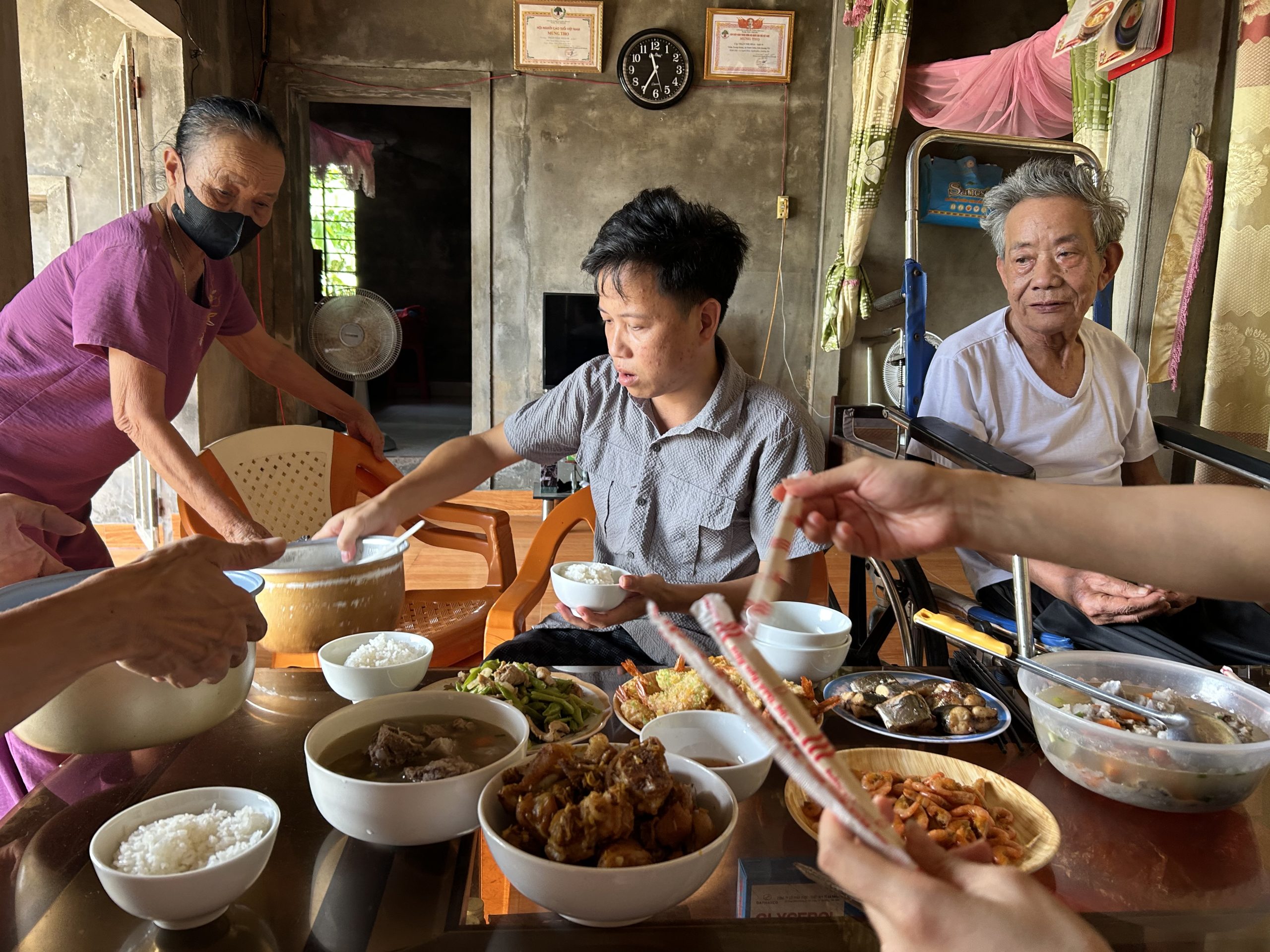
The mother, Duong and Thach during the lunch time.
But his future currently depends on the health of several other people.
Who takes care of the caregiver?
Before leaving, I asked the family what message they wanted this article to carry. Their answer was simple: share their story so that people might help. I promised I would try.
I left the house thinking about Cuc, about Thach’s pain, about his wife’s cancer and about the financial uncertainty facing the family.
But I kept returning to Duong. Caregivers are often present in stories about disability without becoming part of the story themselves. Because their work is so constant, it can almost become invisible. Yet without them, entire systems of support would collapse.
Duong did not become a caregiver because he applied for the role or because it fitted into his plans. He became one because the people he loves needed him.
And perhaps the question should not only be whether he will continue taking care of his family. He clearly will.
The question is who will make sure that, while he does, he is also able to preserve something of his own health, independence and future.
Because caring for victims of Agent Orange should also mean caring about the people who spend their lives beside them.
Clothilde Soenen
Posted By Clothilde Soenen
Posted Aug 16th, 2026