

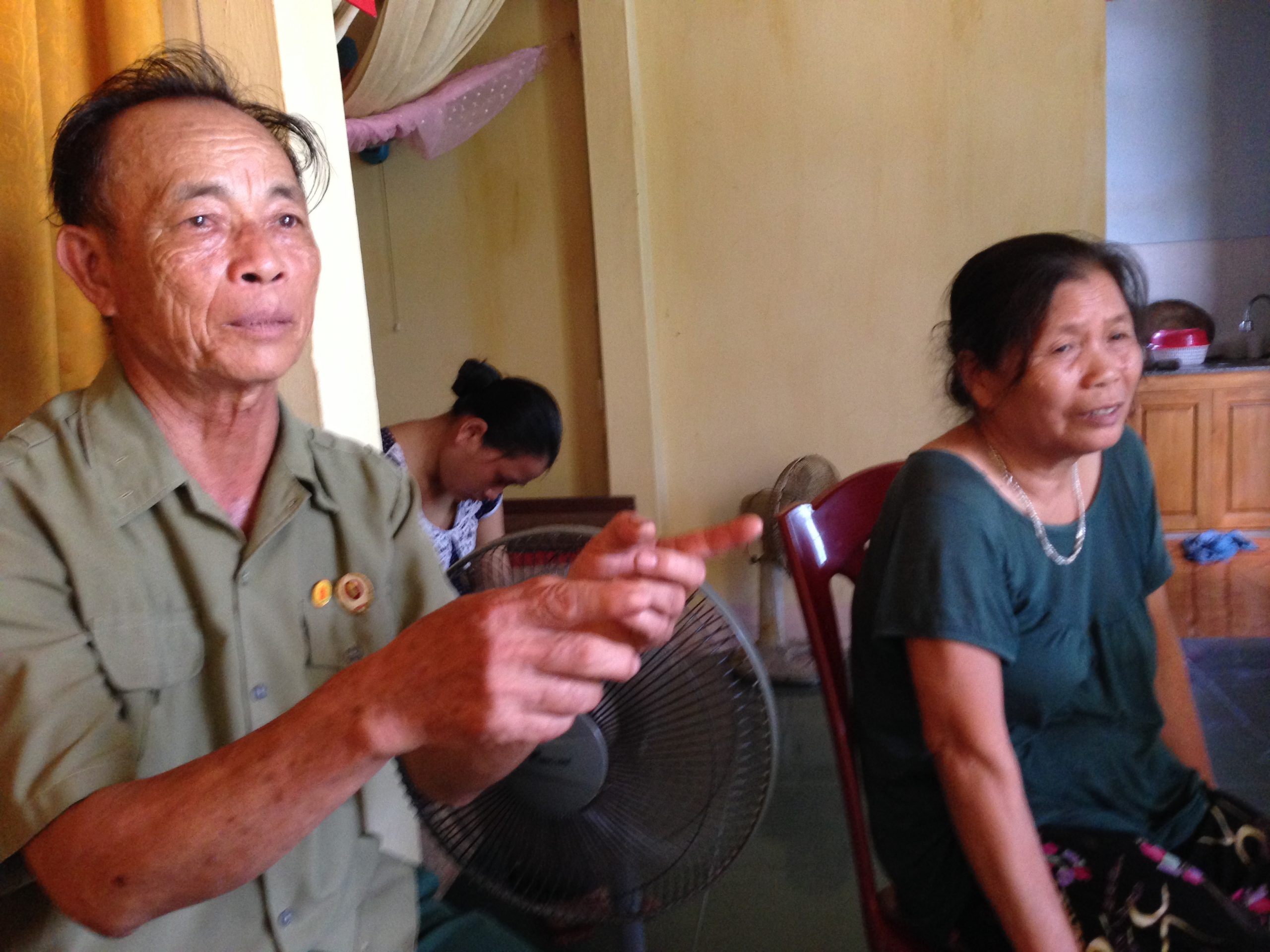
Le Van Dung and his wife Dang Thi Miet, both veterans, have produced thirteen children and lost twelve to Agent Orange. Their thirteenth child, Li Thi Ngoc Thuy, has severe symptoms and their grand daughter is suffering from partial blindness.
Geography has played an important role in the way we remember the Vietnam war. Who has not heard of Dan Nang, Bien Hoa, the Ho Chi Minh trail, Hue, Khe Sanh, My Lai, Saigon and Hanoi?
Quang Binh province is less well known, even though it was here that the North Vietnamese began channeling supplies to the south through the Ho Chi Minh trail. The province lies just north of the Demilitarized Zone (DMZ) that separated South Vietnam from the North and was, as a result, largely spared from spraying. Operation Ranch Hand deposited 3,900 gallons on Quang Binh, compared to the 1.8 million gallons dropped around the Bian Hoa aid base in Dong Nai province. (Figures from the Aspen Institute).
And yet, in spite of generally being largely spared from spraying, Quang Binh has been heavily affected by Agent Orange. The reason is that thousands of soldiers from the province went south to fight and were exposed to Agent Orange. They then returned home when the fighting stopped and passed dioxin poisoning to their children at conception.
According to one 2013 report from the People’s Committee of Quang Binh, 5,266 individuals in Quang Binh were receiving compensation for illness associated with Agent Orange that year. Of these, 1,411 were sick soldiers and 2,324 were family members who were classified as “indirect” victims.
The lack of correlation between spraying and sickness helps to explain why it has been difficult to estimate the overall number of Vietnamese affected. Early on, the Vietnamese Red Cross came up with an estimate of around 3 million, which has struck many as a wild exaggeration but was not dismissed out of hand by a 2012 report from the US Congressional Research Service. The CRS team was also told that 365,000 Vietnamese veterans and family members had been diagnosed with a related medical condition.
Another reason for the fuzzy numbers is that the exact process of transmission remains a medical mystery. The best guess is that dioxin poisoning scrambled the DNA of the fetus at conception. Common sense would certainly suggest that Agent Orange was behind the twelve consecutive miscarriages suffered by Dang Thi Miet (photo above), given that she was exposed to spraying while on active duty during the war.
But it has been impossible to prove this medically. One reason is that most of the dioxin carriers have also produced healthy children. How and why some siblings succumb while others are spared is not known, but this fiendish lottery does make it impossible to show a necessary cause and effect between Agent Orange and sickness – a fact that has been exploited by chemical companies that have been unsuccessfully sued in the US.
Also, when a death occurs, the cause is most likely to be recorded as one of many opportunistic ailments that preys on the weakened DNA or immune system of victims. In one example known to us personally, Nguyen Van Xoan’s son Tuan suffered from paralysis in his legs for years. But it was hemofilia that killed him in 2018.
Faced by the medical uncertainty, but confronted by the very real fury of American veterans, the US government gave up the effort to pinpoint a medical diagnosis. Instead, it agreed that all US service members who served in Vietnam between 1967 and 1971 should consider themselves as having been exposed to Agent Orange and offered to pay for the treatment of any one of 20 serious medical conditions linked to Agent Orange that are still listed on the website of the Veterans Administration. Vietnam followed the same approach and used almost the same list of ailments.
In other words, both governments agreed that Agent Orange was guilty beyond a reasonable doubt – even if the medical evidence was inconclusive. One thing is not in dispute, however: dioxin poisoning has worked its way into every region of Vietnam, every level of society, and every living generation.
Read the story of Le Thanh Dung, Dang Thi Miet and their 12 missing children
*
Posted By Iain Guest
Posted Jan 20th, 2026