

My first visit took me to the Quảng Kim Commune to meet the family of Mr. Giả Thanh Kiểm. The commune lies 62 kilometers from the city, about an hour and twenty minutes’ drive from the AEPD office. I set off with Mai, who would be my translator for the field visit to the two families AP and AEPD hoped to support this year. Along the way, we picked up Lưu, the AEPD outreach worker who had first connected with these families. He was full of energy, speaking rapid-fire Vietnamese punctuated by bursts of hearty laughter. His warmth was infectious and reminded me faintly of my dad and uncles in Fuzhou.
AEPD has three outreach workers, Lưu, Nguyên, and Minh, who are all persons with disabilities similar to the families they work with. Lưu and Nguyên are landmine survivors, while Minh is an Agent Orange victim. Their situated knowledge is central to AEPD’s approach, which values the insight and trust that comes from lived experience. As disability activist Mia Mingus writes, non-disabled people often see disability only as an individual medical issue or personal tragedy, but for disabled people, it is a multifaceted, embodied experience shaped by social, political, and material contexts.
“The power of access intimacy,” Mingus reminds us, “is that it reorients our approach from one where disabled people are expected to squeeze into able-bodied people’s world, and instead calls upon able-bodied people to inhabit our world.”
Rather than treating disability as an abstract problem, AEPD relies on those who know its realities firsthand to guide and support others in the community, practicing the very concept of access intimacy that Mingus calls for. In this spirit, all field visits are led by the outreach workers themselves.
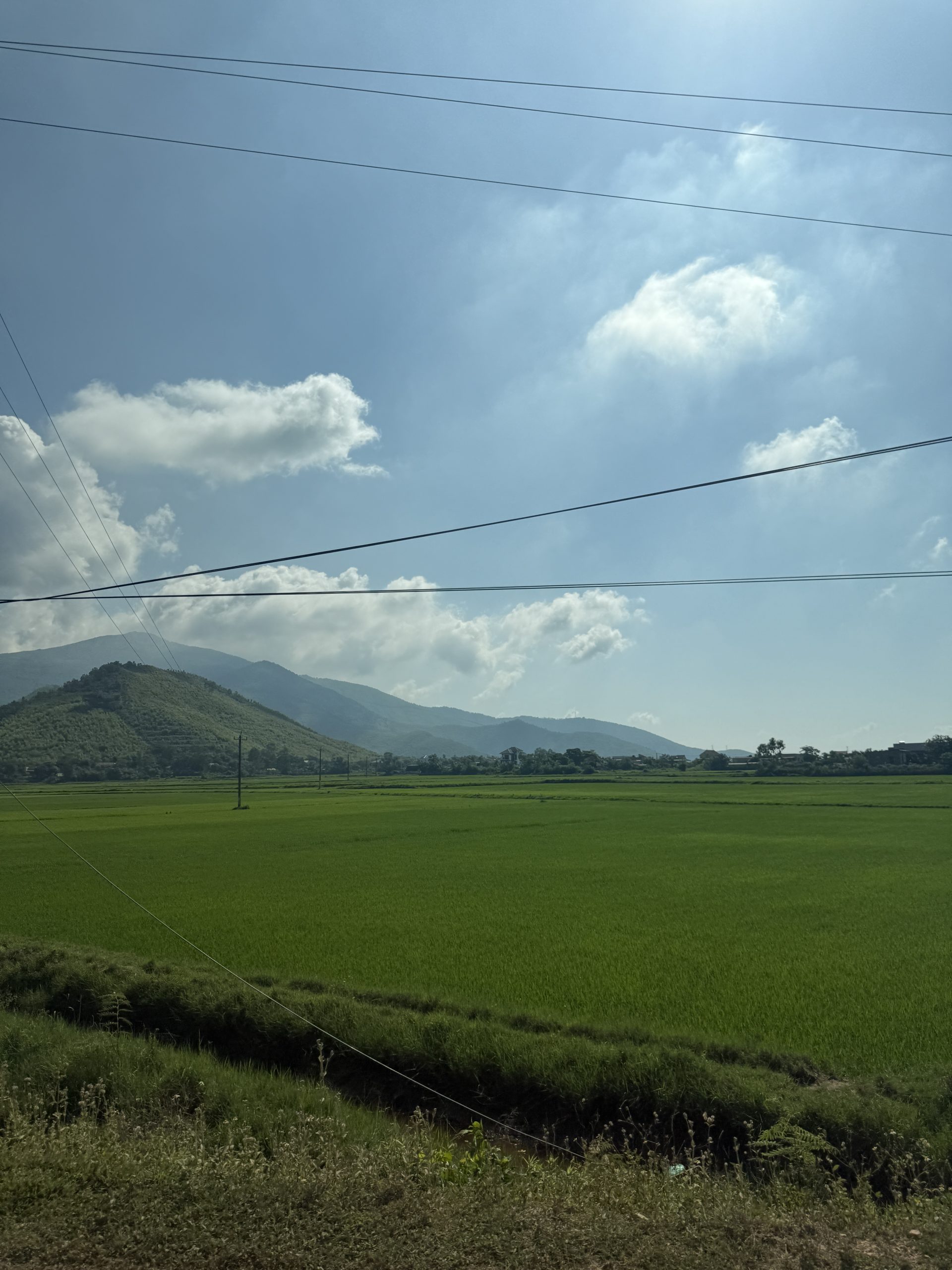
Road to the Quảng Kim Commune
For our first visit, Lưu took the lead, guiding our driver along a series of winding roads until we reached the Quảng Kim Commune People’s Committee office. There, we met Thanh, the commune officer for Culture and Social Affairs, who would accompany us to the families. We continued down various dirt paths for several minutes and crossed a narrow bridge, getting lost twice before finally arriving at the first house.
The house was modest and weathered, with a corrugated metal roof and faintly colored concrete walls. A few chickens darted around the small yard, and two Muscovy ducks that looked like turkeys waddled by, unbothered by our arrival. Waiting for us was Kiểm’s wife Minh, a warm, middle-aged woman with a lively two-year-old daughter named Anh. She quickly ushered us to a wooden table to the side of the house, surrounded by five bright orange plastic chairs.
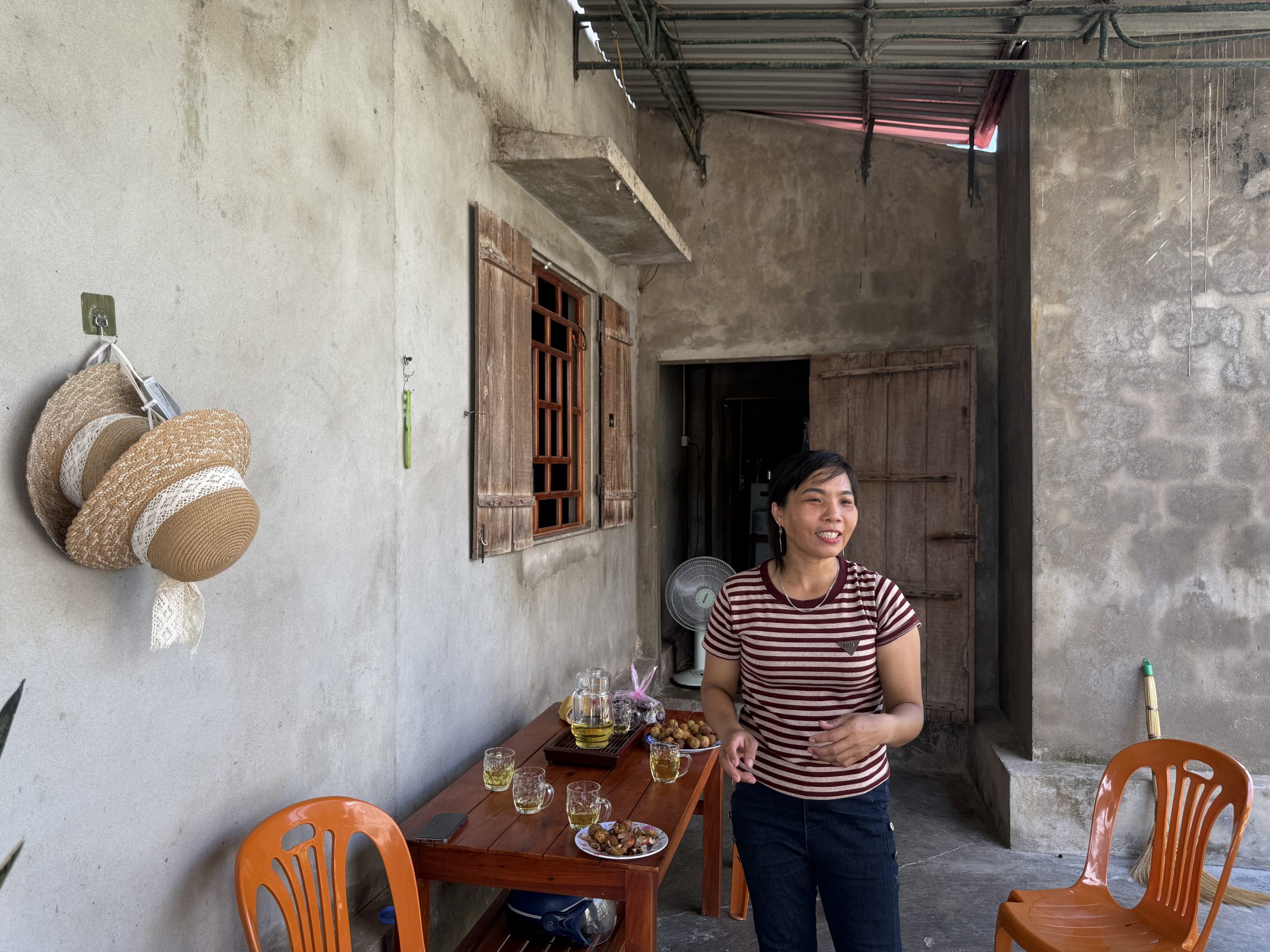
Mrs. Phan Thị Minh

2-year-old Anh
A pot of tea and a plate of lychee sat waiting. She poured each of us a cup, pulling Anh to her lap and brushing her hair back into a neat ponytail. Conversations overlapped as the four adults spoke easily around the wooden table. Mai reached to hold Anh’s small hands, her voice rising and falling in gentle, playful tones that made Anh giggle and flash two fingers in response. Beside them, Lưu spoke with energy, gesturing freely and drawing laughter from Minh and Thanh.
We began the interview with Mai giving introductions before moving on to the list of questions I had prepared. That morning, Kiểm had gone out to the forest to collect bamboo leaves for temporary work, so we spoke with his wife Minh instead. She spoke softly, her brows furrowed as she described their life, the four of us listening intently.

Minh (left), Lưu (center), Mai (front), and Thanh (right)
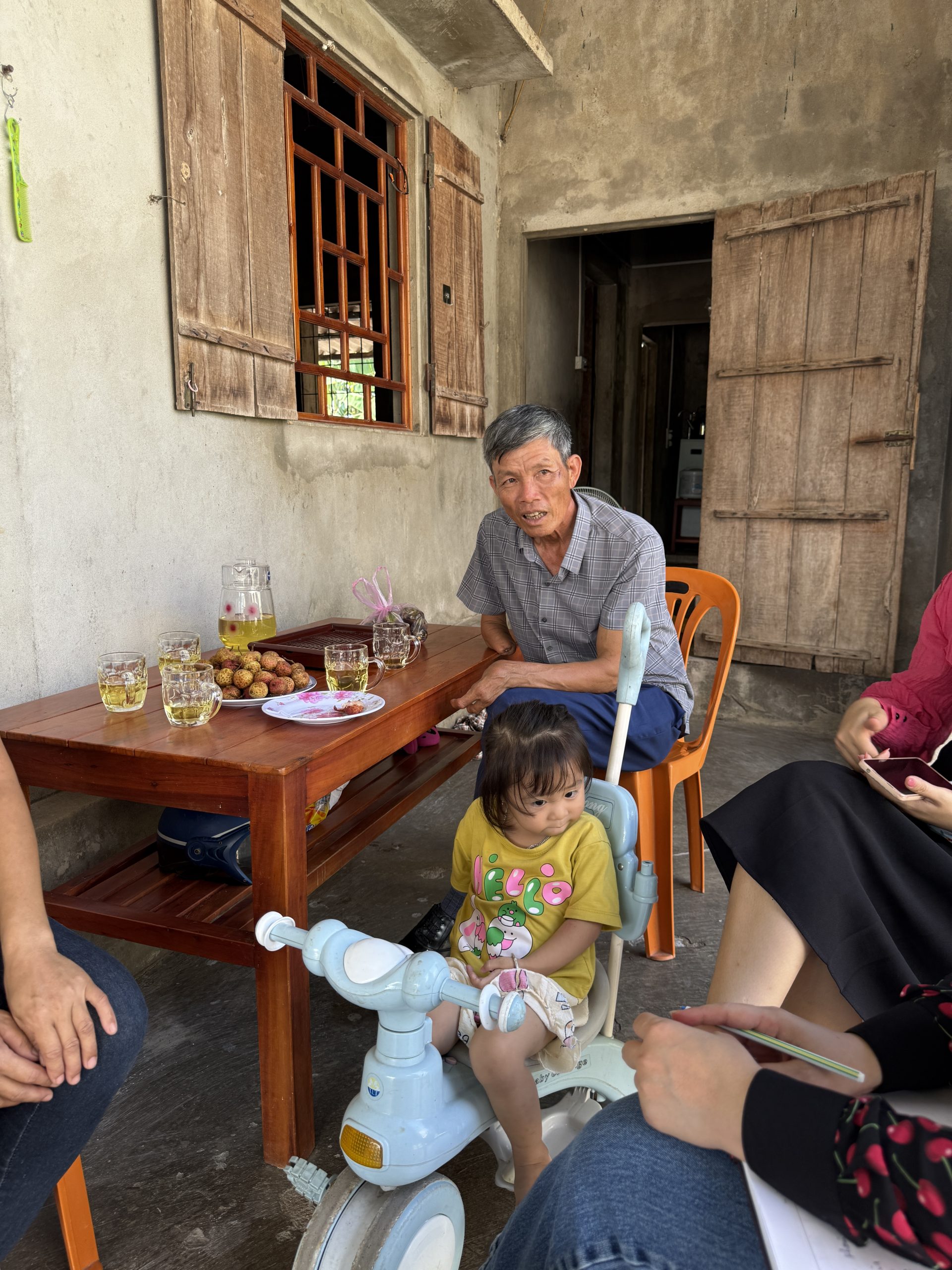
Baby Anh (center) and Lưu (back)
Kiểm was a second-generation Agent Orange victim, meaning he was born with dioxin poisoning passed down from his father, who had suffered direct exposure during the war. Unlike most U.S. soldiers who had acute, direct exposure to Agent Orange during the war, Vietnamese communities have endured continuous, transgenerational exposure (USIP, 2023). Agent Orange’s impact spans generations, harming children, grandchildren, and even great-grandchildren of those exposed. For Kiểm, the dioxin had resulted in chronic weakness, epilepsy, and infertility. After years of trying to have a child, the couple eventually adopted Anh from Ho Chi Minh City.
In Vietnam, households with disabilities are twice as likely to live in poverty as those without (USIP, 2023). Recent data from the Vietnamese Ministry of National Defence (2025) shows that 70% of Agent Orange-affected families live below the poverty line. The Gia family is one of them, earning a monthly income of about 420,000 VND ($16), supplemented by a government allowance of 1,600,000 VND ($61) for assistance to Agent Orange victims.
Minh shoulders the bulk of care work and labor: tending to their small plot of land, caring for Anh, and taking on small jobs like gardening and catering to make a little more money for the family. She explained how AP’s livelihood sponsorship, a breeding cow, would more than double their income. But when asked what would help most urgently, she pointed to the house.
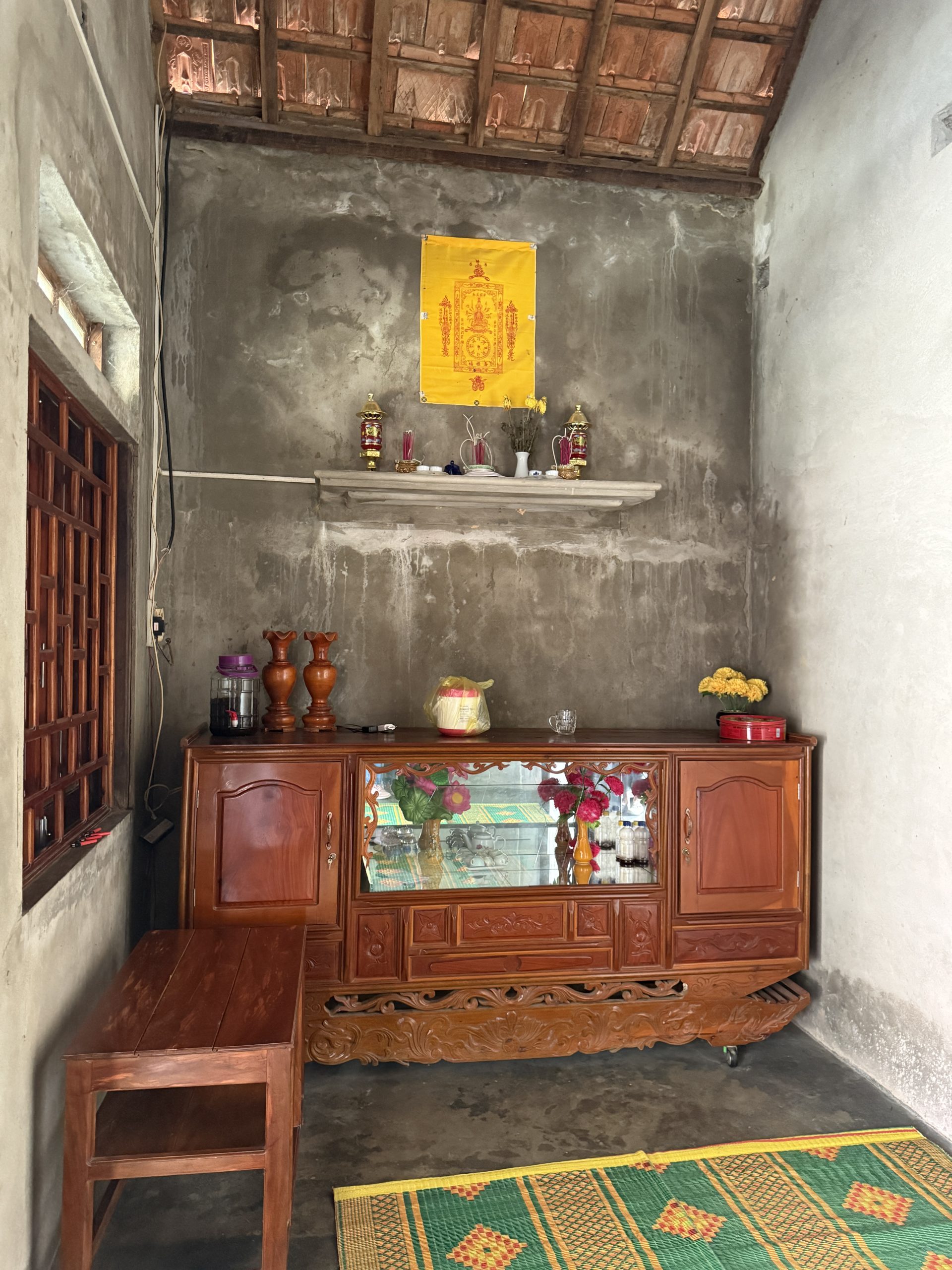
Entrance to the house
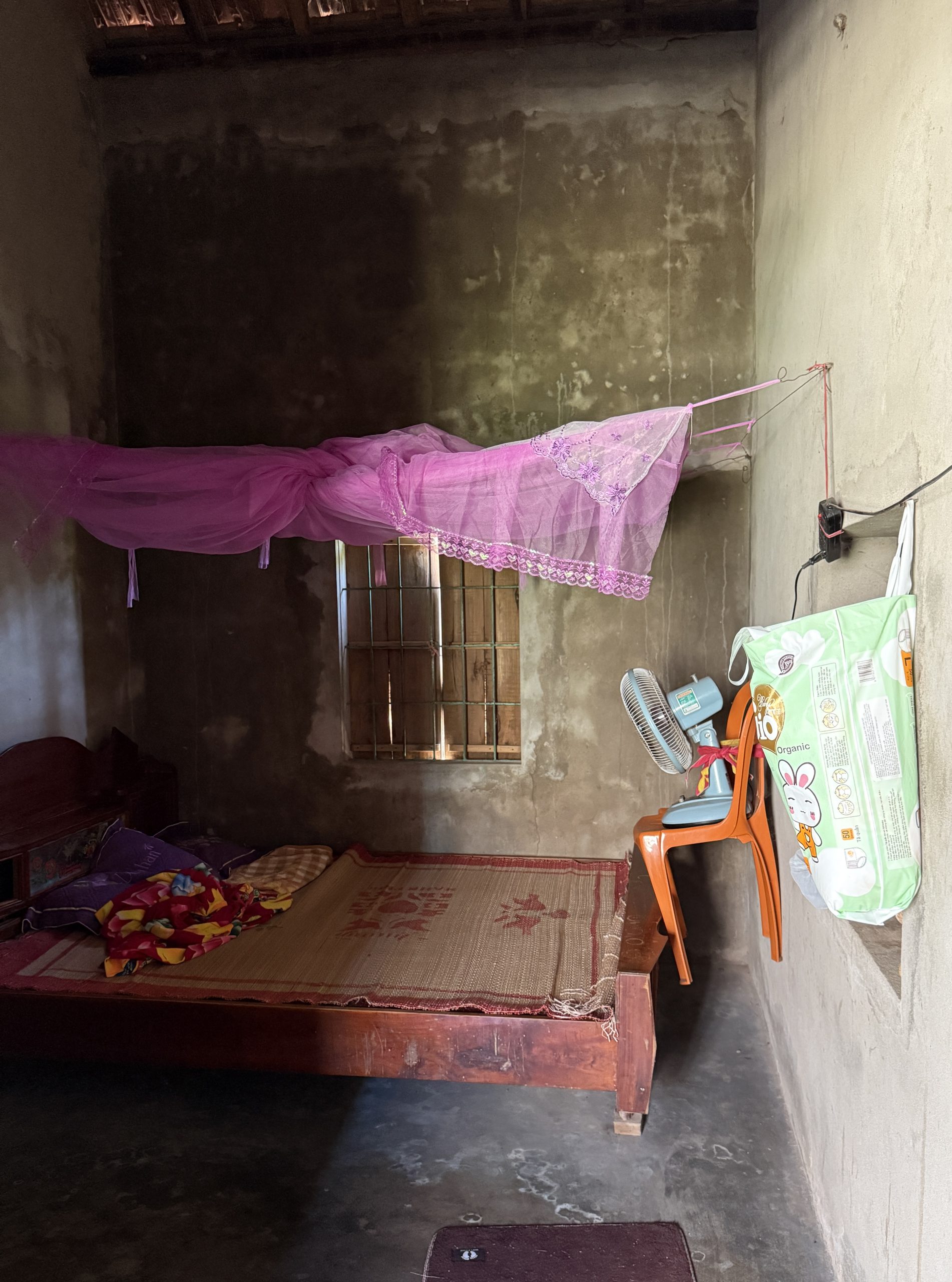
The family’s bedroom
Minh led us through the front entrance, where an ancestral shrine sat above an ornate wooden cabinet, with fresh flowers and a few sticks of incense burning on the altar. The space felt warm and welcoming. Just a few steps in, we reached the bedroom. A low wooden bed lay beneath a pair of colorful blankets, and across from it, a plastic chair was tied to the wall to hold a small electric fan for the sweltering heat. A bag of baby diapers hung neatly beside it. Behind the bedroom was a small kitchen; a single gas burner rested on a wooden cabinet, surrounded by sauces, spices, and a bowl of limes. As we moved through the narrow hallway, little Anh ran back and forth, her footsteps echoing. Her bursts of laughter filled the space, and Minh smiled, amused.
She paused and pointed upward, drawing our eyes to the roof. There stood thin wooden planks, weathered and soft from the storms and typhoons common in Quang Binh. Each season, she explained, they brace for typhoons, knowing the roof might not hold. When the rain pours in, the family seek shelter with neighbors, returning only when the storm passes.
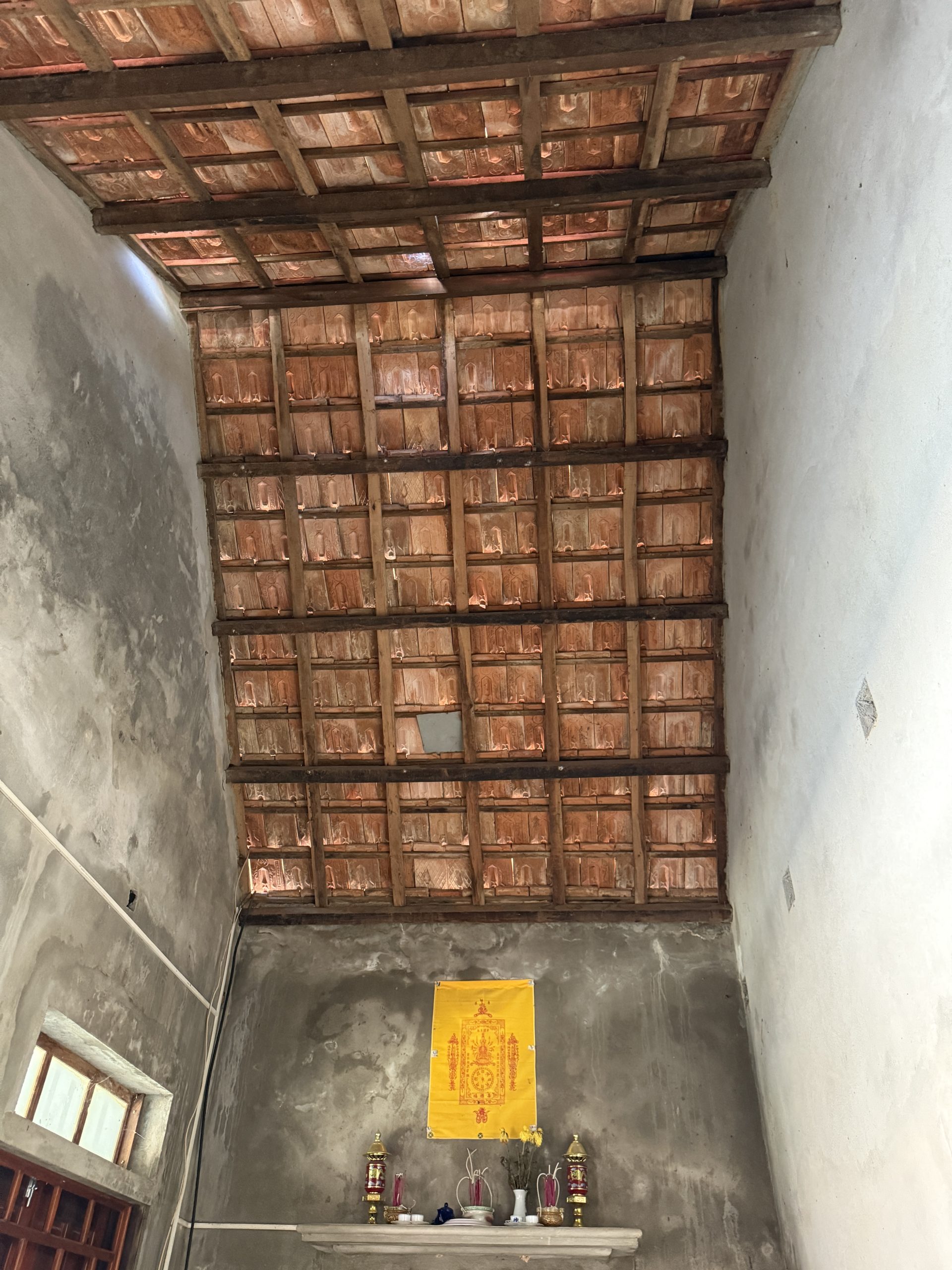
The roof, built by hand by Minh’s brother
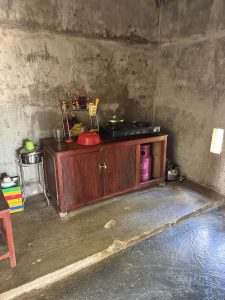
The family’s kitchen
Outside, Anh clambered onto the family’s old motorcycle, her small hands gripping the handlebars and her legs dangling playfully to the side. Lưu laughed and scooped her up, swinging her high into the air as she let out a bright, shrieking giggle that rang across the yard. Nearby, Minh, Mai, and Thanh stood together in quiet conversation, Mai reaching out to gently overlay her hands with Minh’s in a soft, reassuring gesture. Minh shared with us her hopes for the future: she wished for her husband to be healthy enough and live long enough to raise Anh together.
Posted By Angie Zheng
Posted Jul 20th, 2025
5 Comments
Iain Guest
July 21, 2025
What a wonderful, heart-felt portrait of this family! Really well written and very informative – and I can’t wait to read more! We don’t meet Kiem, who inherited dioxin poisoning from his father, but we get to know him through his family, lovingly portrayed. Your point about the second and third generation – and the persistence of dioxin – is well taken and you also give us some valuable information about the poverty that these families have to endure. It might help to have a bit more information about this for future visits, because it helps to explain why outside help is so important and what kind would work best. Does the government give any assistance at all to affected families – if so, how much? Does the family earn, and if so how much? Do they own their houses or pay rent?
Emma cohen
July 24, 2025
This is such a beautiful piece, Angie. Your discussion of access intimacy as practiced by AEPD is an important reminder of the power of their work. And your description of Kiểm, Minh, their house, and, of course, Anh, is really moving — communicating both the impact Agent Orange has had on their family and the deep love and affection they have for one another. I’m eager to hear how you and AP continue to work with them.
Aaron Bailey
July 28, 2025
This visit captures so clearly the layered realities of disability, care work, and resilience in rural Vietnam, I myself have learned about these realities here in rural Uganda, it is challenging indeed. I appreciated how Minh’s story didn’t just focus on material need, but also conveyed the emotional stability and hope she tries to build for her family — even while dealing with structural challenges like poor housing and income instability. The detail about the roof, and how they rely on neighbors during typhoons, is a powerful reminder that what we consider to be priorities sometimes do not align with theirs. Although hopefully the AP donated cow will lead to money to fix their roof.
Shuyuan Zhang
August 3, 2025
I really, really love the way you write—it’s not just storytelling but a way of seeing. The way you observe and weave emotions, context, and reflections together is so powerful and immersive. It helps me understand more about how disabled people think—not just from an outsider’s assumptions of what they need—and makes me start thinking more deeply about Agent Orange victims in Vietnam.
» Agent Orange Revisited – Outreach Workers in Vietnam | The Advocacy Project
January 27, 2026
[…] Hoc’s co-workers have been equally impressive. Hoang Van Luu’s parents were killed by American bombers in 1967 when he was three. He himself lost his right […]