
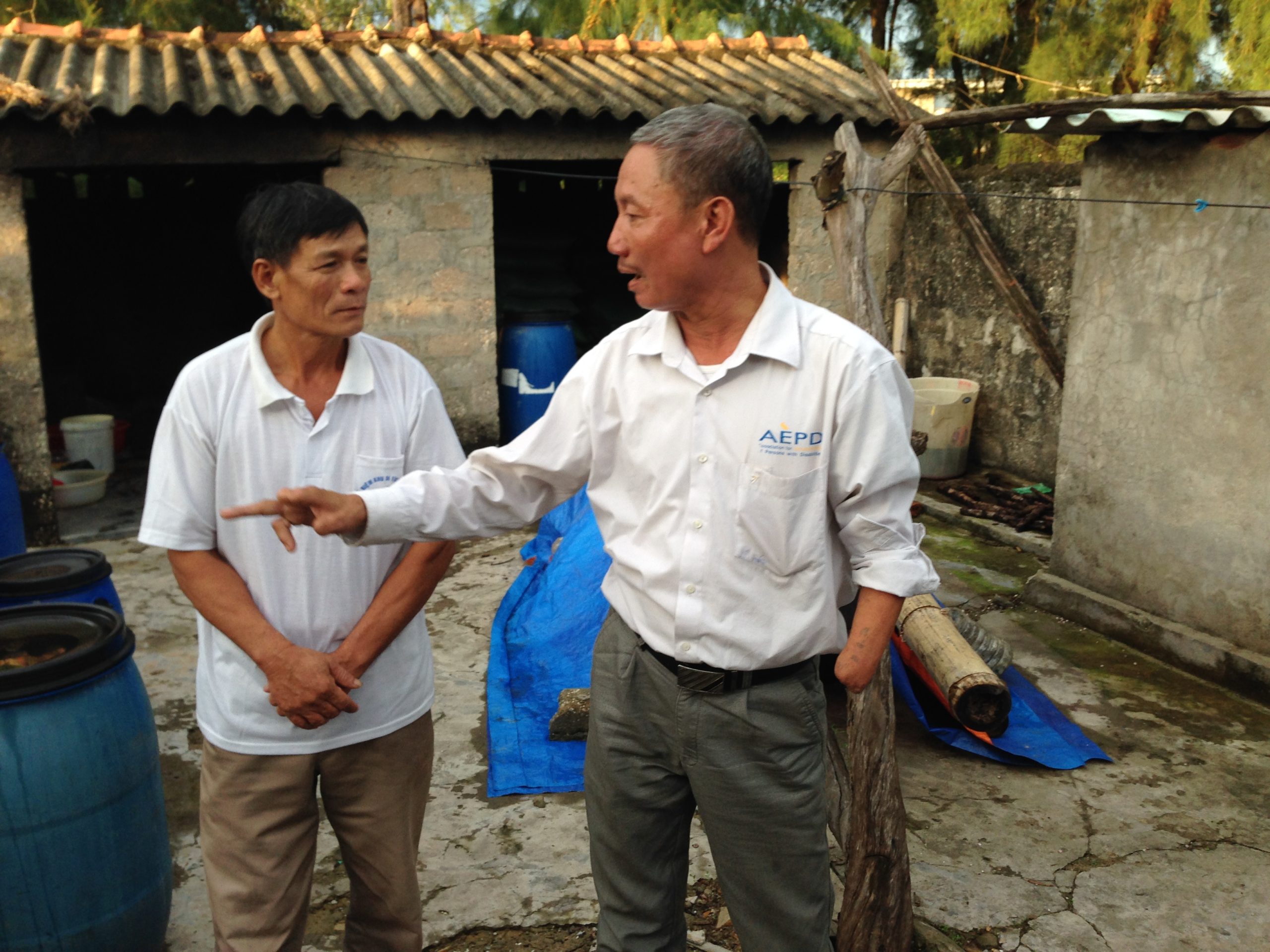
Man of authority: Le Thanh Duc gets advice from Nguyen Van Thuan, one of several outreach workers at the AEPD who have helped the 15 Agent Orange caregivers use their donations wisely. Mr Thuan lost his left arm and most of his right hand during a mining explosion in Cambodia in 1978. The outreach workers are much respected in the villages where they were viewed as war heroes.
In managing their grants, the Agent Orange families have been helped by several veterans who were themselves severely injured in the Indochinese wars and are at the heart of AEPD’s people to people model. Over the years these remarkable individuals have developed deep emotional ties to the families and become fast friends with our student volunteers.
Last summer Truong Minh Hoc accompanied our Peace Fellow Angie Zheng to the home of Ngo Gia Hue and his wife Tran Thi Thao, whose three daughters suffer from extreme dwarfism. It felt like a family reunion, as Angie wrote in a blog
“As soon as we arrive, Huệ greets Minh with both hands. They clasp each other tightly, leaning in with warmth. Huệ’s eldest daughter hurries forward and throws her arms around him. She holds his hand and doesn’t let go, smiling wide, while Minh laughs in his boisterous, easy way.”
Like the family he was visiting, Mr Hoc himself was exposed to Agent Orange while fighting in Quang Tri province during the war. He also knows the agony of having passed dioxin to a child. His oldest son is prone to wandering the streets alone.
Ten years earlier our 2016 Fellow Ai Hoang had profiled Mr Hoc in a blog and summed him up in one word – “kindness.” To this I would add tough. Mr Hoc was shot in the leg while serving in Laos in 1984 and went through six surgeries to save his leg. He was in constant pain while riding his bike out to villages.
Mr Hoc’s co-workers have been equally impressive. Hoang Van Luu’s parents were killed by American bombers in 1967 when he was three. He himself lost his right forearm and three fingers on his left hand after picking up an unexploded bomb four years later. Luong Thanh Hoai was blinded in one eye during the 1988 battle of the Truong Sa Sea between Chinese and Vietnamese forces.
Nguyen Van Thuan, another AEPD outreach worker, joined the army as an engineer in May 1978. Mr Thuan was on a mining mission in Cambodia three months later when a landmine exploded, destroying his entire left hand and three fingers on his right hand.
These grim experiences have given the AEPD outreach workers a unique insight into the challenges facing the Agent Orange families. I remember watching Mr Thuan advise Le Thanh Duc about his fish sauce while Mr Duc nodded respectfully, as if meeting with a superior officer (photo above). Mr Hoc was compassionate but firm in dealing with Mai Thi Loi’s breakdowns.
I remember visiting the home of Duong Thi Anh, a war widow. Her son Huong had lost his sight in one eye and was going slowly bind in the other and he took great comfort from the visits of Mr Hoai, the AEPD outreach worker who had also lost an eye in the war with China. As fate would have it, the two first met while being treated in hospital (photo below).
Finally, and critically, the outreach workers have great authority in the villages, where they are viewed as war heroes. This has allowed them to act as a bridge between the local community and Agent Orange families, who generally keep to themselves. This ensures that isolation does not tip over into ostracism. This is peer support at its best.
The biggest risk is that this deeply personal approach will create a dependency and leave a hole when it ends. Nguyen Van Thuan passed away two years ago and Le Minh Hoc’s war wounds have forced him to retire. Mr Luu is still going strong and he was recently joined by two new outreach workers, Le Anh Nguyen and Tran Gnoc Minh. Both have undergone serious illness and accident, but they were not wounded in war or exposed to Agent Orange. It will no doubt take time for them to build rapport with the families.
Thanh Nguyen Hong, the director of AEPD is unbothered by this. Among its many attributes, her organization knows how to recruit and retain highly qualified staff. It is another example of their strong people to people model.

Le Quoc Huong, left, was poisoned by dioxin after his father was exposed to Agent Orange during the war. He lost his sight in one eye and has struggled to retain vision in the other. Mr Huong is seen with Luong Thanh Hoai, an AEPD Outreach worker who himself lost an eye during the 1988 Truong Sa sea battle between Vietnamese and Chinese forces. Ironically, the two men first met in hospital when they were both recovering, Mr Hoai’s experience has helped the younger man manage the growing challenge of blindness.
Watch this 2011 video of Mr Luu, an AEPD outreach worker since 2003
Next – Student Volunteers from the US
Posted By Iain Guest
Posted Jan 20th, 2026