
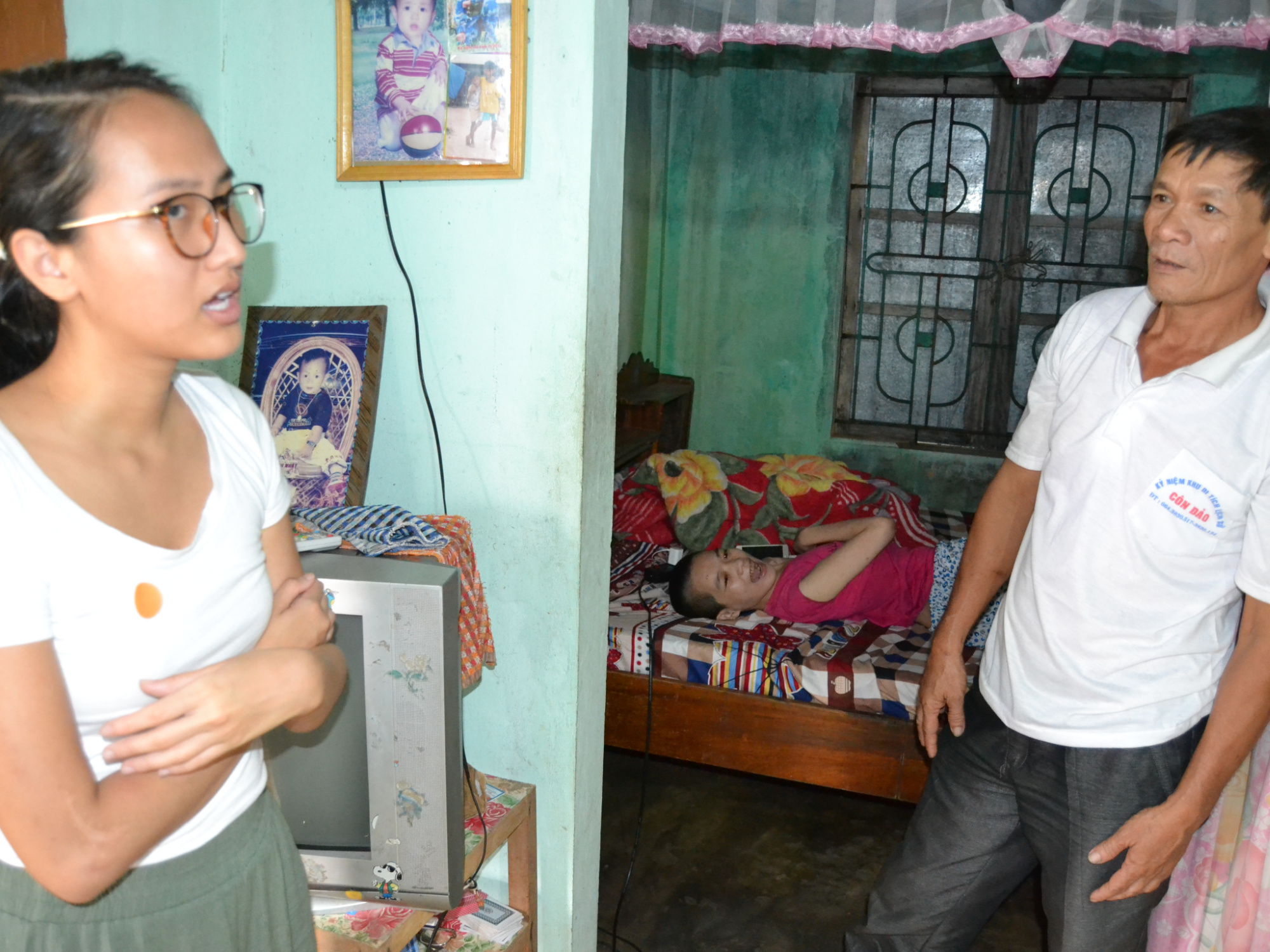
Ai Hoang, our 2016 Peace Fellow, comforts Le Thanh Duc during a visit to meet Mr Duc’s daughters. Ai and her family have donated four cows to Agent Orange caregivers.
If AEPD contributes to this program through its outreach workers, our contribution has come through the thirteen student volunteers, or Peace Fellows, who have spent their summers at AEPD since 2008.
We have made few demands on these outstanding young professionals beyond asking that they do what graduate students do best: be smart, friendly, curious, tech-savvy and focused. Working through the AEPD outreach workers, they visit past beneficiaries and bring their stories up to date through blogs and photos. Most Fellows have also helped us to raise money for new families on GlobalGiving.
All of our Fellows have brought their own expectations and skills to the task. Our first Peace Fellow Chi Vu (2008) was part of the wave of refugees that fled Vietnam after 1975 and spent two years in refugee camps before reaching the US. Ai Hoang, another Vietnamese American whose photo is seen above, left Saigon at the age of nine and was studying at the Columbia University Mailman School of Health when she signed up to return to Vietnam for the first time in 2016. Both Fellows wanted to give back to the country that had, in effect, rejected them.
Ryan McGovern, our 2011 Fellow, joined the US Army after high school and was deployed to Iraq in 2003, where he developed a special loathing for UXO and landmines. Seth McIntyre (2014) served in the Peace Corps in Guyana and embraced social justice after studying the impact of uranium on a Navajo reservation before enrolling at Brandeis University. Angie Zheng, who volunteered last summer, studies conflict resolution at Georgetown.
Agent Orange is, of course, a compelling human drama and this has produced strong writing and photographs. Jesse Cottrell’s short documentary on the Phan Siblings even drew a compliment from the actor Alec Baldwin. Armando Gallardo (2015) used his skills as a photographer to capture some remarkably intimate moments of Mai Thio Loi and the other families. The blogs of Seth McIntyre (2014), Jacob Cohn (2017) and Angie Zheng (2025) have been especially strong.
*
All of these students were born long after the end of the war, but they all knew that their government had been been responsible for the horror of Agent Orange. This has made for some nervous moments through the years.
When Ryan McGovern, the US Army veteran, met in 2011 with a group of Vietnamese veterans who had lost limbs in the war he had expected hostility. Instead he was peppered with friendly questions about his own military service: “There’s something about the camaraderie and brotherhood experienced in the military,” he wrote later. “I immediately felt a connection with them the same way I would with a US veteran, which made our conversations very personal.”
Ryan honored the meeting by profiling three of the Vietnamese vets who had all shown ingenuity in rebuilding their lives. They included Mr Hoa, who had tattooed the legend “April 2, 1975” on an arm, in memory of the day that an unexploded bomb claimed his right leg. This struck a chord with Ryan who noted that tattoos and the US Army go together like “peanut butter and jelly.” Ryan was also impressed to learn that Mr Hoa had built a thriving business from planting trees and trained over 200 other veterans with a disability through AEPD.
As a student of global affairs, Seth McIntyre (2014) felt the weight of history more keenly than most and took to describing the war as the “American War” in his blogs. In one blog, Seth described meeting three generations of Agent Orange survivors. Pham Van Giang, the veteran and patriarch, was relaxed, but his son Dung – who had been seriously affected by Agent Orange – was anything but:
“The sight of me (a white, Caucasian, American male) sends Dung into a frenzy. He cries out in Vietnamese “Don’t let him arrest me! Don’t let him arrest me!” No one in the family treats this behavior as out of the ordinary, yet I am growing increasingly uncomfortable. However, Giang looks on softly, reassuring me: “it is ok, just wait.” Slowly, Dung calms down and limps to his mother.”
*
Several Fellows stayed involved after completing their fellowships. After returning home to California, Ai Hoang made a pitch to her father, who had left Vietnam in the early 1990s and was so impressed by his daughter’s experience that he visited AEPD in Quang Binh – his first trip to the former North – and paid for two cows.
The recent Stimson webinar suggested that Vietnamese Americans could be part of a new American strategy on Agent Orange, built around people to people peacebuilding. Ai and her father show how this might happen.
They are not the only ones. Of the 148 individuals who have donated to our Agent Orange appeals since 2016, 23 were Vietnamese Americans. All of our donations have been measured decisions, taken for personal reasons (a major difference with conventional aid.) The cow project was launched in 214 with financial support from Scott Allen, an AP Board member who visited Saigon during the war while serving in the US Merchant Navy.
*
Looking back, it is safe to say that all of us who have worked on this program on the US side came away richer for the experience.
In trying to put this into words, we have several times drawn on the final blog of Jacob Cohn who was studying at the Fletcher School when he volunteered in 2017. Jacob met seven families, including Mai Thi Loi and raised $1,500 to buy a cow for Dong Thi An, as seen in the photo below. Mrs An has two children. One was going blind when Jacob met the family in 2017. The other suffered from Down Syndrome. Jacob wrote:
“I am someone who’s periodically struggled with anxiety and depression throughout my adult life (but I have been) have been blown away by the resilience of (these) people who remain devoted to beating the odds and fighting for a better future for their children…..Having the chance to share (their) stories with the world and to make it easier for them to achieve their goals will probably be one of the most fulfilling experiences of my career.”
Like several other former Fellows who found their calling abroad, Jacob signed up as a writer for USAID only to lose his dream job when the agency was disbanded last March.
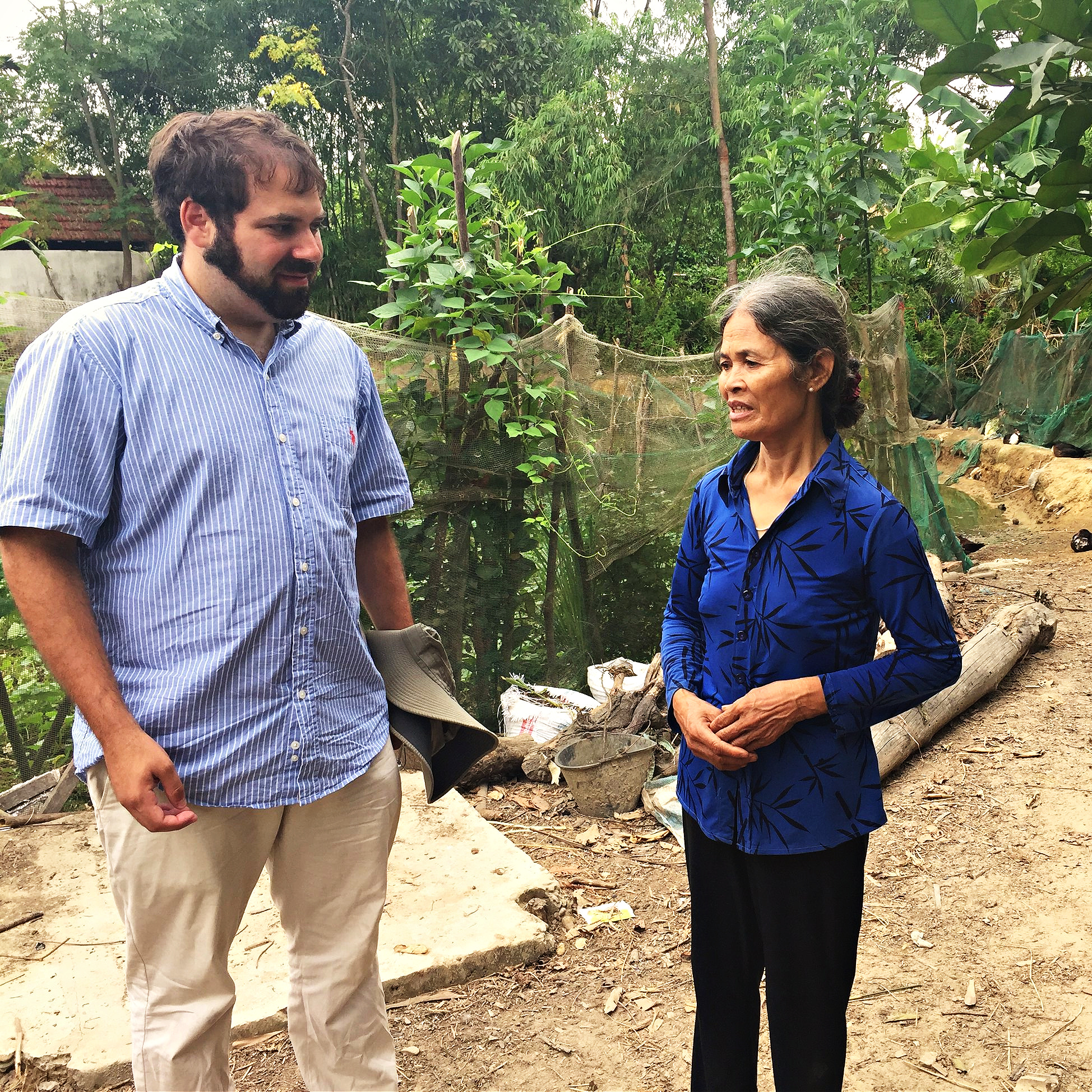
Jacob Cohn, our 2017 Peace Fellow, raised $1,500 for Duong Thi An and her two children. Jacob was so inspired by his experience in Vietnam that he signed up for USAID, only to lose his dream job when USAID was disbanded in March 2025.
Read about Duong Thi Anh and her children
Posted By Iain Guest
Posted Jan 20th, 2026