

The road into Kibera is crowded with merchant stands, water carts, and people going about their day. As mentioned in my previous blog, Kibera is one of the largest informal settlements in the world. Today, Stella and I are visiting Irene to help service her composting bin. Irene is the mother of three children and lives with her husband as tenants in Kibera. She has been part of Shield of Faith’s household composting program for almost five years and continues to grow vegetables in her kitchen garden with the help of organic farming techniques that she learned from SOF.

Irene with her kitchen garden before the compost bin servicing.
To start, we prepped the area near Irene’s kitchen garden with all of the tools we would use to service the bin. This included laying out a plastic sheet, gardening tools, moving the very heavy compost bins, a duster to transport soil easily in small spaces, and gloves. Irene’s home is on a lot with 3 other families, so it’s important that we keep the area (mostly) clean.
Then, we dug right in! We began by sifting through Irene’s compost to divide the worms from the organic matter. The worms seemed to especially enjoy all of the avocado in Irene’s bin. This is a lesson that Stella can share with other composters to enrich their bins and organic fertilizer.
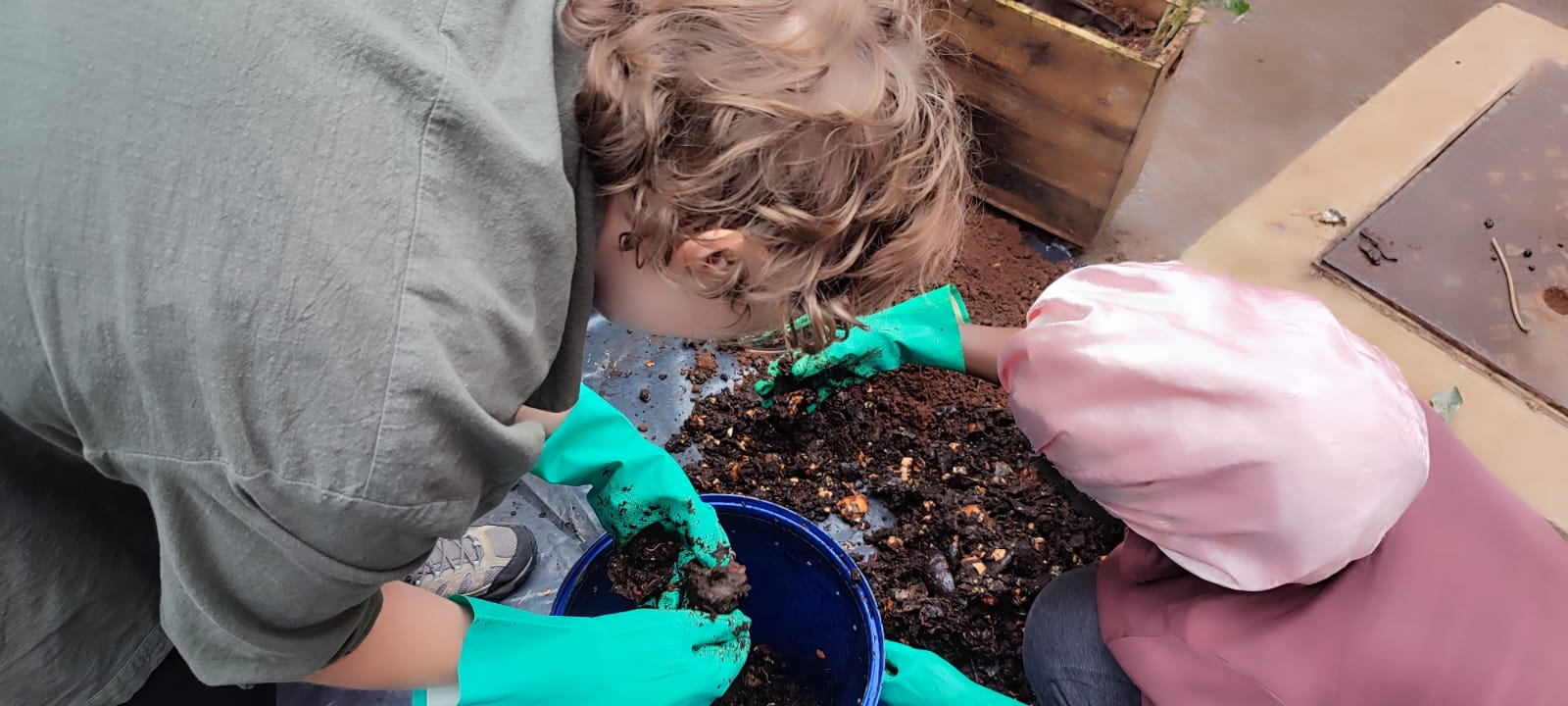
Irene and I sifting through the compost to divide the worms up from the organic matter used to replenish the soil.
Irene’s worms enjoying their avocado home!
After the worms were divided and put back into their composting bin home, we began uprooting the vegetables. Irene also made cuttings from the kale to propagate new stalks. The soil had not been turned in almost 2 years and was lacking any nutrients. It had become very hard and was almost impossible to retain water–and Irene’s vegetables were suffering. We used the spade to break up the hardened soil (if you’re looking for a good workout–look no further!), and then mixed the soil in with the compost from Irene’s bin. The result was a darker, moist soil with new organic material that will help Irene’s vegetables grow bigger, thicker, and stronger.

What’s left of Irene’s compost and worms after we divided out the organic matter. Lishe-grow sits on the bottom right. Irene’s old soil sits next to compost, ready to be mixed, in the background.
Stella taught me a quicker and easier way to more thoroughly mix the compost with the soil.
From there, we added the soil back into the containers and replanted Irene’s vegetables and cuttings. Irene then topped up each container with a mixture of lishe-grow, leachate that drains from the composted material, and water. For best results, the leachate should be mixed at a 1:10 ratio so that it looks like a nice black tea or else vegetables will get chemical burns.

Irene putting her vegetables back in the planters while I wait to pour in the refreshed soil.
Here, Irene mixes the leachate with water to create Lishe-Grow and top up her planters.
Servicing compost bins is a labor-intensive part of Stella’s project coordination. With three people, it took us more than three hours of hard work! But the hard work pays off for Irene, who is able to harvest vegetables from her kitchen garden almost 3 times a week. She uses them as supplements to her families’ dinners, improving nutrition and cutting costs at the market.
The servicing cycle for households is similar to the expansion that Shield of Faith is implementing at Our Lady of Mercy, a school near Kibera, except on a larger scale. Our Lady of Mercy produces almost ½ ton of compost per month and it is no small feat for the caretaker employed by the school to service the compost bins like we did with Irene! But through SOF’s partnership with the 4K Club, a government education program designed to promote agricultural knowledge and practices amongst young people, students are learning how to compost and utilize it in their farming practices. Over the course of this year, SOF will expand into four additional schools!
This is Stella’s vision for students and women engaged with Shield of Faith’s programs: that participants will be empowered by incorporating farming practices into their routines and share it with their communities. Only a handful of worms can make new life out of kitchen waste—imagine what’s possible when women and students begin restoring the systems that feed them.
Posted By Julia Holladay
Posted Jul 8th, 2025
4 Comments
Iain Guest
July 11, 2025
Those greedy red Wrigglers!!! Such a great blog – and I LOVE the video of the avocado opening up to WORMS!! We need to get this out on social media ASAP and make sure it’s shared by Stella’s donors and others. Let’s work on this!! It’s good to be reminded that Stella has NOT abandoned her founding members. Also that they are still composting, even though they no longer receive the subsidy. By now Irene understands the value of composting without being paid – and this is critical for sustaining Stella’s initial model. Stella, meanwhile, continues to keep them in the loop and play a key role by servicing the bins and checking up on the worms. This, combined with the push into schools makes me very confident that this is going to fly (or go to ground, as the case may be!!). Well, done Julia!!
Aaron Bailey
July 15, 2025
Looks like how I spend my Saturdays, although I was never able to get that many worms
Angie Zheng
July 17, 2025
Love the videos!
Shuyuan Zhang
August 3, 2025
I loved reading this! I actually learned how to separate worms from compost (and that they love avocados 🥑🐛) thanks to your post. The detail about mixing the leachate until it looks like black tea is so cute and helpful. Really amazing to see how much life and nourishment a handful of worms and some hard work can bring to a small kitchen garden!