

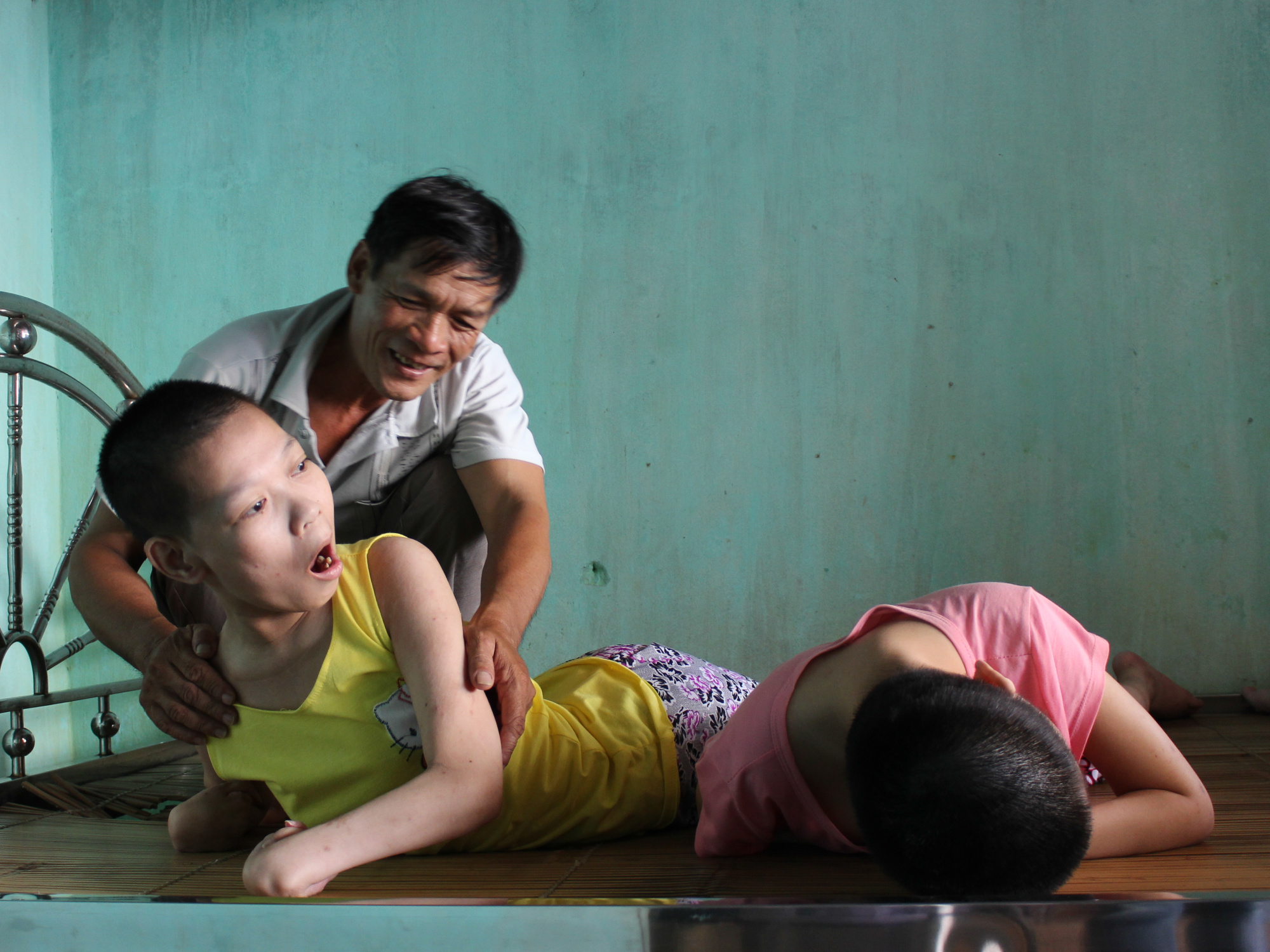
Le Thanh Duc was exposed to Agent Orange while serving at the former US base at Da Nang. His three daughters are almost completely paralyzed, Mr Duc is seen here with his eldest daughter Le Thi Phuong. His youngest daughter, Le Thi Lanh, learned to text before she fell ill and still uses texting to communicate with her parents.
The link between dioxin carried by the Agent Orange herbicide and sickness was conceded early on.
The Vietnamese were first off the mark and organized the first-ever international meeting on herbicides and war in 1983. In 1991 the US Congress passed the Agent Orange Act which promised compensation and medical care to any US Army veterans who had been exposed.
For affected families in Vietnam, it took years for the full horror of Agent Orange to sink in. Mai Thi Loi never found out how her husband, who died of cancer in 1989, had been exposed during the war. But Nguyen Van Xoan, another veteran, is in no doubt. Mr Xoan was deployed in the province of Quang Tri in the south when an American plane sprayed the forest where he was sheltering. He covered his face and later drank rainwater which was “fresh and did not seem dangerous.” But his first two children died early and unexpectedly.
Le Van Dung and his wife Dang Thi Miet, both veterans, were also exposed to Agent Orange while serving in the south. Ms Miet suffered twelve miscarriages before producing a child who lived, but barely. Mrs Miet also has no doubt that Agent Orange was to blame.
Le Thanh Duc, seen in the photo above, joined the army in 1975 after the war ended and took part in the clean-up at Da Nang airport. He remembers being asked to move a leaking canister and in the days that followed he experienced a range of symptoms, including dizziness and headaches. But the symptoms faded and he continued to work at Da Nang – a notorious dioxin “hotspot” – for over a year.
Several years were to pass before Mr Duc began to understand the horror he had unleashed on his family. Three of his children, all girls, came down with a serious pathology around ten and have been almost completely paralyzed ever since. They are now over forty and still in diapers.
During a visit to the Duc family in 2013 Kelly Howell, our 2013 volunteer, noted how the three girls responded to their parents with smiles. Le Thi Lanh, the youngest, was even able to send simple text messages from a mobile phone. During his meetings with Kelly, Mr Duc would move the three girls to a new position when they cried out.
When I first met Mr Duc, in 2015, he was recovering from another unspeakable tragedy. His youngest son had died in a motor-cycle accident the previous year. The boy, 18, had been spared by Agent Orange and his parents were so panicked about keeping him safe that they had asked his superiors to keep a special watch over him when he joined the army.
His death seemed especially cruel and it sent Ho Thi Hong, his mother, into a spiral of depression from which she had not yet recovered when we visited a year later. But Mr Duc her husband was remarkably upbeat. He had just received a loan of 17 million Dong ($647) through AEPD to start a fish sauce business and proudly showed us the big stone jars in his yard, which stank of fish. Mr Duc was also basking in the aftermath of a television show that had turned him into a local hero.
With his wife still incapacitated, Mr Duc was carrying the weight of this damaged family on his own. It was something of a tour de force and he remained optimistic even after his fish business collapsed the following year from a massive die-off of fish caused by contamination from the Taiwanese Formosa steel plant.
At this point, AP launched an appeal for Mr Duc. He invested the money – $1,140 – in chickens. When our Peace Fellow Angie Zheng visited him last summer, he was still selling chickens and had returned to making fish sauce, although he spent most of his time feeding, bathing and changing his three daughters.
*
Posted By Iain Guest
Posted Jan 20th, 2026