
The Tharu Museum in Tulsipor
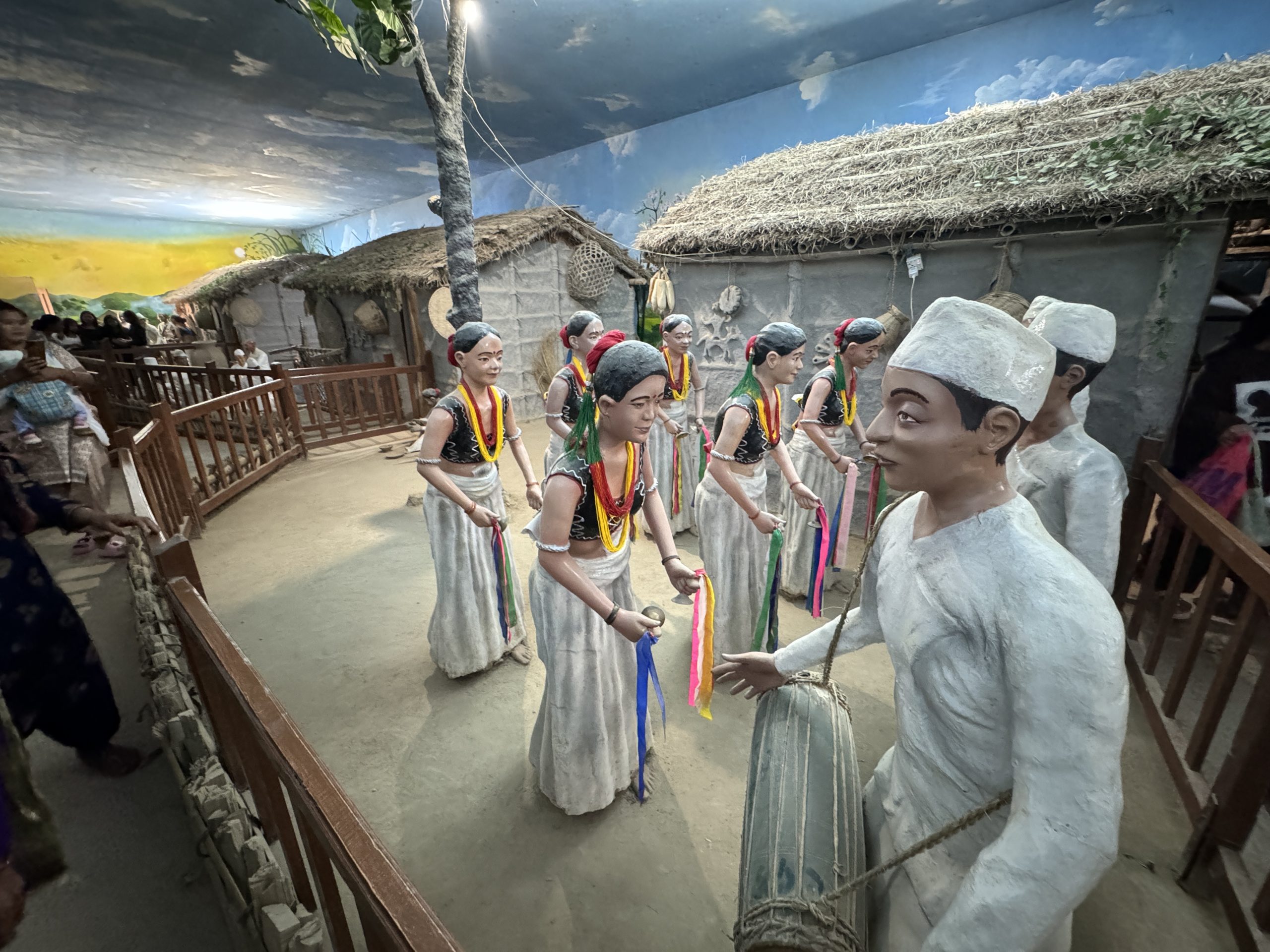
Before leaving, Pinky and I visit the Tharu Museum in Tulsipor. The museum is the brainchild of Dilli Chaudhary, the founder of BASE, who promoted Tharu identity while he was chief minister of Lumbini province. This museum reflects his passion and commitment to his people. It attracts a lot of visitors.
The museum brings our inquiry to a fitting conclusion because it shows how advocacy can produce social change. I noted in my first blog that the Tharu were subjected to decades of exploitation by a rich class of “landlords” and that this system produced bonded labor, child labor, and domestic slavery. Even though the Tharu are a minority, not a caste, many of its victims were led to believe by their exposure to caste that their suffering was outside of their control. I heard this from several myself.
Much of Dilli’s life has been devoted to debunking this myth. Born into a family of bonded laborers, he established BASE to outlaw the practice. After this was achieved, BASE turned to building sustainable livelihoods for the former laborers using land and education. The third phase of the campaign is still under way – to restore dignity to the Tharu people, long described as Nepal’s most marginalized minority. This museum is part of it.
All of this has meshed with Nepal’s emergence as a diverse and tolerant society following the end of the Maoist rebellion in 2006. Hinduism is no longer the official state religion. The monarchy is long gone. The Maoist rebels are part of the democratic system. The 2015 constitution banned discrimination, devolved power away from the capital to provinces, and gave Dalit a guaranteed role in national politics. This gentle revolution has produced role models like Pabitra Badi, who we met in an earlier blog, and given Nepal a reputation for tolerance in Asia.
And yet….…there is something about the immobility of these Tharu figures in this museum that warns against complacency. Social change is a constant process and there is always another threat around the corner.
Challenge
We set out five weeks ago to explore the legacy of caste, which I described as a slippery concept in an earlier blog. I think that was an apt description, and my own views have certainly shifted. The past few weeks suggest that the problem is less about caste per se and more about how people identify and relate to each other – which pretty much applies to any society.
Here in central Nepal we have found that the sense of common identity within these sub-castes is strong. For those who feel threatened and stigmatized, membership of the group offers protection from an unfriendly world. We heard this most urgently from Badi women in the town of Ghorahi, whose sense of exclusion and isolation would resonate with many minorities elsewhere.
But for those who yearn for change, the sub-castes are rigid and inflexible.
Part of this is imposed by the state. Dalit carry the name of their sub-caste and are registered by caste in the census. The state also provides all Dalit families with social support which acts as a major disincentive to change. Several people said that changing an ID is a major hassle and requires time and travel that they cannot afford. All of this acts as a barrier to social mobility.
But if these pressures are imposed, others come from within. Marriage tops the list. Inter-marriage between Dalit sub-castes and between Dalit and the four main castes appears to be very rare. We met only three individuals who had the courage to find partners outside their sub-castes – Dropati Badi, Pabitra Badi and Hari Ram Rai Das.
Occupations
Caste put a value on the traditional occupations practiced by these sub-castes based on their “untouchability.” The very idea of passing a value judgement on occupations is offensive, yet we have encountered some occupations on this mission that are simply indefensible. I would have no hesitation is calling for an end to bird-killing by the Chidimar, as well as the traditional Chidimar practice of child marriage.
On the other hand we have also found some traditional occupations that seem benign and contemporary, like the biodegradable duna plates made from leaves by the Kewat sub-caste. It is also hard to find fault with traditional skills that are handed down through generations such as the making of Badi madal drums, Gandarbha music and even stone-carving by the Kusbadiya.
Ultimately the market place will render the final verdict on all of these occupations. The Kusbadiya grinding stones are being priced out by cheaper alternatives. The Khatik, in contrast, are fetching a good price for their pigs. More power to them.
The biggest problem with these “traditional” occupations is lack of choice. Caste perpetuated the notion that people are “born” into their occupation and should not expect to change. I examined this in earlier blogs about Badi prostitution that described how Badi girls were coerced into prostitution by a social norm, with the full complicity of their families. That branded the entire sub-caste.
But if such social norms are coercive, the same can be said of poverty. Poverty need not be systemic and “structural” to deprive people of choice and discourage them from seeking alternatives, as we saw with the Kusbadiya stone-carvers.
Impact
One product of caste is discrimination, which is a crime in Nepal.
As with hate speech in the US this can lead to acts of extreme violence, as when 24 men in Rukum District killed six Dalit youths in December 2023. (The killers were sentenced to life imprisonment for murder).
We did not investigate acts of discrimination, which is best handled by human rights advocates, but we were looking for examples of stigma which may not be punishable by law but can be deeply dis-empowering. Once again, the Badi are a good example. Prostitution by the Badi caste may have ended almost twenty years ago, but the association still clings to Badi and leaves them feeling stigmatized. This affects their confidence and can be enough to obstruct social mobility and change.
Education
How can well-wishers like BASE respond to the challenge? With its deep roots in the Tharu community BASE has developed several services through the years that seem particularly relevant. These begin with education, which is probably the most effective catalyst for social change as well as the intervention most likely to be accepted.
It is surely no coincidence that the most effective community leaders we have met are personally committed to education: Nirmal Badi, the first-ever Badi teacher appointed to a government school who put his four children through college. Hari Ram Rai Das, whose two daughters both run businesses. Sunita Chidimar, who re-enrolled in secondary school at the age of 34. I would also include the family of Chongiya beggars who are determined to pay for the education of Siwani, 10.
We have also concluded, however, that education initiatives must be creative and tailored to specific needs if they are to be effective. The Badi settlement in Ghorahi is a good example. Half of the children in the settlement are not in school, but they do have access to a well-furbished building that mothers would like to turn into an after-school center. This, they feel, would create demand for formal education, build discipline, attract staff from the settlement and appeal to the municipal government. It could also be a first step towards putting more children in school. This seems like a worthwhile investment, although it would probably not work elsewhere.
Income
BASE has been targeting poverty in marginalized communities for years and built up considerable expertise in such areas as skills training and savings schemes. Pinky and her colleagues are excellent trainers. But as I noted in earlier blogs some of these traditional interventions have not worked particularly well with the sub-castes we have met.
It was not my job to evaluate these projects, but my advice would be to focus more on demand. For example, Gandarbha violins have not sold well because the market is limited. But the demand for Gandarbha music could be huge and YouTube opens up a world of new possibilities. BASE already has good contacts in this mysterious world!
Perhaps the demand for Badi madal drums would also expand if drum-makers are making drums as ornaments instead of exclusively for festivals. Demand for the disposable and environmentally-friendly duma leaf plates would also expand if the Kewat could sell in Kathmandu where demand is sky-high. Even the delicately-carved Kusbadiya stones might find a market if they were promoted as ornaments rather than cooking aides.
All of this seems worth exploring, but it will require new thinking and new skills from NGOs: more marketing and social media, and less conventional trainings.
One final point needs to be made about income-generation. Land appears to be the best of all investments. We were told repeatedly that the Badi have been impoverished by their lack of land, yet many are already living on government land. Land reform was also a key part of BASE’s bonded labor campaign. And according to Nirmal Badi, land would do more than anything else to reverse the fortunes of the former Badi prostitutes in Tulsipor.
Culture
Culture is linked to income because several sub-castes we met are being encouraged to fill a niche market created by ceremonies, weddings and festivals. As an added incentive, it is also assumed that to rescue a sub-caste from poverty may also rescue an endangered culture along with it. We heard this about the Gandarbha saranji, Badi madal drums, Kewat duma plates and even the Chamari drums made by the Chamar/Ram sub-castes.
Nepalis love their festivals, but this automatic connection between caste and culture could present another obstacle to social change and mobility. This may be what worried young members of the Chamar/Ram sub-caste when they demanded an end to chamari drumming at festivals, implying that any automatic connection with tradition is demeaning. The protest by Dalit activists against the mass slaughter of animals at the Dashain festival is another interesting example of a sub-caste rejecting a tradition.
This raises interesting questions: Is a culture (and its traditions) by definition worth preserving, or is this simply sentiment? Should its fate be decided by those directly affected – the immediate stakeholders – or by society as a whole?
And is there a role for outsiders? I would hope so, as long as we take our cue from the stakeholders. Foreign friends can do much to encourage creativity and cultural expression like the Tharu museum here in Tulsipor. The Mountain Music Project was conceived in the US but uncovered a common chord in the music of the Gandarbha in Nepal and fiddlers from Appalachia. The result was an example of cultural survival at its most creative and least intrusive.
Advocacy
The final and most important service offered by BASE is advocacy, and this seems particularly relevant to our inquiry.
The Advocacy Project has met with several inspiring advocates from Nepal through the years: Dilli Chaudhary (bonded labor); Ram Bhandari (disappearances); Uma Badi (Badi women and children); Urmila Chaudhary (domestic slavery); Radha Paudel (menstruation); and Nirmal Badi.
These talented leaders have had two things in common. First, they were motivated by their own experience. Second, they have embraced publicity and the risks that come with it. This is advocacy in its purest form and it seems to thrive in Nepal.
But this trip has also introduced us to strong-willed individuals who do not need a national platform to produce social change: Jamuna Badi, who mobilized other Badi girls to ask for police protection; Dropati Badi, who led a delegation of Badi girls in Ghorahi to demand that the link to prostitution be removed from Badi ID cards; Sunita Chidimar, who advocates against child marriage with Chidimar families; and Hari Ram Rai Das, who supports efforts by younger members of his caste to show less deference to traditions.
Such people are to be found in all sub-castes and/or minorities even if they are hiding in plain sight like Sunita Chidimar in Nepalgunj. If BASE wants to promote social change within these sub-castes, it could begin by seeking out such community leaders and ask for their guidance.
Research
My final recommendation to BASE is to expand research.
Our visit has produced a series of snapshots, and these blogs will probably cause experts to shudder. But what we found is indeed fascinating and we only scratched the surface. We met with eight sub-castes, but the 2021 housing census lists 142 castes and/or ethnic groups. Some, like the Kusunda or the forest-dwelling Raute number less than 1,000 and are struggling to adapt while clinging to their traditional way of life.
The key here is not to impose a vision of change but to help these groups broaden their options and enjoy more choice. In writing this final blog I now realize that this has been our mission all along.
As well as casting the net wider, any new research should also use more professional tools, starting with a detailed questionnaire. If and when a new project emerges, The Advocacy Project stands ready to help.
*
Posted By Iain Guest
Posted Dec 10th, 2024