

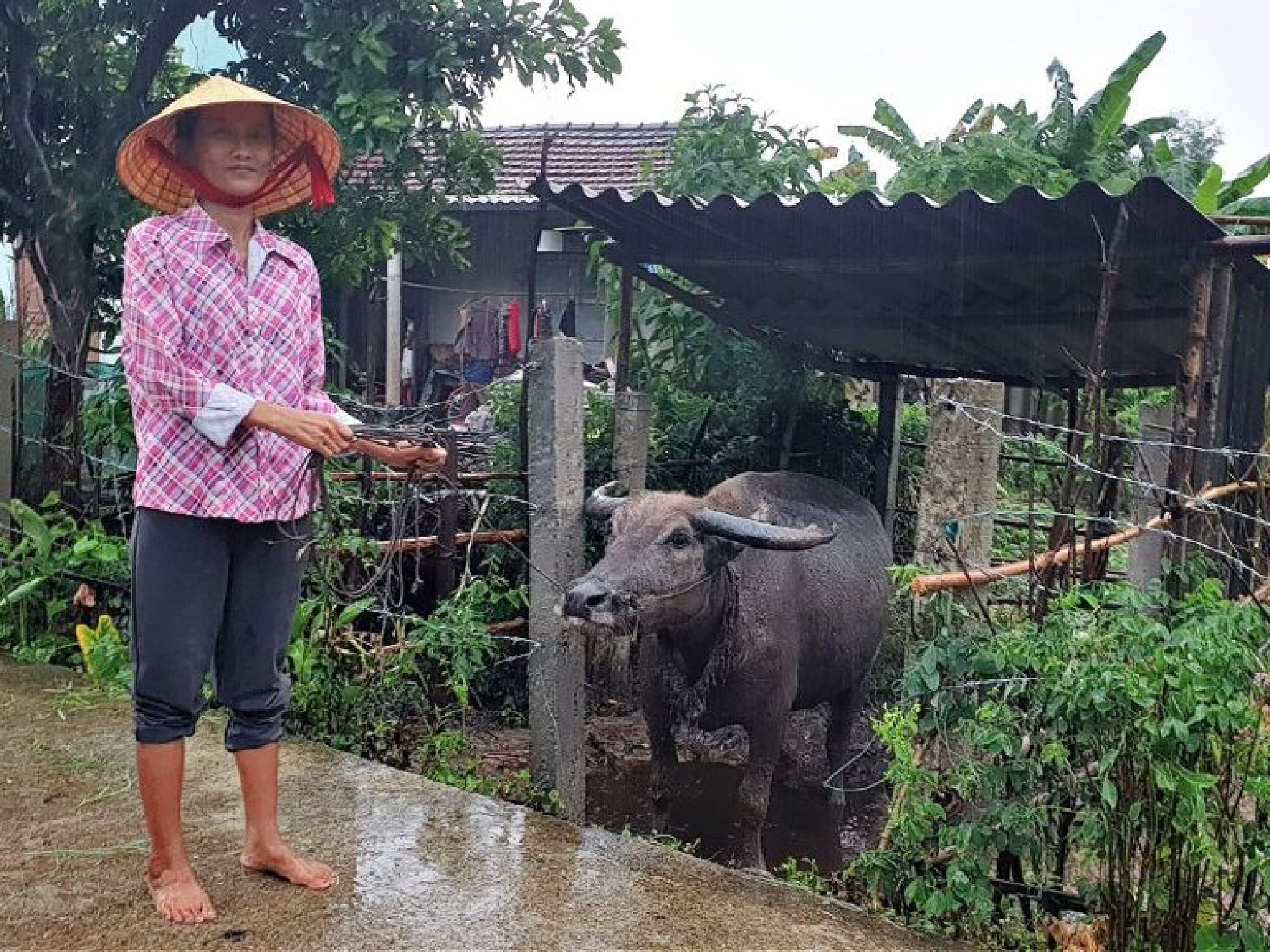
Dương Thị Sen Sen, a single mother and second-generation survivor of Agent Orange, has a repaired cleft lip, a speech and hearing impairment, mild intellectual disability, physical weakness, and chronic pain. She received her breeding buffalo in 2024.
Like many disability advocates, The Association for the Empowerment of People with Disability is committed to the proposition that disability is not disabling.
Our volunteers have seen plenty of evidence of this while working at AEPD. In 2011 Ryan McGovern introduced us to Mr Can, who lost a hand during the war and became celebrated as a producer of bonzai trees in Quant Binh. Mr Can accepted the physical limitations imposed by his injuries and used the discipline that helped him to survive to channel his talents in new directions.
Agent Orange is more merciless than other causes of disability because it strips away human agency. This is not to say there are no heroes. As we noted earlier in this series Simon Klantschi, our 2010 Fellow, struck up a friendship with Nguyen Thi My Hue, who suffered from dwarfism but opened a grocery store with funding from AEPD and dreamed of being an opera singer. Jesse Cottrell (2012) produced a wonderful video about three siblings from the Phan family, who were born without use of their lower limbs but built thriving businesses with financial support from AEPD.
These examples are inspiring but sadly few and far between, because when dioxin poisoning sets in it is irreversible. As a result, and with the empowerment of victims no longer an option, AEPD has decided to support their caregivers.
There is an economic rationale to this as well, because families that are struggling with a severe disability are among the poorest in almost every society. The Vietnamese government gives a monthly allowance for each family member affected by Agent Orange which currently averages out at around $70 a month. Coupled with military pensions and other forms of social security, this can just about cover the basic cost of living.
But only just. As he told our 2025 Peace Fellow, Le Thanh Duc is a war invalid himself with a top 81% disability rating and receives ten million Vietnamese Dong per month (about $395). His three daughters each receive around 5 million Dong (about $200) per month. But diapers alone cost Le Thanh Duc about a million Dong (about $40). Even with his income from fish sauce and chickens, Le Thanh Duc has been forced to borrow 300 million VND (about $11,500) from the bank and is still paying back the loan with interest.
Even climate is adding to the challenge. Vietnam is acutely vulnerable to storms and climate change, and several families have reported serious damage to their homes. For some families, repairing the roof is almost as important as buying medicine.
In choosing to spend our grants, all but one family has opted for a breeding cow or buffalo. As Mai Thi Loi told us in 2016, the animals can be rented out to neighbors and produce milk. Best of all, they produce calves which currently fetch up to $600 – a huge sum in the villages. When Karen Delaney from AP visited Mrs Loi in 2018, she was renting out her buffalo for around 2.5 million Dong a month ($110). This covered the cost of medication for her sons.
The main problem with cows and buffaloes is care and maintenance, and gathering fodder becomes increasingly burdensome as caregivers grow older. Dương Thị Sen, seen in the photo above, relies heavily on her 13 year-old daughter for all-round support. But even when pulling together the two are unable to take their buffalo to higher ground during storms and need help from Mrs Sen’s brother.
As the first generation caregivers age, their prospects for making a sustained living without help from neighbors or family grow dimmer. Their best hope will lie in increased government support. This will be the subject of a later blog.
Read more about Duong Thi Sen and her daughter
Next – Outreach Workers in Vietnam
Posted By Iain Guest
Posted Jan 20th, 2026