Tag Archive: Uganda
-
WASH at Kulu Opal: Celebrations and the Handover Ceremony!
1 CommentThe last few weeks have been filled with celebrations and final touches to the toilets. During one of our last visits to Kulu Opal, we were treated to Music, Dance, and Drama (or “MDD”) performances by the students. Kulu Opal was hosting the sub-district competition, so we saw a few different schools perform. We later learned that Kulu Opal scored the highest in their sub-district!
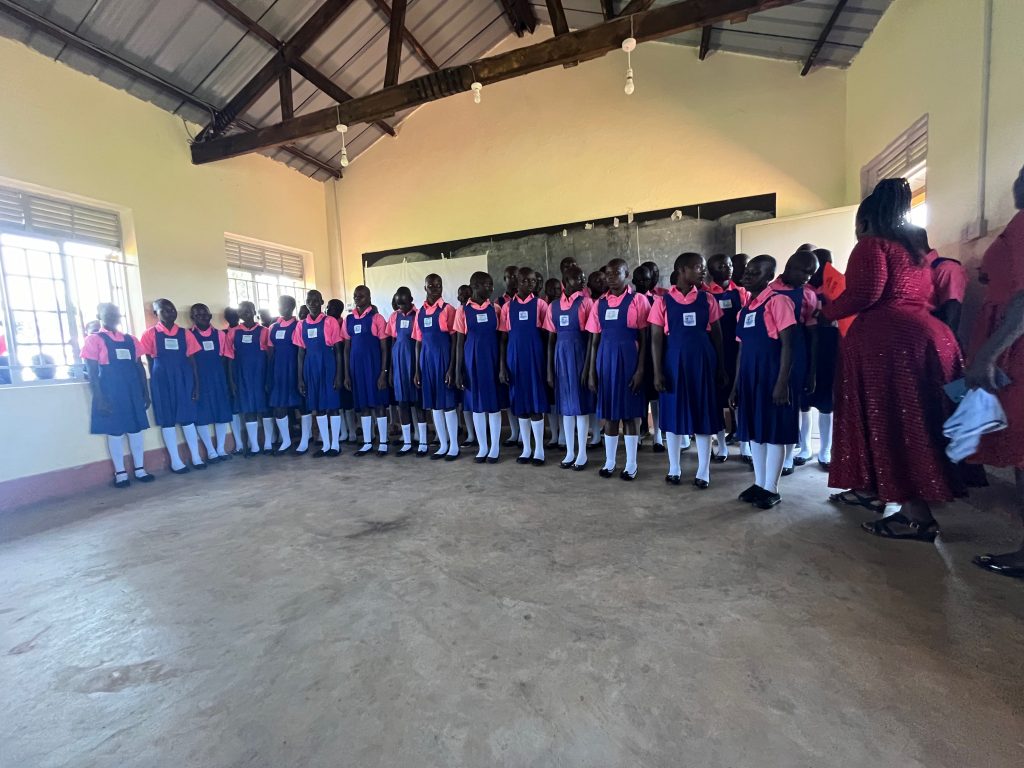
The students of Kulu Opal Primary School at the MDD competition.
And finally, the toilet was complete and we had the handover ceremony. The ceremony was attended by the GDPU team and Board; Kulu Opal teachers, parents, PTA, and SMC; Gulu District officials; and the local tribal chief.
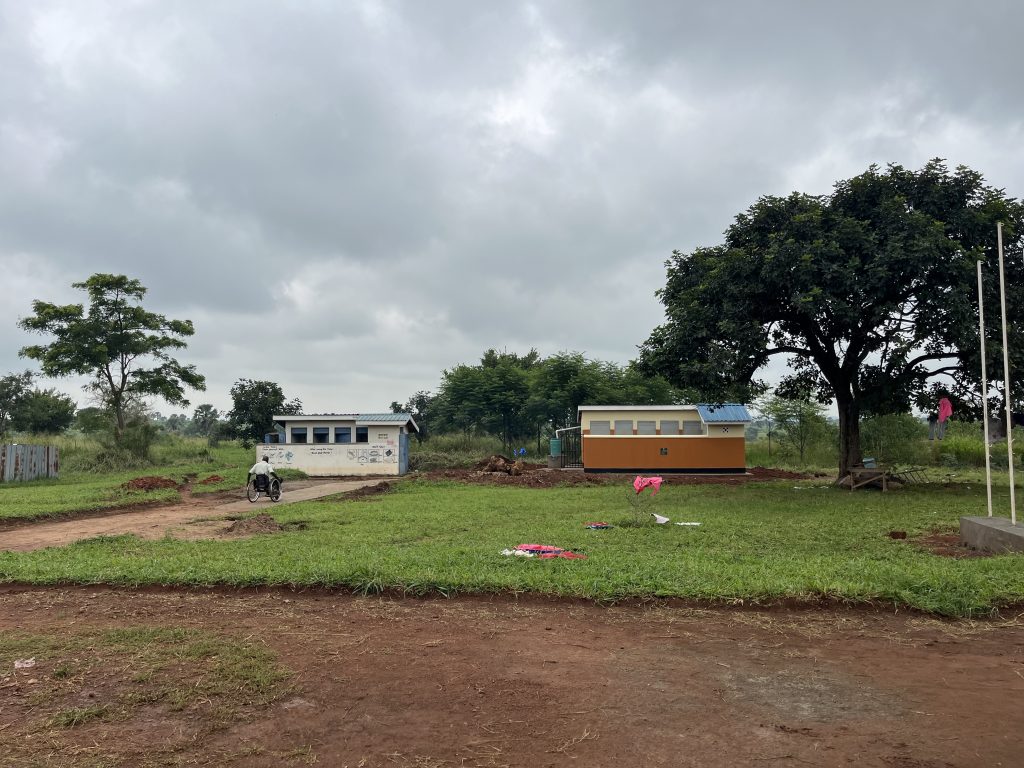
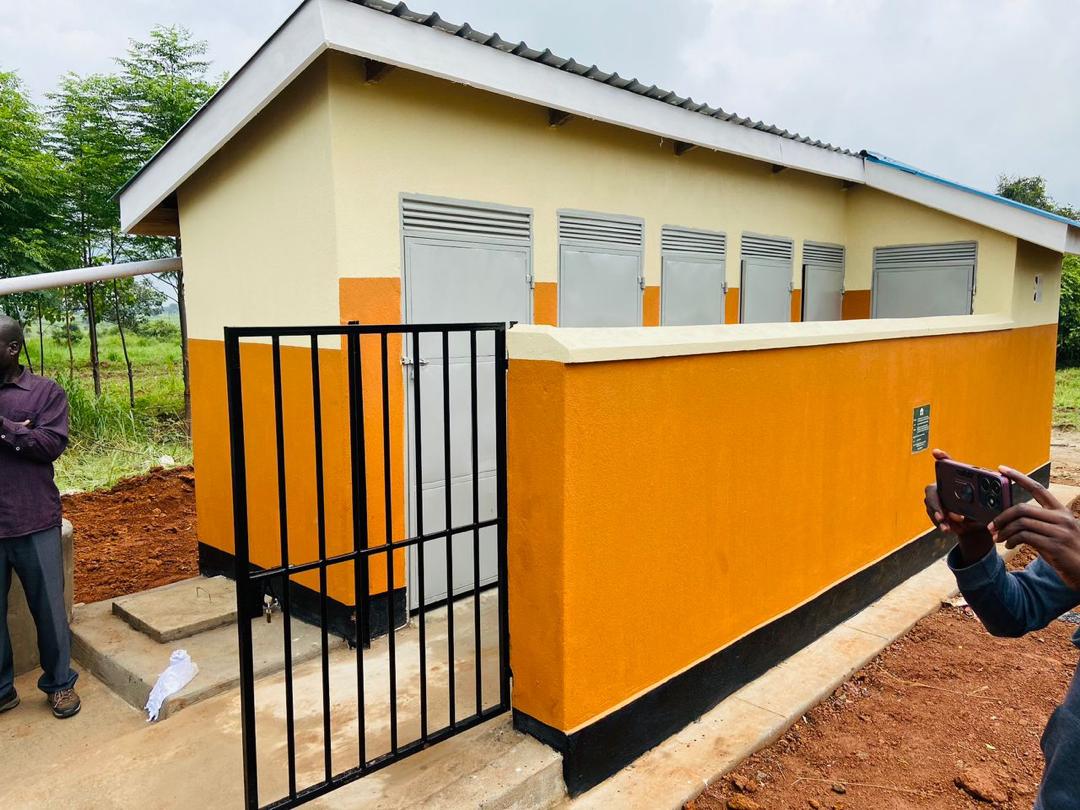
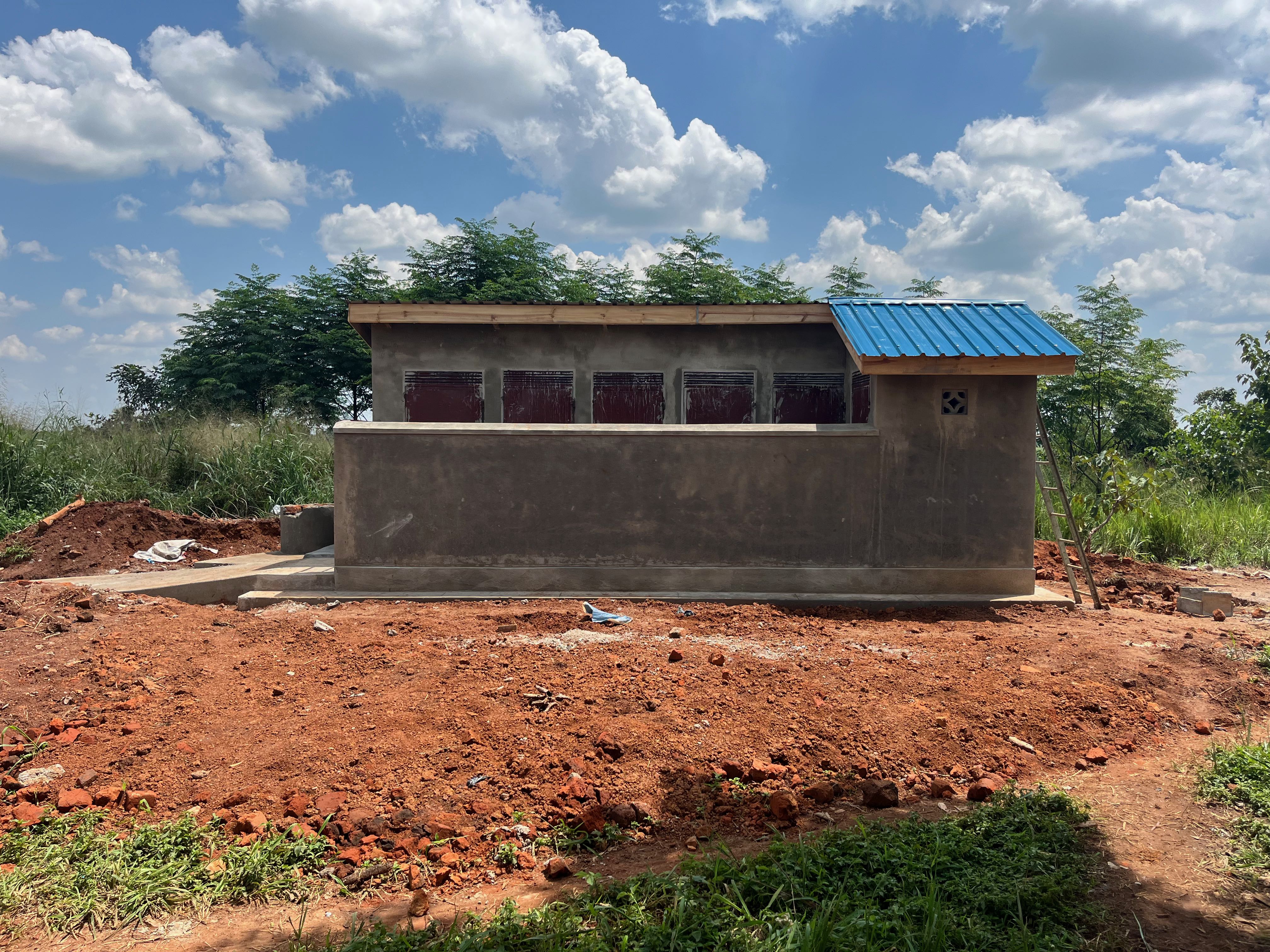
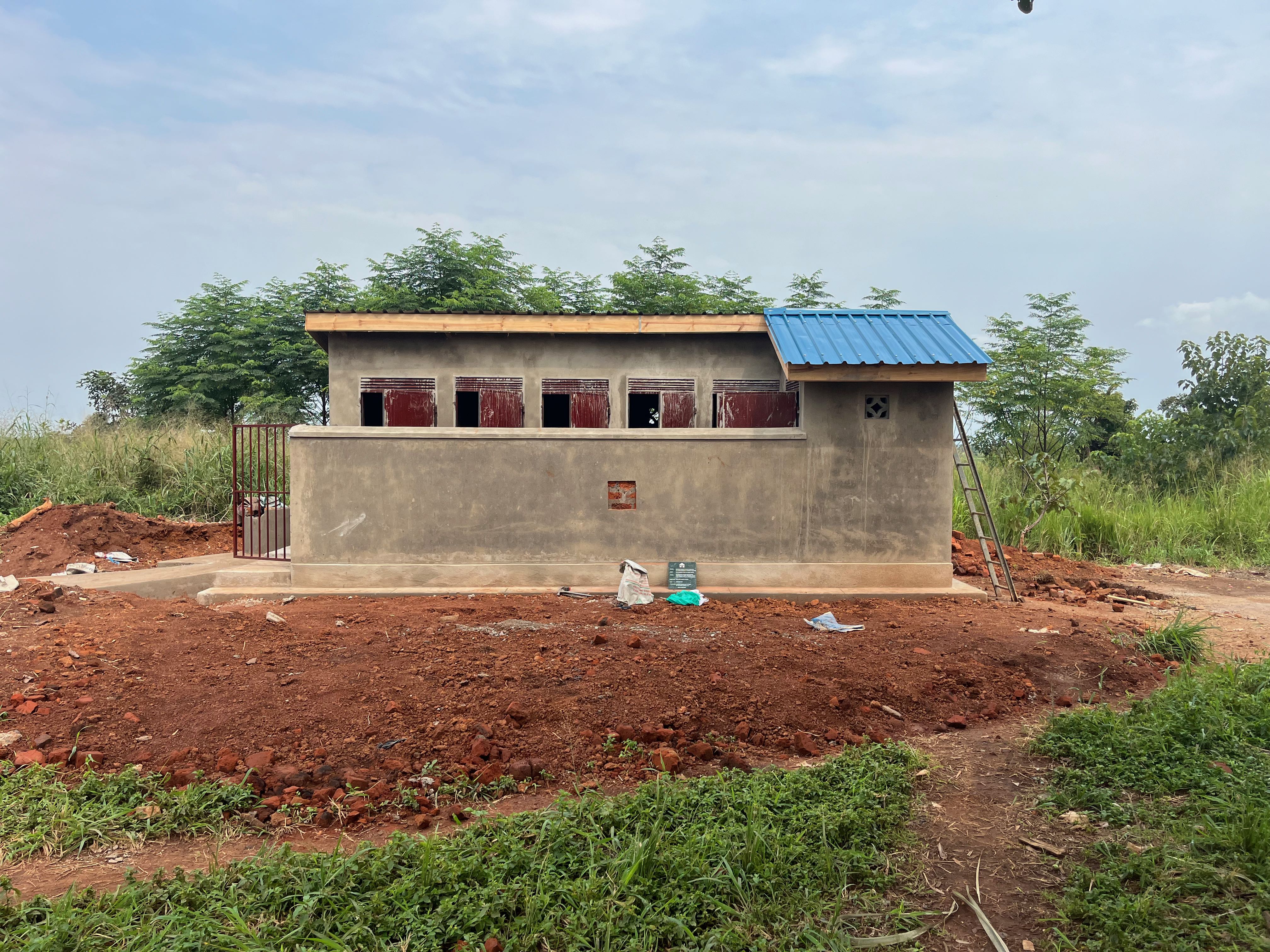
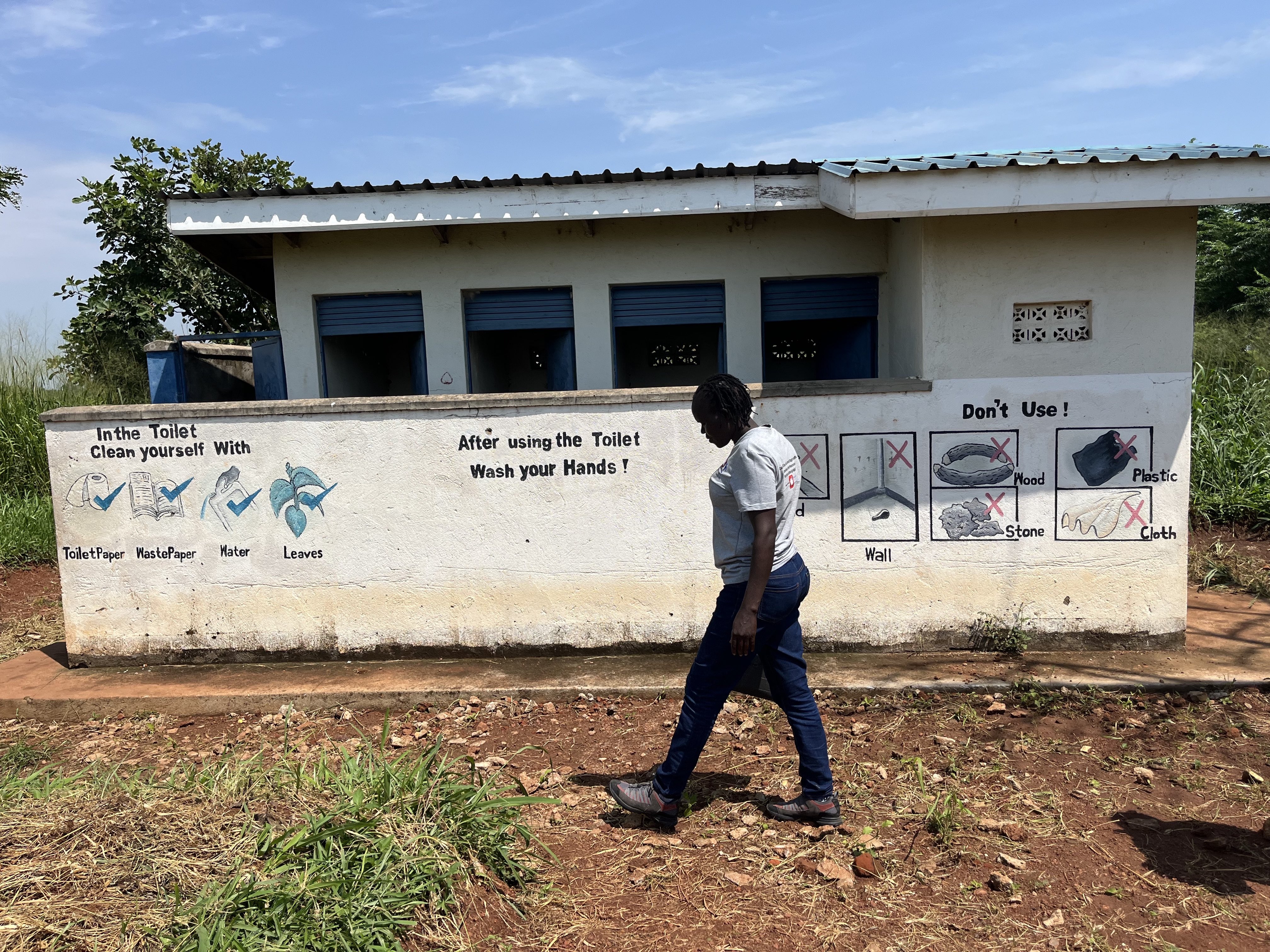
The completed toilet!
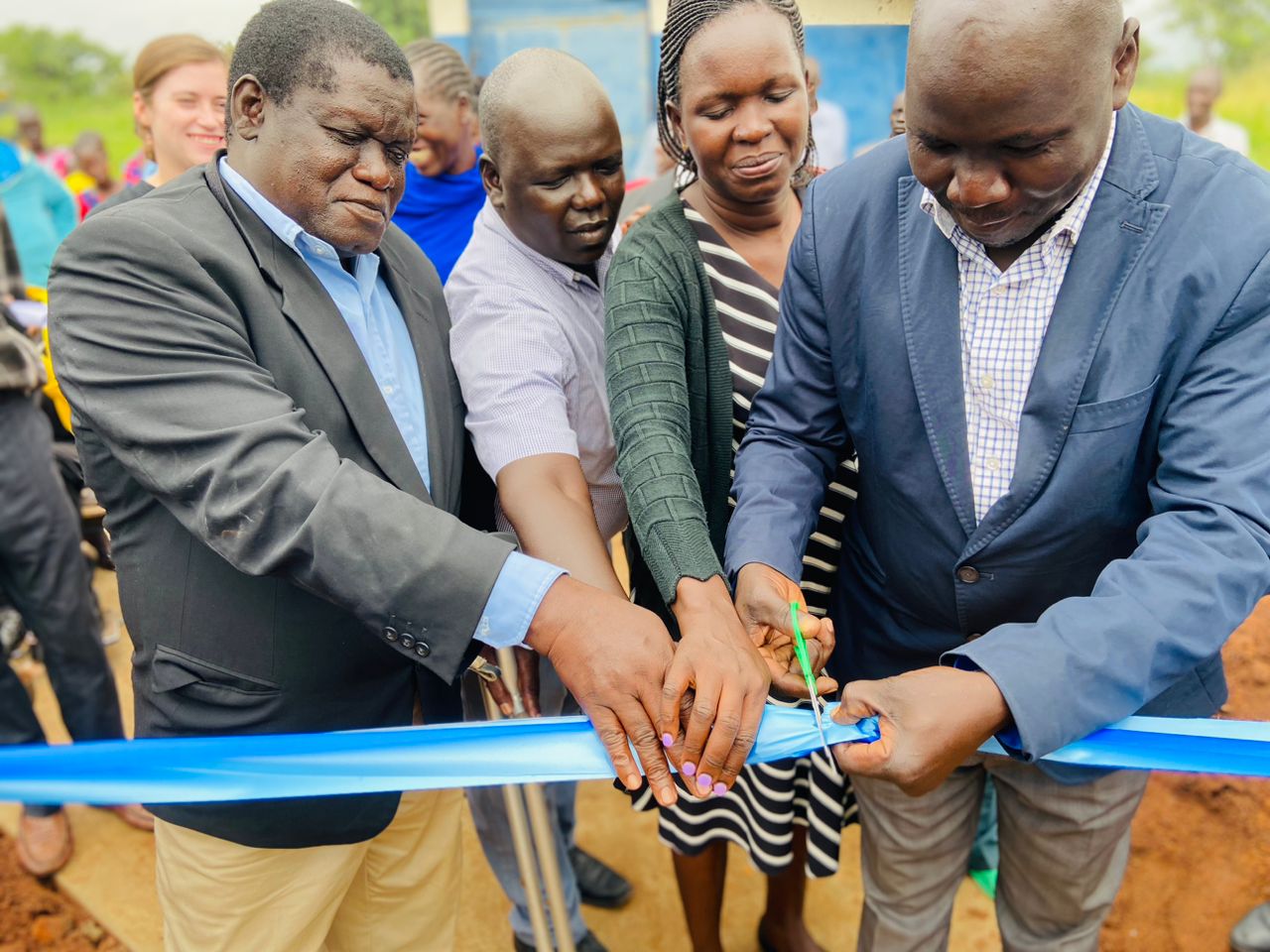
We had speeches from many of the guests, a performance by the Kulu Opal choir, and an official ribbon-cutting opening for the latrine, before sharing in a traditional lunch. It was a very joyous day and everyone expressed their gratitude for the program and the impact it will have on their students.

The students performing at the handover ceremony.
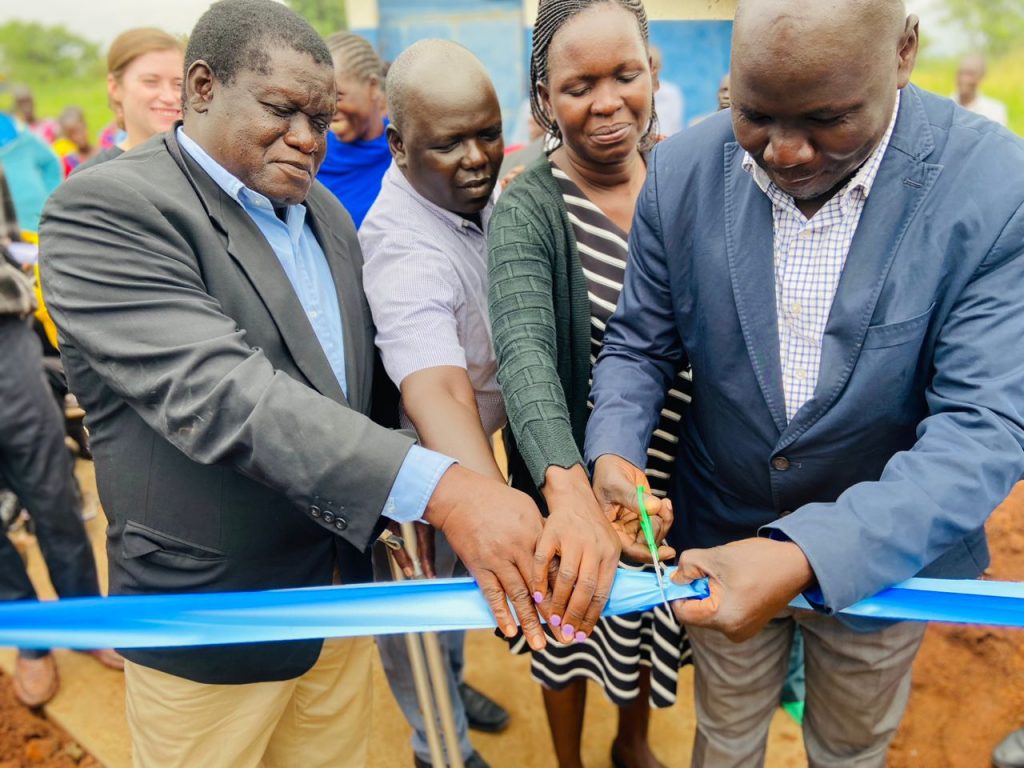
The GDPU Chairman, Head Teacher, District Education Office representative, and Secretary of Health and Education representative cutting the ribbon for the toilet.
It was a great ending to the WASH program, my fellowship, and my time in Uganda.
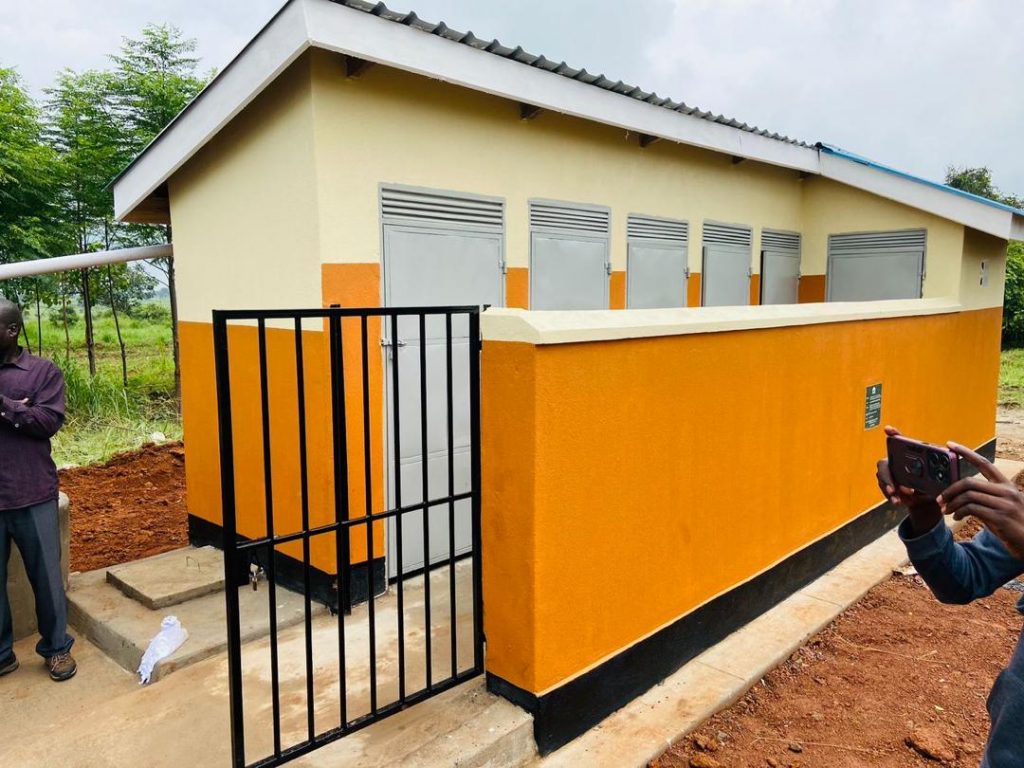
The completed toilet with the fresh coat of paint!
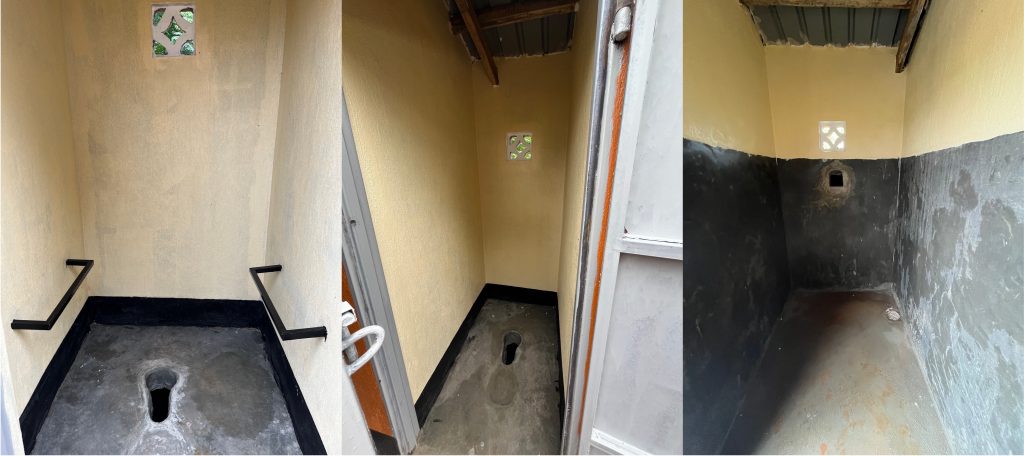
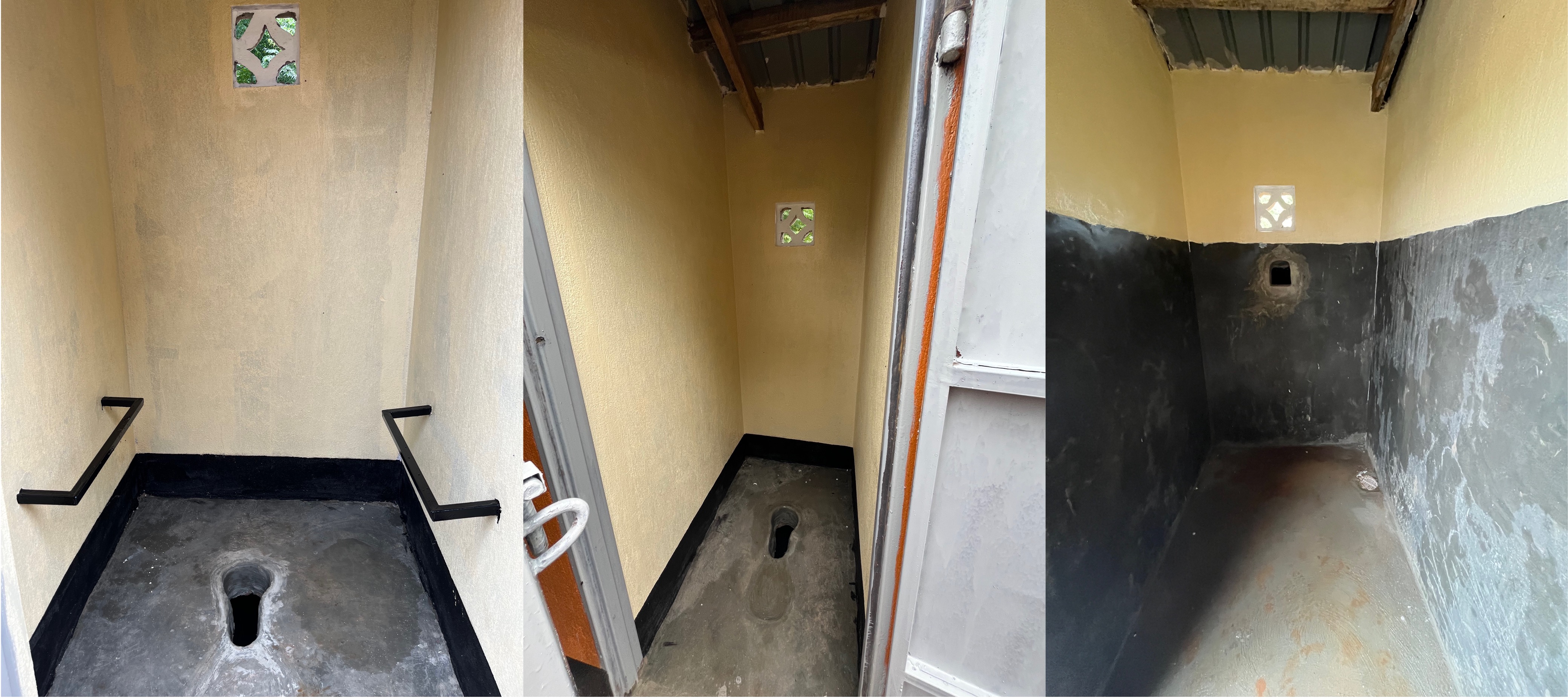
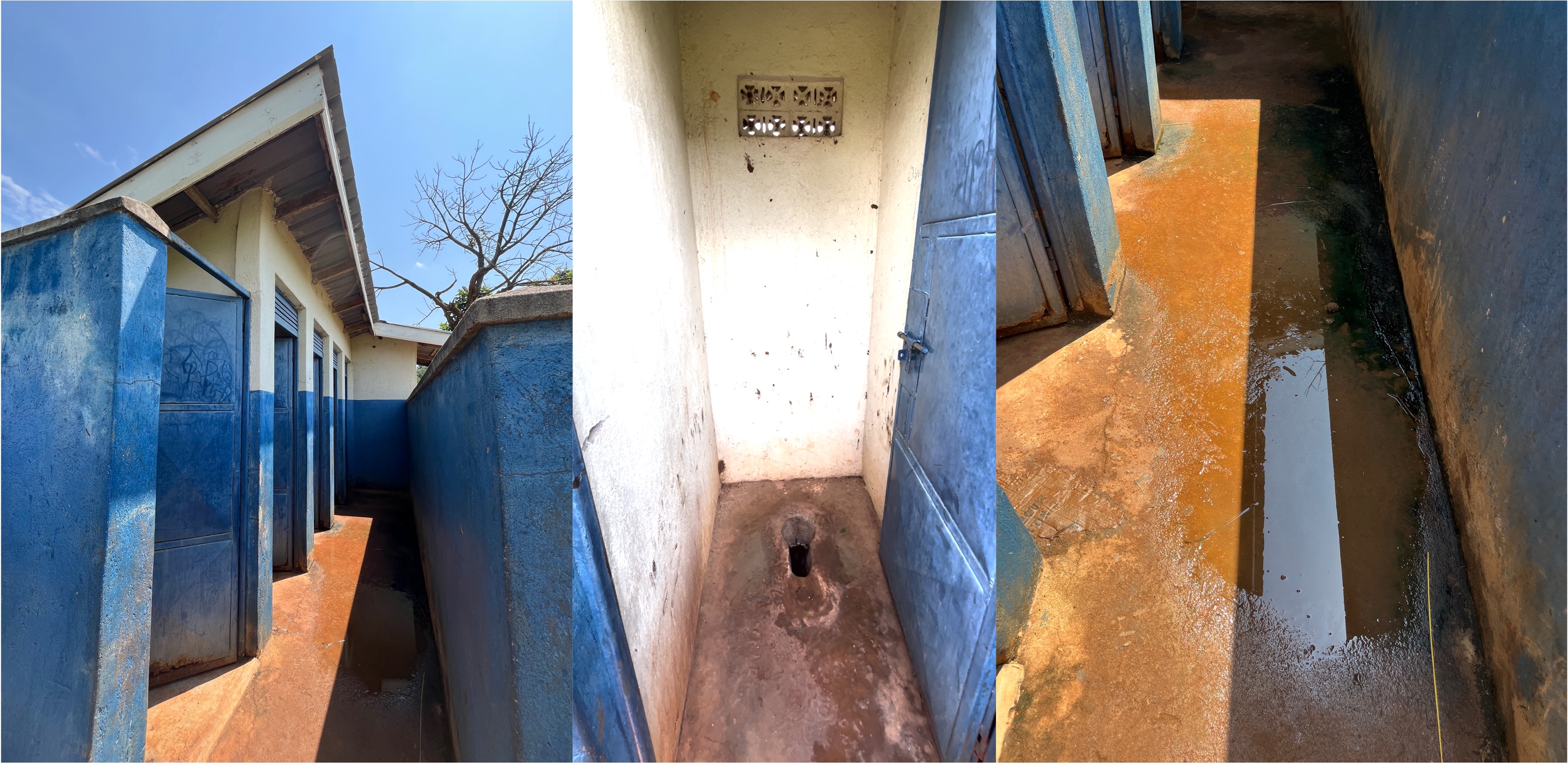
The disability-accessible stance with handrails (left), one of the 4 regular stances (center), and the girls changing room (right).
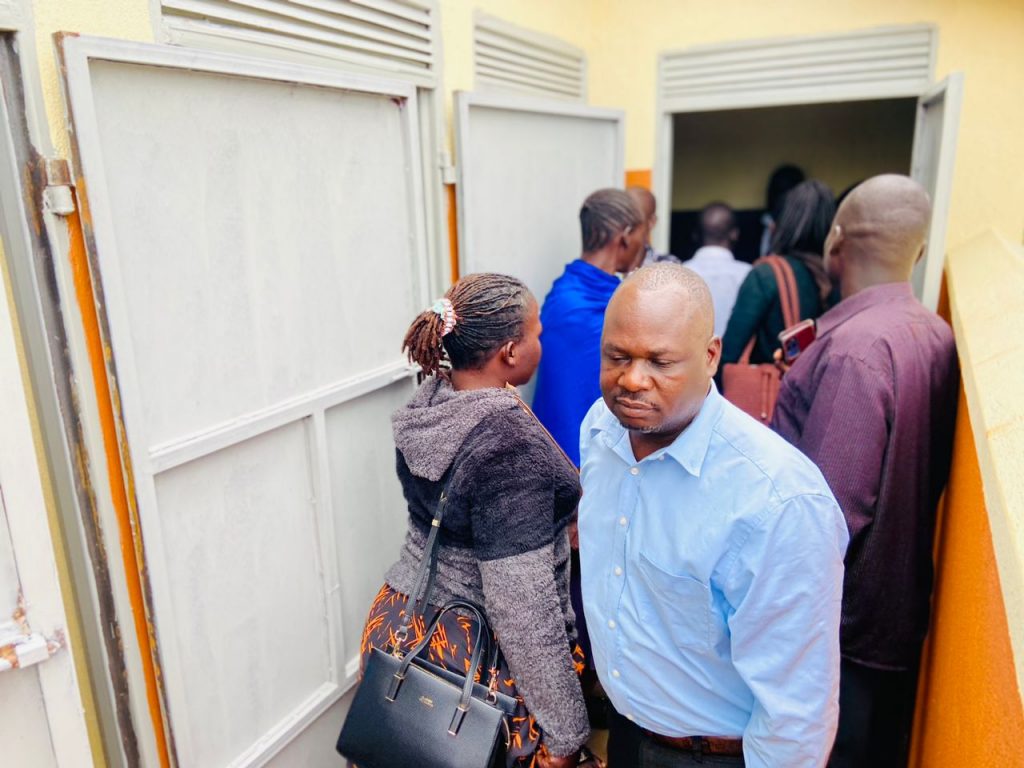
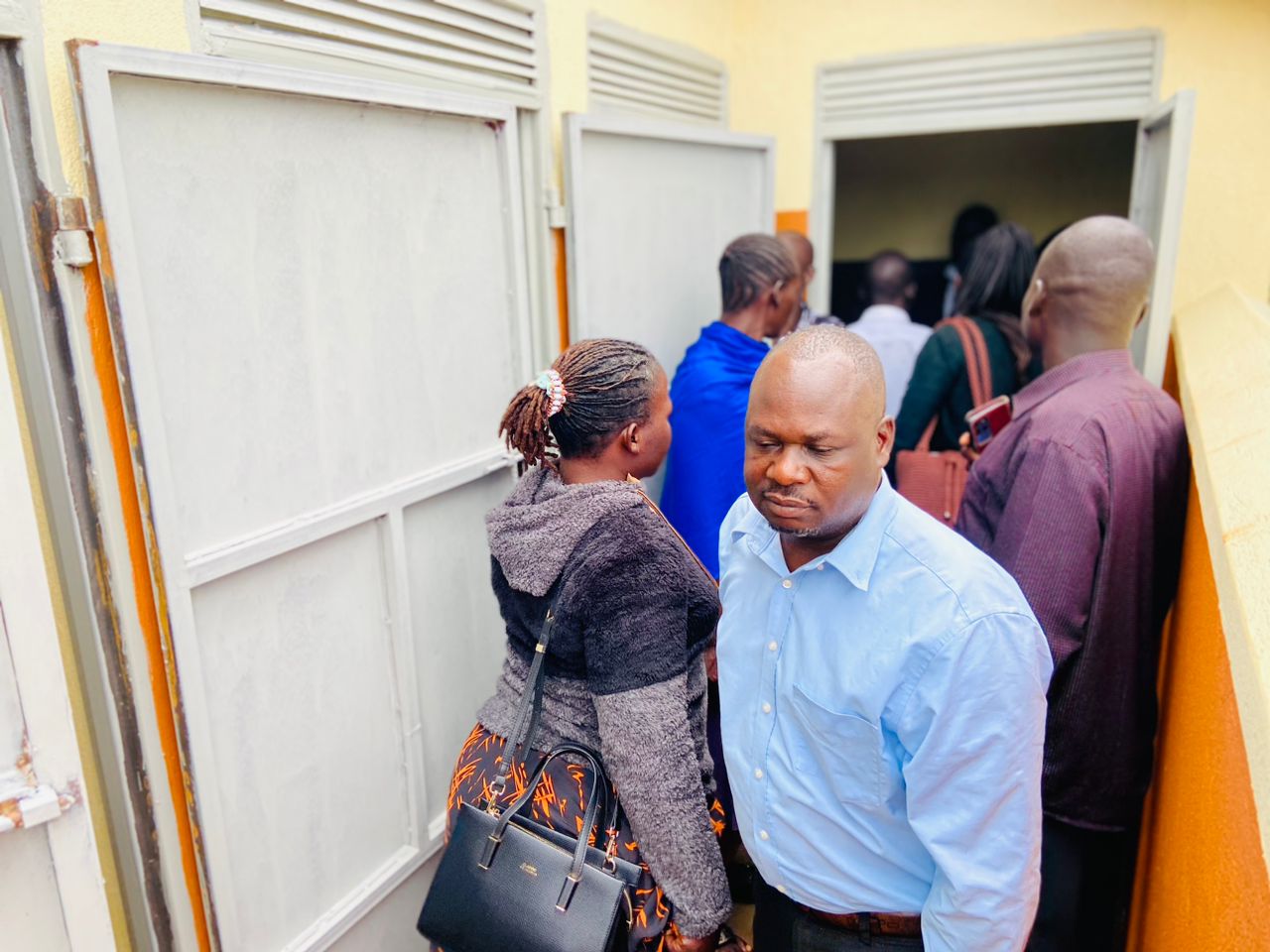
Everyone investigating the completed toilets.
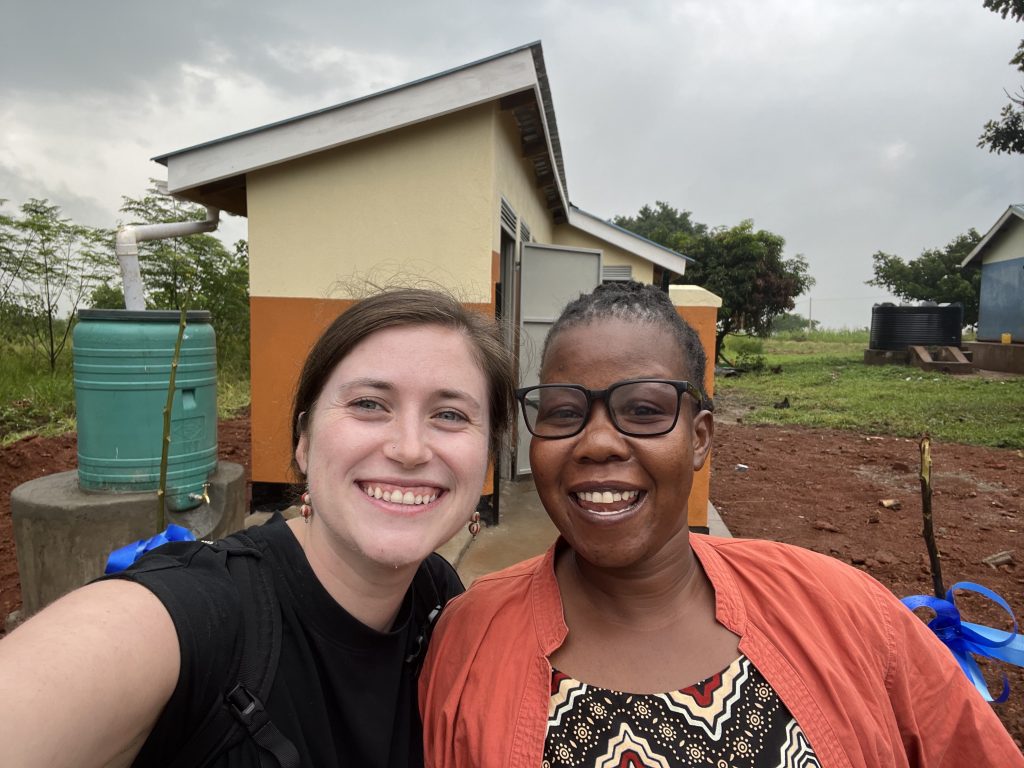
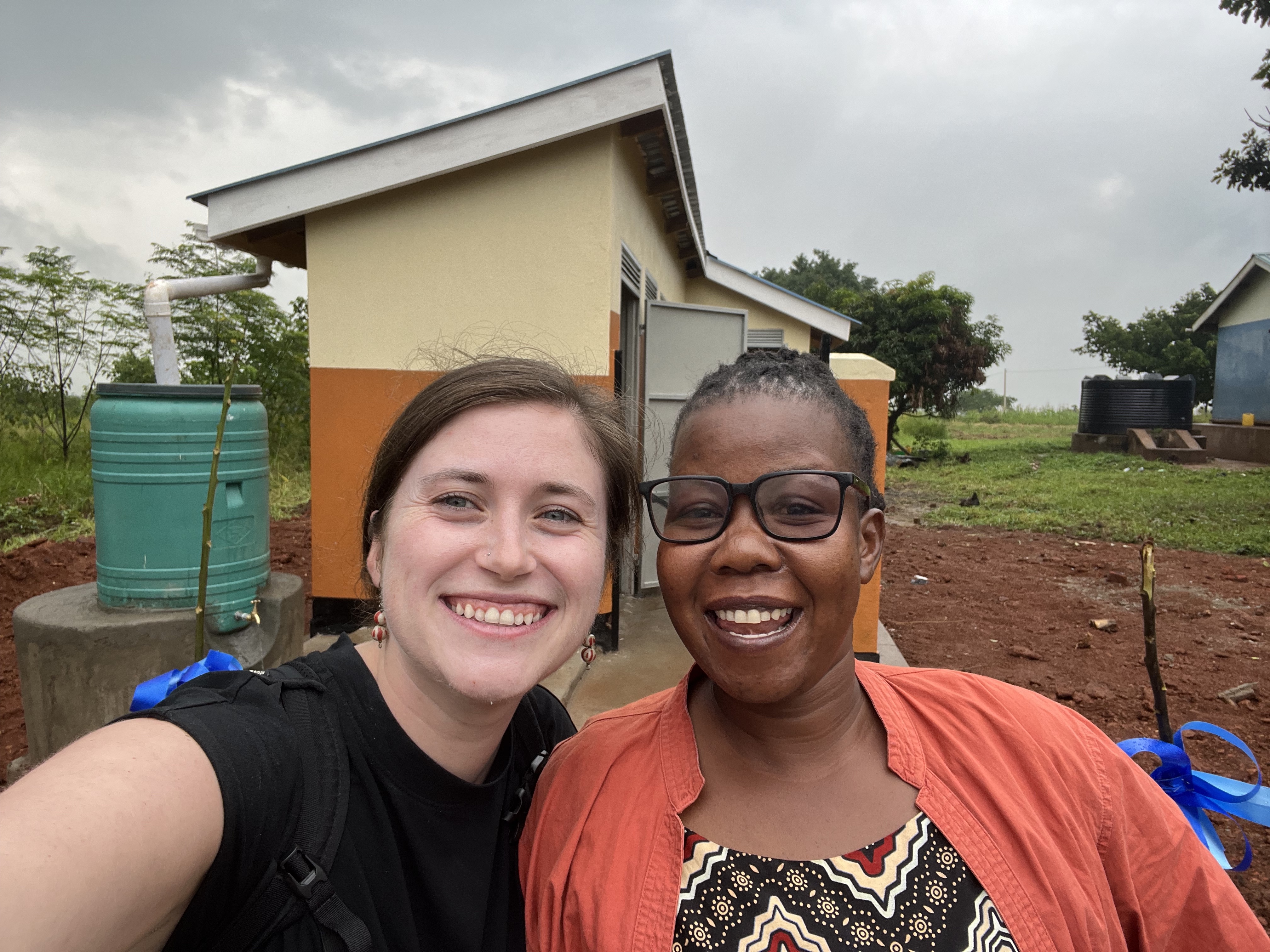
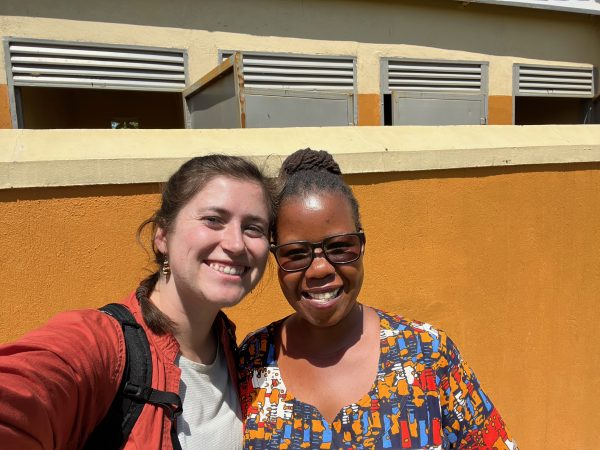
Emma and I celebrating the end of the project!
-
WASH at Kulu Opal: Monitoring and Menstrual Hygiene
2 CommentsAs part of the WASH program, I supported the design and implementation of a monitoring and evaluation strategy for the six schools that GDPU has built toilets at in the past. Visiting these schools provided some context to how the WASH program has evolved, from building only 2 stances at Torchi Primary school, to building 5 stances with additional accommodations and providing resources and trainings at Kulu Opal.
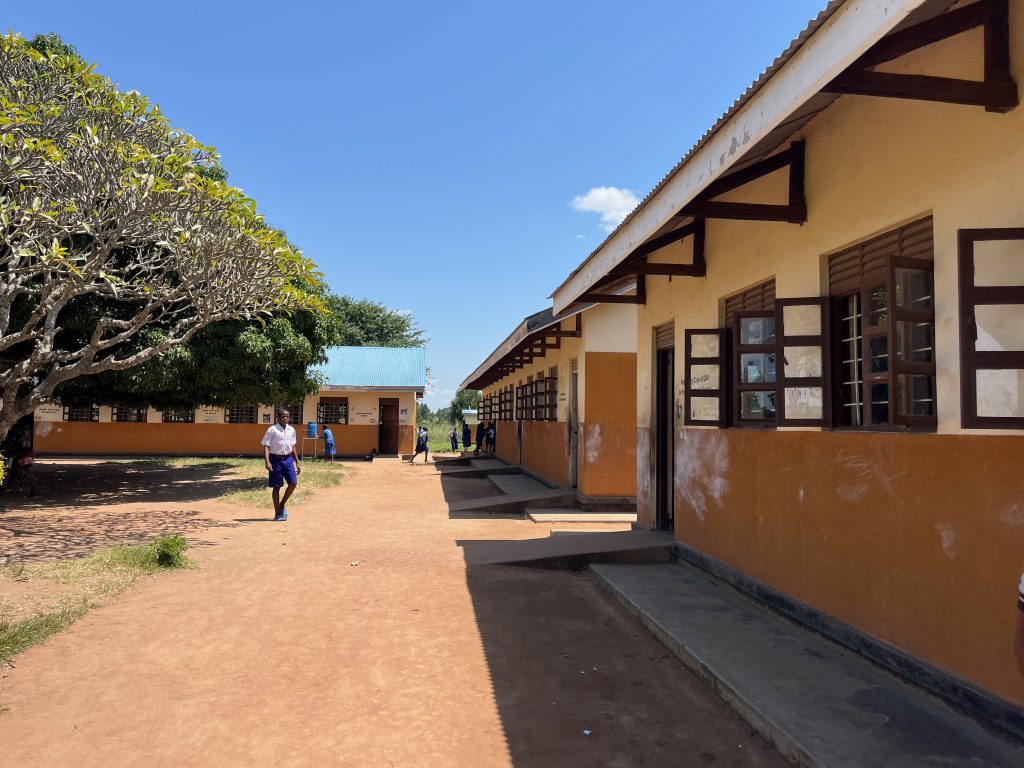
Visiting Awach Upper Primary School.
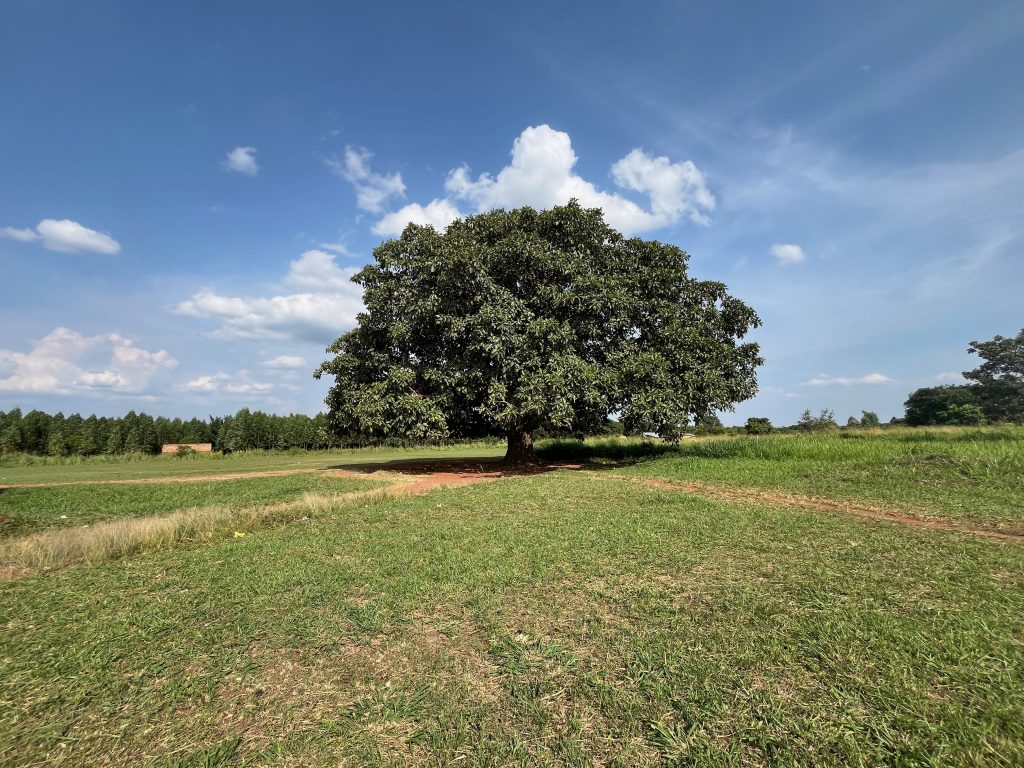
A beautiful mango tree at Ogul Primary School.
The schools we visited varied widely. The schools range in enrollment from 352 students to nearly 1400 and in government term budgets from 2.3 M UGX ($600) to 11 M UGX ($3,000). Some schools are a 10-minute drive from the center of Gulu City and some took almost 2 hours to reach. Some have received new classroom blocks or hygiene trainings from organizations like the Norwegian Refugee Council, USAID, Save the Children, and Africa Women Rising, and some have not been visited by the government or an NGO in years. Some schools have Head Teachers that are very cued into the challenges their girl students face, and some Head Teachers seemed afraid when we asked about how girls dispose of sanitary pads.

Emma and I on our monitoring visits.
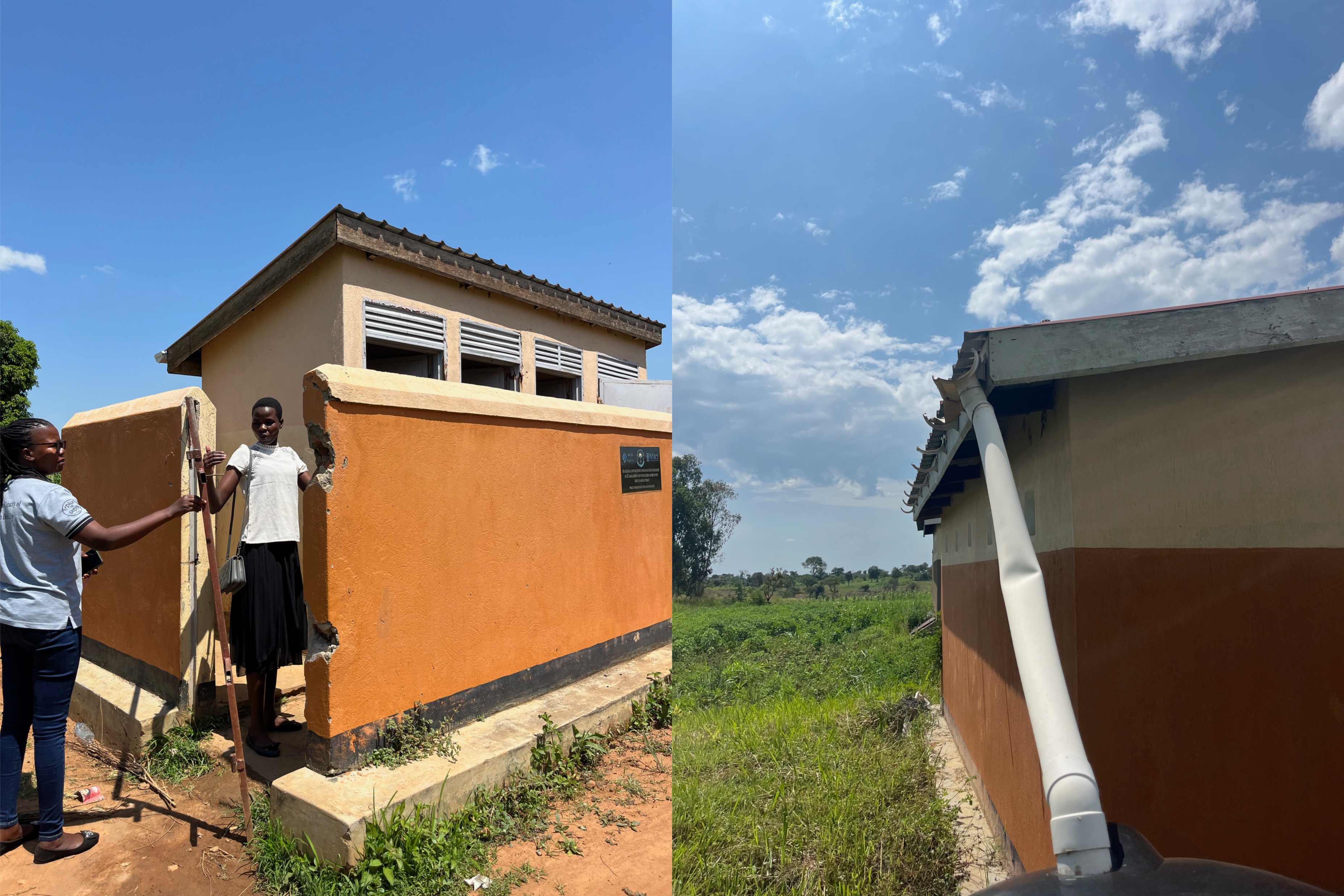
The status of the building and facilities also varied, but many of the newer ones are in fairly good physical condition. The primary issues are related to broken doors, gutters, and handwashing tanks, but the walls and roofs are all intact. However, the cleanliness of the toilets ranged from generally mediocre to absolutely disgusting. Most latrines had feces on the floor and were covered in flies, even if the Head Teacher promised that they clean the toilets daily.
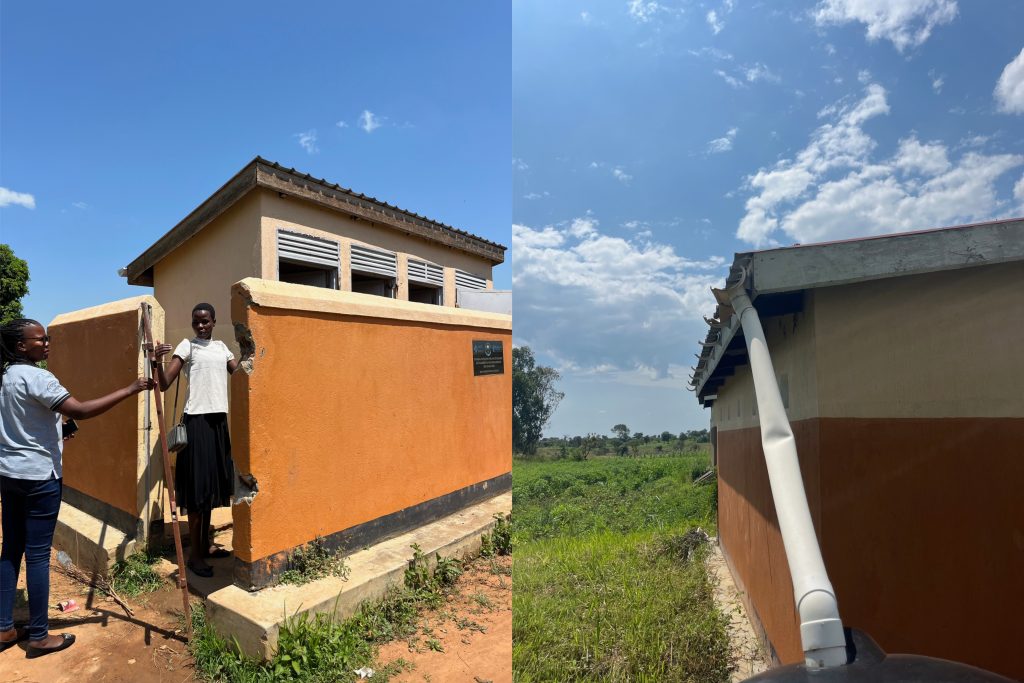
Inspecting past GDPU projects.

This was not the first or last time I saw a puddle of human feces (feces not pictured).
This is in part because the schools may not have funding for soap and brushes to clean the toilets, but also due to basic neglect and disregard by the Head Teachers. The only trend I noticed in our monitoring trips is that if your school receives more government funding and/or your Head Teacher is a woman, your latrines are much cleaner.
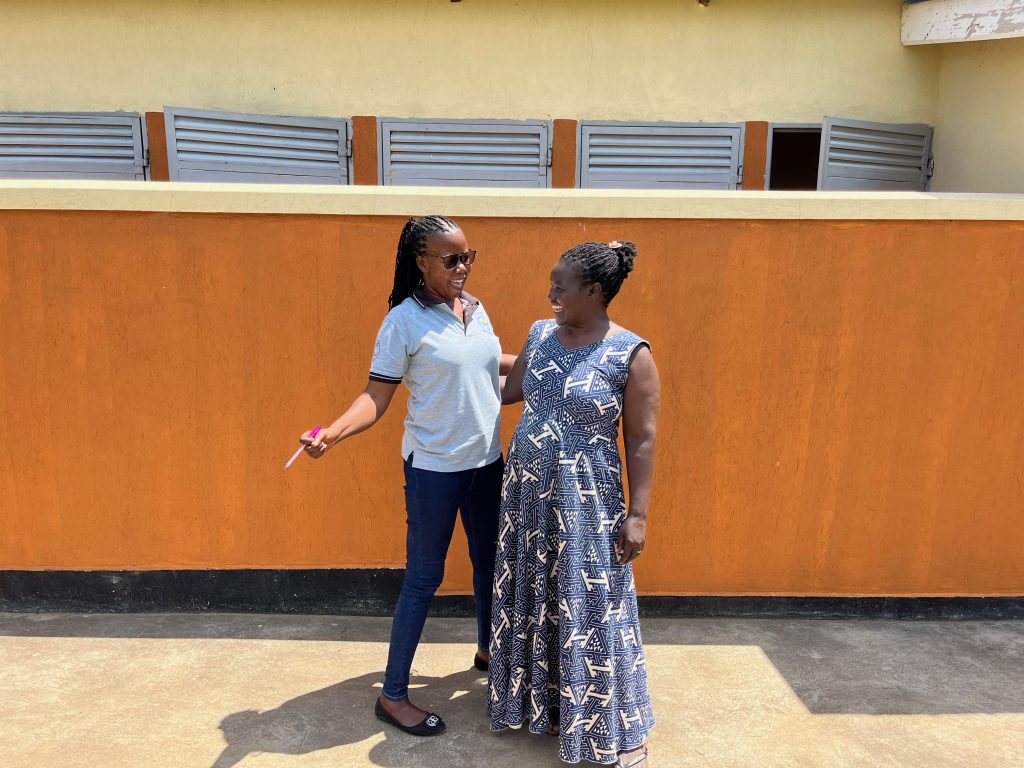
Emma and Joyce, the Head Teacher at Awach Central Primary School, who is an absolute rockstar.
A challenge that Head Teachers often shared with us is that many girls do not attend school when they are on their periods. This can be attributed to the physical pain and symptoms of a period, but moreover to the lack of sanitary pads and abysmal condition of some of the toilets. I can only imagine the embarrassment girls must feel if they have to manage their periods without privacy or any way to clean themselves and how discouraging that would be from attending school.
Currently, the girls toilets at Kulu Opal are mostly inoperable, have broken doors, and do not have space for girls to change. They also do not have an incinerator, so the girls drop used sanitary pads in the latrines, which make them incredibly difficult (if not impossible) to drain. GDPU has included changing rooms in their WASH projects since 2018, but the project at Kulu Opal will be the first GDPU effort to also include an incinerator for menstrual products.
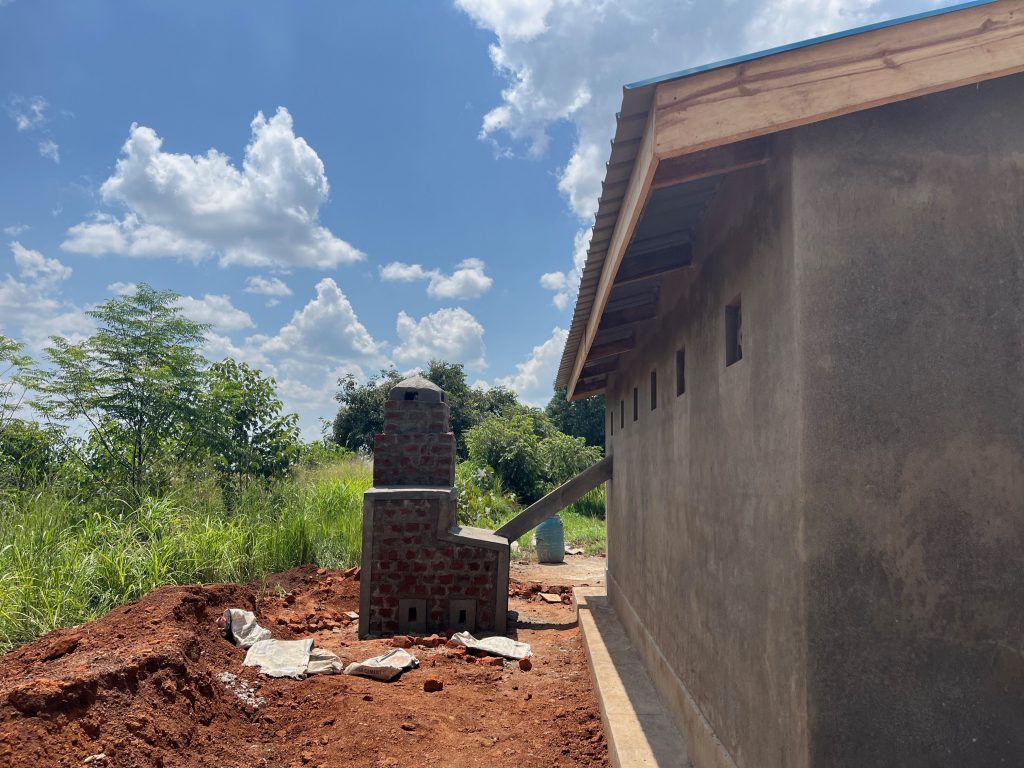
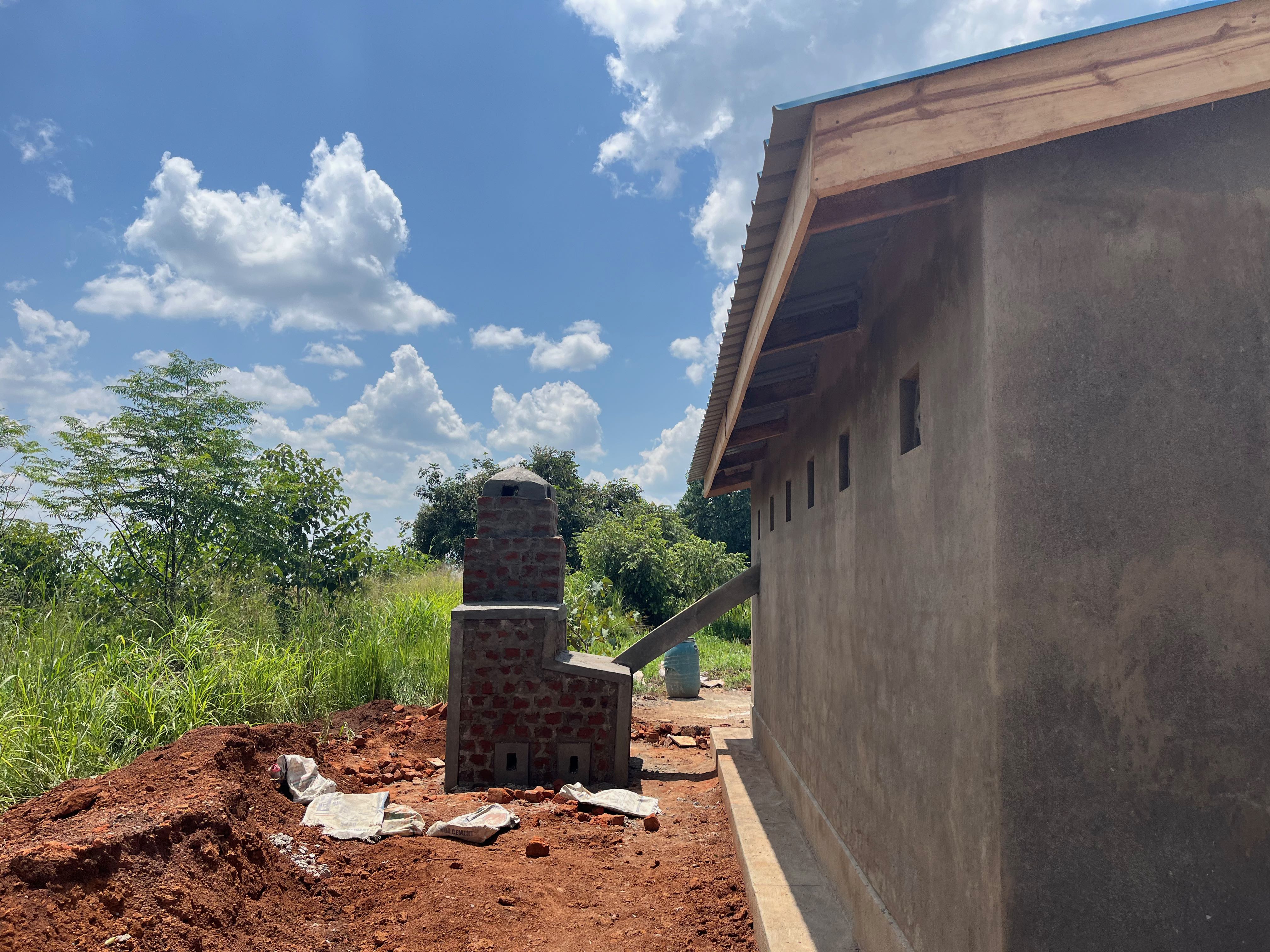
The incinerator at Kulu Opal. The concrete angled tube connects to the girls changing room.
The incinerator is a brick structure used to burn used menstrual products. It is connected to the girls changing room through a durable, concrete-layered tube. When girls want to dispose of a sanitary pad, they can enter the changing room and throw the pad in the tube without being seen. The changing room also has a hole so that when girls use the space to clean themselves, the water can drain out of it.
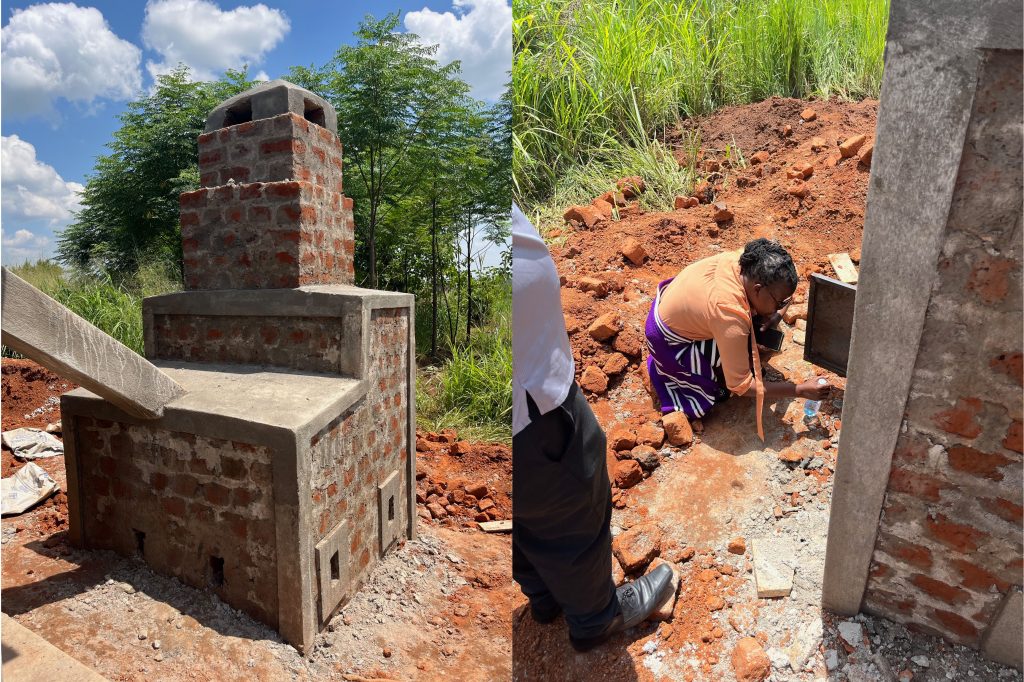
Emma inspecting the incinerator at Kulu Opal.
This newest addition to the GDPU WASH package will provide girls a private, clean, safe space to care for themselves so they can feel more comfortable going to school every day of the month.
-
WASH at Kulu Opal: The 4 F’s
1 CommentThe Kulu Opal project is moving along well, as we are almost to the handover ceremony and the end of my time in Uganda. It seems like almost overnight, the latrine pit became a building with walls! Once the walls were constructed, the building truly started coming together.

Kulu Opal project progress on July 16.

Kulu Opal project progress on July 19.

Kulu Opal project progress on July 25.

Kulu Opal project progress on July 27.
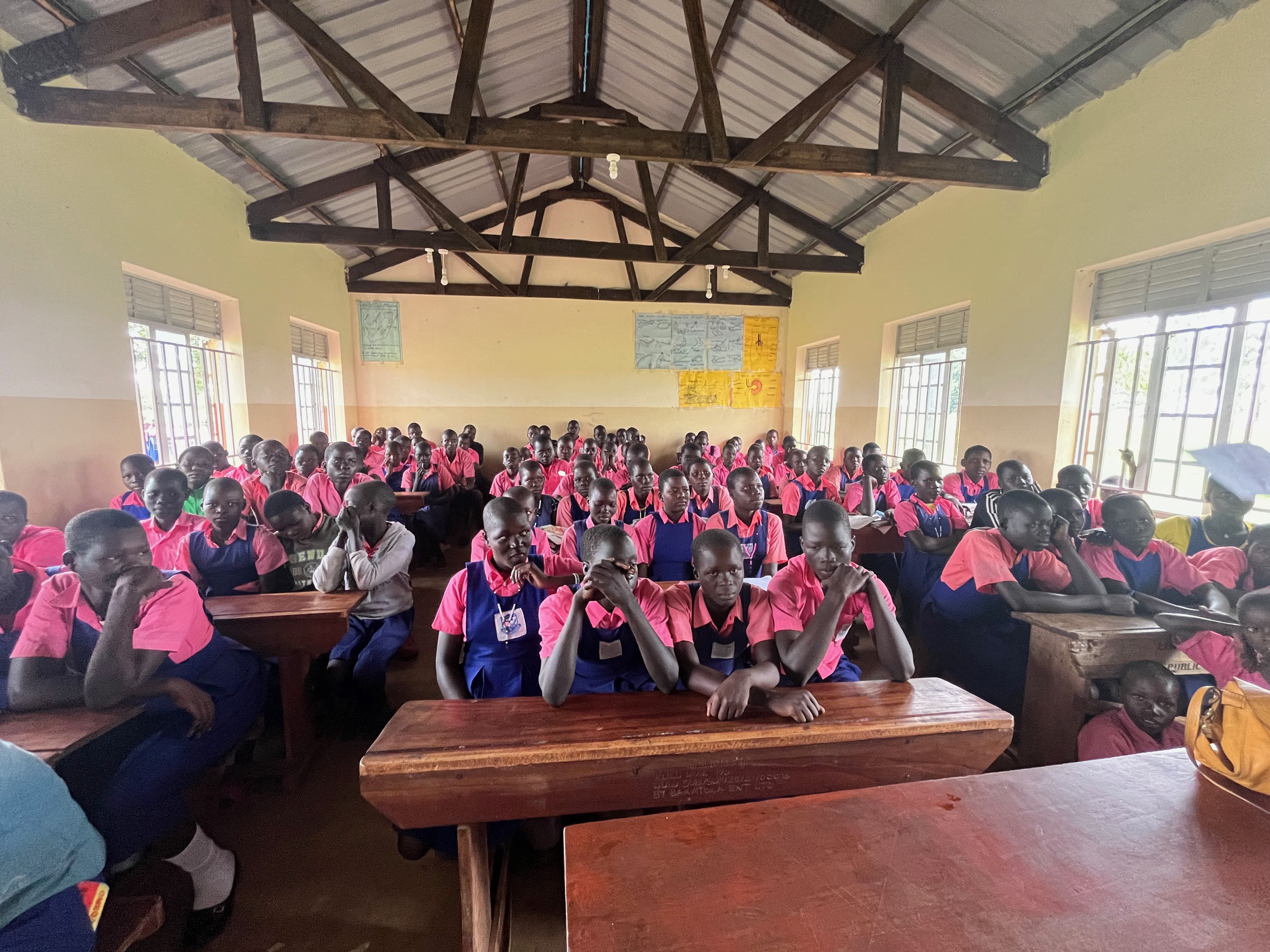
As part of the WASH Program, GDPU offers two trainings to Kulu Opal: Hygiene and Sanitation Training for the students and a Disability Inclusion Training for teachers, the School Management Committee, and the Parent Teacher Association. Last week, we held the Hygiene and Sanitation Training, which evolved quickly from only P4-P7 students, to all P1-P7 students outside by the central mango tree on the campus, to however many students we could fit in two classrooms because it started thunderstorming.

The original training set-up under a tree.
Emma, Joe, and Daniel led the trainings in Acholi. I helped a little at the end in English, which Daniel kindly translated for me. The training covered what a germ is, the importance of proper sanitation and hygiene, and handwashing demonstrations. They spoke about the “Four F’s” (Fingers, Flies, Food, Feces) of how germs can spread, which is core curriculum in Uganda public schools.
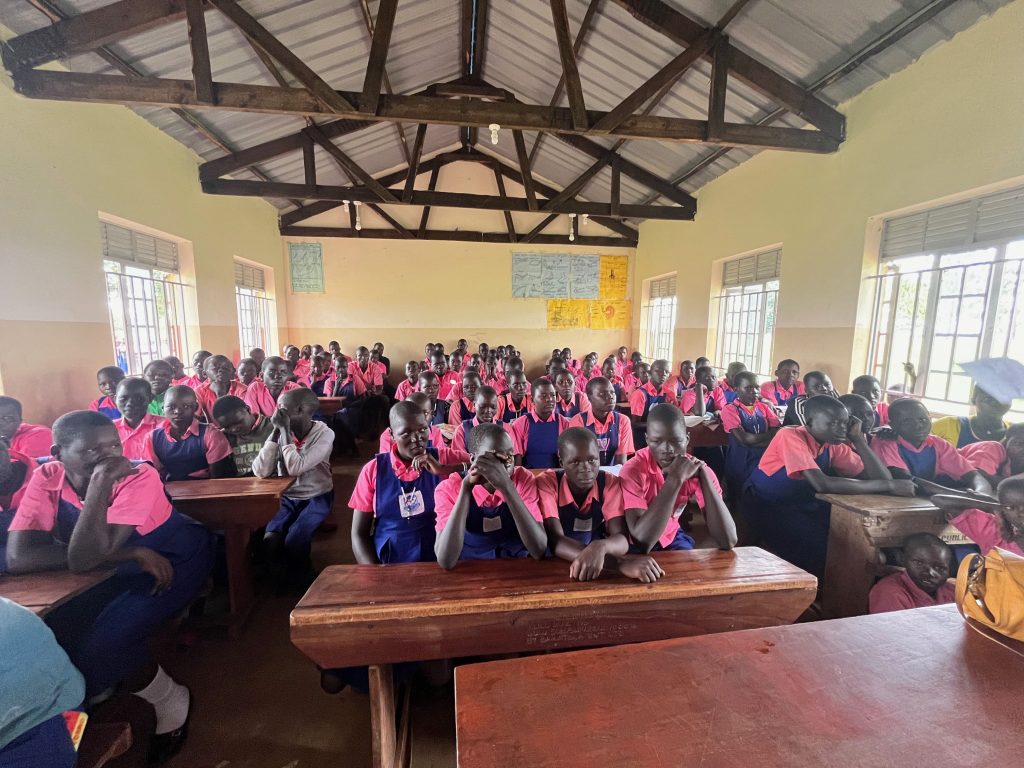
The new training set-up, with as many students a possible squeezed into a classroom.
The GDPU team and Head Teacher did a great job engaging the students and making the demonstrations lighthearted – the Head Teacher even mimicked how not to use toilet paper, which made everyone giggle for the rest of the day. I was super impressed by how attentive the students were, especially since it was right before lunch!
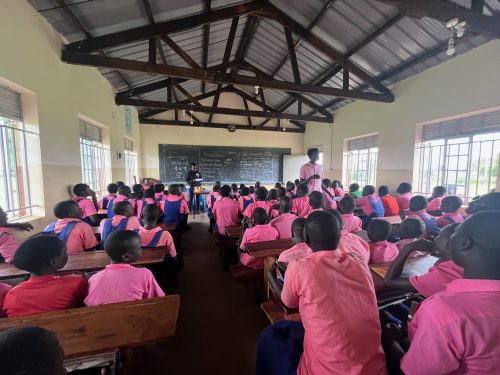
Daniel and Emma leading one classroom of learners at the WASH training.
Even though this training was in good faith, I can’t help but wonder how impactful it is. We can encourage students to change behaviors and tell them washing their hands with soap is important, but in reality, the school does not have adequate funds to buy soap on a regular basis and most students likely do not have soap at home. This is a core challenge of meaningful development – not just behavioral change or resource provision, but efforts that can be financially and logistically sustained in communities long after the funding and support is gone.
-
Meet GDPU: “GDPU is a very committed organization.” – Emma Ajok
2 CommentsThis is an article in a series profiling staff at GDPU, the Gulu disability community, and those who call northern Uganda home. All contents of this article have been approved and shared with the permission of Emma.
Emma Ajok has worked at GDPU since 2015. She currently serves as the Safeguarding Focal Point Person and the Water, Sanitation, and Hygiene (WASH) Program Manager. She has an degree in Community-Based Rehabilitation from Kyambogo University and hopes to pursue a career in safeguarding and child protection. I have been lucky to get to know Emma well through our long trips out to Kulu Opal and other schools in the district. She has welcomed me warmly to Gulu and Uganda, whether that’s sharing new food like jackfruit, teaching me how open groundnuts correctly, or helping correct my terrible attempts at speaking Acholi. Emma is proud to call Gulu home and lives here with her son, Josh.
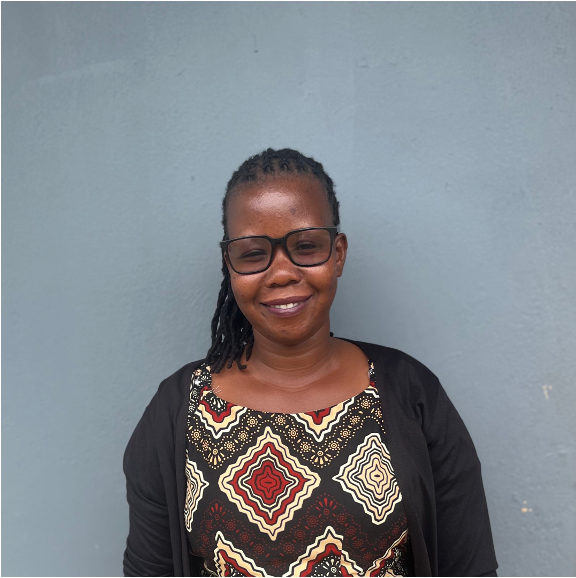
Emma Ajok of GDPU
How did you start working at GDPU?
I started working here as a volunteer. I worked on a project for facilitating parents of children with cerebral palsy. I was training them on how to take care of children with cerebral palsy, models like communication, positioning, feeding, toileting.
It was something that I was interested to do because during my internship, I realized that children with disabilities are being locked inside, especially those ones with cerebral palsy. You find the parents tied them inside or even put a padlock on. And they got to do their daily business.
I became concerned. I wished I could do something for these children. So when GDPU gave me the opportunity, I was so excited. Because I knew I would at least make changes, talk to the families. That’s how I got connected to GDPU.
Where did you do your internship that you mentioned?
I did my internship at the local government, at Layibi, one of the divisions in Gulu [District]. There, I was put on a Community-Based Department. Well, we would move to the field with the CDO [Community Development Office]. He would show us where our persons with disability lives, what they do.
How did you first hear about GDPU?
I heard about it from a lady called Florence. She was already here, participating in one of the wheelchair projects. She does sports.
So when I went for my internship, she was like, “I want you to come. I pray to God that you come and work at GDPU.” And I was like, “What is GDPU?” And she was like, “It’s an office for persons with disability. You just need to come and visit.. after you’re done with school, you come and visit.”
What is your role at GDPU?
I’m working as the Safeguarding Focal Point Person. It’s someone who makes sure that GDPU is an organization that respects the rights of persons with disability.
I carry out training of staff, volunteers, interns. I make sure that they know what is in our policy on safeguarding because it’s important that they all have the knowledge on safeguarding. Safeguarding is all about ensuring that GDPUs programs and projects don’t [cause] harm to our beneficials. For example, we need to look at the project design, the timing, the meeting venue… carrying out risk assessment when you carry out an activity so that we don’t expose our beneficiaries to risk.
I am also the WASH Project Manager. I’m managing one of the projects that is being supported by the Advocacy Project. I joined the project five years ago. Every year we install accessible, drainable pit latrines at one of the primary school that is being directed by the DEO [District Education Officer]. We make sure that the school is inclusive. We train teachers on inclusion and how they should do that classroom settings. We also conduct hygiene training to make sure that toilets are clean and there are enough brushes, toilet paper, liquid soap.
You’ve been at GDPU for 9, almost 10 years now. What work have you been proudest of here?
I think I feel so good since I came here. I worked on different projects. One that I did not talk about is V-Plus. It’s a skills training. We recruit youth with disabilities to come and study different skills, like sweater knitting, design and decorations, motorcycle repair, electronics repair.
I feel excited when I go to do follow-up and they’re doing something, they’re earning a living. They’re no longer being discriminated in the community. It makes me so proud.
And also on the WASH project, I think I feel so good when I go to school where we’ve installed of the toilet and the number of children with disabilities or the enrollment has increased because of the package that we put. It also makes me very proud. If I see that they’re taking good care of the toilet, it gives me more energy to advocate for more schools.
How did you become passionate about working with people with disabilities?
I think when I was applying to university, even selecting the course that I did, I already had the passion. Because I remember someone told me “The course that you’re going for – it has sign language, it has braille… you’ll be supporting the vulnerable groups.” I decided yes, I am ready for this.
How did you decide on that course of study?
In Uganda, in Gulu, we had a long period of insurgency, the LRA war. During that period, many people were affected. People got a lot of disabilities. Even my own relatives, others were killed. Others were left disabled – their nose, mouth were cut off. So during that period, I was like, “if there is anything that I would do, and if I can go and study something related to disability, I would be so grateful.”
So when I finished my senior six, I was like, I think I want this course. It will expose me to [the field of disability] more. If I do it, if I have a degree in this, it can push me and I can do more for them. So that’s how I started.
What do you hope GDPU accomplishes in the next 10 years?
I think GDPU is an organization that is committed to advocate for the rights of persons with disability for them to access all that is required for them. GDPU is really working so hard to make sure that there is at least improvement in the lives of persons with disability through advocacy, doing a lot of things that can support them, providing assistive devices.
I wish we would get more funding so that we are able to support the numbers of persons with disabilities in Gulu.
If a donor showed up tomorrow and gave GDPU the equivalent of $1 million USD (about 4 billion Ugandan Shillings), how would you use it?
There is a lot of need for persons with disabilities and I feel GDPU doesn’t have enough resources. I would think if there is money, we would provide enough assistive devices for persons with disabilities. Things like wheelchair, because they are very expensive.
Some people cannot afford them. Actually all of them [cannot afford them]. And the projects that we have here doesn’t meet all their needs.
Things like wheelchairs – you give this and the next year, the child is outgrown and needs another one. So if there is capacity, GDPU would be doing their best to give them assistive devices. Things like the hearing aids will have never given because we don’t have the resources. Even the crutches, the white canes, they’re all very expensive.
What is something you wish people knew about GDPU?
They should know that GDPU is a very committed organization for persons with disability and they are always ready to support. They’re transparent. They have an organized board. We are ready and very committed to do the work.
Do you have any questions for me?
When are you coming back to Uganda?
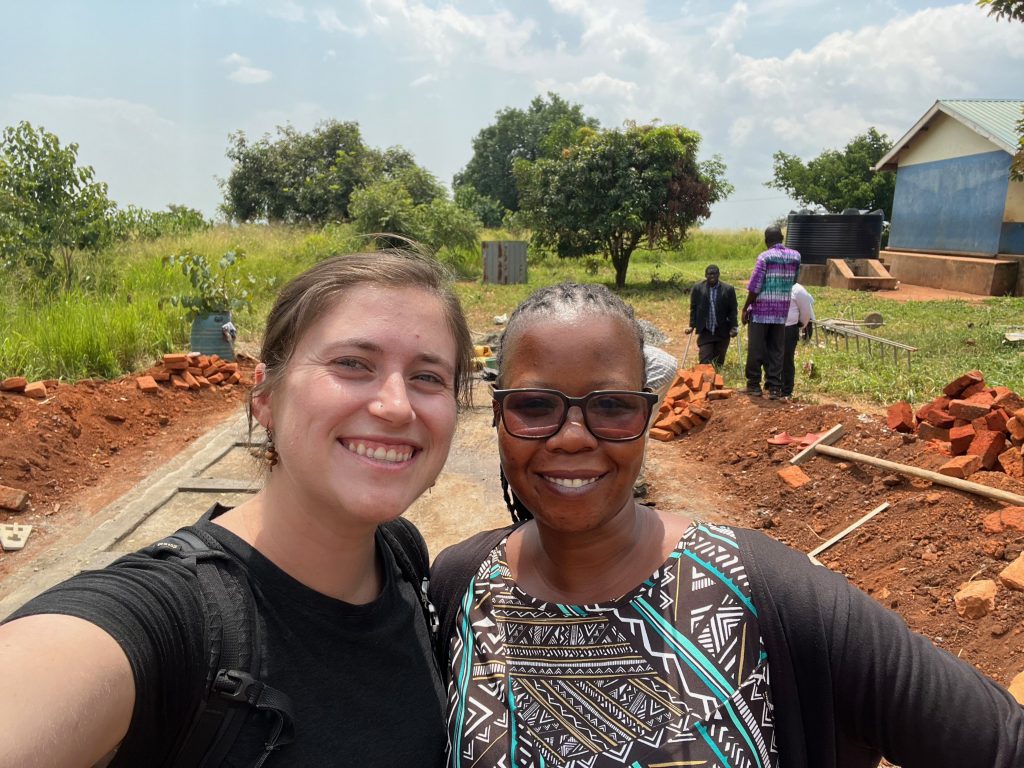
Emma and I during a visit to Kulu Opal.
-
WASH at Kulu Opal: Foundations and Floors
2 CommentsThis is a well overdue update on construction efforts at Kulu Opal! Emma, other GDPU staff, and I visit the school twice a week to monitor construction. As soon as the pit was done, the Contractor and his team began lining the pit with bricks and concrete. They also started laying the foundation for stance walls and exterior building walls.
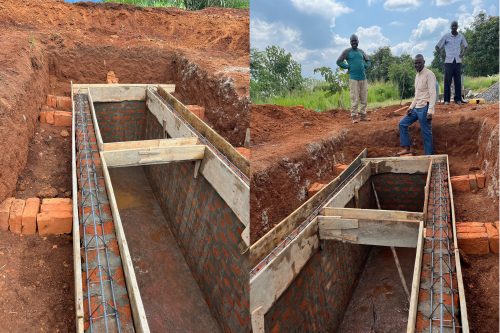
The brick and concrete lining of the latrine pit and wall foundation.
Then, the bricks in the pit were covered with a smooth layer of concrete and they built up the wall bases. You can see the construction crew in the pit in the photos below.
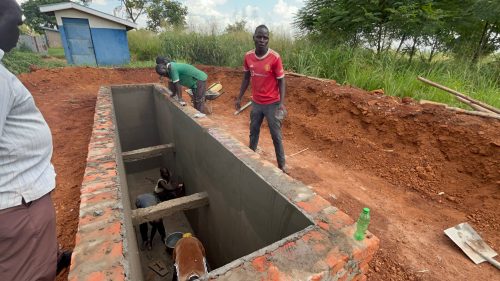
The crew covering the pit and wall foundation with concrete.
Once those were complete and dry, the crew covered the base with a slab of concrete, leaving latrine holes for each stance. The large hole on the left side of the photo below is the connection point to the pit so that it can be drained once it is full.
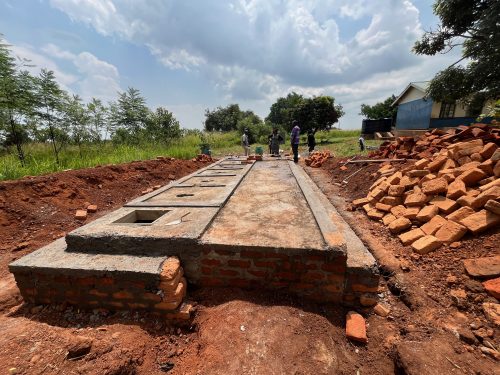
The completed concrete slap with holes for each stance.
Over the last month, Emma, I, the interns, and other GDPU staff have been hard at work making liquid soap. This soap will be given to Kulu Opal at the handover ceremony and is sold to past GDPU beneficiary schools at a reduced cost.
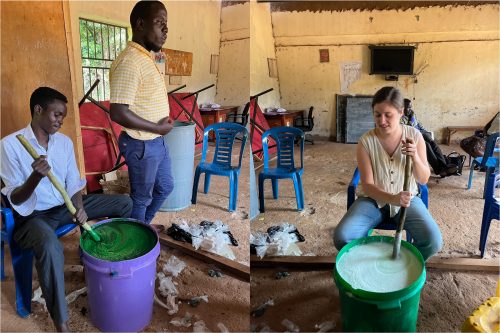
Daniel, Crispus, and I mixing the ingredients for soap.
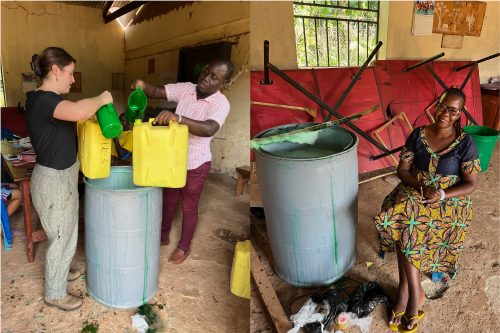
Crispus and I packaging the soap into jerrycans and supervisor Emma looking on.
Skim through the following photos below to see a summary of the construction progress! The next major step will be the wall and roof construction.
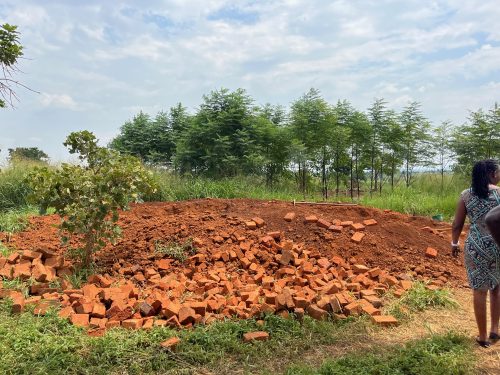
Kulu Opal project progress on July 2.

Kulu Opal project progress on July 4.
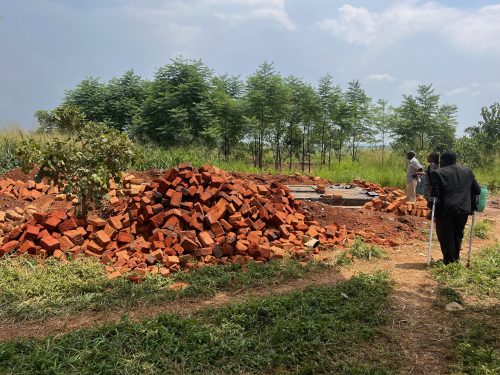
Kulu Opal project progress on July 9.
-
Meet GDPU: “It’s something that comes from the heart.” – Daniel Nyeko and Marylyn Amony
2 CommentsThis is an article in a series profiling staff at GDPU, the Gulu disability community, and those who call northern Uganda home. All contents of this article have been approved and shared with the permission of Daniel and Marylyn.
Daniel talked about different music in our interview. Click here to listen to Burna Boy, Patoranking, and Shania Twain.
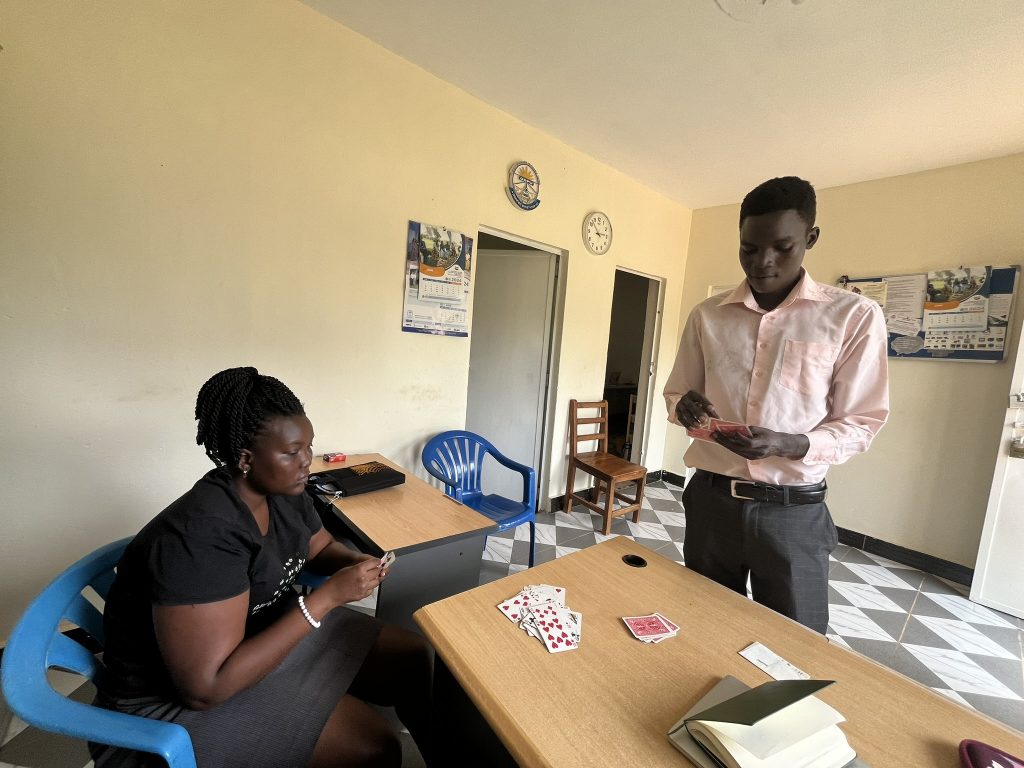
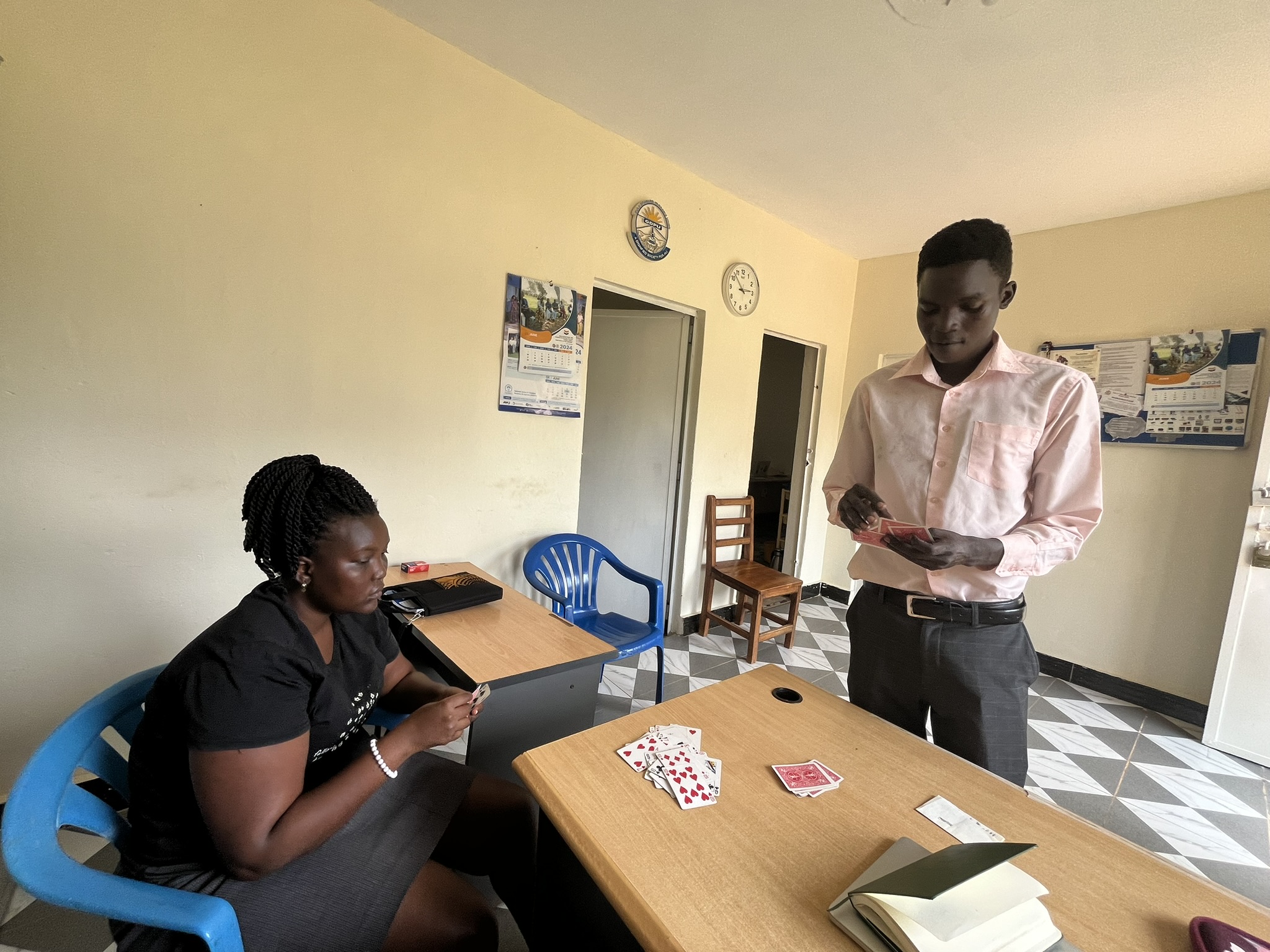
Daniel and Marylyn teaching me to play Acholi cards during our lunch break.
Daniel Comboni Nyeko and Marylyn Goretti Amony are summer interns at GDPU. They supports various programs at the Union. They will graduate from Kymbago University in 2025 with degrees in Community Development and Social Justice. After graduation, they both hope to find supporting the disability community. Daniel is incredibly hardworking and quickly became my omera matidi (little brother) here. He has been very kind to share music with me (a current favorite is Shania Twain’s “Don’t Be Stupid”). Marilyn is quieter but very funny, as I learned when she and Daniel taught me to play a local card game (similar to Uno but with extra rules) and she wouldn’t teach me all the rules so she could win! Daniel and Marilyn grew up in Gulu, but now call both Gulu and Kampala home.

Daniel Nyeko of GDPU
What are you studying at university and why did you chose it?
I am studying community development and social justice. I chose it because I love to work with the community. I see that there are a lot of problems in communities in Africa. The biggest percentage of people in Africa are poor and really suffering from things like disability. Due to several things like conflicts and stuff like that. And they also need people to support them. And very few people can be willing to work with such kind of people. So I decided [on my degree program] so that I can also be among the helpers.
What are you going to do when the internship ends?
I’ll have to look for a job.
What do you want to do?
Same thing – support people with disabilities. If possible, I wish I could go and start my own foundation to deal with people with disabilities.
Is there anything specific you would want your foundation to do?
It should be general – there should be a business section, a training section, skills… everything. So long as it is something that can make these people have courage in life.
Would you want that to be here or in Kampala?
Gulu. It is better. The North is the most affected area with disability in Uganda because of a lot of things… because there was a war here. The LRA war. So it affected people.
We found a lady from Nwoya district. She was telling us that she got a hearing impairment because of the war. There was a war battle – there was a bomb that passed her. Boom! It affected her hearing on the left. She couldn’t hear anything because it was too near. So I see that northern Uganda is the most affected in the whole of Uganda.
How did you first hear about GDPU?
From school. I knew before that there is a union that supports people with disabilities. And I didn’t know that many people that there were people who were disabled.
As an intern, what are your responsibilities?
For me, most of the time I interact with disabled people. I worked with peer mentors. I had a business training with them. And there was some Street Business Training with Emma.
What work have you been proudest of at GDPU?
Changing the lives of kids living with disabilities. [For example,] we went to the field in Nwoya District and did some counseling… We were teaching them about [support for] gender-based violence.
Why are you passionate about working with people with disabilities?
Humanity. It is general knowledge – you need to help another person. If you really feel pain for someone else, and you really want to love that person again, then you can just go to that line without anyone telling you. No one should come and tell you. You go and help people – poor people, people with disabilities… It’s something that comes from the heart.
What do you like to do outside of work? Do you listen to music?
Too much. My favorite singer is Burna Boy from Nigeria. He’s very good. And Patoranking from Nigeria. It’s Afropop music.
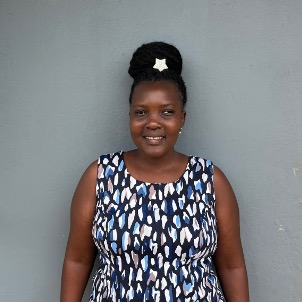
Marylyn Amony of GDPU
What are you studying at university?
I am studying community development and social justice.
How did you first hear about GDPU?
I heard about GDPU earlier in my primary level since I was studying nearby.
As an intern, what are your responsibilities?
I counsel and train people with disabilities. I also go to field activities and support the provision of assistive devices to people with disabilities. I am learning sign language and attend different skills training as well.
What type of career do you want to have?
I want to be a community development officer and work with disabled persons and disability organizations.
Why are you passionate about working with people with disabilities?
Because I am also disabled and because of the love I have for people with disabilities.
-
Conflict Survivors are Building Community for Themselves
2 CommentsTrigger Warning: This blog discusses serious topics, including war, sexual violence, and captivity. If those topics are especially disturbing to you, please skip reading this blog!
Additionally, this blog highlights a new tailoring start-up that Women in Action for Women is beginning for its members. Please consider donating to the project on GlobalGiving to help them reach their goal.
Women in Action for Women (WAW) is an organization based in Northern Uganda that supports women survivors of the Lord’s Resistance Army (LRA) conflict. Their intent is to empower women with the skills to uplift themselves, their families, and their communities through business skills and vocational training. The LRA was a rebel movement in Uganda from 1987 to 2006, which abducted approximately 50,000 children (although numbers vary significantly based on the source). Today, there are over 3,000 female survivors of the LRA conflict in Northern Uganda – 95% of which are single mothers. Returning to life after the abductions has not been easy. Many survivors did not finish secondary school and faced social exclusion once escaping the LRA, left with few ways to support themselves.
WAW was founded by Victoria Nyanyjura, a survivor herself, who has gone on to attend university in Kampala and Notre Dame and work for the United Nations. She always has a twinkle in her eye when she talks and is clearly very passionate about the work she does. WAW is also supported by Florence Nakito, a current intern who will be graduating from Makerere University in Kampala in the spring. She and I have become fast friends, as we both arrived in Gulu around the same time without knowing anyone!

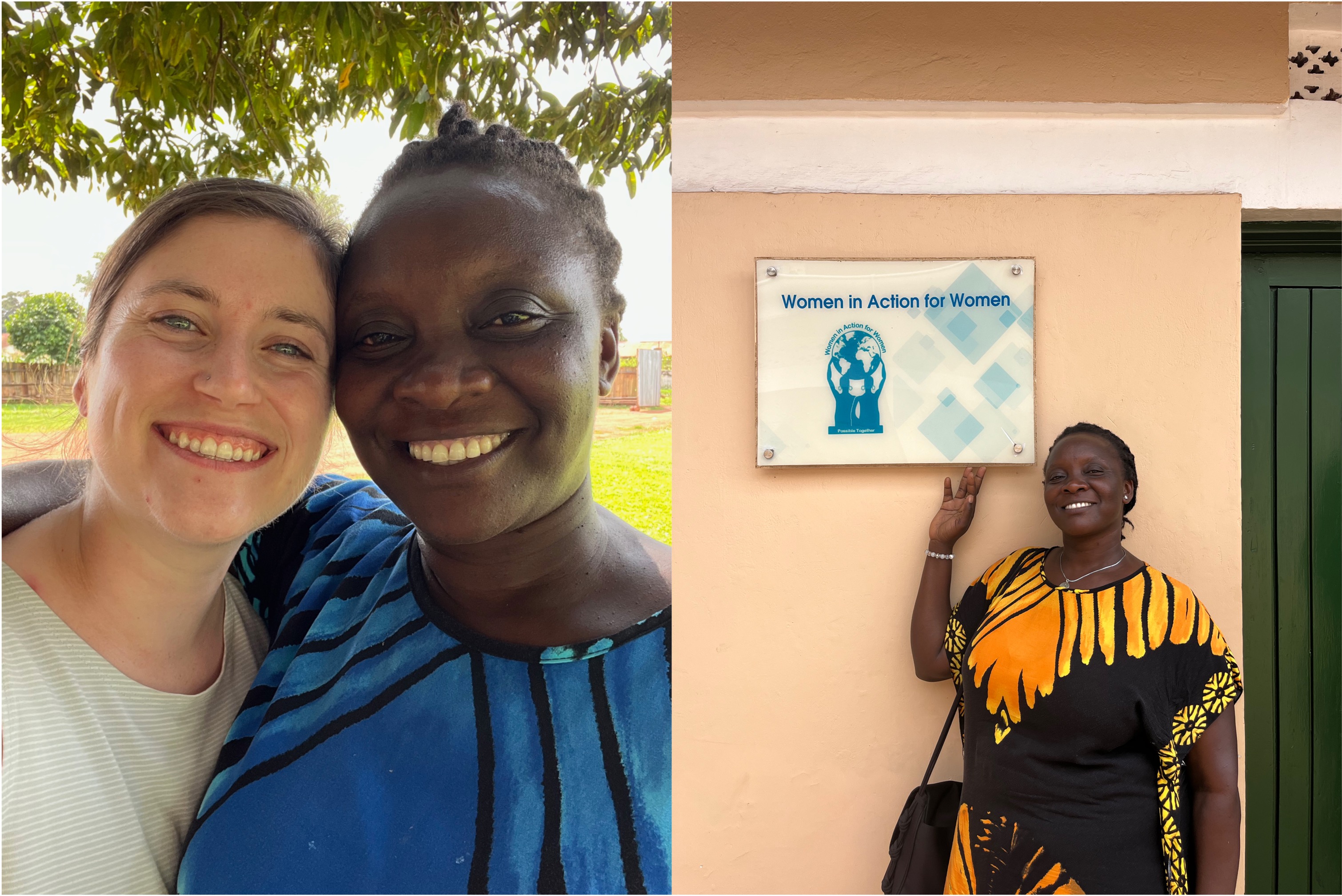
Victoria and I together and visiting the WAW office in Gulu.
Advocacy Project has a history of partnering with WAW on various embroidery and quilting projects. Bobbi of the Advocacy Project Board visited Uganda a few years ago to teach the women to embroider. Since then, the women have created multiple quilts that visualize their personal stories from the war and from COVID-19.
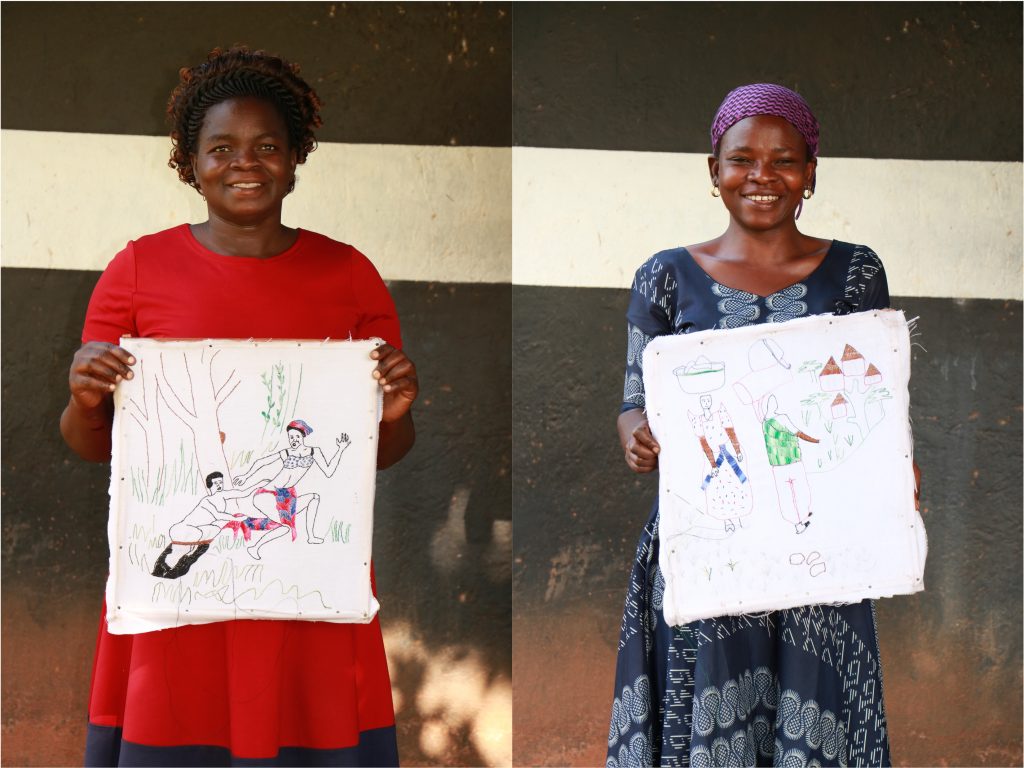
Two women of WAW holding their embroidery blocks for the War Survivors Quilt.
The current project is a nature-themed sister artists effort. The members of WAW embroider butterflies and birds and are paid for their products. These embroideries are shared with “sister artists” in North America who create quilts with the embroidery blocks. The quilts are put up for auction and all proceeds are shared back with WAW.
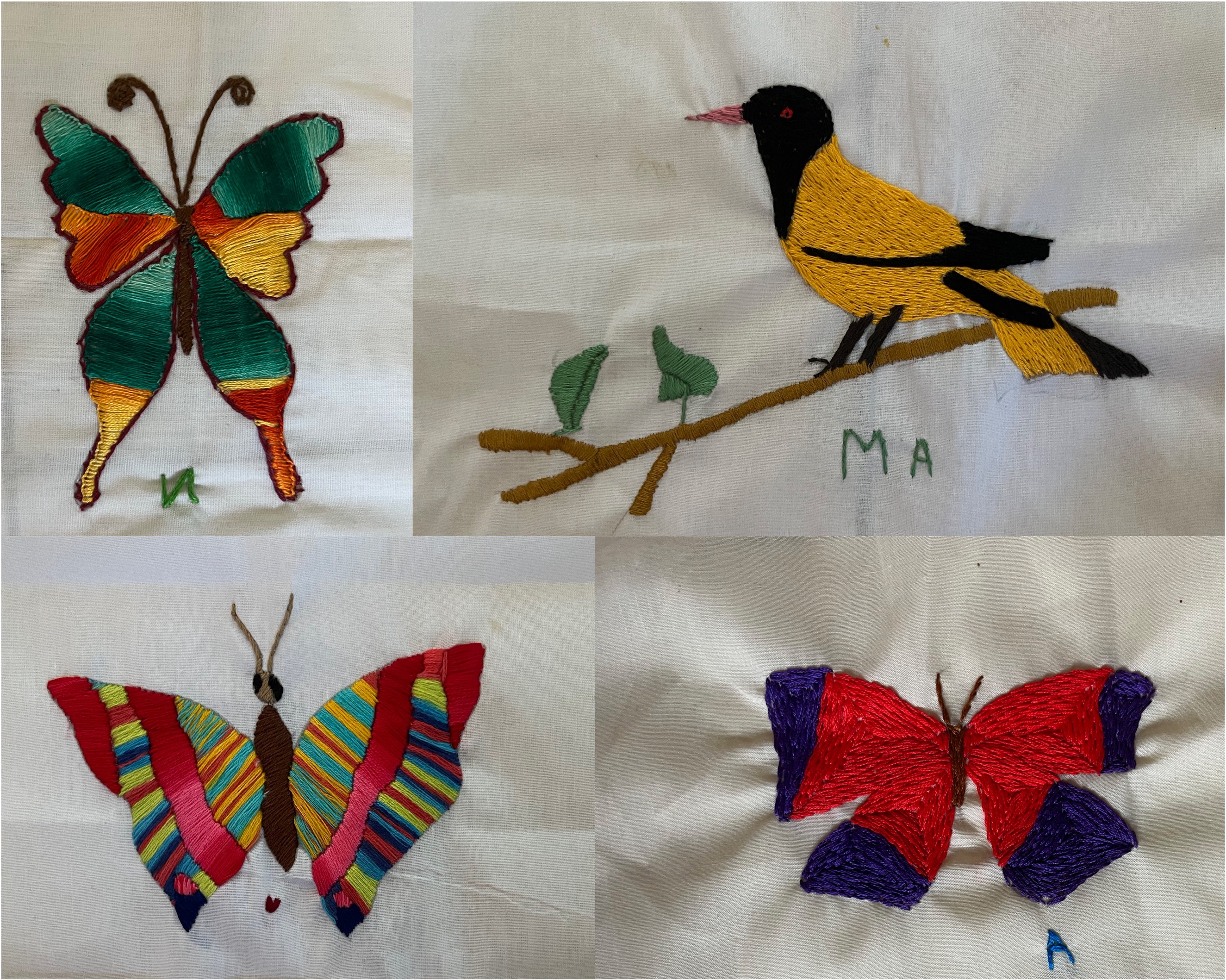
The first time I met with WAW, we enjoyed a traditional Ugandan meal together (beans, meat, rice, and posho). I gave them the colorful threads I had brought with me from the States and collected some of the embroideries they had created. I will collect even more embroideries before I leave and bring them back to the U.S. to be distributed to the sister artists. Each woman uses a unique style to the patterns and colors in their embroideries. They also add a signature (you can see the letters or symbols in the pictures below) to indicate which blocks are theirs.
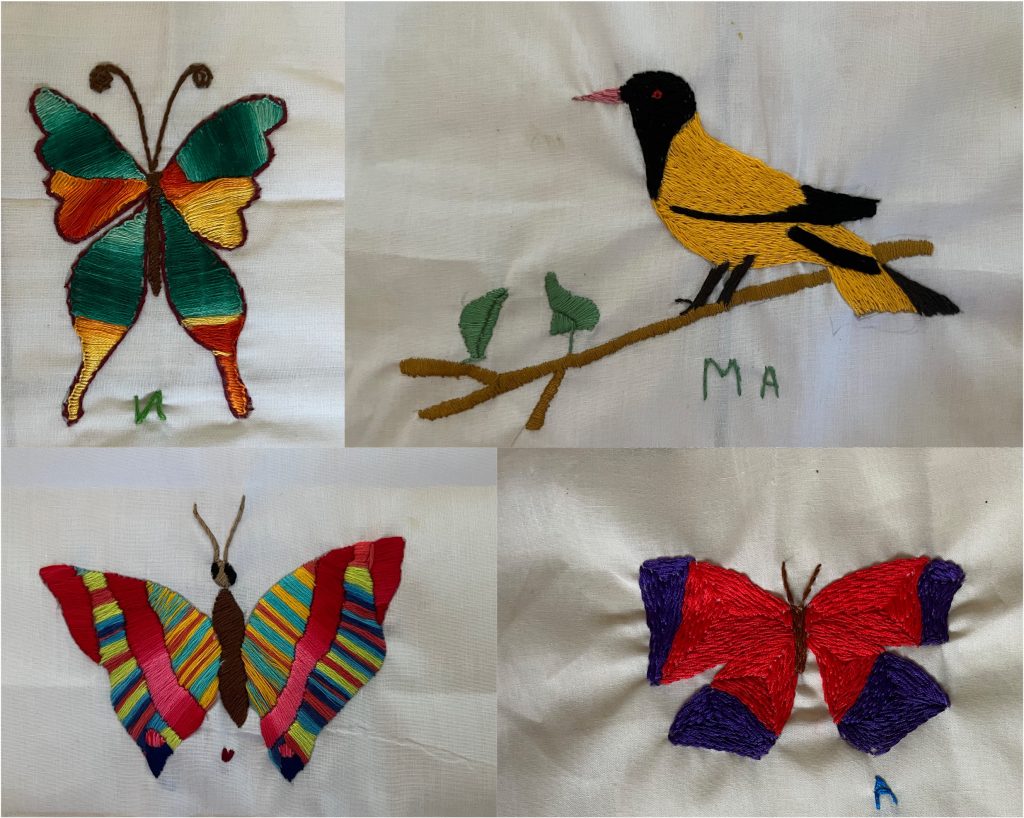
Some of the embroidered birds and butterflies.
I have been lucky to meet with Victoria, Florence, and the members of WAW a few times since arriving in Gulu and have listened to some of their stories from captivity (or “going abroad” as they call it, because they were all taken to South Sudan). These women endured starvation, rape, sexual abuse, and forced marriages and childbirth, often before the age of 15. Many of them have visible scars on their heads, arms, and chest from their time in captivity. One woman shared how they would be forced to follow a commander to the next town that was getting ransacked to make food for the soldiers and new recruits, often without food, water, or any instruction for how long they would be walking. They have also talked some about the challenges of repatriating and starting anew in their communities that look very different from when they left. You can read more about Victoria and the WAW members’ stories here.
Unfortunately, their stories are not unique, as I’ve heard anecdotes of the war from countless others in Uganda. Multiple people have shared that when growing up in Gulu, they would sleep in a different part of town at night that was safer, and then return to their homes in the morning. One person talked about how all four sons from their neighbor’s family were kidnapped, and years later only three returned. I’ve learned from GDPU that the Acholi sub-region has more people with disabilities than other areas in Uganda because of the war. These disabilities may have resulted directly from LRA brutalities, like forced amputations and PTSD, or indirectly, like mental disabilities caused by starvation and malnutrition and the generational impacts of trauma. While listening to these stories aches my heart, it is also a huge honor for people to feel comfortable sharing these personal and family histories with me.

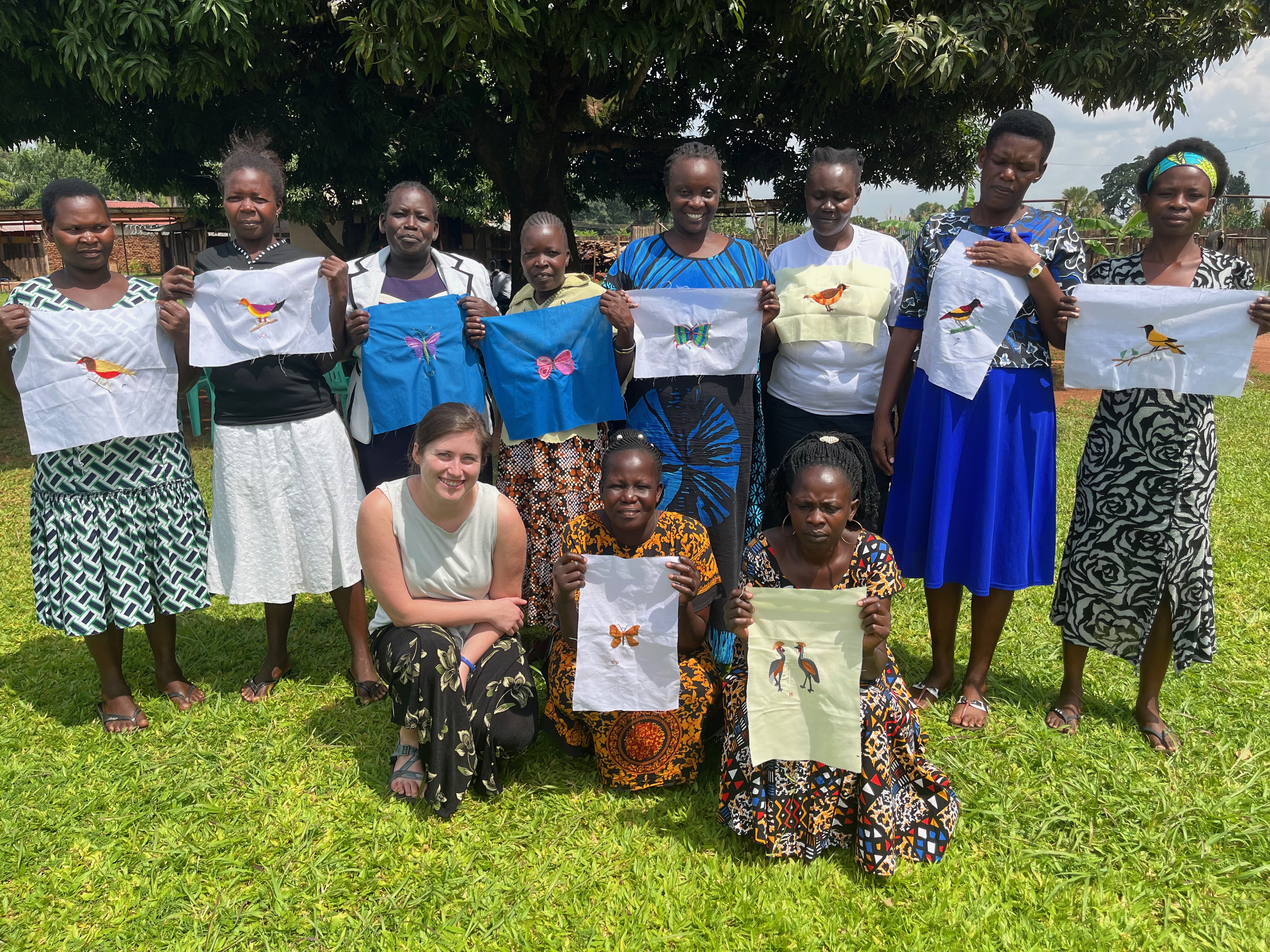
Me and some of the women of WAW with their embroideries.
Organizations like WAW are driving recovery and support for survivors by not only providing them with tangible skills, but also by creating spaces where survivors can safely build community with others who are recovering in tandem. WAW is currently in the process of designing and implementing tailoring training program. This program would enable the women to expand their existing artisan skills into clothing repair and production and help them initiate a business to receive a direct source of income. Please consider donating to their start-up to support this incredible organization.
-
Meet GDPU: “I have the passion to see that someone’s life changes completely.” – Faruk Musema
3 CommentsThis is an article in a series profiling staff at GDPU, the Gulu disability community, and those who call northern Uganda home. All contents of this article have been approved and shared with the permission of Faruk.
Faruk Musema has worked at GDPU since 2014. He has served in many roles, as a Guidance Counselor, Monitoring & Evaluation Officer, Skills Training Center Lead, and now as the Project Coordinator. He has an undergraduate degree in Social Work and Community Development, focused in Disabilities, from Kyambogo University and a post-graduate degree in Community Development from Gulu University. He hopes to pursue a Masters in Development Studies in the future. Faruk is always smiling, singing, and/or dancing in the office, and in watching his interactions with persons with disabilities, it is clear that this work is really fulfilling to him. Faruk grew up in Onang Village in the wider Gulu District, but Gulu City is where he calls home. He currently lives in Gulu with his wife, Sharon, and their two kids. In addition to working at GDPU, Faruk founded and is the director of Ability Sports Africa, the only organization in Uganda that provides sports programs for persons with disabilities.
In this interview, Faruk speaks about music videos that students have made at GDPU. You can view one of the music videos here.
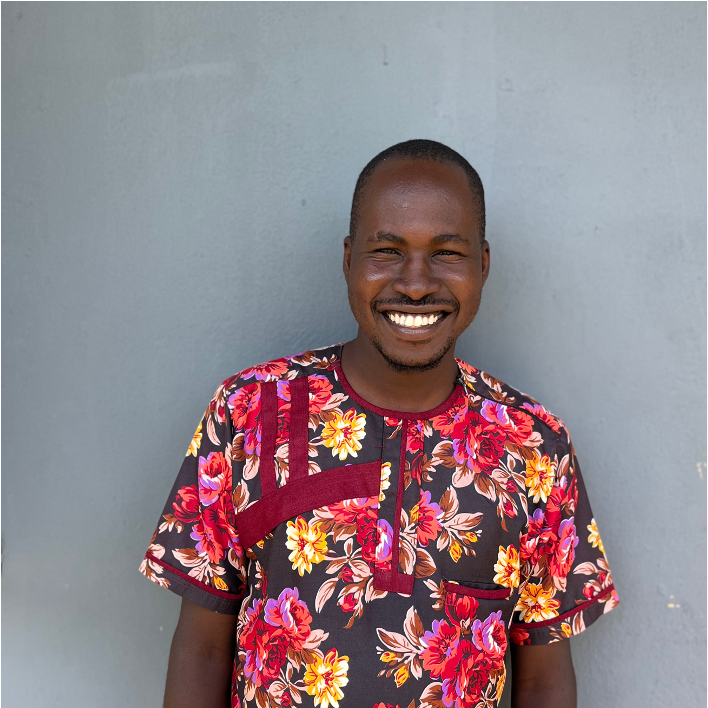
Faruk Musema of GDPU
How did you first hear about GDPU?
When I was at university, I gained interest in disabilities when I took a Kyambogo disability course. I started checking which areas or which organizations within my locality work with persons with disabilities. So, I got to [learn] more about GDPU in 2010.
I met one of my friends [at GDPU]. He’s called Charles. I studied with him in high school. He’s a victim of landmine; he was amputated completely [from below the waist]. When I met him here, he played wheelchair basketball. So, I wanted to play with them and I gained more interest in their organization.
But I did not think of working here. When I completed university in 2013, I applied for a job with VSO. Then they posted me here – I found myself at GDPU. It was a very, very good thing that happened to my life.
What is your role at GDPU?
So [when I started] my job title was a Guidance Counselor. I [had] been supporting our youths with disabilities on psychosocial support, guidance and counseling, group counseling… and all other kind of support that can help our youths with disability to cope up with the stress and the trauma they had. I worked with mental health, reproductive health, and other institutions to ensure that if I don’t have knowledge in this area, I can refer these youths to get services from those who can best support.
I was also leading the skills training center here. I was the principal of the center, Guidance Counselor, and also the Monitoring and Evaluation Officer. I couldn’t leave the place at night because I need to ensure the safety of our youths. There are other youths who are a little bit bigger, there are others who are young… Back then we never had matron and patron. So, if everyone goes out of this office, I needed to stay to ensure that they are well. If there is no issue, then I leave.*
Right now I’m working as a Project Coordinator. I coordinate two projects. One is the V-PLUS (“Vocational Plus”). The “plus” component is the music, the follow-up support – these different tailor-made trainings that we are offering to our youths – because it is now something beyond the vocational training. The project is supporting 115 youths with disabilities in Gulu, Amuru, Omoro, and Nwoya Districts. We follow up on them on a monthly basis. We go and check on businesses that are running, the challenges that they are facing, and tailor trainings based on the gaps.
We have brought in a new concept of peer mentors. We wanted the peers who were successful beneficiaries to take the lead in supporting their peers who are still struggling. So, we are training them. We are building their capacities. We have a total of 12 peer mentors. And they are coming from all the districts. They will be helping us in mobilizing and following up on the youths. We train [the peer mentors] and we want the peers to train the other ones so that it becomes easier for them to co-exist. Because when you hear something from someone whom you are in the same age group, it becomes easier for you to work, to communicate, and interact.
The second project is called Viva La Visa. It is more of the music program – music for social change. The donor for that program is Viva La Visa UK… During our skills training program, youths with disabilities showed interest in singing, in music. But we did not have that opportunity to have those kind of [trainings]. So, one time, I gave them money. I told them, “You go and make the music. You go to one of the studios. You go and record. I want to hear that music.” Then, they went and recorded.
In two days, they came with the music. It was a very nice song. The song was about how we, people with disability, we are also human. It had a very strong message. So, I [thought], “Why don’t I record this song?” I made the video locally. Then I put it on YouTube and share also with those of Mac, the donor of V-PLUS. They shared it with their friends and that is how Viva [La Visa] got interested.
You’ve been at GDPU for 10 years now. What work have you been proudest of here?
One is ensuring that the skills training program is running. The first skills training program ended in 2015. But I kept on pushing it. And it is something that has made the center more vibrant because the identity of GDPU is now skills training for youths. Everyone knows when they hear about GDPU, they think of skill development for youths. That is something that makes me really proud of what I’ve put in place.
Secondly, sports for persons with disabilities. I’m happy to see that a number of our youths have now got an opportunity to travel outside Uganda to represent the country – like Brenda. I introduced Brenda in athletics in 2018. And from there she started gaining slowly, slowly. Right now she’s a Paralympian. In August she’ll be going to Paris to represent Uganda.
And that makes me also happy to see that. These youths, they have gained esteem. They feel proud of themselves. They are confident. When I go to the market, I get to see all my beneficiaries. They are working. And all this, they give it back. And I feel happy when they talk about it.
Most people [work on] projects because of money. They don’t come because of the passion. So the difference I might be having [compared to] many of the people is that for me I have the passion to work, to do and deliver, to see that someone’s life has changed or changes completely. I have that in me.
How did you become passionate about working with people with disabilities?
Way back when I was young, I had a friend of mine called Saidi. Saidi is a person with physical disability. He has been very close to me. But when we used to go to school, [my friends and I] would abuse him, sing songs about his disability, all these things. But there’s a time I sat with him, he was telling me, “I feel I don’t like even being me and because people talk about my disability.” That is when my mindset started changing.
The expression on his face was something that made me feel that, “Okay, we have been doing something wrong to this guy.” He dropped out of school because of us. But we stayed close and lived in the same blocks [of housing]. I started engaging with him, encouraging him. But as a young child, I did not think much of the support that I’ve been giving him.
So when I joined Senior One (equivalent of 8th grade in the United States), that is when I met Charles. His disability again gave me a lot of pity. I related it to Charles, Saidi, and I decided I need to do something in this line [of work] to ensure that I support persons with disabilities. I support people with disabilities so that they can also live a dignified life. They inspired me.
What do you hope GDPU accomplishes in the next ten years?
GDPU is an umbrella organization for persons with disabilities. And this one started way back and it has been [operating] during the war time. It has been serving Gulu, Omoro, all these districts that were part of Gulu [District]. GDPU is one of the strongest organizations for persons with disabilities in Uganda. It follows NUDIPU, the national union. We get our own donors, we get our own support. But when you compare us with all these other NGOs, OPDs (organizations for persons with disabilities) in different districts, most of them they depend on the national union. And those that are within Gulu District depend on us. Our projects target youth from [other districts] and bring them here, or we give support directly to them.
We [should] register as an NGO organization that can work in more than five districts. Right now, GDPU is operating on CBO (community-based organization) registration status, which is not something that I really desire.
So, my vision for the organization is to go regional – we become an umbrella for the northern region. We are very big. There are other small, small organizations that are being now created that are [in competition with] GDPU… All these organizations for persons with disabilities should subscribe to GDPU. We will build a very strong network among persons with disabilities in the region.
It will become easier for us to channel support based on needs. Right now, projects are concentrated in a specific area… We have left out the hard-to-reach districts, like Omoro District – they have bad facilities and they have the highest number of persons with disabilities. If we have a [regional GDPU] system, we can understand where the challenges are, we compare with other [challenges], then we support them. It would become easier for us to balance our support based on the needs.
If a donor showed up tomorrow and gave GDPU the equivalent of $1 million USD (about 4 billion Ugandan Shillings), how would you use it?
One is forming that [organization] structure that has connection with all the districts within Northern Uganda. Then, while the structure is being formed, we’ll do a survey based on needs, checking on the gaps that are there, the challenges. From there, we’ll develop a [project] concept based on the problems identified in the different districts.
I think that will help us support our people best. Because we don’t want to dictate. When money comes, people start dictating, “Oh, we need this, oh, we need to build bridges.” Yet, people’s needs are different. So, if survey is done, a concept is developed, and basing on that need, that is where money can be channeled. Then will need maybe 400 million or more. Then we will have a project based on what the community wants. The money is channeled there.
I think that is how this money can be used. When big money comes like that, you’ll get confused and you start doing projects that have no impact. But if you do dialogue meetings and consultations with persons with disability in different communities, you can get their idea. You get what they want.
What is something you wish people knew about GDPU?
One thing is that GDPU, what I would tell people mostly is that GDPU is an organization that advocates for the rights of persons with disability. We want to see people with disability live a dignified life. And we have services that we offer to our people with disability so that they can live like other people within our communities.
Is there anything we did not talk about that you would want people to know about you or your work?
I did not talk about me going to India for training. The training that I went for gave birth to me starting Ability Sports. In 2019, I went for about seven, eight months to Kerala, India. I went there and studied more about organization management skills.
They developed us on how to manage your organization as a founder. When you are going to start your organization, you are going to be the accountant, you are going to be the media personality… You have to know knowledge of how to build your website, update it, go to your Facebook page, you update it. You have to have some basic knowledge on how to shoot videos. They trained us on writing proposals, donor proposals, pitching. How can you pitch to this person in 30 seconds so that they understand more about what you want?
So, we are trained all around and that is when I came and started [my organization]. But my organization was affected by COVID. I came back in December 2019 [from India]. Then COVID. So, it affected everything. But it is the same knowledge now I’m applying at GDPU.
—
*Note from Julia: Some students at GDPU live here during the school term in dormitories. The Matron (woman) sleeps at the school and monitor the students overnight, ensuring their safety. It is common for primary schools to have a boarding section attached to them, often for P7 levels. This was especially necessary during the conflict in Northern Uganda over the last 30 years.
-
WASH at Kulu Opal: Sweat Equity in Action
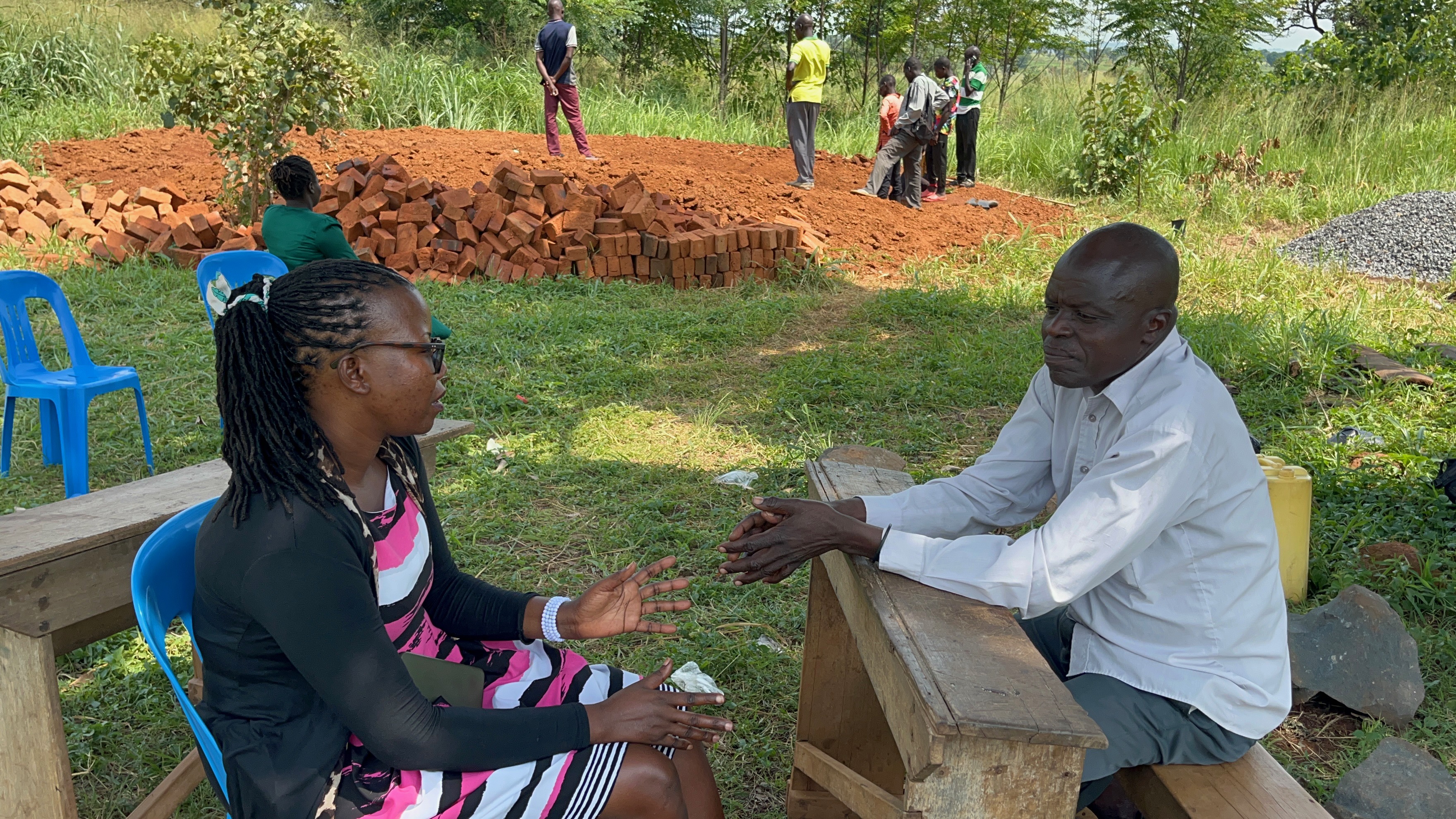
3 CommentsBefore starting construction, GDPU held a series of meetings with the Head Teacher, construction Contractor, School Management Committee (SMC), and Parent Teacher Association (PTA) to discuss the project and answer questions. Importantly, the SMC and PTA mobilize parents and community members to dig the latrine pit for the project and monitor on-site progress. Gaining their approval and buy-in was vital to the project’s success.

SMC and PTA members at our meeting
This requirement reminds me a lot of the “sweat equity” vision employed by Habitat for Humanity – to drive ownership of a project by requiring active contributions from the community. The GDPU staff and I have talked a lot about the issues they see with various latrine projects in the District. Challenges include that the community vandalizes the toilet and abuses it on weekends and holidays. The school may let teachers and staff use it instead of students or are just not willing to engage in the maintenance required to keep the toilet operational (I’ll be speaking more to this in another blog on the monitoring of toilets in Gulu District).
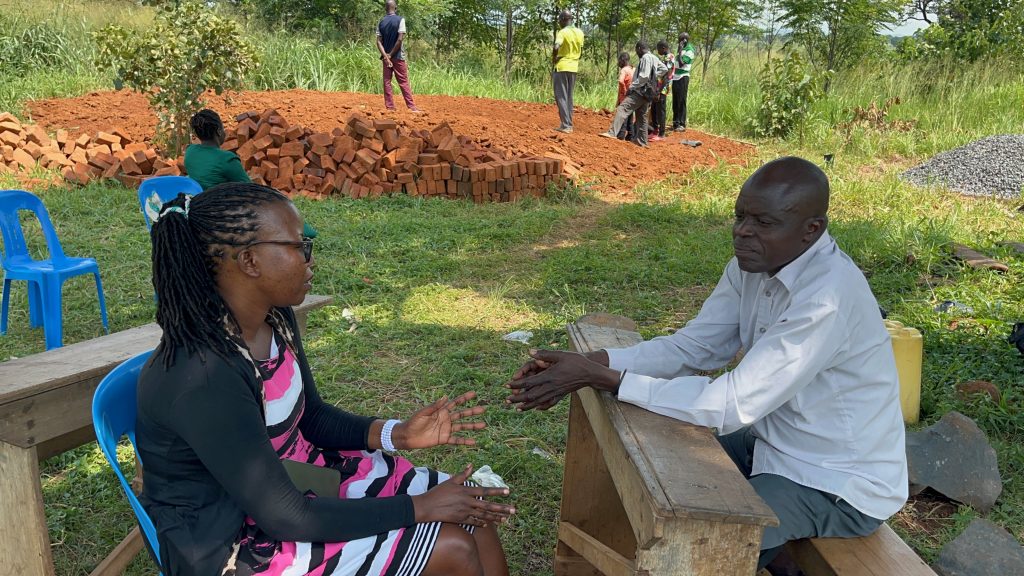
Emma speaking with the SMC Chair
Communities need to be involved in the project throughout the design and implementation, so they truly find ownership in the care and maintenance of the latrine after the project handover. This aspect of GDPU’s WASH program design contributes directly towards the sustainability of the project.
The SMC and PTA were eager to approve the project, grateful for GDPU and AP’s presence, and agreed to their responsibilities. As soon as the memorandum of agreement was signed among GDPU, the Head Teacher, the SMC, and the Contractor, the parents began digging!

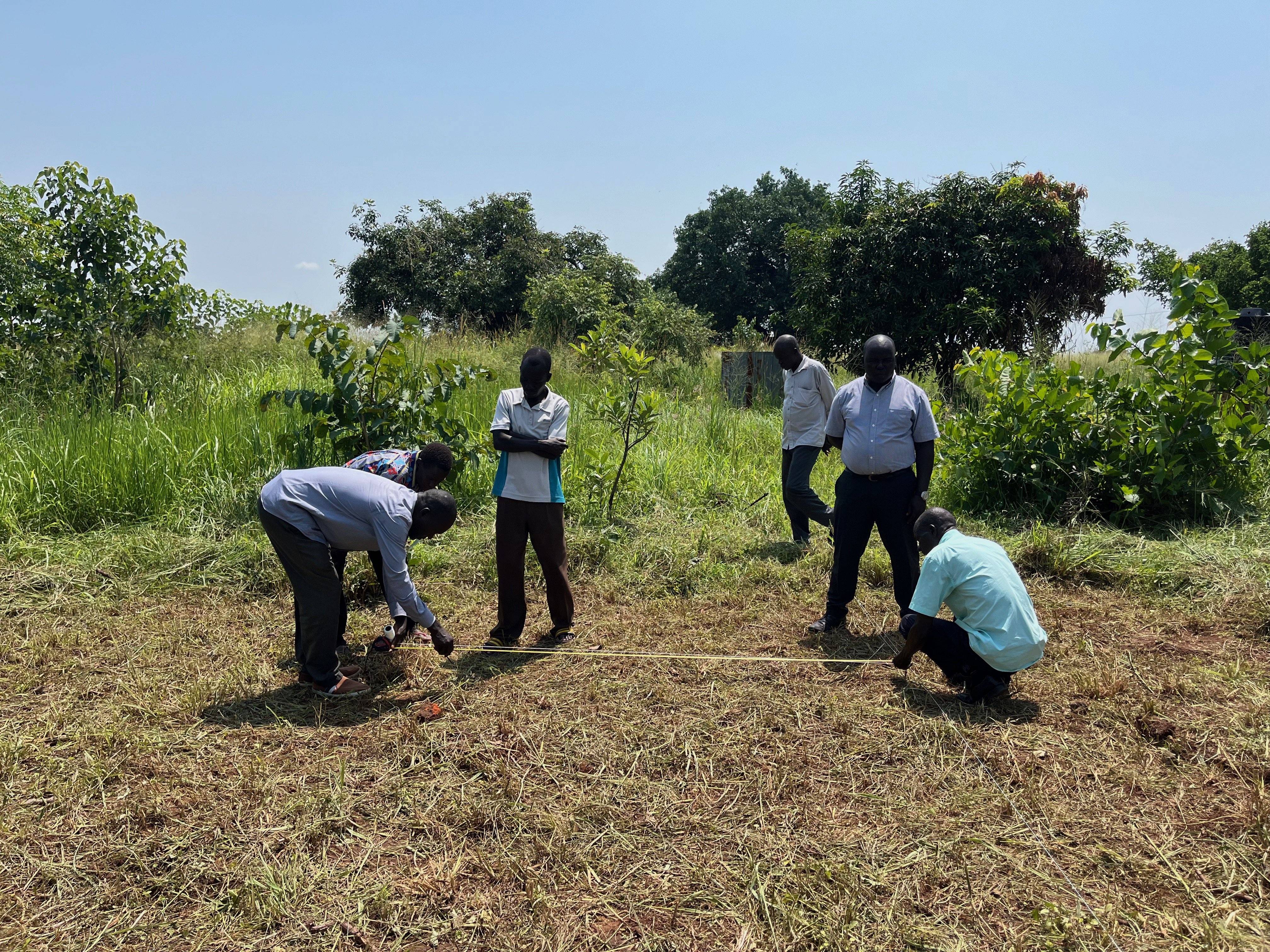
The Contractor, Head Teacher, and SMC identifying and measuring the final location of the latrine
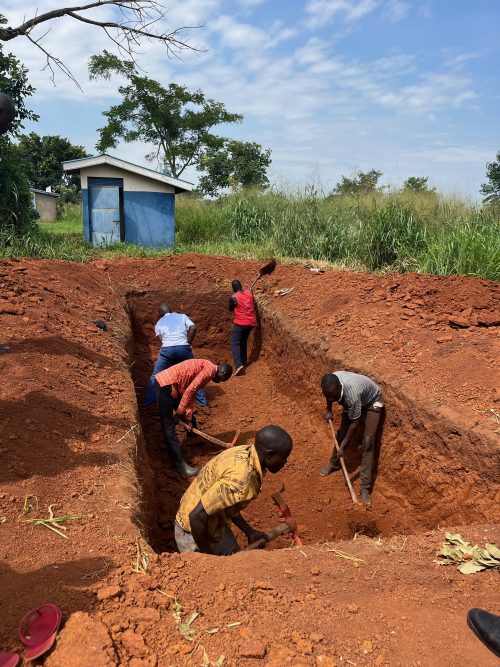
The pit will need to be 9 meters long, 2.5 meters wide, and 3 meters deep. Over the following two weeks, Emma and I visited Kulu Opal regularly to monitor progress and talk with the parents. In Panykworo in 2023, over 100 mothers and fathers showed up in shifts to help with digging, finishing the pit in a record 5 days. This time, it was a little more challenging to engage parents. But with the drive of the Head Teacher and SMC, a small group of dedicated fathers dug through the layers of rock and dirt to complete the pit.

Parents digging the latrine pit at Kulu Opal
Skim through the following photos below to see the progress! Now that the pit is complete, the Contractor and his team will take over and begin the construction of the latrine.
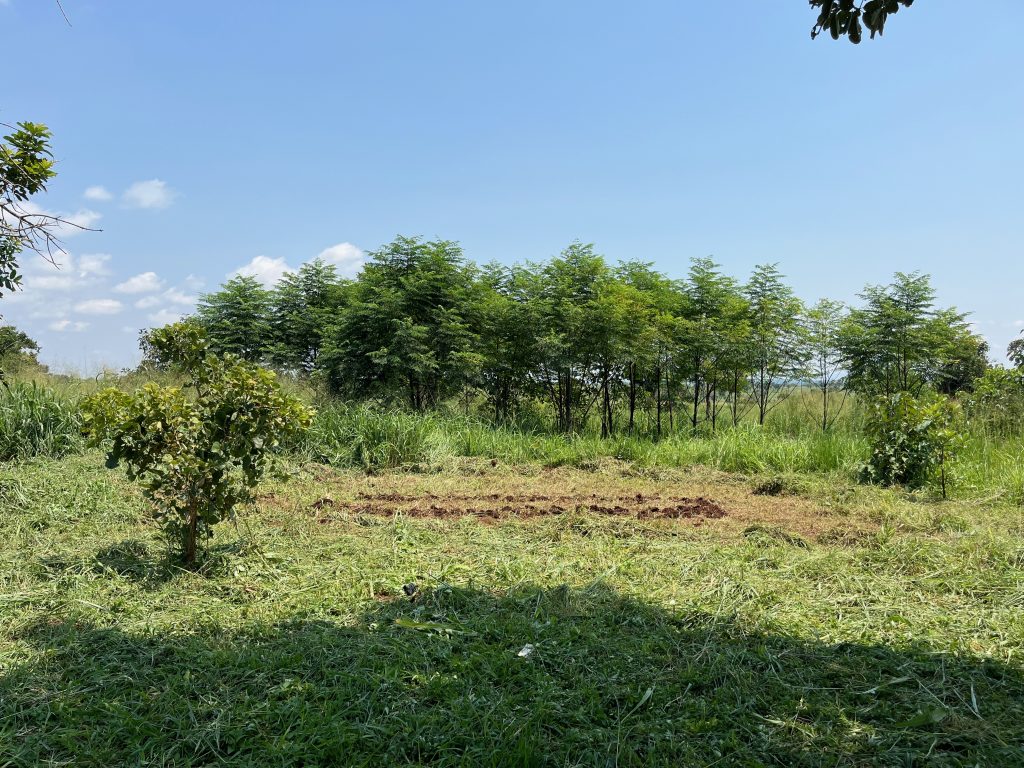
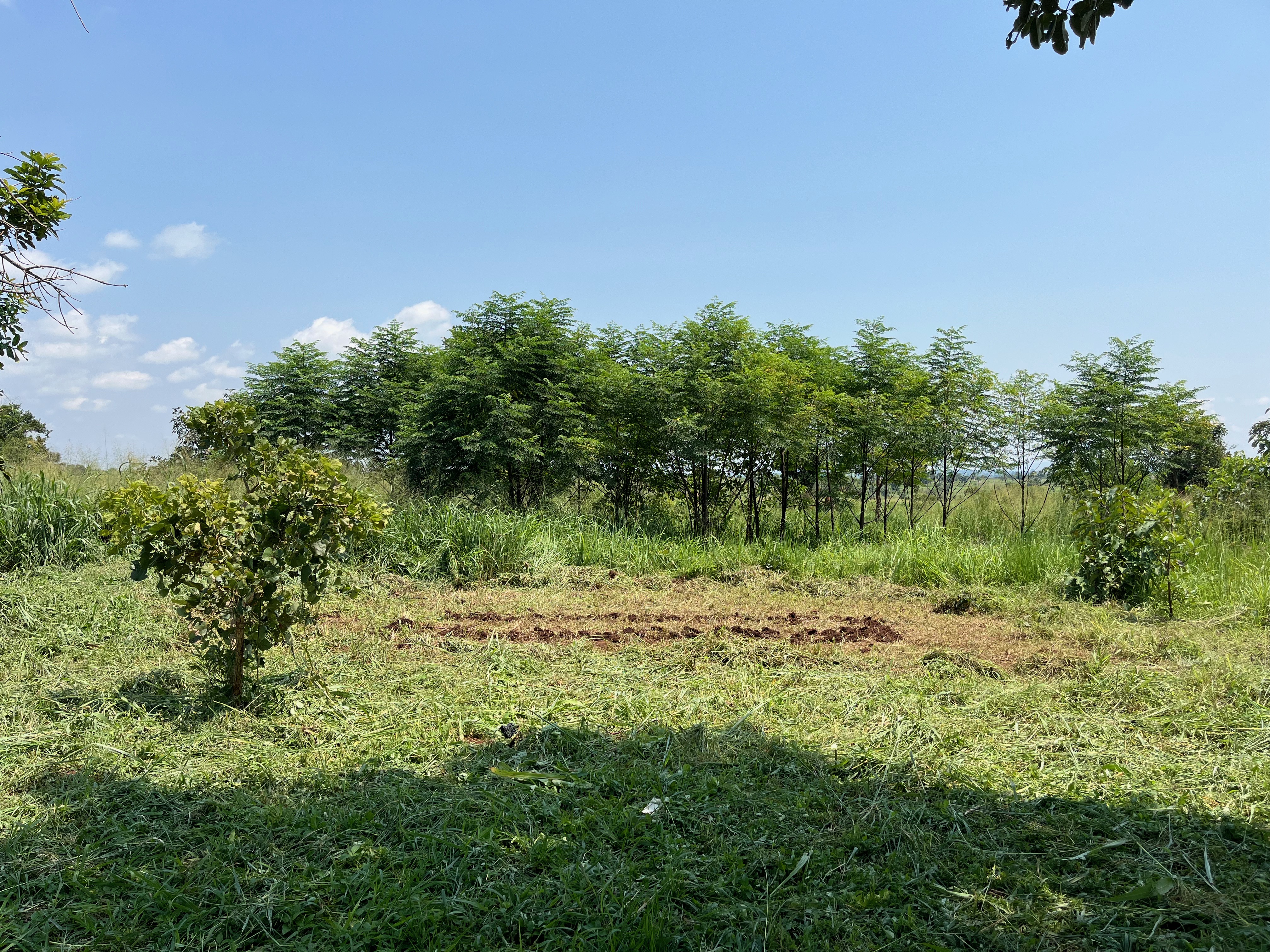
Kulu Opal project progress on June 18

Kulu Opal project progress on June 21

Kulu Opal project progress on June 25

Kulu Opal project progress on June 28
-
Coach Julia, Reporting for Duty
6 CommentsIn addition to his role at GDPU, Faruk is the founder and director of Ability Sports Africa – the only non-profit in Uganda aimed at supporting youth with disabilities to play sports. Faruk invited me to volunteer with his organization, and every Sunday morning since I’ve spent at Pece Primary School helping coach the only girls team in the league.
Girls face extra cultural, social, and safety barriers to play sports in Uganda. Girls are expected to contribute to household responsibilities, like fetching water, cooking, and caring for siblings, leaving them with less unburdened time than boys. It can still be social taboo for girls to play sports among some of the more traditional communities. Whereas boys can easily change into their uniforms in front of everyone, the girls have to use the latrines at the school. But there isn’t enough room for all of them, so many girls change in the open air between a wall and the bathroom stances. I’ve watched the boys often lurk closer and closer to the girls as they change (I now stand outside the latrines like a watchdog, staring down and telling off any boy who comes near).
For these girls to even attend a soccer training is a minor miracle in itself.
During my first Sunday with the team, “Director Faruk” introduced me and told the girls that he “brought them a woman coach from America.” The girls all looked curiously at this strange mzungu with a baseball hat in front of them. I was the only woman (and only white person) of all the coaches, volunteers, and parents present, adding to the rightful hesitancy. I helped lead the girls through warm ups, encouraged them to cheer for their teammates, and gave everyone supportive high fives. They are still learning positioning and how to pass, so the games look a bit like bees swarming to the ball.
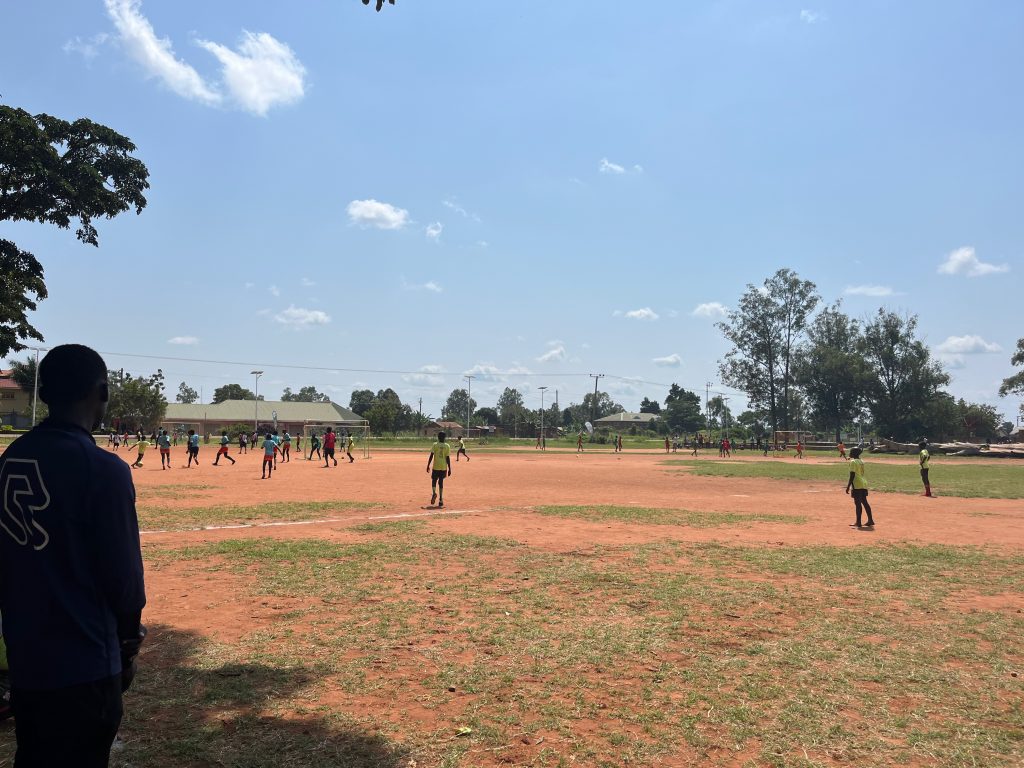
Football match at Pece Primary School
After the game, the girls asked me a whole list of questions that they had probably been keeping inside for the last few hours. I’ve had some practice now fielding questions and have learned to respond in a way that is more aligned with the cadence of a Ugandan. The conversation went something like this:
Where are you from? United States, on the other side. What state? Originally I’m from outside of New York City – one hour drive by car. It’s a small town, smaller than Gulu. Now I live in Washington D.C. where I go to university. Who is in your family? I have a mother, father, and brother. My brother is called Nicholas. Are you the first born or the follower? I am the first born and my brother follows me. How many years are you? I am 27. What do you study? I’m getting a master’s degree in development studies. But my university degree is in engineering. Why are you in Gulu? I am working for Gulu Disabled Persons Union for the summer with Director Faruk. How long are you in Uganda for? I’ve been here for a couple weeks. I will leave in August to go back to school. Why don’t you stay here forever? I have to go back to school! Can I touch your hair? Yes, that’s ok. Why is your hair like that? My hair is too slippery – it won’t braid like your mom’s hair. So, I put it in a ponytail like this.*
And of course, I returned the favor:
Do you go to school? Who is in your family? What do you want to be when you grow up? Lawyer, doctor for babies, doctor for animals, teacher, football coach. Who is your favorite football player? Messi. Ronaldo. Daka. Who is your favorite women’s football player? I don’t know. What do you mean? You don’t know one women’s football player?
Women don’t play football.
I paused and stared at the 10, very curious girls staring back at me. And it almost brought me to tears. I grew up admiring the soccer players of the United States Women’s National Team (USWNT); women who showed that being a girl means being strong. The USWNT uses their platform to fight for social justice. Their fight for equal pay has and will continue to positively impact other women athletes and women in any professional. The team has inspired girls and boys alike. And that’s just one team – there is a growing movement in the United Kingdom and Japan and Spain and Australia and Nigeria and Zambia to support their women athletes.

USWNT Signing the Equal Pay Agreement in 2022 (CBS News)
While I understood that having a WNT supported by your country’s federation is rare, I hadn’t spent a lot of time thinking that there must be so many places in the world where girls don’t even know that professional women soccer players exist. This gave some context to the comment that one girl wants to be a football coach when she grows up, not a player, because she doesn’t think a woman can be a professional football player.
This summer has been a lesson in many things, one of which is unpacking new layers of my privilege. It is a privilege to have role models that are women athletes, and even more so to have these role models look like you. But at a baseline, it is a privilege to just know that these role models exist.
Back to my conversation with my team:
Yes, yes there are professional women’s football players! There are so many of them! There are leagues all across the world for professional teams and there’s a Women’s World Cup. And there are players not just from the other side – from Africa, too.
I quickly pulled up pictures on my phone of professional African players I knew of in the National Women’s Soccer League (NWSL) in the United States. I showed them Barbra Banda, a forward from Zambia on the Orlando City Pride who is arguably the best striker in NWSL right now. I showed them Temwa Chawinga, a Malawian player on the Kansas City Current whose team is at the top of the NWSL table. I showed them a picture of the Washington Spirit, the DC NWSL team, who have three superstar strikers in Trinity Rodman, Croix Bethune, and Ouleymata Sarr; three Black women with hair in braids, braids that are probably similar to the mothers and aunties of the girls on our Gulu soccer team.
And in that moment, I unlocked a whole new privilege: to watch the moment someone’s world becomes wider; to watch young, Black, African girls who love football find new role models who look like them. Spending time with this team has and will continue to be one of the most impactful experiences of my time in Gulu.
—
* The “other side” is a phrase used to denote distance. It is not akin to the connotations of “the other side of the tracks” that we have in the United States. It could refer to the other side of town, the other side of the district, or somewhere outside of Africa.
The idea of “following” and “first born” are used to describe sibling order. If you are the oldest sibling, you say that you are the “first born” and other siblings “follow you.” If you are a younger sibling, you say that you “follow” your older sibling or are the “follower”.
Many people, adults and children alike, are fascinated with my hair. It makes sense – my hair is light brown and straight as a pin. People often ask me why it’s not in tight braids or twists common for adult women in Uganda, and I have to explain that my hair won’t hold that shape.
-
WASH at Kulu Opal: “Operational” Toilets
3 CommentsThe purpose of our first visit to Kulu Opal Primary School was to meet with the Head Teacher (equivalent of a Principal in the United States) and discuss his role in the project. The Head Teacher is the primary contact for the project and responsible for overseeing its implementation on a daily basis. Mary, Emma, Walter, and I drove down a dusty and divot-ridden road for an hour to reach Kulu Opal – certainly the most remote place I have yet to visit in Uganda.

Views from our drive to Kulu Opal
The Head Teacher is named Layroo Gioffrey* and is a smart, motivated man. He quickly assumed the responsibilities of mobilizing the parents, Parent Teacher Association (PTA), and School Management Committee (SMC) (equivalent to the Board of Education in the United States) and overseeing the project implementation on site. He has warmly welcomed us to his school and is kind enough to offer us lunch (chicken, posho, and beans) when we visit!
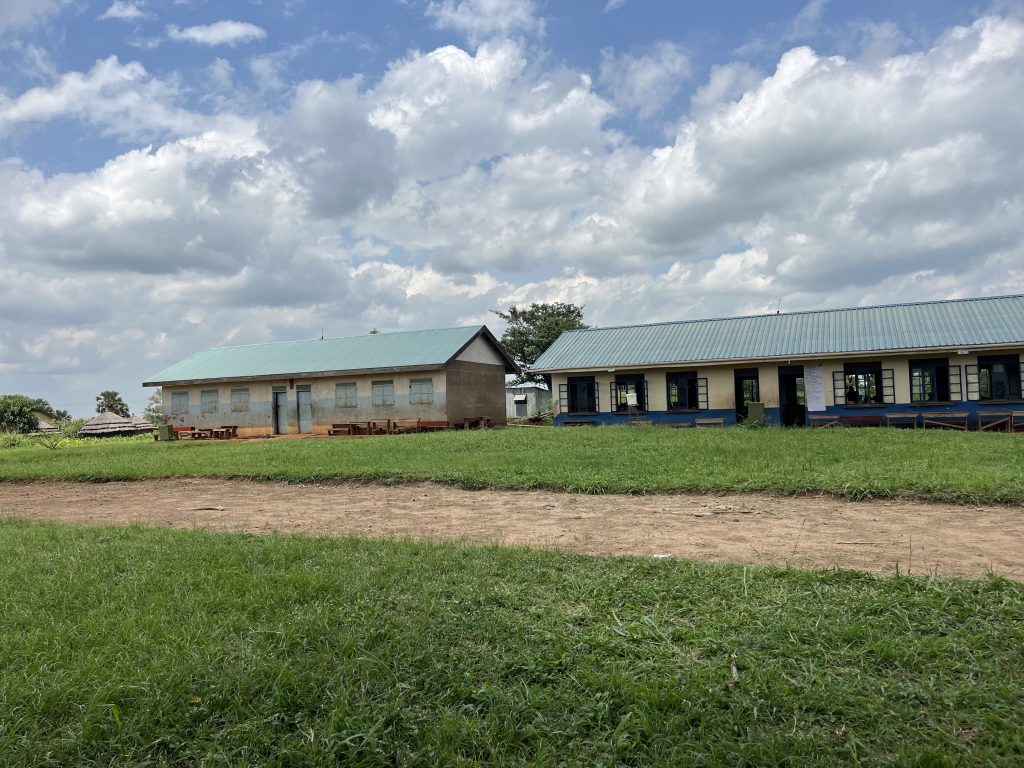
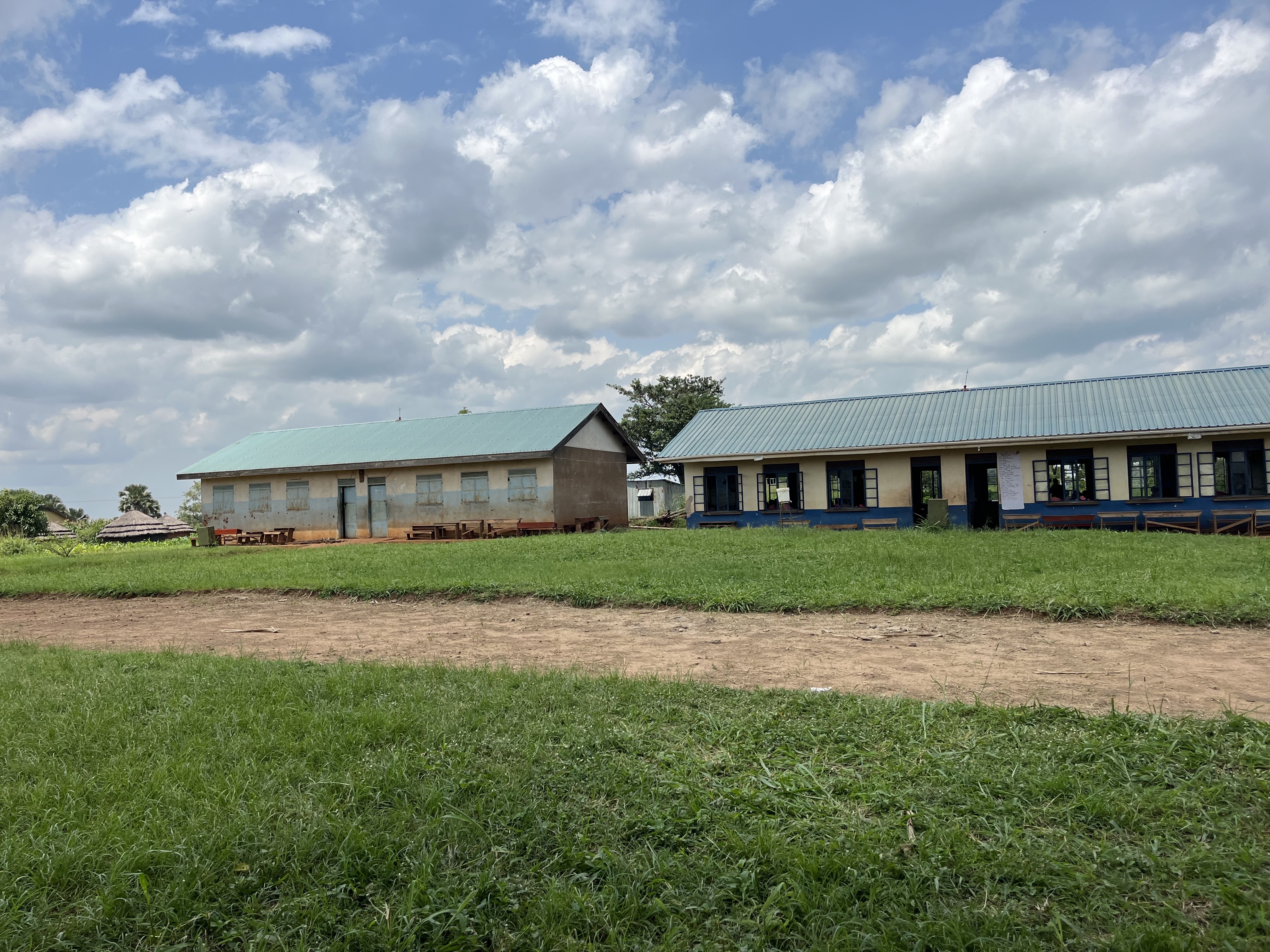
Kulu Opal Primary School
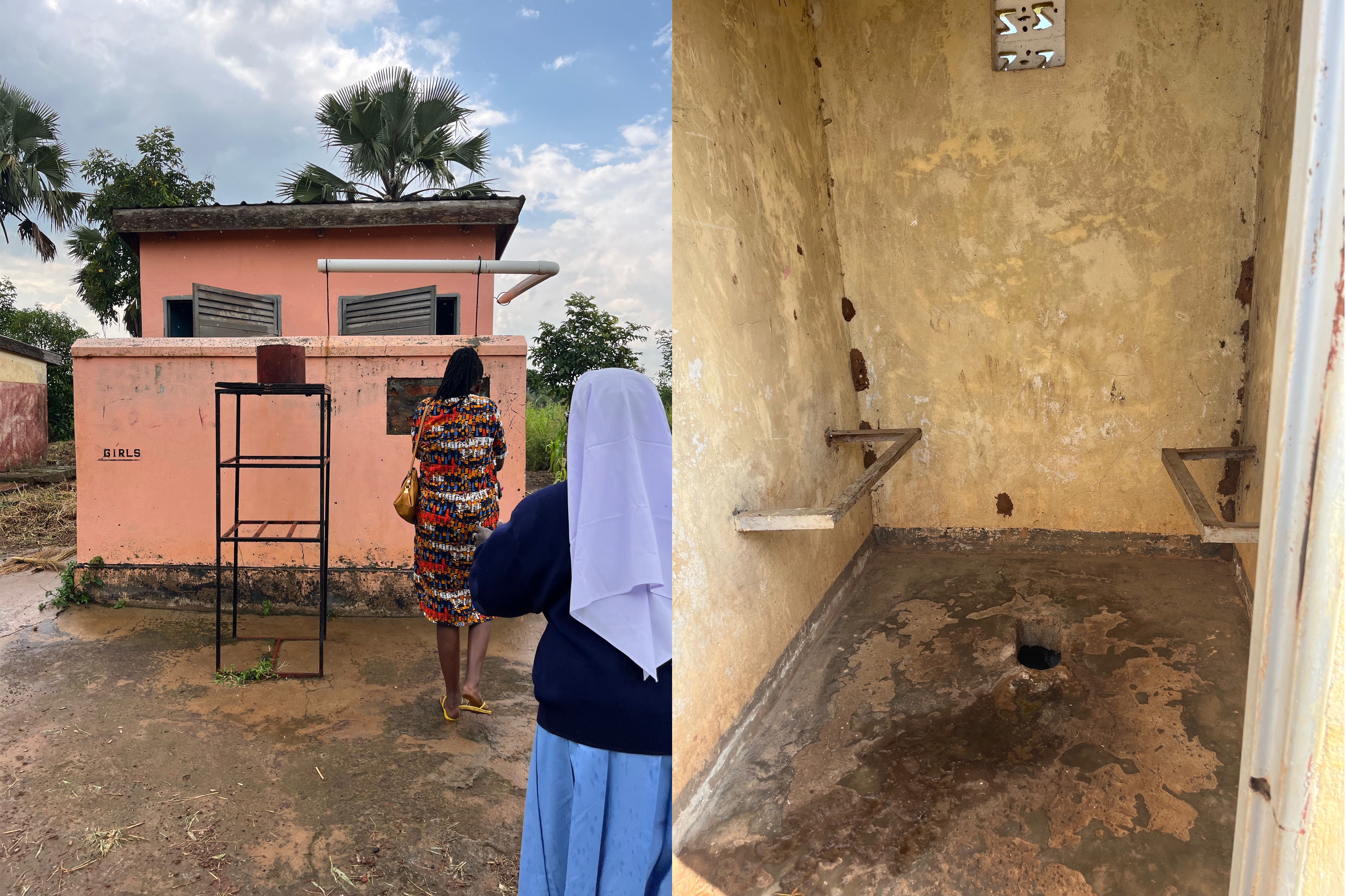
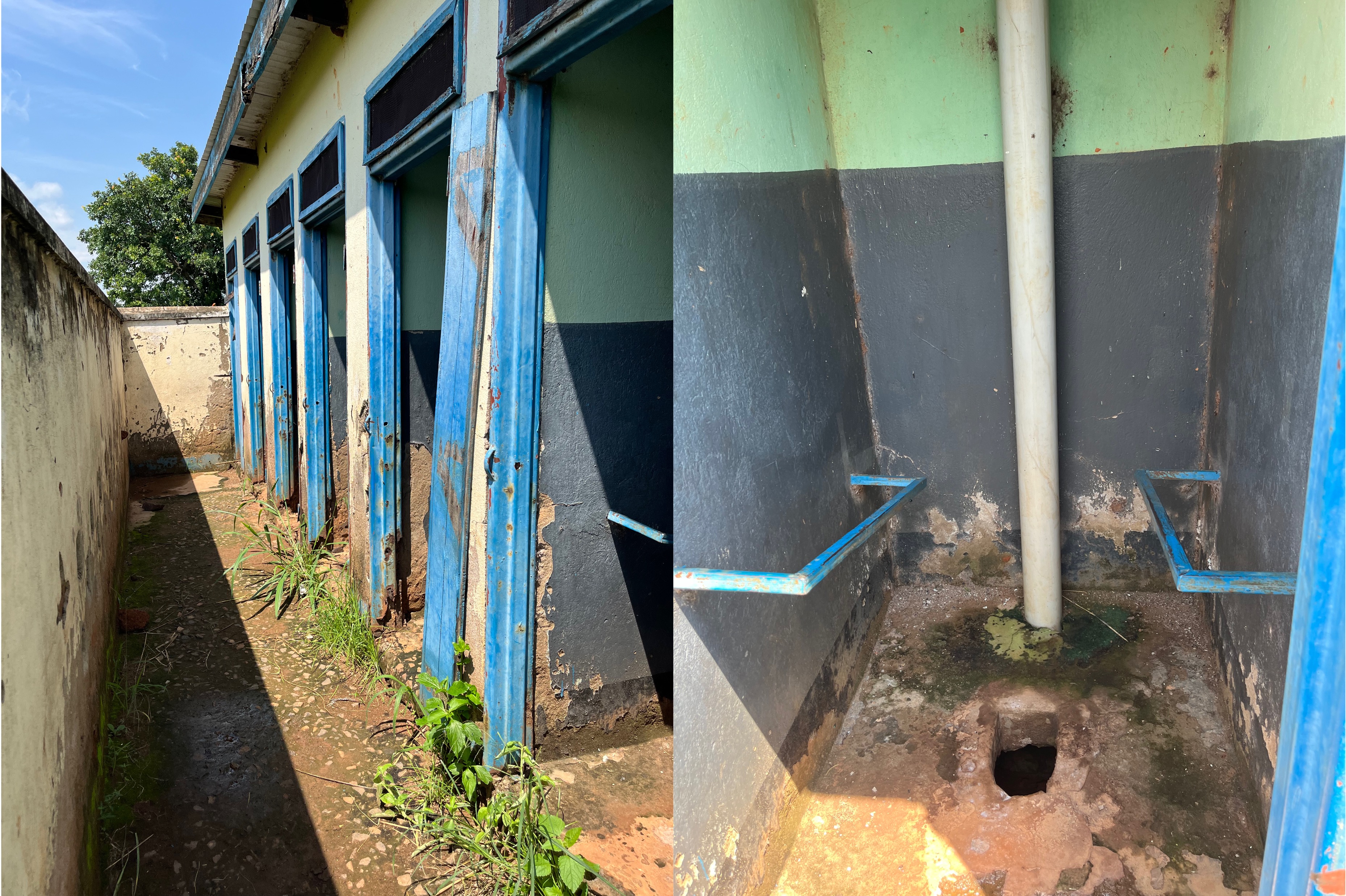
After speaking in the Head Teacher’s office, we toured the existing latrines. The school currently has 4 sets of 5 stances – 2 sets for boys and 2 sets for girls. However, one of each sets of stances are non-operational.
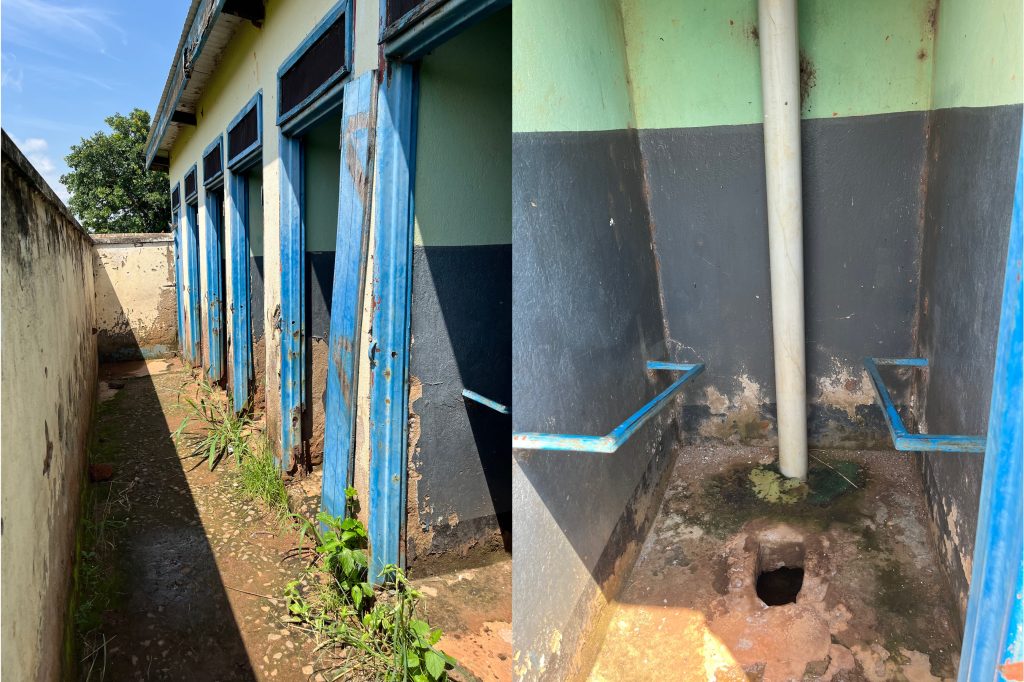
Non-operational girls toilets at Kulu Opal
The District Education Office set a standard of at least 1 latrine for every 40 students. Unfortunately, Kulu Opal does not meet that mark, with only 1 latrine for every 80 boys and 1 for every 72 girls. Even the stances that are “operational” are not in good condition.
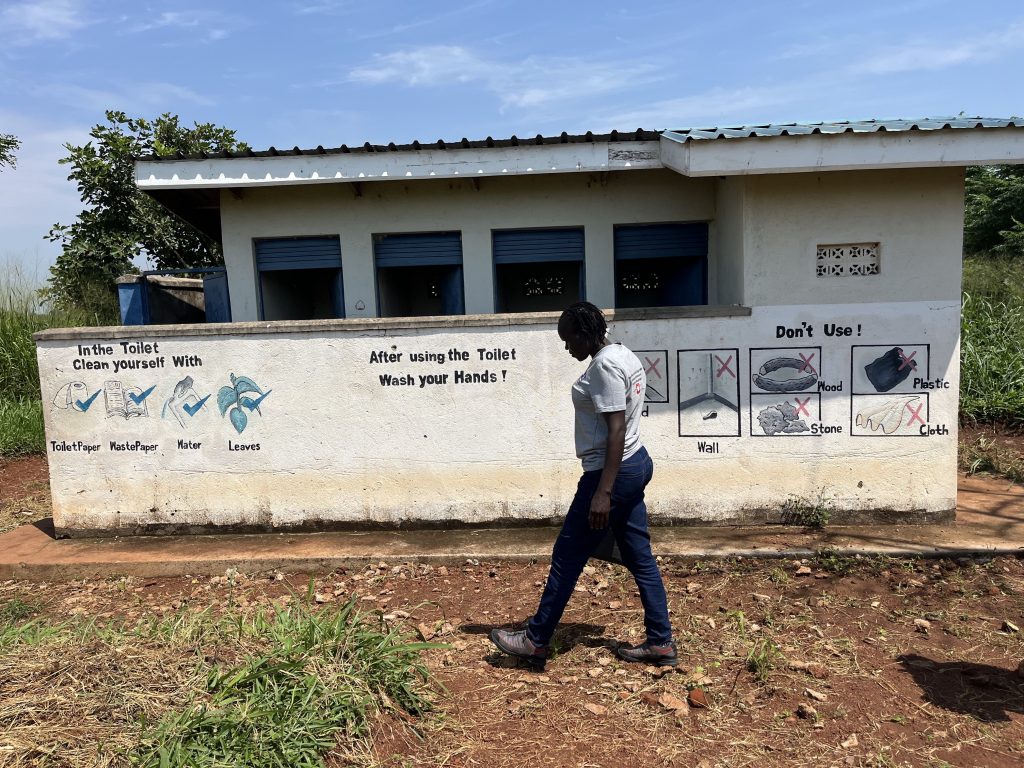
Mary, Emma, and I inspecting the “operational” girls toilets at Kulu Opal
The stances do not have working doors. There were huge spiderwebs in the corner of the latrines, swarms of flies above the latrine holes, with old feces smudged on the floors and walls. The flies are of high concern, given the high malaria risk in northern Uganda. Click here to view a video made by GDPU and the Advocacy Project that shows the status of the toilets in Kulu Opal in 2023.

“Operational” girls toilets at Kulu Opal, with standing liquid at the entryway (it had not rained that day)
The Head Teacher told us that this WASH project is desperately needed at Kulu Opal, and in seeing the status of these toilets, I am assured it is true.
—
*In Uganda people say their surname/last name first and then their first name second. It is a little confusing, but it also makes a lot of sense when we consider alphabetizing lists and grouping individuals by family.
-
WASH at Kulu Opal: “If you educate a woman, you educate a whole nation”
3 CommentsWe have kicked-off the core effort that will be completed during my fellowship here: the water, sanitation, and hygiene (WASH) project at Kulu Opal Primary School. GDPU has built latrine stances at 6 schools since 2016 with the support of the Advocacy Project and their Peace Fellows. You can read more about the projects through Peace Fellows’ blogs, following toilet construction at Tochi (Josh Levy, 2015), Ogul (Lauren Halloran, 2017), Awach Central (Chris Markomanolakis, 2018), Abaka (Spencer Caldwell, 2019), Awach Primary (Kyle Aloof, 2022), and Panykworo (2023). I’m grateful to join the ranks of past Peace Fellows and document our journey this summer!
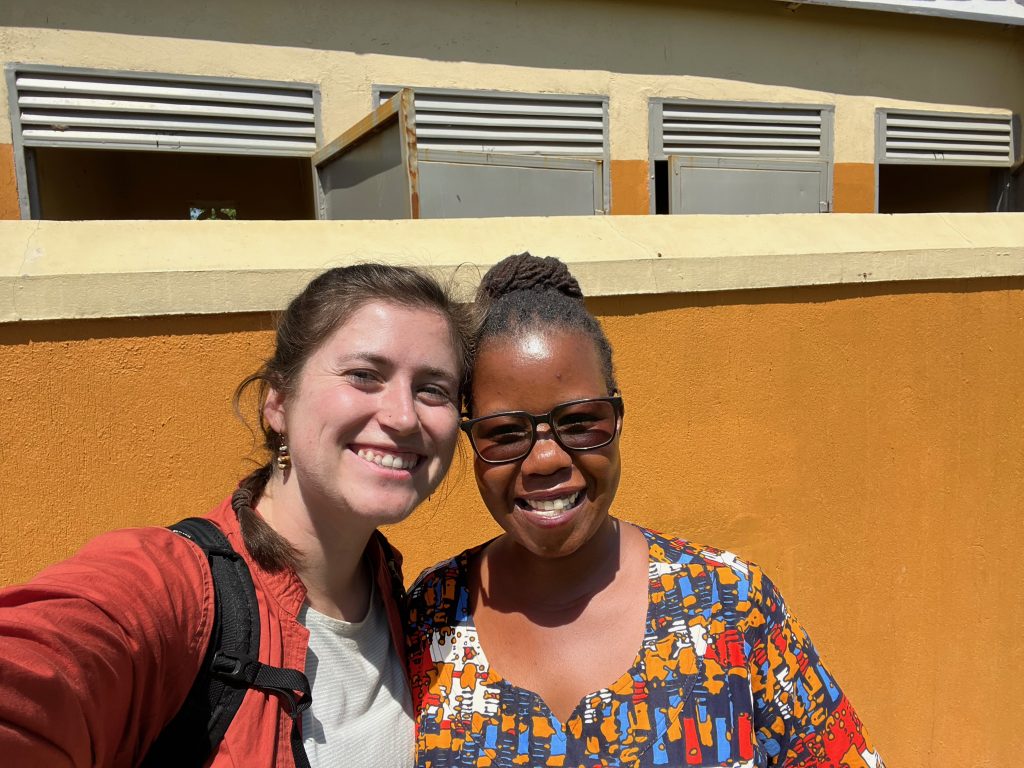
Emma and I visiting the Panykworo Primary School WASH project installed in 2023
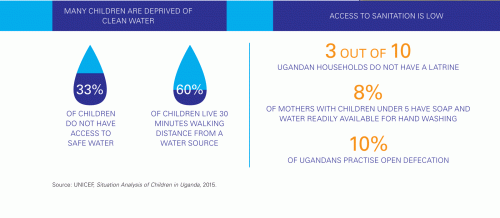
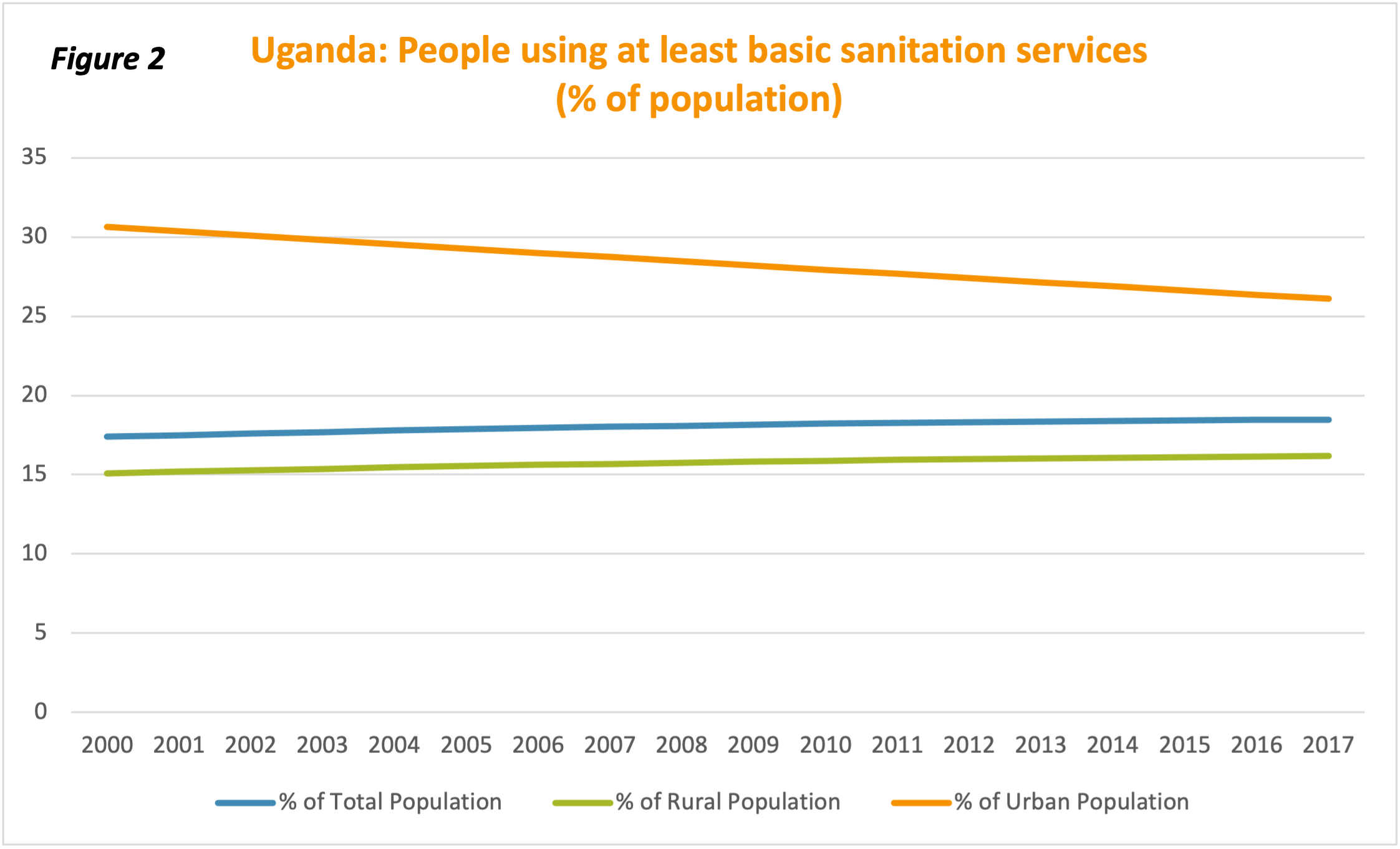
Proper WASH facilities at schools is a huge challenge in northern Uganda and over much of East Africa. UNICEF estimates that 33 children die of diarrhea every day in Uganda, caused by drinking unsafe water and improper hygiene behaviors (e.g., not washing hands after using the toilet, open defecation). Diarrhea can also stunt growth and cognitive development, impacting school performance and the livelihoods of children.
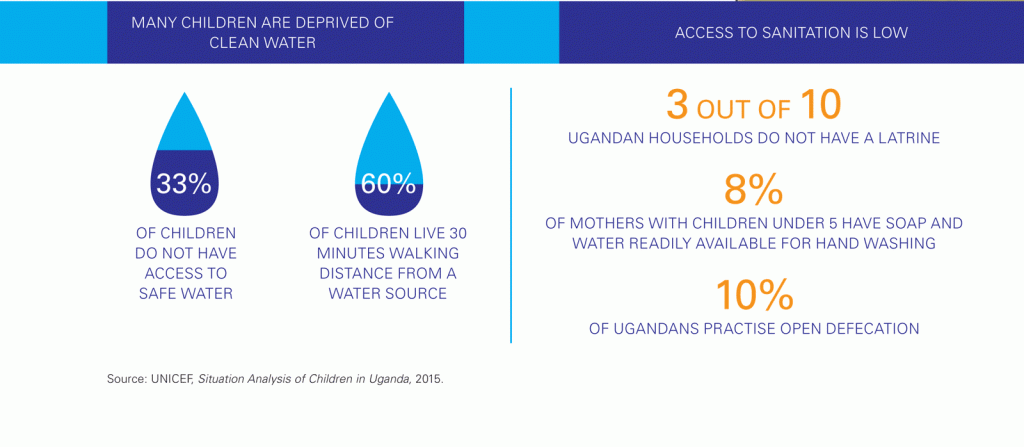
WASH conditions for children in Uganda (UNICEF)
Accessing latrines and proper hygiene behaviors at school can be especially challenging for persons who are menstruating and those with disabilities, both of whom need additional accommodations to use the toilet. Persons with physical disabilities need handrails and extra space to allow them to enter the stances. In Uganda, there aren’t tampons or pads or diva cups or fancy underwear available to manage periods – they use rags that need to be disposed of after each use. At schools, menstruating persons need a changing room that is clean and protected from the boys, and they need a way to dispose of used rags. If these additional accommodations are not provided, menstruating persons will miss school during their periods each month and may stop attending school altogether.
This project aims to address these challenges by providing safe, accessible WASH facilities for girls so that they have the ability and confidence to attend school. The WASH package at Kulu Opal will consist of the installation of 5 latrine stances for girls (1 of which will be wheelchair-accessible), a hand-washing station, a girls changing room, a menstrual products incinerator, and a wheelchair-accessible concrete ramp to the stances.
GDPU will conduct Inclusion Trainings for teachers, to increase awareness and capacity for engaging persons with disabilities, and WASH trainings for students, to promote proper hygiene behaviors. Once the construction and trainings are complete, GDPU, Kulu Opal, and the broader community will participate in a handover ceremony, during which GDPU will give Kulu Opal a year’s worth of high-quality soap.
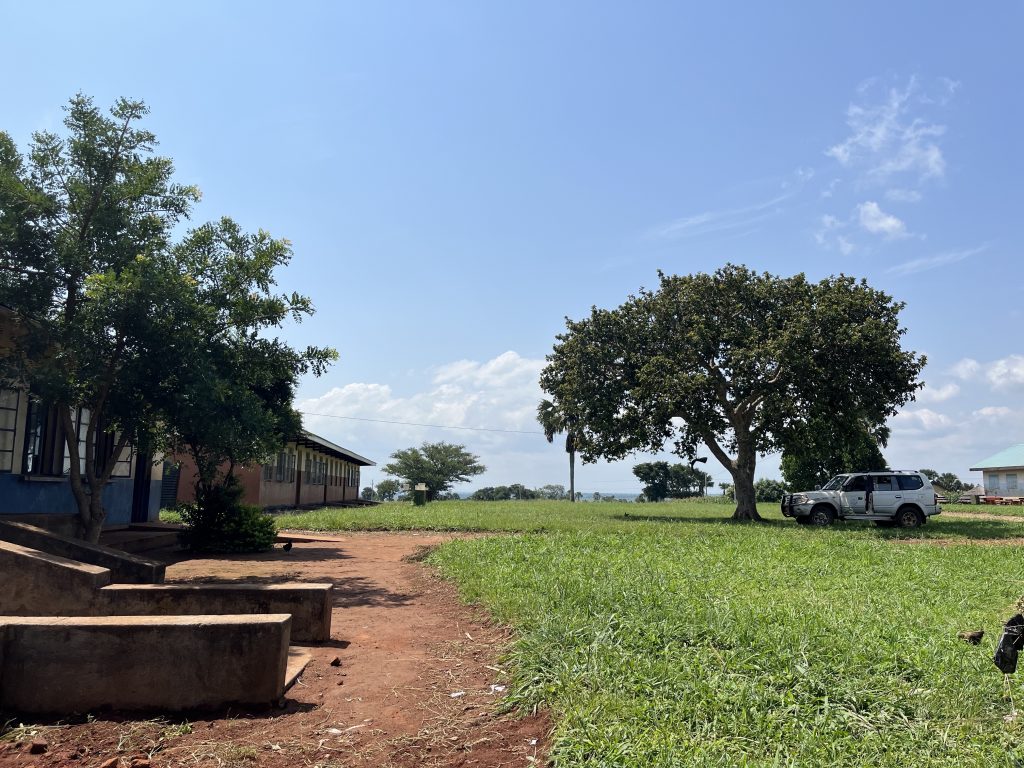
Kulu Opal Primary School
I heard the saying “If you educate a woman, you educate a nation” over the radio recently; an African proverb that is sometimes attributed to Dr. James Emmanuel Kwegyir-Aggrey. I have been thinking about that phrase a lot – how supporting the most vulnerable persons can have ripple effects for others. Research shows that educating girls for one extra year of primary school can boost wages up to 15%, and one extra year of secondary school can boost wages up to 25%, with higher return rates for girls than boys.
Educating girls is an effective way to not only help their individual growth and future job prospects, but to support the economic betterment of their families and communities. Investing in women and girls increases household well-being. Women are more likely to spend income on their families before themselves, which is why many development interventions target women for cash-based transfers. One study estimates that women invest 90% of their income into their families, whereas men only invest 35%. Women are likely to spend income on nutrition, health, and education, accelerating the development of their communities.
We have high hopes that the WASH project at Kulu Opal will allow girls to feel safe attending school year-round, and in turn improve the lives of students, families, and the whole community.
-
Meet GDPU: “Maybe the word disability downplays their ability.” – Joe Okwir
3 CommentsThis is an article in a series profiling staff at GDPU, the Gulu disability community, and those who call northern Uganda home. All contents of this article have been approved and shared with the permission of Joe.
Joseph Johns (Joe) Okwir has worked at GDPU as a Programs Assistant since 2024, but previously was an intern student in 2022 whose skills and work ethics paved the way for his return in 2022 as an employee of the organization. He has an undergraduate degree in Bachelors of Business and Development Studies from Gulu University and is starting a Masters in Conflict and Peace Studies this fall. Joe immediately struck me with just how passionate he is about his community, his work, and his future goals. This energy is equaled by his passion for the people in his life – on my first day in the office, he led the charge to plan a birthday celebration for a colleague. His family is originally from the Agago District, but Gulu is where he calls home. He currently lives in Gulu with his fiancé, Gloria. His dream is to champion solutions for children in refugee host communities and those affected by emergencies, driven by a dedication to creating positive change.

Joe Okwir of GDPU
How did you first hear about GDPU?
I heard about GDPU when I was working in a [health] clinic. It was Dennis (a Counselor for Persons with Disabilities in Gulu District), actually. I was a receptionist. I greeted him and Dennis asked, “Do you want to work for an organization for people living with disability?” I said “if there is a vacancy.” He told me to apply. So I applied and that was my first time to come here… I brought in my application with Patrick, went through the interview, and I started working.
In my secondary school days, a debate program aimed at empowering young individuals with disabilities caught my attention. The topic centered around disability, and my reputation as a formidable debater and position as the speaker of district student association meant I was always going to be called upon or involved in organizing the event. With ease and determination, I contributed to the success of the debate.
Little did I know that this experience would introduce me to the Gulu Disabled Persons Union—an encounter that ignited my passion for advocacy and community impact. At the time, I was in Senior Five, equivalent to 11th grade in the United States. This pivotal moment marked the beginning of my journey toward making a difference.
What is your role at GDPU?
While attending university, we were required to complete internships as part of our graduation criteria. I submitted applications to several organizations and secured placements at Child Fund, World Vision, and GDPU.
However, what truly resonated with me was the opportunity to work with people with disabilities. This unique experience influenced my decision to join this organization. Currently, I serve as a Programs Assistant, providing support across various projects, including WASH and V-PLUS. Whenever assistance is needed, I am there to contribute.
What work have you been proudest of at GDPU?
In the crucible of life and death, I faced a pivotal choice during my internship. The organization I worked with supported people living with disabilities, including those with epilepsy. One fateful weekend, I encountered a girl in the throes of a seizure. The staff were absent, leaving me—the intern—with an impossible decision: take her to the hospital or risk her life. I chose the former, disregarding my own fate. The girl survived and the organization understood the gravity of my risk. Another triumph followed during the pandemic: convincing unvaccinated students of the vaccine’s importance. These moments taught me that sometimes, the greatest risks yield the most profound rewards.
What do you hope GDPU accomplishes in the next ten years?
I want to support the organization expand beyond the confines of Gulu District/city and become a national entity; this should be our long-term strategic goal. As we evolve, our role must transform into a central hub—a reliable source of information and coordination for disability interventions. By meticulously cataloging data on the disabled population, their needs, and effective interventions, we empower ourselves to drive positive change. As we forge ahead, we need to leverage our knowledge as a potent force for advocacy and impact for the good of persons with disability.
If a donor showed up tomorrow and gave GDPU the equivalent of $1 million USD (about 4 billion Ugandan Shillings), how would you use it?
First, I will focus on the need to address critical need for assistive devices which should be our core mission. Next, elevating teacher training to empower educators in handling special needs and disabled populations. Sign language proficiency is essential. Additionally, I would be advocating for accessible structures—classrooms, offices, and restrooms—to accommodate wheelchair users, crutch users, and those with visual impairments in all public institution, schools above all. Our campaign will extend to coaching for special needs games, ensuring not just existence but also enjoyment. Lastly, fostering awareness—because the right of a disabled person are human rights.
How did you become passionate about working with people with disabilities?
My journey from my days as a high school debater and organizer introduced me to my current path of employment, I was requested to put together a debate program for PWDs while I was in my secondary school which I did with ease. Initially, I grappled with misconceptions about disability, but witnessing the strength and abilities of individuals with disabilities transformed my perspective, they produced very smart arguments in the debate and surprised me with how they meticulously argued, I then had an interaction with them later on and I realized how wrong I have been about them. So, as I pursued university studies, community development became my calling—a way to champion the rights and well-being of the most marginalized, including those living with disabilities. So then I made a deliberate choice to join GDPU, I was admitted in three other organizations for internship at the time, but the chance to work and learn from Persons with Disability. This was a chance to do something truly greater than my own self, and I would never say no to that chance.
What is something you wish people knew about GDPU?
GDPU serves as an umbrella organization, uniting entities like the Blind Association, Association of the Deaf, Association of Women Living with Disability, and Survivors of Landmines. Yet, we are more than a collective; we embody compassion and a profound commitment to disability advocacy. Our understanding of disability has evolved through firsthand experiences. We embrace versatility, collaborating with anyone willing to uplift people living with disabilities. Our dedication extends beyond rhetoric—we actively engage in policy reform and dialogue to enhance lives of persons with disability in this community.
-
Meet GDPU: “It can look like a small center, but it has a big heart.” – Mary Lakot
4 CommentsThis is the first article in a series profiling staff at GDPU, the Gulu disability community, and those who call northern Uganda home. All contents of this article have been approved and shared with the permission of Mary.
Mary Lakot has worked for GDPU since 2014 as the Accountant. She has a Bachelor of Business Administration degree from Gulu University, concentrating in Accounting. Mary has an infectious smile and brings an immense amount of joy to her work and the GDPU offices. Mary lives in Gulu with her husband and three children. Although she has lived here for 16 years, Kitgum is where she calls home. One day, she hopes to become the best female entrepreneur in Uganda and the entire East Africa region with a wholesale clothing business.

Mary Lakot of GDPU
How did you first hear about GDPU?
I heard about GDPU when I was working in a [health] clinic. It was Dennis (a Counselor for Persons with Disabilities in Gulu District), actually. I was a receptionist. I greeted him and Dennis asked, “Do you want to work for an organization for people living with disability?” I said “if there is a vacancy.” He told me to apply. So I applied and that was my first time to come here… I brought in my application with Patrick, went through the interview, and I started working.
What is your role at GDPU?
I am the Accountant. The job for an accountant requires knowing a budget and what we have to spend, guiding project people on how they are managing their funds, and looking for resources – what do you need to do to generate income? I look for the best resources our organization can acquire.
What work have you been proudest of at GDPU?
I am really very proud of being part of trainings. You see the lives of youth changing through the projects that came in. People recognize the impact. You are changing the lives of people with disabilities.
What makes me feel good is that before coming here, I used to imagine that they are different. But now that I have worked with people with disabilities for ten years, when I meet them along the street, to me, we are the same. They are people with special abilities. [People ask me], “You are going to your office, how do you communicate with them?” The assumption people here make is that people with disabilities and mental issues should shake you. But not me. Now, I am an advocate for them. We are all on the same level.
What do you hope GDPU accomplishes in the next ten years?
GDPU should be self-reliant and come up with something that can help it generate income. There is always challenges with funding. GDPU depends entirely on project funding, so when there is no project, you are not able to keep your staff. When there is no money, then no one will be here.
In all of northern Uganda, this is the strongest union for persons with disabilities. If you compare GDPU with disability unions in Kitgum or Omoro, they look at us as their role model. So GDPU should strategize on raising money and coming up with business enterprises so they are self-reliant.
Do you have ideas on what that could be?
Yes… We are intending to start up a workshop where we can repair assistive devices from here. The money can be small, the youths can be few, but we can integrate mixed [participants] – those with disabilities and those without disabilities. First, we need to improve on the dormitory and improve on the classrooms. Then we are good to go.
But you know, stepping out of your comfort zone is just another thing. There is that fear of “How many kids will we have? Will we be able to sustain them? Do we have enough resources?” The resources will always not be enough. But we need to take risks. We can start small and improve. We also need to learn to generate money by fundraising locally… Charity begins at home.
If a donor showed up tomorrow and gave GDPU the equivalent of $1 million USD (about 4 billion Ugandan Shillings), how would you use it?
First, I would set up GDPU with a big hall. So if there is any workshop in Gulu, people can come, and pay for the hall. You improve the infrastructure first… Since we already have a school and the land is big enough, we build a dormitory that is accommodating and inclusive for both boys and girls. It should accommodate at least 100 boys and 100 girls. If you set up the facility, it can generate money on its own.
And then, you put a production workshop outside. We now have former beneficiaries – youth who have trained in welding, youth who have trained in electronic repairs. We can identify former beneficiaries and employ them, and we produce quality product. You get exceptional people with good track record already, and you help them build their capacity and their resilience.
We won’t put everything in one basket. We should start generating money, so after the $1 million, [GDPU] is able to stand on their own. Business-minded, that’s me.
Right now, if there is a workshop, it is very expensive to [rent] other places. Because now when other organizations, like National Union of Disabled Persons of Uganda (NUDIPU) come to do a training, they go look around at other places. But when you improve your facility, you can host your own project. The facility should be clean, the floor should be tiled, the walls should be good. You should have good power, a generator on, and set up the Wi-Fi. When people come, they should feel comfortable. The first thing to consider is inclusiveness. Is the environment inclusive enough? We are people advocating for persons with disabilities, we know all the criteria needed.
Also, if we had a guest house, not necessarily here, but in GDPU name, we could make money. We have had Peace Fellows for the past four years. [If we had a guest house], we would have had that money coming back to us, not going out. All of these are things that can keep GDPU moving.
How did you become passionate about working with people with disabilities?
I feel that God was preparing me for this. There was a girl with disabilities who sat behind me in primary school. I found her at GDPU when I started working here. We were in the same class for four years. My second year at university, I was living with two girls with disabilities in the same room. So I started thinking, “Why was I meeting these people?” Was it because I was coming to work here? Maybe.
When you see some of the children, your heart breaks. [Parents] don’t take care of them well. The child is sleeping naked at ten years, nine years [old]. But at least if you get the parents taking care of a child with disability very well, you get motivated. You feel happy. You appreciate such a parent. But you protect your heart by just saying, God knows.
But it’s hard, eh? You feel broken. The first time I visited the school [for children with disabilities in Gulu], I talked to [the head teacher] and he told me, “I know today you’re broken because it’s your first time.” When I came back, I had a headache. A very bad one. I said [to Emma], “If you knew you were taking me to such a place, you should have told me.” The kids look so bad. They were feeding them posho (corn meal), cabbages – it looked like they were just boiling them. There’s no nutrients there. These kids need protein, they need beans, at least. But [the head teacher], he’s trying his best. I could not blame him.
I believe I’m very strong. But whenever I see children with disabilities, that is the part that kills me. Because I’m a mother… It’s too hard for a child. Because you don’t know what happens.
What is something you wish people knew about GDPU?
This is a home for everyone, whether you are disabled or not. And in this place, you are able to be humbled and learn a lot about disability and people around you. At any time, you are just temporarily abled. Being here, I’ve learned a lot. Some are not born with disability, they just got it along the way. So when you are out there seeing someone with disability wanting to cross the road, help them. You don’t know what tomorrow brings.
It can look like a small center, but it has a big heart. And once you are here, you learn to love – a person with disability, you will not put them aside.
Is there anything we did not talk about that you would want people to know about you or your work?
I love this place. It will be very hard for me to walk away from GDPU. I do not know why. It has been part of my home. At some point, I walked away and worked somewhere for three years. But when they called me, I willingly came back.
But there will be a time for me to exit. I want to leave GDPU using improved financial software. Because for the past five years, we have only used simple accounting packages. The challenges is money and [the software] needs money to sustain it. If we could improve our accounting software, I would have left GDPU better than I found it.
-
A Warm Gulu Welcome
4 CommentsKapongo from Gulu! Emma, the WASH Project Officer, and I made the slightly treacherous bus ride from Kampala to Gulu together at the end of last week. After settling into Gulu over the weekend, I started my first day at the GDPU office. As past Peace Fellows have described, GDPU is the parent organization for four non-governmental organizations (NGOs) providing services to persons with disabilities, including those with mental and physical (e.g., deaf, blind, mobility) impairments. The NGOs and their offices are centered around two grand mango trees that provide shade from the intense Ugandan sun.
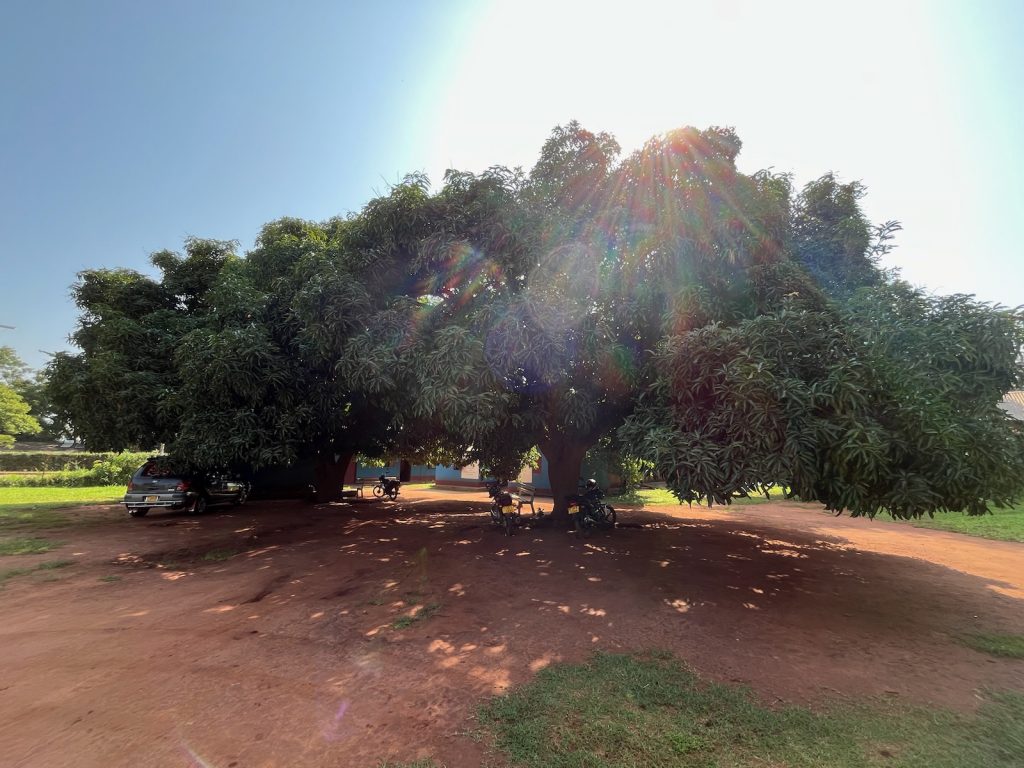
Mango trees that are the center of the GDPU and partner organization offices
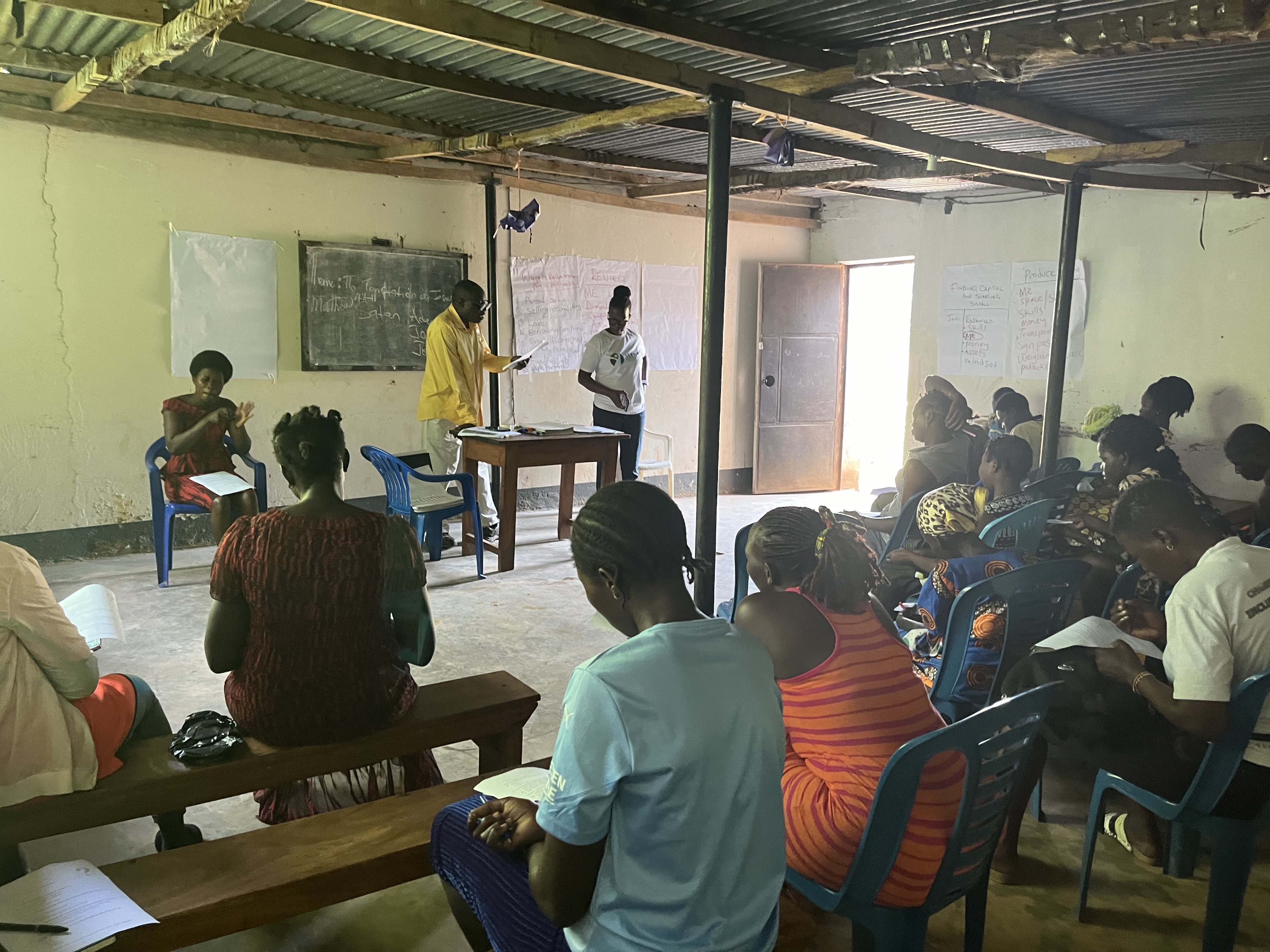
The mission of GDPU is to “empower persons with disabilities to live independent and dignified life.” I got to see this mission in action in my first day at the office. I observed a training conducted by Patrick, the Director of GDPU, and Emma as part of a series from the Street Business School. The trainings teach persons with disabilities how to start and sustain businesses on the street (e.g., selling produce). Attendees were primarily women and ranged in age from a teenager to a more elderly woman.
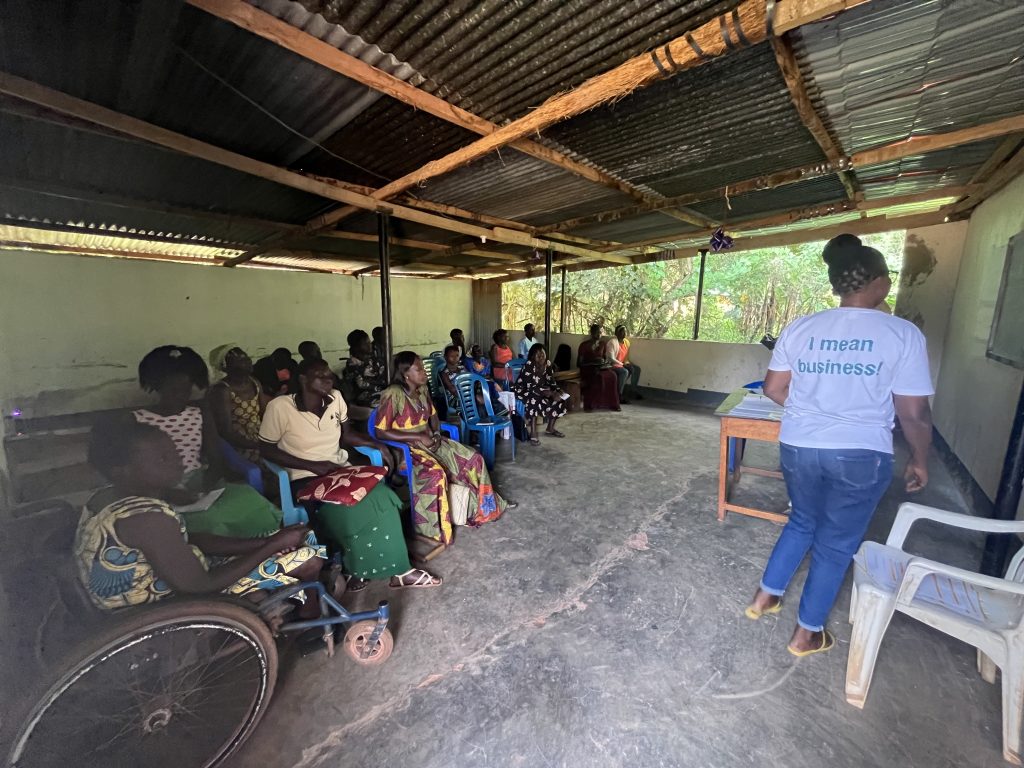
Attendees at the Street Business School training
I watched Patrick come alive in the training as he very sincerely and earnestly shared knowledge with the attendees. The training was verbally taught in the local language Acholi, translated into Ugandan Sign Language (USL), and written on poster paper in English. I imagine that a space like this, with simple but meaningful efforts to ensure the information was made as accessible as possible, is not a common experience for the participants. The attendees clearly found value in the information – every person was listening/watching intently and taking notes. It was the perfect introduction to GDPU and the impact their work has on their community.
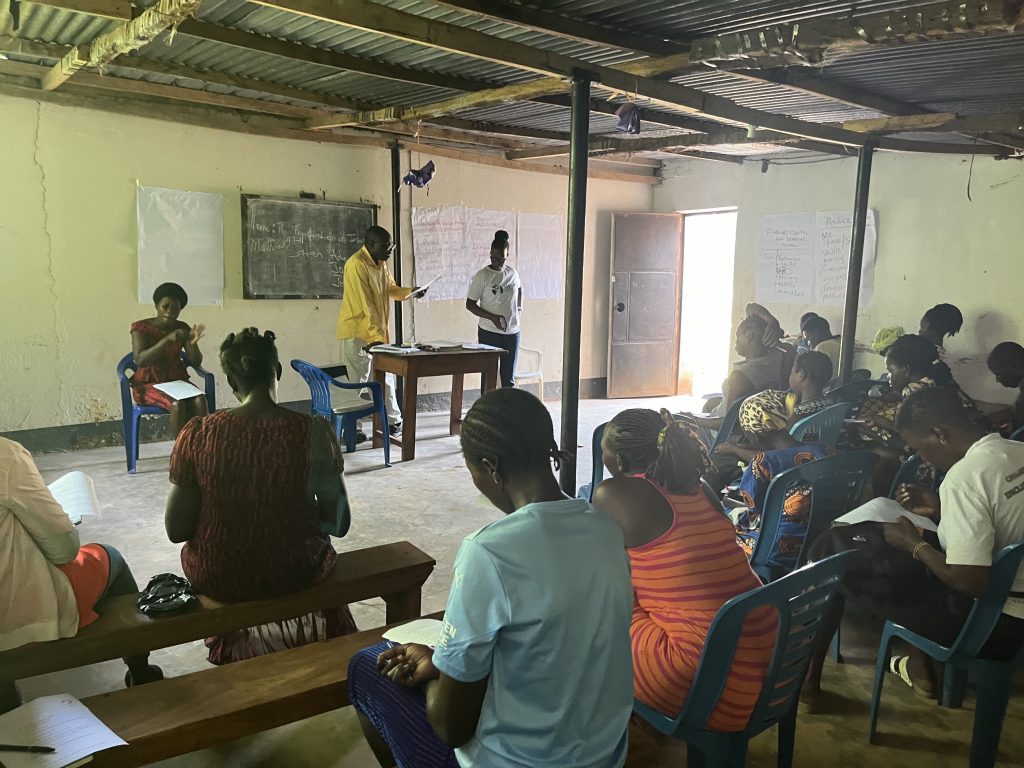
(From left to right) Nancy, Patrick, and Emma teaching the training
Over the course of this week, I was introduced to the full GDPU office team – Patrick, Emma, Faruk, Mary, Joe, Walter, and the GDPU Board members. I was also lucky to meet other members of the Gulu community: Brenda, a teacher for the GDPU vocational skills program; Nancy, an Acholi/English/Uganda Sign Language translator; Steven from Explosive Network Ordnance of Survivors; Caesar, the District Education Officer, and many more. It is unsurprising that people stop to come meet the “mzungu” (white person) that is suddenly in their space, but I am surprised and honored by the warm welcome each person has given me to the place they call home.
I will leave you with a few new phrases I’ve learned in Acholi. While the country’s official language is English, the people of Uganda speak over 70 different languages. My new Acholi vocabulary includes:
- Kapongo = Hello
- Itiye ni ning? = How are you?
- Atiye maber, kono in? = I am fine, and you?
- Icho = Good morning
- Iree = Good afternoon/evening
- Afowyo = Thank you
- Tima kica = Excuse me/sorry (a very important one for a foreigner in a new place)
Afowyo! See you!
-
A Lesson from Flora
6 CommentsAfter a few teary airport goodbyes and delayed and un-delayed and changed flights, I finally arrived in Uganda to begin my Peace Fellowship. I am grateful to be supporting the Gulu Disabled Person’s Union (GDPU) program that builds accessible toilets and handwashing stations at schools in the district. I will primarily support two GDPU efforts this summer:
1. The monitoring and evaluation of existing latrines and handwashing stations that GDPU has built at schools in the district.
2. The installation of a new latrine and handwashing station and menstrual products incinerator at a school in Kulu Opal.
As someone who studied environmental engineering and is passionate about water accessibility, the opportunity to work for Emma and the GDPU team on this project is an immense privilege. I can’t wait to get started. But before heading to Gulu, I have a few days stopover in Kampala.
The sunset from my first night in Uganda
On my first morning in Kampala, I visited the Uganda National Museum. I find that a history museum, and what a national government wishes to highlight about their country, can teach you a lot. The museum is an accumulation of many different themes and eras of Uganda. There are exhibits about traditional clothing and foods, excavated archaeological findings, Ugandan Olympians, and geological forces that changed the topography of Uganda over millions of years.
The museum boasts a multi-room exhibit about primates, focusing heavily on the mountain gorilla. Only approximately 1,000 mountain gorillas currently exist on earth, half of which live in Uganda’s Bwindi Impenetrable National Park. The rest of the mountain gorillas live in the Virunga Volcanoes, a region including Rwanda, DRC, and the Mgahinga National Park in Uganda. The exhibit highlights the dedicated Ugandan researchers who are working towards the conservation of these precious animals.
A very glared mountain gorilla taxidermy from the Uganda National Museum
I was definitely surprised by some exhibits. For example, there is a room about Henry Ford, the American founder of Ford Motor Company. The exhibit features an actual Ford Model T car but no written explanation of the connection to Uganda (although I later found out there is a Ford dealership in Kampala). There is an exhibit about why oil is beneficial to the environment and the economy. Curiously, this section was funded by the Uganda National Oil Company. This reminded me of the oil and gas section at the Bullock Texas State History Museum, curiously also funded by the Texas Oil and Gas Company…
In the back of the museum, the Uganda Ministry of Tourism, Wildlife and Antiquities recreated a “Cultural Village.” This series of traditional homes demonstrates indigenous living styles, each aligned with a different region of the country.
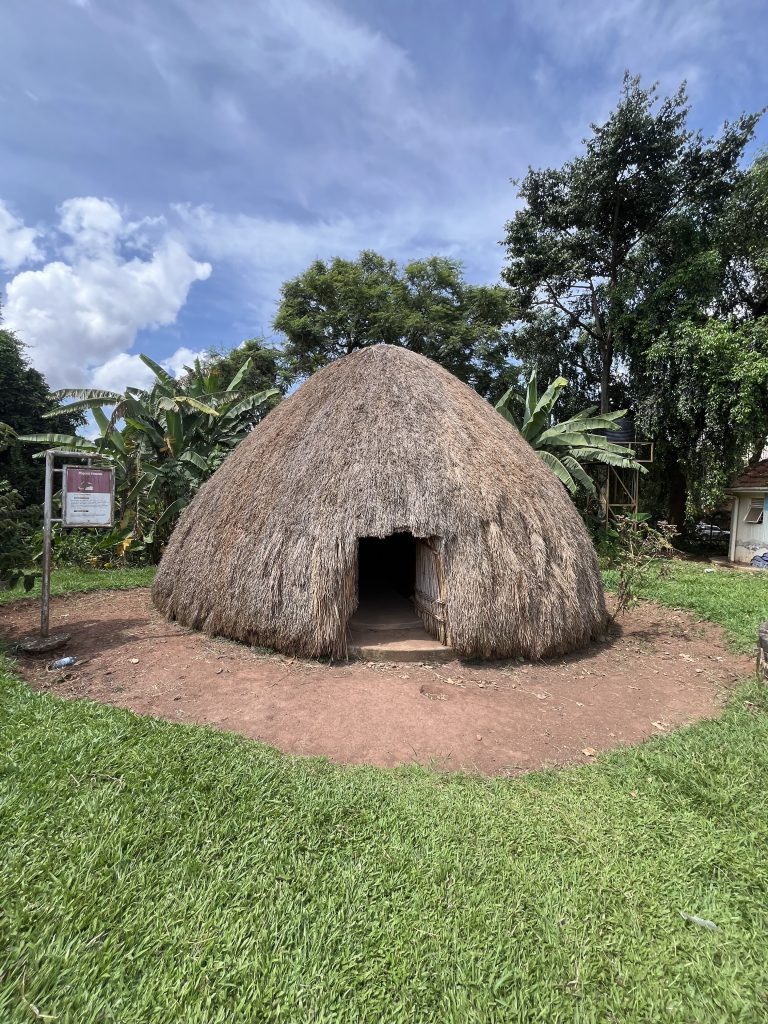
A recreated traditional home at the Uganda National Museum
As you might be able to see in this photo, Kampala is a city but also very green. I am amazed by how large the flora are. Palm trees and arrowhead plants grow just about everywhere.
The arrowhead plants pictured below are located at the Uganda National Museum. The plant on the left is about 3 feet (1 meter) tall and has leaves about 8 inches (20 cm) long. The plant in the right photo is about 6 feet (2 meters) tall and has 2-foot (60 cm) leaves! In comparison, I have tried again and again to keep an 8-inch (20 cm) tall arrowhead houseplant alive in my apartment in the United States, to absolutely no avail.

Arrowhead plants at the Uganda National Museum
I also noticed this phenomenon when I visited Malawi and Tanzania – plants growing to almost comically large proportions, developing uninhibited when planted in the right conditions. In East Africa, it seems like things flourish in places where they are meant to be. I hope this will be true for me this summer as a Peace Fellow, as well.
-
Start of an Exciting Journey
4 CommentsI started working for the Advocacy Project as a Peace Fellow the last week. There are a couple of projects I work on. In this blog, I want to discuss why I am super excited to support a soap-making project and the WASH (Water, Sanitation, and Hygiene) Project to install accessible toilets in Uganda. I will provide some data about the accessibility of the water, sanitation, and hygiene services in the region. I am sure the numbers make you surprised and convinced of how vital to work to improve the conditions over there!
First of all, water, sanitation, and hygiene (WASH) are critical to health, survival, and development. Many countries are challenged in providing these services for their entire populations, leaving people at risk for WASH-related diseases. People living in rural areas, urban slums, disaster-prone areas, and low-income countries are the most vulnerable and the most affected.
Water
According to CDC, 785 million people today do not have basic access to water. Finding effective and sustainable solutions for water supplies is significant regarding the fact that 30 to 40 percent of the rural water supply in low-income countries does not work.Sanitation & Hygiene
Lack of sanitation can be a severe barrier to individual prosperity and sustainable development. Sanitation is essential for all, helping to maintain health and increase life-spans. According to the WHO, an estimated 2.4 billion people lack basic sanitation throughout the world (more than 32% of the world’s population), while 673 million people practice “open defecation.”Children
The consequences of unsafe water, sanitation, and hygiene on children can be deadly. Many children living in impoverished urban settlements, like slums, are deprived of their drinking water and sanitation rights. UNICEF reported that over 800 children under age five die every day from preventable diarrhea-related diseases due to the lack of appropriate WASH services worldwide. Three billion people worldwide, including hundreds of millions of school-going children, do not have access to handwashing facilities with soap. When children, especially girls, cannot access private and decent sanitation facilities in their schools or learning environments, their right to education is basically restricted. These all have severe implications on their health, nutrition, education, and learning abilities, which prevent a child from achieving his or her full potential.Africa
According to UNICEF, when it comes to Eastern and Southern Africa, more than 70 percent of the population (340 million people) has no access to essential sanitation services. Among these, 98 million people (19 percent) practice open defecation, 179 million use unimproved facilities, and 63 million shared sanitation facilities. Ethiopia, Uganda, Kenya, and Tanzania have the largest number of people in the region with no access to basic sanitation services. Eritrea, South Sudan, and Ethiopia have the largest proportions and numbers of people practicing open defecation. In schools, over 50 million (27 percent) school-age children have no access to sanitation services, while 117 million (62 percent) have no access to handwashing facilities in schools.The Trend Over Years
You might think that the percentage of the people who have access to WASH services increases adequately as time passes. Unfortunately, the pace of increase in access to essential sanitation services is quite far away from the UN’s Sustainable Development Goals (SDGs). Access to essential sanitation services in communities has only increased by 6 percent since 2000. There were more people without basic water and sanitation services in 2017 than there were in 2000 in the world!Uganda
I prepared two charts according to data derived from the World Bank’s DataBank. Charts depict people with basic handwashing facilities and people using at least essential sanitation services in Uganda. Because data is available only for the period between 2000 and 2017, we can track the trend over 17 years.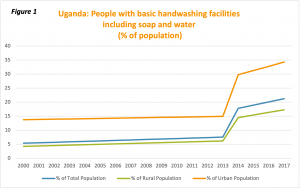
You can see the percentage of people with basic handwashing facilities, including soap and water, in figure 1. Until 2013, there had been a slight increase in the rate of the population who have access to basic handwashing facilities. Access to handwashing facilities in the total population increased by 6.7 percent in 4 years and reached 21 percent in 2017. However, there is a significant disparity between rural and urban areas. From 2013 to 2017, people with access to handwashing facilities increased by 11% in rural areas; the number reached 19% in urban areas.
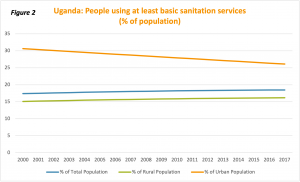
Figure 2 shows how urgent working for providing better and sustainable WASH services is essential for essential sanitation services. As you can see from the chart, there has been a slight increase among the total population and urban population who use at least essential sanitation services. Interestingly, the percentage of people having access to sanitation services in urban areas had decreased by 4.2% percent over 17 years! There must have been a constant increase over the years to achieve the UN’s Sustainable Development Goals for Uganda. Rather than seeing a continuous improvement in the region, we face a situation that has been worsened over the years.
This quick introduction and data presented make me super motivated to support the community-based response to one of Uganda’s most pressing problems – the lack of WASH services at primary schools and soap making. Besides, the Advocacy Project’s vision of working directly with local communities, planning the agenda according to local people’s demands, and giving immense importance to their feedback make me more excited. I do believe that the inclusion of local communities in projects is an indispensable part of fostering sustainable development and peace over the region. I will talk more about this in another blog!
-
A Comedy of Errors: Travel in the Time of COVID
2 CommentsI made sure to take a PCR test within 24-hours of my flight’s departure from New York City to Amsterdam. It is a requirement for passengers travelling to the Netherlands to test within 24-hours. I wasn’t sure about passengers merely passing through the airport, but to be safe I took my test on Friday before flying out Saturday evening at 6:30 p.m.
My PCR appointment was initially scheduled for 4:00 p.m. on Friday, but it was moved to 6:00 p.m., and then to 8:00 p.m. Not a problem, the company assured me: I would still receive my result by 3:00 p.m. the next day — in time to print my results before heading to the airport. I spent Saturday morning packing and relaxing, and at around 1:00 p.m. went out to a delicious Italian lunch with my parents.
When I got back to the house, I had two missed calls on my phone from the testing company. They had left a voicemail: “‘Hi…we are unable to get in touch with the lab and don’t think we’ll have your result by 3:00 p.m. I am so sorry about this. We are going to reimburse you because we guaranteed that you would have the result by 3:00 p.m. Please call back when you get this message.'” A chill momentarily passed through my body. This wasn’t according to plan. “It’s OK,” I assured myself, “I’m sure you’ll have the result soon.'”
I called back to learn more about the situation. The man told me that the result should have been in at 10:00 a.m. that morning, but that the lab had alerted him at 12:30 p.m. that they hadn’t yet tested the samples they received last night. He wasn’t able to get a hold of the director, but was sending him messages through their secure system. I felt a wave of panic pass through my body. “Ok, but when do you expect to receive the results?” I asked, my frustration bubbling to the surface. “Uhm… we’re not sure. I don’t know if it will be 30 minutes or an hour or two hours because uhm… we don’t want to make another guarantee and uhm… I haven’t been able to get in touch with the lab.” It was 2:30.
He told me that the best idea was to get a rapid test at the airport just in case the results did not come in on time. But didn’t he understand that I had taken a PCR test to avoid getting tested at the airport facility, which was sure to have a long line? “Relax. Calm.” I soothed myself. “It will be fine.”
At 3:00 my parents and I hopped in the car and sped off to the airport — for about 7 minutes, until we hit stop-and-start traffic that was moving so slowly the Bronx River Parkway felt like a parking lot. To make matters worse, the quickest route to the airport — the Hutchinson River Parkway — was closed.
After numerous calls to the company and no lab results to be found, it began to dawn on me that I might not get the results in time to check in for my flight. “Look up other flights,” my dad barked from the driver’s seat. “If you have to wait for results at the airport, you are not going to make your flight in time with this traffic.” My heart began to race; this was turning into a disastrous start to my over 30-hour trip to Gulu. I was no longer in control…
Luckily, a quick Google search told me that KLM offered another flight an hour later to Amsterdam, which would still give me time to make my connecting flight to Uganda. After holding for 20 minutes on KLM’s customer service line, I finally reached a representative. She was able to change my flight with no additional charge. I instantly felt more relieved, but still had to book my testing appointment at the airport. The second time I refreshed the airporting testing website, I found an available appointment at 5:45 p.m. I would barely have enough time to get tested and make my flight, but I had no choice; I booked it. This was going to be tight.
When we arrived at the airport, I hurriedly said goodbye to my parents outside the terminal. I rushed to the bathroom, and then to the testing center. Two people in front of me, about 25 minutes to get results. Not bad. I would be able to test before my allotted appointment. After checking in and paying the $225 fee (!), I was ushered into a room where a nurse took down my information and swabbed my nose. “Can I check in while I wait for my result?” I asked, pressed for time. “No, you need your negative test result,” she told me, with a look of pity on her face. “Don’t worry, though, you have plenty of time,” she cooed soothingly. Relieved, I sat down in the waiting area with renewed hope.
About thirty minutes later my negative result finally came in. It was now 6:00 — just one hour and a half before my flight. I rushed upstairs to check in at Delta, only to find a huge line that snaked outside of the roped area. My jaw nearly dropped to the floor. There was no way I was going to check in on time. Instead of waiting in that long line, I went directly to the designated KLM area, but was turned away by a staff member. “You have to wait in that line,” she told me sternly. I returned dejectedly.
After about 20 minutes, the line had barely moved. “You are all going to miss your flight,” a blunt staff member told the desperate people in line. When someone complained that they had a 7:30 p.m. flight she simply said: “You should have gotten here earlier. You’re going to miss your flight.” There was no way that I was going to miss my flight after the ordeal that I had already been through. I left my bag in line and steamrolled directly to the KLM desk. “My flight is at 7:30, and I need to catch it because I have a connecting flight,” I desperately told the agent. Taking pity on me, he commanded me to hurry up; “if you don’t check in now you’re going to miss your flight” he practically yelled in alarm. I ran back to the line, grabbed the bag I had left behind, and sprinted directly to the desk. I was checked in in under 2 minutes.
Right before checking in, my negative PCR test came in. “What did that matter now” I thought to myself with a self-pitying laugh. I rushed through security and sprinted through the airport until I arrived at my gate. Ironically, there was a long line to check in; apparently I had made it with time to spare. When I finally got to the front of the line around 45 minutes later, I showed the Delta agent the negative test I received at the airport. “Where are you going?” he asked. “Uganda” I told him. After typing the destination into his computer to check the COVID requirements, he reported that I needed a negative PCR test to enter the country, and the test I had showed him was not a PCR test. Chills ran through my body. Forgetting that the 24-hour test was a PCR test, I replied, laughing nervously: “To be safe, I got another test.” I showed him the result from the other test, which had come in just an hour before. “Use that one; it’s better,” he instructed me. He signaled for me to pass through the jetway. Relief poured over me as I realized I had made it.
-
Ethical Considerations of Travel to Uganda During COVID-19
6 CommentsI have made the decision to stay in Gulu, Uganda for ten weeks this summer as a Peace Fellow with the Advocacy Project (AP). This was not an easy decision, because COVID-19 has painted in stark relief the ethical questions that come with traveling to third-world countries. Inadequate health care, high rates of autoimmune diseases, and widespread poverty make Uganda particularly susceptible to COVID outbreaks, and negative outcomes for sick patients. Given the situation, why did I elect to travel?
Most importantly, AP’s Uganda partners have invited me to come. The Ugandans with whom we work know the on-the-ground situation best, and have assessed the risk of my stay to be minimal enough that the benefits of having an AP partner in Gulu outweighs the costs. Furthermore, the government of Uganda has granted me a tourist visa. In their expert opinion, my entry does not sufficiently risk the wellbeing of the Ugandan people.
I have planned my travel to be as COVID safe as possible. I am fully vaccinated. 24-hours before traveling, I will take a PCR test that I must present before boarding the plane in New York. Upon return to the United States, I will also take a PCR test (available at the Entebbe airport). I will travel directly from Entebbe to Gulu with a hired driver, and will keep my mask on at all times inside the car. In Gulu, I am staying in my own building within a compound. The compound has its own restaurant, so I will be able to eat my meals in my room. In the case that I need to quarantine, I can safely do so there. I will travel to and from meetings with a hired driver, and will wear a mask. I will conduct meetings outside whenever possible (it is the rainy season), and maintain social distancing.
In reality, most people with whom I interact will not be masked, and will not maintain social distancing. I am not responsible for their choices, but I am responsible for my own. I believe that the preventive measures I take will prevent others from possibly contracting the virus.
Although I am fully vaccinated and will adopt best COVID-safe practices, only 0.6% of the population of Uganda has been fully vaccinated, and around 5.8% of the adult population are HIV+. Furthermore, hospitals are notoriously underfunded, and have low technical efficiency. This means that Ugandans are at high risk for severe COVID cases, and negative outcomes given hospitalization. This begs the question: As a fully vaccinated person, can I still contract and, more importantly, spread the virus? Recent studies have shown that vaccinated people who contract the virus are less infectious because they have less virus in their systems. Further supporting the conclusion that vaccinated people are extremely unlikely to spread the virus is the finding that fully immunized participants were 25 times less likely to test positive for COVID-19 than were those who were unvaccinated. Although there is a small chance that I may contract the virus, there is an even smaller chance that I will spread it.
Even if I am unlikely to contract or spread COVID, I may get sick from another illness and take up space and resources at a health clinic that would otherwise go to a Ugandan. This is an issue that is present in non-COVID times, but is especially salient during the pandemic. In order to prevent severe illness, I have gotten vaccinated against yellow fever (a requirement to enter the country) and typhoid, and will take malaria pills for the duration of my stay. In order to treat a possible infection without the need for a doctor’s visit, I am bringing antibiotics. These measures, in addition to my COVID-safe practices, should protect me from contracting an illness that necessitates a visit to the hospital.
I believe, along with AP’s Uganda partners, that the benefits of travel outweigh the costs. I look forward to your comments!
-
Nancy Okot
3 Comments
Nancy is the oldest of seven children. In Uganda, being the oldest child carries a lot of responsibilities which made the fact that Nancy is disabled especially difficult. “My parents love me, but my father struggles to accept me.” She told me that for a long time her father blamed god for her disability. Imagine being born into a world were even your father sees you as inferior, what would that do to a child’s self-esteem?Once Nancy began school, things only became more difficult. “Some people have disabilities that you cannot see, those are the lucky ones. Children would see me and mimic my arm, which really hurt me.” Anyone reading this should try to remember being a child. The fear of not fitting in is universal. Nancy’s entire life has been defined by one feature of her body. It’s unfair. It’s heartbreaking, but for Nancy, it’s an everyday occurrence. She says people treat her like a child because of her disability, even though she’s exceptionally sharp. She wants to become a seamstress, but for now she farms. I asked her if it’s difficult for her to use a hoe with her disabilities to which she quickly replies “”It’s not easy, but I can farm better than you!” Current score: Nancy – 1, Chris – 0.

Nancy is quite a charming, albeit spunky, young woman. I noticed during our interview that some teachers were standing a few feet away. I thought they were curious about the question I was asking or maybe they just wanted to see the mono (Acholi for white person). My ego quickly deflated once I concluded the interview, and the teachers flocked to Nancy. They began joking and laughing like old friends. One teacher took Nancy by the hand and walked away with her, their laugher still echoing off the classrooms at Tochi Primary School. And I was left sitting there, alone. Updated score: Nancy – 2, Chris – 0.

-
Why a latrine?
6 Comments“Why a latrine?” It’s a simple question asked by a friend who shall remain nameless. “Couldn’t you dig a well or something? You know, something urgently needed?” I laughed it off. Obviously the point is valid: People – Water = Dead, however I want to use this blog post to explain how a latrine can alter a child’s life entirely.
Monica Ajok speaks in a very soft voice; so soft you have to lean in close to hear her speak, but it’s worth the effort to listen. She has a story to tell. I asked Monica what her favorite subject was in school. It’s a great icebreaker that adults have used on children since the dawn of public education. Most kids say recess or art. But Monica is not most kids and would not be contained by the rigidness of my question. She lists off English, Math, Science and Social Studies as her favorite subjects. How dare I assume she had only one! Monica aspires to be a nurse, to help sick people feel better. I told her that requires a lot of school, but that didn’t faze her. Here is a young girl who knows what she wants and is willing to work for it. There is something more to Monica than her love of studying and aspiration to heal people, she is disabled. I hadn’t even noticed her leg until her mother told me.

“Monica has a lot of challenges. She cannot do a lot of things that other children can do. When she gets home from school, she cannot fetch water. She cannot clean. She has difficulty moving; sometimes she comes home complaining that her leg is [burning].” But Monica’s mother was quick to counter these challenges with a resounding, “But she is just as smart as other children!”
Why a latrine? Before Gulu Disabled Persons Union (GDPU) constructed a latrine at Monica’s school, she had a daily choice between two terrible options. “Coming to school is easy, but I never went to the bathroom. I would either [hold it in] or walk home to use my own toilet.” A school day in Uganda is eight hours long just to put the first choice into perspective. Like most students in northern Uganda, Monica’s house is not exactly close to the school. “It takes me an hour to get home from school.” Just to be clear, a girl with a bad leg walked an hour to her house just to use the bathroom. That means it was another hour before she returned to class. I’ll let that sink in a bit before I tell you the good news…don’t worry, there is good news. Because of the latrine build by GDPU in 2017, Monica can now stay at school without worrying about stomach pains or a two hour hike to the bathroom. “Now my school has a clean toilet [with handrails]… there is soap and water to wash my hands so it’s easier for me to study. “
So why a latrine? It may not be glamorous, but if it empowers more girls like Monica to reach their dreams then I think the question should be; why not a latrine?

Find more pictures from my time in Uganda right here!
-
And the summer begins: Welcome to Uganda!
7 CommentsEarly Sunday afternoon, as my plane taxied down the Entebbe runway, I was excited to have finally made it to Uganda. I’ll be in Uganda for ten weeks this summer working with the Gulu Disabled Persons Union (GDPU) as an Advocacy Project Peace Fellow. GDPU advocates for people with disabilities in the district of Gulu.
This summer I will be helping to install an accessible toilet in Ogul Primary School for disabled students, as well as assisting GDPU staff in inclusivity training for the school. I have been looking forward to this opportunity since I learned I would be a Peace Fellow in April and I’m excited to have the opportunity to share the work of GDPU with people back home. However, I still had a few more stops to make before I really began my summer fellowship in Gulu. The plane slowly pulled up and eased to a halt in its parking spot, all passengers disembarked down the stairs and off the plane to make their way across the tarmac to the Entebbe International Airport.
View of Entebbe and (in the distance) Lake Victoria while flying into Uganda
I got through customs in Entebbe around noon local time and felt the last bit of my energy kick in to get me to my final trip for the day, the MTN booth outside the airport where the driver would be meeting me. Once that was achieved, I settled in to enjoy the scenery on the way to Kampala. The single lane highway connecting Entebbe and Kampala was a fairly easy drive and passes right alongside Lake Victoria. After two nights of rest in Uganda’s capital, I took the early morning Post Bus from the Post Office in Kampala six hours north to Gulu. On arriving, Gulu greeted me with rain, overcast skies, and deep-red muddy roads. Once unpacked and settled at my hostel, I took a walk around my new town. One thing that immediately jumped out at me during this walk was that everyday movement in Gulu is likely not easy for people with disabilities. The roads are unpaved and riddled with potholes, there are very few sidewalks, and to get to them you have to cross over slated grates that cover the sewers (if they’re still there). Ease of movement and accessibility of services is an obstacle for persons with disabilities anywhere you go and I only scratched the surface of it during my walk through Gulu.
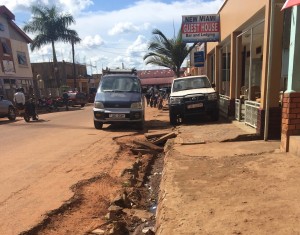
One of the many roads in Gulu that can be hard to walk down.
This issue is not limited to Gulu, or to Uganda, take a look at the environment around you at home, at work, at school, is your community doing enough for people with disabilities? Everyday obstacles like these make it hard for people with disabilities to lead an independent life. And obstacles to schooling, like toilets that are not accessible, make it hard for children with disabilities to receive an education. I head into GDPU tomorrow morning to begin my summer fellowship. I’m excited to learn more about this issue and about GDPU and to share their stories here. So check back to see the great work that GDPU is doing to advocate for persons with disabilities in Gulu!
-
Violence and Humanity: The U.S and Uganda
125 CommentsI was reluctant to write about this, especially for my first post in Uganda because I don’t want to bring the wrong message across about Gulu or the work I am doing here. While reading this please keep in mind that I am safe and do not take this as a testament to daily life here.
Sunday was my first full day in Gulu and after 4 days of traveling alone I made some connections with a few other people staying at my guesthouse. They had been in town for a few weeks and were kind enough to show me around. Overall it was a great day.
We returned from a meal to get reports about the tragedy in Orlando. Our hearts were with all of you even though we were so far from home. I was happy I didn’t have to tune into the U.S TV media to hear how it would all be spun but the sadness, frustration and anger came across through all of my friend’s Facebook posts and news articles.
Later that night I would have my own experience with gunfire in this part of the world. Two housemates were sitting outside when we heard some loud sounds: “What is that?” “I think it’s fireworks.” No sooner was that uttered than my housemates came in and told us to lock the door and turn out the lights because it was gunshots. We quickly got away from the windows and kept quiet.
The staff at the guesthouse were amazing and immediately closed the gates and ensured our safety. They were familiar with the sound and knew what it was. My guesthouse is also prepared for this sort of thing: it’s in a compound surround by a wall with barbed wire on top and a guard. The LRA has been out of Gulu for several years now and the town is rebuilding but I’m sure the memories of what happened during their regime are still very close.
The gunfire was not directed towards civilians and after about an hour of shooting the roads in town slowly started to see traffic again. Some reports say it’s related to issues with the government Daily Monitor . Things have returned to normal in the days since however we all have a heightened sense of awareness and taking precautions.
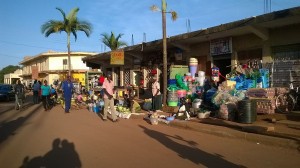
(Daily Life in Gulu at the market)
My first day at the GDPU was on Monday and the director assured me that my safety and that of the other staff was always the priority. I was talking to another staff member and explained that in the U.S the sounds I heard were usually associated with fireworks or a car backfiring so it didn’t register with me immediately. He told me about a trip he took to India during Diwali and was used to associating gunshots with the sounds of firecrackers going off around him but then said said “I got used to it. Now I am used to both sounds.”
I’m not trying to compare these two events, they involve completely different issues and cultures. The parallel of being “used to” this sort of thing is what struck me. Although I’m not used to the sound of gunfire in the U.S, I am used to hearing about mass shootings throughout the country. The idea that any group of people gets used to hearing gunshots or hearing about gunshots is very sobering and just makes me sad.
I also don’t want to tell you what you should do but if violence makes you angry then do something, whether it is related to policy or making a change in yourself. What I will say is that I am and will continue to be amazed by the resilience in people and the humanity that comes out of tragedy. I know that the same humanity exists outside of tragedy and we need to strive to find that within ourselves as often as we can. My heart is with all of you in the U.S, Orlando and all the LGBTQ community who I have a great deal of love and respect for. Love is Love is Love
-
Lesson 1: Shut up and listen
95 CommentsI am wrapping up this week of orientation with The Advocacy Project as a visitor in Washington DC. It was less than a week ago that I arrived as a New Yorker in a city that, although smaller than Manhattan, was unfamiliar to me. While being somewhat intimidated by using public transportation and unsure how to navigate myself I was reminded that each city is different and has its own unique culture. This thought is one that I’m reflecting on even more as I prepare to travel to Uganda to work with the Gulu Disabled Persons Union (GDPU) this summer. Every culture has its own traits and as a visitor this week I’m reminded of the importance of listening and observing those distinctions rather than assuming control.
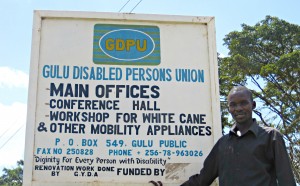
(Photo taken by previous AP Fellow at GDPU)
My fellowship this summer will be the second time I have had the opportunity to spend time in Uganda. My first trip was 7 years ago as a social work student at Simmons College. It was my first time going anywhere in Africa and added to the handful of times I had been out of the U.S. I didn’t change the world in the 4 weeks that I was there but the experience added to my growth as a person and taught me an important lesson that I will be taking with me on my return: shut up and listen.
Before going to Uganda, my American mind had conjured images of what it would be like when I got there. For so long I had heard stories of the AIDS epidemic and the continent of Africa had become synonymous with poverty and sickness. Try as I might, I couldn’t shake the crude images I had seen on TV ads until I actually arrived. While the country has its share of issues they do not define it. Uganda is filled with smart, capable and kind individuals who are working hard at solving their own problems. It is not a country in need of a white knight to save them. They are helping themselves but are open to assistance.
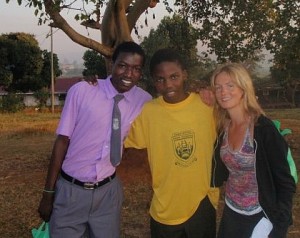
(Me and some students from my 2009 trip)
My first experience in Uganda taught me to shut up and listen, then and only then should I attempt to act. This is an invaluable lesson, which has continued to guide me as a social worker and public health professional. I have tools that I can provide to others but it’s important to first learn how to best put them to use.
While there is a lot of work to do this summer I need to remember my role: I’m a visitor and a fellow not a savior. I’ve learned many new skills during this week of orientation but I know that none of them will be as effective as they can be unless I first shut up and listen.
Practicing photography outside AP training
-
Reflecting and Moving Forward
Leave a Comment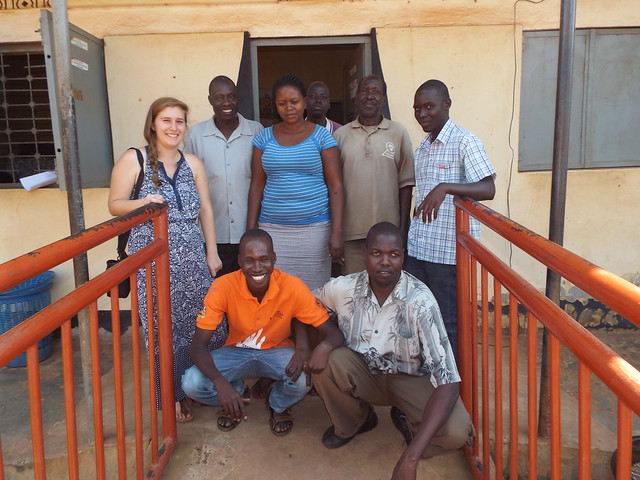
GDPU staff outside the office
As the year winds down I thought is was important to both recap the last six months and also unveil some of the exciting new components we at GDPU are working on. In 2014, one of our biggest successes was putting the bus park toilet into working order. Between GDPU’s tenacity in politics and my technical knowledge we were able to open the toilet for use. The toilet was also evaluated this summer by 15 persons with disabilities living and working in the immediate area. We found that there is a great need for the facility and many PWDs intend to use the toilet. In 2015, GDPU will continue to monitor the toilet and provide feedback to both the vendor and the local government, who now have ownership of the facility. We have received extremely positive feedback from those who have used the toilet so far.
Our second major project in 2014 was undertaking a needs assessment of 10 schools in Gulu District. The assessment featured observations, interviews with the headmasters, and focus groups with students. This needs assessment has greatly informed our 2015 project and the proposals which I am currently working on. In the assessment we found many schools attempted some form of accessibility, but none of the schools met Ugandan accessibility standards. For example some toilets had ramps to a step, handle bars with no sitting provision, or doorways too narrow. In 2015, GDPU and AP would like to fundraise to provide model accessible toilets at three primary schools, as well as, work with the local government to ensure that accessibility standards are created so that every sanitation project meets the correct specifications.
In the needs assessment it was also found that the after water and sanitation concerns, bullying was one of the major problems faced by students with disabilities. Click here to see some of the drawings by students by disabilities. In an effort to include both bullying and “soft” components in our 2015 program, I have been working with Tochi Primary School’s headmaster and music, dance, and drama teacher to create an educational program, which could be modified for use at all schools in the district. The program combines sensitization of teachers and administration, activities year-round for students focusing on a one week competition, and an event for the community to participate in. Topics included in the program include disability awareness, bullying, and hygiene. The program would support the infrastructure in that students and the community would be aware of the importance of the latrine and help to sustain it. It also will work to include students with disability into both their school and wider community. This program is extremely unique as no other program has been implemented in schools with a designated focus on disability. This program is exciting as it can be implemented in combination with the building of an accessible toilet or on its own at a low cost.
On behalf of Gulu Disabled Persons Union and myself I would like to wish everyone a happy holiday season as we reflect on the successes and challenges of 2014 and look towards to new possibilities for change in 2015.
-
The Women of GDPU: Empowered and Educated
1 CommentAcen Franka

In 2003, Acen Franka dropped out of Senior 1 at the age of 19 when she conceived a child, shortly after which she got married. Her husband promised he would take her back to school after giving her a break to raise the young child. The years past and Franka and her husband had another two children. Her husband then refused to take her back to school.
The tipping point came when her nearly 50 year old husband brought another wife into the home, a 17-year-old, was also pregnant. The two wives and their husband all lived in the same room and even slept in the same bed. This wife, however, the husband took back to school after giving birth.
Franka never gave up on her dreams and left her husband in 2012 to continue studying. Franka is now in Senior 3 and is not giving up hope. “If you’re not educated you can’t do anything. You can’t afford to food to eat or pay the school fees of your children” said Franka. Since she left the village, her husband has disallowed her to see the children, yet she remains hopeful about visiting them this Christmas. On her husband she noted, “short man can delay to grow old.”
Franka works with the GDPU as a caretaker of children whose parents train at the vocational program.
Aciro Moreen

In 1995, Moreen dropped out of Primary 7 due to financial problems. She began working in a clinic as a cleaner. In 1997, at around 20 she got married and had three children with her husband.
Life changed drastically in 2004 when her husband, a driver for World Vision, was murdered by the LRA during fieldwork. World Vision gave her compensation, however her brother-in-laws came and took everything: the monetary compensation, two motorbikes, the land, her home, and all belongings in the home. They left Moreen with nothing, an unfortunately common instance with widows in Uganda. “They say women have no power over anything” said Moreen. They rationalized that they were taking the belongings for another niece, whom her husband was helping to support.
Years later Moreen found out World Vision had offered to pay school fees for her children, yet her brother-in-law had enrolled his kids under the names of Moreen’s children. For three years her brother-in-law’s children were going to school without paying fees. When she found out she went to World Vision, but instead of correcting the mistake the stopped paying school fees altogether.
In 2011, Moreen decided to go back to school enrolling in Senior 1. “I want to become a mid-wife, but my level of education did not match [the requirements]” said Moreen. Today Moreen, the Office Assistant at GDPU, takes night courses and is currently in Senior 3, which happens to be the same level as one of her sons. When I asked her son what he thought of his mom in the same level as him, he said he was very proud. Moreen says she “just does what pushes my life to tomorrow.”
Ajok Betty

Betty finished Senior 6 at age 20 and was immediately off to England where her new husband lived. While living in England for five years she had her son. She left England as her marriage began to crumble and the feeling of isolation grew. “The social life was bad. You stay without knowing your neighbors,” Betty said.
Back in Uganda she attempted several times to finish an Associate’s Degree. The first time she dropped out due to money issues, her husband refused to give any payment as he falsely believed she had remarried. The second time dropping out because she was offered a job as a secretary for the Lord’s Resistance Army (LRA) during peace talks. Finally, on her third attempt she finished her two year degree.
Today, Betty teaches literacy and numeration at the GDPU for students at the vocational training. On the weekends she is completing her Bachelor’s in Development Studies. Using her son as inspiration, Betty is working hard to provide a better life.
-
Photo Gallery: This is Uganda
Leave a CommentBelow are just a few of the many photos I have taken during my fellowship. To see more check my Advocacy Project Flickr account. These are the faces and places of Uganda.

Ivan is a 14 year old student with physical disabilities at Tochi Primary in Gulu

Student at Tochi Primary in Gulu
Nancy almost dropped out of school because other children bullied her for being disabled
Uganda’s national bird: The Crested Crane

Straw weavers feet

National Mosque Minaret
Chameleon along the Bwamba Pass

Joining the straws
Ugandan flower in the Rwenzoris
Ugandan National Kayak Team Member on the Mission
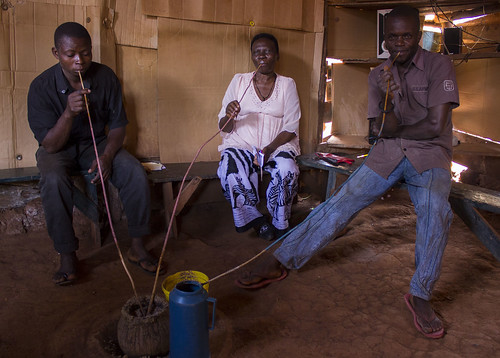
Sharing African Beer
Rooftop cat in Kinawataka

Kids outside Reach Out clinic in Kinawataka

If you yell muzungu at me I will not feel bad about taking your picture

Zebras outside Lake Mburo National Park
Girls in Kinawataka

Nile kayaker dropping into the surf on Club Wave
Monkey in Bujagali
Collecting straws to recycle
-
Projects, Proposals, and Budgets Oh My!
1 Comment
Women of KIWOI
While I have been hard at work here in Uganda, I have been slacking on my blogging. Just to check in, I am in fact still alive and well with the women of Kinawataka! Over the past couple of months the focus of my fellowship has evolved. Initially my goal was to implement the AP deliverables providing capacity building training and support on NGO management and communications under the 5by10 module. While I am still supporting both of those areas, my focus has shifted to fundraising and project development.
I’ve been at a loss about what to blog about relating to work, management and proposals aren’t necessarily the sexiest of topics. However, as AidSpeak blogged: “If you want to save lives, make the spreadsheet cells calculate properly.”
So what exactly have I been up to?
Since September I have been conducting outreach to embassies in Kampala on behalf the Kinawataka Women Initiatives and Gulu Disabled Persons Union. Several embassies provide small grants to community based organizations. My goal is to submit at least five proposals by the end of the year. So far I have sent one off and am in the finalizing steps of another.

Collecting straws in Kinawataka
A major aspect of my fellowship is getting KIWOI into a place where the organization can be competitive for funding opportunities. This has been a lengthy process. We have formalized our board of directors, drafted an annual report, changed our bookkeeping practices and created expense reports. I created a detailed budget for the organization and each of our proposed projects. This was significantly more challenging than one might imagine. A lot of the information needed had not been tracked and determining costs was quite the process. Excel and I have come to terms though and the budget is finally complete.
What am I fundraising for?
While we are seeking funding to cover the core costs of the organization, another major aspect of my work these past months has related to project development. We have several exciting programs in the pipeline for 2015. Nearly all of the groundwork to implement these programs has been completed and once we gain funding KIWOI will be off and running!
Plastic bag reduction campaign
Plastic waste constitutes a major threat to the environment in Uganda. In order to combat the plastic threat KIWOI has developed a project for the upcoming fiscal year to remove 100,000 plastic bags from the Kinawataka slum in 2015. The project would involve the distribution of 400 reusable and durable straw bags to five stores in Kinawataka, six community trainings, and the development of a campaign to remove plastic bags from Uganda. A pilot program was implemented in 2012 and to promote the use of reusable bags rather than single-use polyethylene bags. The project was a major success and customers continue to utilize the reusable bags and the expansion of the program holds much promise
Trainings in quail raising, tailoring and mushroom growing
In order to create self-sustainability for women in Kinawataka, KIWOI plans on hold three trainings on the income generating activities of quail raising, tailoring and mushroom growing. Each of these trainings provides significant dividends for the women in Kinawataka. These trainings were requested by the women in the community and would significantly improve their quality of life by giving them new skills, which can be used to generate an income.
Working with women in prisons
Uganda’s prison system is focused on punitive rather than corrective incarceration. Prisoners leave the system with little means or skills to improve themselves often leading to the resumption of crime due to lack of perceived alternatives. KIWOI began working in women’s prison and trained over 70 women to produce straw bags and crafts from recycled drinking straws. However, the trainings were discontinued due to lack of funding. Kinawataka hopes to renew the trainings and expand them to additional prisons providing training on straw product production and other income generating activities.

Peace Fellows Shannon and Katy with KIWOI Founder Benedicta
Before I came to Uganda, the majority of my experience had been in conducting research, writing memos and reports, and advocating on human rights issues. I had never drafted a grant proposal, developed a project, wrote a budget or annual report, or completed a log frame analysis. These are all critical skills and I’ve enjoyed learning them. The work has been a challenge, but one that I have been keen to complete. I’ve grown quite attached to the women of Kinawataka and am dedicated to doing my best to get them funding to sustain this innovative organization. I have three videos in the pipeline and do my best to everyone updated so stayed tuned exciting work is happening in the slums of Kampala!
-
Bullying of Children with Disabilities
Leave a Comment“They tell you you’re ugly.” 13-year-old female
“Sometimes they abuse you and tell me that I should go away because I don’t see.” 12-year-old female with visual impairment
“People use abusive language. They say that my hand is just like my mother’s, but it’s not.” 16-year-old female with physical disability
“For me, I don’t like the isolation. It’s both teachers and children, it’s all around. ” 17-year-old male with visual impairment
“For you, you look like a dead person.” 16-year-old female with visual impairment
“Other students beat me in class.” 10-year-old male with intellectual disability
“They say hurry up disabled person the rain is coming.” 12-year-old male with physical disability
“Others they abuse. They say there is no space for you here, you should study from home. Others even play with my crutches.” 9-year-old male with physical disability
“He’s a mad person he should go to the hospital and get medication” 12-year-old male
“I will think about transferring.” 11-year-old female
“For me I would change attitude of people towards persons with disabilities and tell them to treat everyone equally.” 17-year-old male
During our water and sanitation needs assessment we conducted focus groups with over 150 children with disabilities in ten schools within Gulu District. While many of the focus group questions surrounded the state of water, sanitation, and hygiene we also left room for students to openly discuss challenges they faced at their school. While there were many students open to discussing bullying it was clear the problem was even larger when we asked students to draw or write their challenges. We has students pair up into groups, with those who cannot draw giving their idea to their partner. After water and sanitation structural problems, bullying was the second most drawn topic, with pictures depicting painful realities they faced from their peers at school.
- Tochi Primary School
- St. Mauritza Obiya Primary School
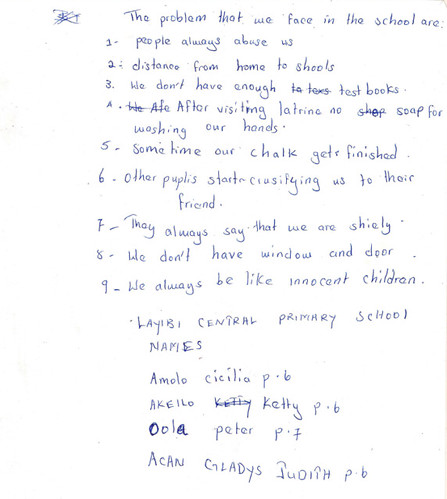
- Layibi Central Primary School
- “They are quarreling” Tochi Primary School
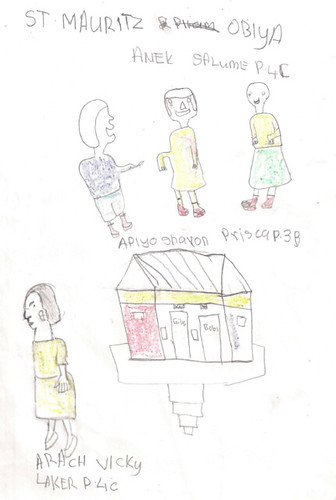
- St. Mauritz Primary School
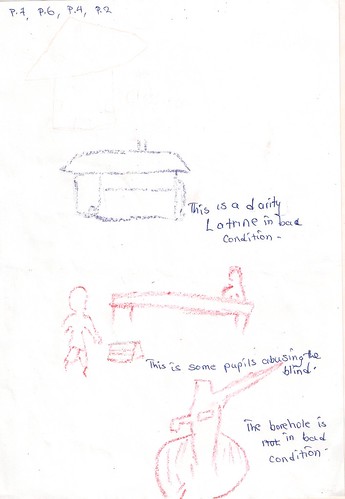
- Gulu Primary School
- St. Jude’s Primary School
This assessment was extremely important as we seek to build a schools program. Originally GDPU and AP planned to build accessible toilet and include a hygiene program, with a small element of bullying prevention. With this assessment we were able to find out that the majority of students are adequately accessing hygiene education at school in both the classroom and during assembly. From our focus groups with students however, it is clear that instead our educational program should focus on bullying prevention and sensitization of both teachers and student.
-
Ugandan Time
1 CommentThings in Uganda move at a different speed than in the United States. The streets and sidewalks are busier but at the same time, things to get done at a much slower pace. They talk about African time in relation to punctuality. When booking a bus ticket to Kenya, the bus driver emphasized, “We leave on Muzungu time, not African time!” yet we still departed 30 minutes late.
Two of my many flaws are procrastination and sleeping-in, which seem to be common side effects of African time so I have had to struggle not to fall into the relaxed flow too much. Dealing with African time has certainly taught me patience. This place could break a Type A person. Every time I travel to Africa, there is an adjustment period where I shift my expectations of time. Arriving 45 minutes late to an interview or important meeting here is commonplace, whereas in the U.S. it would almost certainly lead to a negative outcome.
At a training session for students on entrepreneurship at Makerere University here in Kampala, the speaker stressed with the audience that we must create a “Ugandan time” to create efficiency. The crowd burst into laughter, nodding in agreement but also disbelief that is would be possible.

KIWOI Executive Director and Ugandan Time Pioneer Benedicta Nanyonga
One of the reasons the founder of Kinawataka Women Initiatives, Benedicta Nanyonga, has been so successful is her diligence with time. She rises before the sun does to take care of the cow, pigs and chickens that live in her backyard and prepare the orphans she raises for school. When I leave in the evening she is still hard at work and sometime goes into the late night and early morning to make sure the job is completed. The office is connected to her home and work encompasses much of her life. While she may not look it, Benedicta just turned 67 years old, which makes her stamina all the more impressive.
At a recent meeting for members of KIWOI, women rolled in over the period of an hour. It was the first meeting we had held in some time and only 4 out of the 20 were on time. For those who showed up an hour after the meeting begin, Benedicta sent them away. When I asked why she wouldn’t let them participate she explained that they would not learn to be prompt otherwise. If anyone is going to help pioneer the concept of “Ugandan time” Benedicta is certainly the woman for the job.
-
I hesitated to write this blog
112 CommentsI hesitated to write this blog. I questioned the ethics of even taking the photo, first asking my colleague what I should do and then for permission. When I travel I rarely take photos preferring instead to capture the experience and not infringe on others. In NGO work, however, photos are a key component.
Needless to say I am still unsure about sharing this story. I don’t want to take advantage of the situation of a person with a disability in a desperate situation. With the boy and his community perhaps questioning why this muzungo (foreigner) came yet nothing changed or even worse that I gained somehow from the interaction. However, my goal in sharing my interactions with this boy is to raise awareness for PWDs in Gulu, which hopefully can in some, however small, way make a positive change.
As part of the schools assessment GDPU and AP are completing in Gulu District, I meet with several District Education Officers. When describing the research I asked the officers if there was any school in particular we should visit. It was then my attention was turned to to a rural school which had a boy in primary five using a wheelchair. The officer told the research team that while there was an accessible toilet for the boy but it had fallen into disrepair. As a team we decided it was important to visit the school.
When we arrived at the school they said the boy was not in class because the heavy rains made the mud too thick for him to come to school. We explained that we wanted to discuss with him the water and sanitation situation as part of our overall needs assessment. The headmaster told us we could go visit the boy at his home, which was nearby. When we arrived the boy, named Dennis, turned out to be more so a young man than a man, and in approximately his early 20s. The headmaster explained that in actuality no one knows his age, but they just put 17 on school documents as students over 18 are not allowed to be enrolled in that primary school. The boy wore a muddy hooded sweatshirt and shirt. The headmaster translated that he told him he did not have a shirt was for the painfully simple reason, that he has no sap with which to was it. His small hut, where he lived in alone, was constructed from little more than plywood, wooden posts, and a thatched roof. It stood without a door, allowing us to peer inside at the absence of any furnishings or bedding.
I, was both eager and concerned, to find out if he was going to school and ask about the latrine situation at school. From discussions with Dennis, the boy, he had not been to school at all this term and last term he was often absent. From conversations with the boy and the neighbors, his family had left for an undermined amount of time and his sister had locked his school uniform in her hut for reasons we were unable to discern. He was getting by on generosity of his neighbors who brought food to him.
I wouldn’t consider myself sensitive, or squeamish in matter of development, having traveled extensively in developing countries, but the living conditions of this boy left an impression. The entirety of possessions amounted to the clothes on his back and the straw roof over his head. When services don’t exist, when parents believe disability is a curse, PWDs will continue to be marginalized and neglected. I remain skeptical towards this blog. I hope that by posting Dennis’ story it may serve as a small catalyst for support and growth in disability services; and not be seen as an exploitation of his life. While the realities of his physical impairment cannot be changed, perhaps the condition which he, and many other PWDs, operate can be.
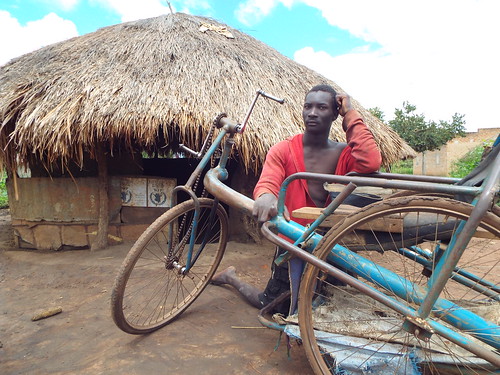
Reality of PWDs in rural Gulu District
-
5 Days, 10 Schools, 1 Needs Assessment
246 CommentsBetween October 16th and October 22nd two members of the GDPU and I visited 12 schools, although we only assessed 10, within various sub-counties of Gulu District. We had three goals with the assessment. 1.) Understand the need to children with disabilities (CWDs) in school in terms of water and sanitation 2.) Gather important data which can be used by GDPU to write proposals and present at conferences on this issue 3.) Determine locations of accessible latrines we plan to build.
I can say we have succeed in all three of our goals and learned an immense amount on the way. GDPU plans to turn this data into a complete report in November, but here’s just a snapshot of our findings.
On water and sanitation:
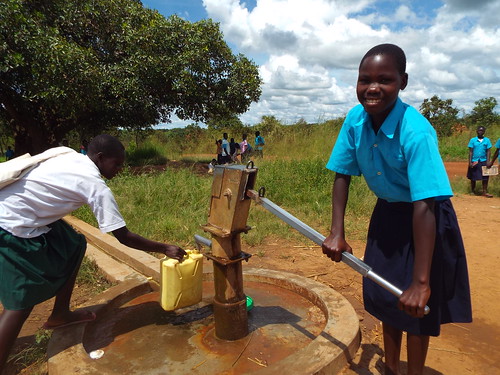
Borehole at Akonyiebedo P.7.
• While some NGOs attempt to build accessible latrines for students they are often taken over by teachers or administration for personal use
• Communities surrounding the school heavily uses latrine and borehole causing extreme wear and tear
• While NGOs often attempt to provide accessible water and sanitation, it is not up to standards required for persons with disabilities (i.e. doors are too narrow, ramps too steep, no sitting provision)
• No school has attempted to modify the borehole to allow it to be accessed by CWDs
• There is a lack of coordination between NGO service providers and disability advocatesAttitudes towards CWDs:
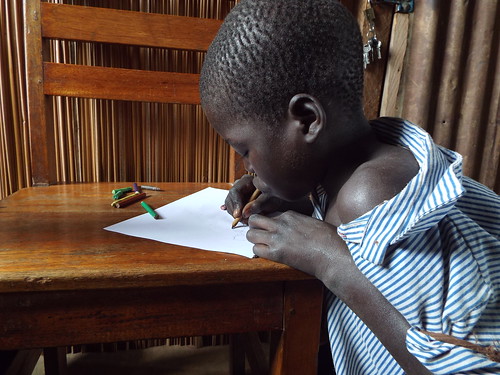
Students drawing challenges at their school
• Bullying of children with disabilities is one of the largest issues facing children with disabilities
• Majority of public schools offer no services to children with disabilities
• Teachers are unsure of how to assess and often do not assess students with disabilities
• Teachers and administration are aware of issues related to children with disabilities, but lack knowledge of solutionsSchool Environment:
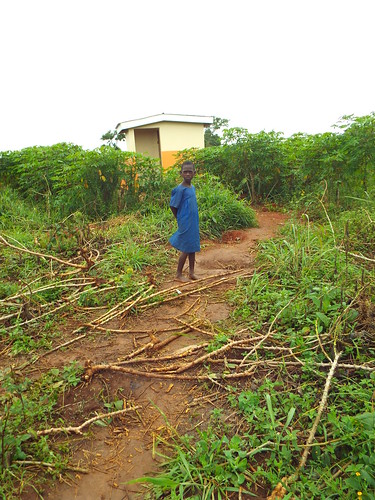
While this school has new toilets, which have made some provisions for CWDs, the path is clearly inaccessible.
• While ramps may be at the school, paths around school are often rough
-
Advocacy Training with Gulu Women with Disability Union
Leave a CommentWith funding from Disability Rights Fun for capacity building Gulu Women with Disability Union, GDPU’s sister organization whom we share a compound with, held an Advocacy and Partnership training. The training was facilitated by UN High Commission on Human Rights (OHCHR).
While the first day of the training covered the material of the average undergrad human rights course, it was hearing the issues and context from the outspoken and fierce Board Members of GOWUDU the stood out significantly. As the facilitators were broad on rights, the Chairman of the Board brought the facilitators back to the grassroots level they work on. For GOWUDU staff and board having human rights is all well and good, but in a culture where formally children born with disabilities were “thrown into water,” getting the community to see the child as a human, and an equal is a difficult task. As the facilitators asked, “why do we have rights?” A board member quite gracefully responded “We are the same. The same process that bore me, bore you [translation].” As the GDPU Chairman, Teddy states, “how do you expect outsiders to treat you if your own parents think you are a curse?”
The second day of the training was extremely practical and thought provoking on how advocacy works. The OHCHR split all participants into groups of three using case studies. We were to take the case study through the process explained on the first day of training. The process started in understanding problems, choosing a problem to advocate for, then coming up with an advocacy plan. My group consisted of both GDPU’s Chairman, GOWODU’s Chairman, and a GOWODU board member. Through working within the group I realized one of the biggest weaknesses is the lack of ability to focus in on one issue. It’s true within the case study, as well as, in their work there are A LOT of problems. However, to make a strong case in advocacy it’s better to stick to one concise problems with well thought out solutions.
Another of the largest take-aways is often the lack of clear planning that happens before advocacy meetings. Before going in we should know exactly what change we want, a clear change. It’s not awareness raising or dialogue, that’s not advocacy.
Gulu Women with Disability Union
-
Things for Uganda
Leave a CommentWhen I was preparing for my fellowship I wasn’t 100% sure what to expect. I had never lived outside of Virginia before, let alone on a different continent. For future fellows and world travelers, I compiled a list of things I am incredibly glad I brought along with me and things I wish I had considered.
Top 10 things I’m glad I brought to Uganda:
 Chacos: I love my Chacos. They have been on countless adventures with me for over 8 years. For the long walk to work they are super comfy and supportive. Plus they produce really sexy tan lines.
- Canon T3i: I’ve taken so many photos! It’s a fun way to share my experiences and document the organizations work and the T3i takes quality shots.
- Pepto-Bismol: I’ve eaten some questionable food here so I’m thankful for my pink friend to clear up poor decision-making.
 Motorcycle helmet: Riding boda-boda’s can be terrifying; I don’t know how there aren’t more wrecks here. I value my mental capacity and therefore my helmet. Plus my helmet has Bluetooth so I can rock out on the morning commute and little kids look hilarious wearing it.
- Rain gear: It rains a lot here, even during the dry season. There were 3 weeks in August and early September that it rained everyday. My Arcteryx Beta rain shell and pack cover have sure come in handy.
- External hard drive filled with movies and TV shows: Nice way to relax in the evening after work. Plus all these photos and video take up a lot of space.
 Kayaking gear: The Nile has world-class whitewater and since it is only 2 hours away, it’s the perfect weekend escape from the craziness of Kampala. The river is my happy place.
- Nalgene and Camelback Water Bottles: We are about protecting the environment by reducing plastic waste here at KIWOI so I’m happy for my indestructible water bottles.
- Steri-Pen: I don’t want to have to buy water or boil constantly so glad I’m brought my Steri-Pen to produce some high quality h2o.
- iPod: Even the most frustrating situations can be at least partially remedied by a good playlist.
3 things I wish I brought to Uganda:
- My banjo: I miss playing music and it would have been a good way to spend the down time plus one of my roommates plays guitar and fiddle so could have had a jam partner.
- Camping Gear: There aren’t many reasonable day hikes nearby so a tent and sleeping pad would have been nice. Squeezing into a 2 person tent with 3 people and 1 sleeping pad just doesn’t do the trick.
- A warmer jacket: Even though Kampala is only 30 minutes from the equator, it can get surprisingly chilly here.
-
“I was safe when I was there”: Evaluations of accessible toilet
Leave a CommentOne of my key objectives during the course of my six month fellowship with the Advocacy Project and Gulu Disabled Persons Union is to interview persons with disabilities (PWDs) on the bus park toilet as part of the monitoring and evaluation process. For new readers to this blog the bus park toilet was project undertaken by GDPU and AP to provide an accessible toilet at a central location within Gulu Municipality. The interview was formulated to ask PWDs questions such as the use of facility, impact toilet had on PWDs life, and feedback on design among many.
To complete the survey we’ve been using what’s known as snowball sampling, which essentially means that we are using both GDPU contacts and the contacts of those we’ve interviewed to identify PWDs who could complete the new survey. Many of the interviewees we’ve been able to interview at their place of work, for example a large number of PWDs mend shoes under umbrellas near the bus park. I need to thank Stephen, GDPU Program Assistant, for venturing into town with me on this mission and translating for me. While I have not yet completed the official report on the survey we have interviewed about fifteen PWDs and I would like to share a small sample of results.
– More than 80% of the interviewees were aware of accessible bus park toilet
– Majority heard from GDPU chairman about toilet
– Although hand washing facilities, soap was not there (soap should be provided by vendor)
How did accessible toilet impact your life:
– “I was safe when I was there”
– “It reduces distance we were moving”
– “Makes our life easier. We will not contract disease”
What challenges do you face using public toilets?
– “Water is flooding everywhere. People leave their droppings anyhow”
– “If you don’t have glove it could lead to infection [for PWDs who crawl]”
– “There’s nowhere [to go to the toilet], if I want to go to latrine I will go to GDPU because at least it is designed for people with disabilities. Other toilets the challenge is crawling because some are very dirty and I can get some very bad things. The toilets which is mixed is always dirty.”
– “At market is should be accessible because there are latrines for ables should also have for all disabilities.”
Constructive feedback on design:
– Floors should be rougher. With tile floors if they get wet those using crutches can slip.
– Crossbars (railings) should be painted red
Personally, some of the results of the survey are surprising, hearing that people just leave their “droppings” on the floor. The majority of the people we interviewed were using a tri-cycle device, which were made to handle the Ugandan terrain and the long distances people move; however, the problem becomes fitting this large device in any room, let alone a toilet. Cleanliness and a sitting provision then become clear priorities for development in this area.
Through the interviews we found there was in fact a strong need for an accessible toilet. It’s a right PWDs have under the 2006 Convention on the Rights of Persons with Disabilities, so that they may have the highest attainable standard of health.
I want to thank all those who have donated to the accessible water and sanitation program. We are continuing to raise funds to advocate and build accessible latrines in schools within Gulu Distract.
-
Building a long term program
Leave a CommentOver the past two months my primary goal was formulating a three year accessible water, sanitation, and hygiene program. We’ve (a combination effort on the part of GDPU staff and AP staff) completed many drafts, with slightly varying objective, timeframes, and budgets. Our overall goal has remained the same: ending discrimination of persons with disabilities in the provision of water, sanitation, and hygiene services.
In the program’s original conception we had planned to survey key public facilities including health centers, sub-county and division headquarters, and primary schools. Based on this assessment, toilet facilities would then be built. Through our rigorous revision process it was decided to target only schools for both an assessment and site latrines will be built. This decision was made for several reasons:
To give the project proposal as Iain (AP Executive Director) would say “laser-like focus”.
Evidence schools and schoolchildren are a good entry point for changing behaviors and attitudes both of children themselves and of community members.
Poor state of latrine facilities, which can cause water-borne disease such as diarrhea, which would cause students to miss school
Interviews with several children who identified that problem of latrines in schools
Ability to market school latrine program to donors
With that revisions continued. Our plan was to survey 25 schools, a quite large assessment which would give us quality baseline data, research which we could present to Net Law Man at regional conference, and strong data to advocate for change with the local government. In 2015, we would then build a large number of latrines with educational programs and begin to challenge institutional norms and strengthen the legal requirements. However, several weeks ago the project suffered a setback common in many programs. A donor pulled out a large donation. It was extremely frustrating for both GDPU and Advocacy Project. Due to the unforeseen circumstances, we once again continued with our drafts of the program.
With a reshuffling we now have a detailed program for 2014 and will focus on writing project proposals for phase two by the end of the year. In 2014, our primary objectives are establishing need, completing repairs on bus park toilet to improve flow of water, and establishing a successful pilot toilet and educational program at one school.
To repair the bus park toilet we will continue to build a cooperative relationship with Pece Division (the area of Gulu which the bus park is in) and the District Engineer, which we have already begun. We will then sign a memorandum of understanding (MOU) with the Pece Division which will specify responsibilities. With this document repairs of the toilet will begin. Simultaneously, GDPU will begin to identify a pilot schools. The original needs assessment will be condensed to a smaller sample size. However, at each school we will gain a large amount of data through physical observation, interviews with the head teacher, senior women teacher, and special education teacher (if there is one), as well as a focus groups with students themselves. A MOU will then also be signed with school administration. The agreement will also specify the importance of a sensitization program with administration and students so that all understand the importance.
Based on a successful program and lessons learned we can then write a large proposal or work smaller donations one school at a time. In 2015 and 2016 the objectives will also shift with a primary emphasis on ending discrimination through challenging government attitudes and institutional norms as well as scaling up the number of schools with accessible water and sanitation.
To donate to this program and contribute to our mission of ending discrimination click here. Please write GDPU in the comment section.
-
Jennifer’s Story: Inaccessibility of schools in Gulu District
3 Comments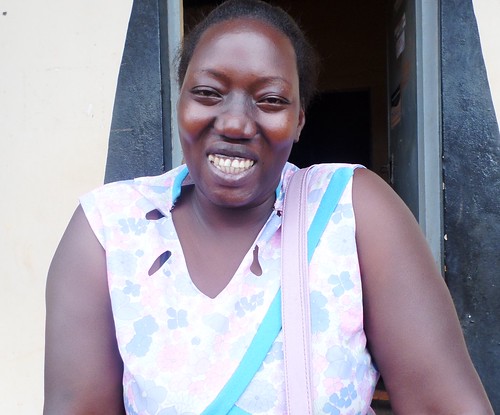
“For the success of persons with disabilities at least every school should be having ramps and an accessible toilet”
– Adokorach Jennifer
Jennifer’s story of her time in school is not unique. It is a story she shares with the majority of persons with disabilities (PWDs) in Northern Uganda. When Jennifer finished primary seven she was admitted to Sacred Heart Secondary School, an all-girls public school within Gulu. She was admitted, however, without the schools knowledge of her physical disability. At the time Jennifer was using a wheelchair. To access buildings and classrooms, students had to help lift her wheelchair. Using the same pit latrine as other students posed additional difficulties to access, as she would have get down from her wheelchair to use the latrine used by her classmates. According to Jennifer, “some people don’t know how to use the toilet properly and there is waste on the ground. It is terrible.” These daily routines proved challenging, but she didn’t see any alternative and was committed to her education.
Administration at the school saw Jennifer as a burden. At the end of the term they wrote a letter to Jennifer’s guardian, her sister, asking that Jennifer not return to the school because it was not accessible.
Jennifer’s sister instead decided to seek out human rights organizations and the Gulu Disabled Persons’ Union. With the pressure of these organization the school reluctantly made small modifications such as ramps to the classrooms and an accessible toilet. However, after the completion of these project, the negative attitudes of the school administration and students towards her made going to school almost unbearable. Now no one would assist Jennifer in moving around the school and teasing increased.
The majority of PWD’s drop-out of school. According to Jennifer, issues of accessibility, cost, low self-esteem, and teasing are the major reasons. Jennifer, however, persevered and graduated from Uganda’s top university, Makerere University, last year. Jennifer is now a small business owner and board member of Gulu Women with Disabilities Union.
Author’s note:
I learned about Jennifer’s story through discussions with Simon, GDPU chairman, and Patrick, Project Coordinator, as we discussed our long-term water, sanitation, and hygiene (WASH) plan. On Thursday, I was able to interview her while she attended a meeting at GDPU. While originally our WASH plan focused widely on public buildings, GDPU and Advocacy Project have decided to narrow our future projects on providing accessible WASH facilities and services on schools in the district. It is stories like Jennifer that solidify this decision.
Donate here to help end the discrimination of children with disabilities in the provision of water, sanitation, and hygiene services in schools in the Gulu District. Simply write GDPU in the comment space.
-
“Do Not Keep Quiet”: Demanding water and sanitation rights
2 CommentsWhat is the difference between sanitation and hygiene? What does your home need in order to be hygienic? What is missing in your community? These were just some of the questions asked during a water, sanitation, and hygiene (WASH) sensitization workshop held at GDPU on Friday.
Around thirty persons with disabilities (PWDs) of every age from the Laroo Division (one of the four areas in downtown Gulu) came to the engaging workshop facilitated by the Laroo Division Inspector of Health. The workshop was funded by AMREF, who provided a small transport refund for participants. As the workshop was conducted in the local Luo language, GDPU program assistant Stephen quietly translated to me.
The discussion was lively and respectful with facilitators making clear that everyone here was adults, but that their main goal was that PWDs “do not keep quiet.” If there was a latrine being built, PWDs should make sure that it was accessible, that by speaking up they would better be able to engage with community projects and push forward their needs.
So, what is the difference between hygiene and sanitation? Participant answers ranged from “hygiene is good health”, “hygiene means having a good latrine”, “hygiene is keeping your body healthy”, “hygiene is having rubbish bins.” The facilitator then explained that hygiene refers to the practices you do to keep your body health, while sanitation refers to the environment. The next question, what does your home need in order to be hygienic? Participant answers were typical with answers like “latrine”, “good water point”, and “rubbish bins” with the facilitator adding a clean kitchen and bathing area. The most interesting answers came when the Inspector asked “what was missing in the community?” Many community members answered that there community was missing proper latrines and no rubbish pit. The most surprising would be that people often climb inside the water points and stand while getting water. The largest conversation came when it was mentioned that people often sleep in the same room as their animals, which the inspector warned against. An elderly lady then tells the facilitator that what else is she supposed to do, someone will steal her goats at night if she does not put them in her house.
While talking to the facilitator after the event it was clear they were attempting in many ways to follow the Community-Led Total Sanitation philosophy which attempts to initiate change by making participants adverse, or even disgusted, with their own unsanitary behaviors. CLTS, however, is often more graphic in nature showing participants clearly that, where they do their business affects what they eat or drink. The facilitator made it clear there’s no real budget here for constructing accessible facilities, but what we can beneficially do is promote behaviors and teach PWDs to speak up on projects happening within their communities.
This program, although small in scale, helped encourage and spark conversation within GDPU on our own program, to provide accessible toilets, and with working with the government to mainstream disability in WASH programming. This program also shows that the local government is aware of the struggles PWDs face in accessing clean water and sanitation. My questions is now that they are asking PWDs to demand their WASH rights, are they ready to provide? Can we (GDPU and members of the community) make institutional change a reality?
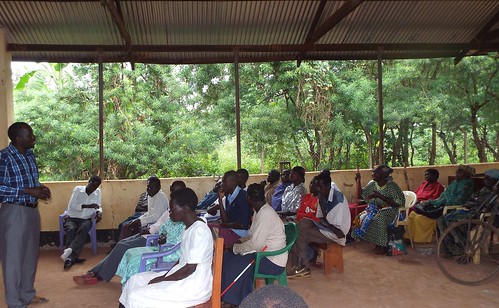
-
Francis Ojara’s Vision
2 Comments
Francis Ojara, 26 years old, has been repairing shoes next to the GDPU gate for five years. His smile and positive outlook are infectious. He started his business with just a sewing needle and thread sitting under a tree. His business progressed and he has slowly able to buy rubber soles and other products before acquiring construction materials to build a temporary structure. Francis has big dreams of returning to school and continuing among the other students before taking the skills he learned to the village to teach other PWDs technical skills “so that they too can become somebody.”
As I asked Francis about his years in school, his life like almost all in Gulu, recounts the struggles of the LRA occupation with the added challenges of having a physical disability. During the occupation both of Francis’ parents were killed while attempting to go back to their garden in the village. In senior school Francis attended a boarding school for those who had been displaced. The administrators at the school told him not to attend as they did not have the services for PWDs, but instead of being discouraged Francis got in touch with the GDPU chairman at the time. Francis and the Chairman then, rightfully, convinced the school he could learn the same as his other classmates. Francis notes that this was before rights of PWDs were recognized. Instead, at this time most people believed that having a disability was a curse from god.
Although Uganda has progressed, Francis still believes the community needs greater awareness of services required by PWDs. Churches he explained, while supposed to be a place of acceptance, are extremely inaccessible to PWDs. He has moved church to church and not one has had an accessible toilet. In the community there are so many types of people he explained and all disability is different, some not even visible.
When I explained to Francis that my goal in Gulu was to work on models of accessible toilets, he agreed it was a worthwhile mission in that it would open the eyes of many people without disabilities to the types of serviced needed by PWDs. He also explained if someone used the accessible bus park toilet, if they for example had a brother or sister with a disability, that they could build a toilet similarly and increase accessibility for a family member. For Francis he tells me he uses the facilities at GDPU which are accessible with a wide opening and a sitting provision, but using other toilets is “extremely terrible.”
Please support Gulu Disabled Persons’ Union and the Advocacy Project Give a Shit campaign so that we can come one step closer to mainstreaming disability and providing accessible sanitation in Gulu District. Please “like” Gulu Disabled Persons’ Union of Facebook or follow @GiveaShit2014 on Twitter.
-
The Environmental Impact of Polyethylene Bags
328 CommentsSingle-use plastic bags pose a global threat to the environment with over 1 trillion plastic bags used and disposed of each year. In the United States, over 500 million plastic straws are used each year; the number across the world is beyond count. Plastic overwhelms landfills, clogs gutters and poses a risk to animals when improperly disposed.
Plastic usage and disposal is especially a challenge in developing countries where garbage collection and recycling services are often not available or inadequate. While Uganda does have trash collection, it is still often disposed of in the streets or burned releasing toxins into the atmosphere. Unfortunately recycling is not a common value and the need to protect the environment is not a priority. In the month I’ve been in Uganda, I’ve come across few public trashcans and no recycling bins.
In the Kinawataka slum and elsewhere in the country, plastic covers the roads and clog drains causing flooding. Life is much more communal here with goats, chickens and ducks roaming the area freely. Livestock are a major commodity and provide sustenance and income for the community. Animals commonly become ill or are killed from ingesting plastic and other trash.
The Kinawataka Women Initiatives (KIWOI) attempts to address this environmental problem by recycling used drinking straws into reusable bags. In addition to offering eco-friendly alternatives to polyethylene bags, KIWOI provides training to groups across the country to educate Ugandans on the need to recycle.
While these trainings have a positive effect in local communities, change is needed across the country. In order to have a major impact across the country, the Ugandan government must take ownership and establish a nationwide recycling initiative where the reusable bags are incentivized and recycling is taught as a common value.
-
Silver Linings: Learning about HIV and disability
1 CommentAt the GDPU’s office the power comes and goes. Sometimes it’s just our line or it’s the entire town. I have now become more surprised when the power is on when I get to the office, than when it’s off. On Wednesday, it was typical no-power day. This time it was all of Gulu, meaning it would take longer than usual to get the power back on. By 10am my laptop had died and I was trying to sort out what I could do without my computer. When Okema Moses, a Project Officer at GDPU, told me he was heading to the TASO office for a meeting I jumped at the opportunity. Last year when I was in Uganda I had been impressed by the work of TASO in reducing the prevalence of HIV in Uganda. The prospect of visiting their office and learning from the many partner organizations was one I wasn’t going to pass up.
The meeting as I found out was called among HIV/AIDS organizations in Gulu to share experiences and challenges. Moses, of GDPU, was the first to speak. Although GDPU does not currently have an operating HIV program, the organization sometimes works as a linkage between the disability community and local HIV organizations. Moses spoke of the challenges in getting information and services to persons with disability (PWDs). Most often HIV organizations only go to the central part of town, which is often difficult for those who have a challenge with mobility, and never have a sign language interpreter with them. He then discussed the discrimination persons with disabilities face as a result. Many of those in the community often believe that PWDs are the safest in community, in regard to the transmission of HIV. They often forget that PWDs have the same desires as any other community member, yet are easily overlooked in this regard. There are also factors that put PWDs at a higher risk of infection such as low self-esteem, higher instances of sexual abuse, and rumors that having sex with someone with a disability will cure HIV or AIDS.
At the end of his short presentation, Moses urged other organizations to join with GDPU and work together to reach those PWDs who have been long ignored. In the world of competition between NGOs for grants and resources it unfortunately breeds lack of cooperation between organizations. To implement change, however, partnerships between NGOs is necessary; as the current competition between groups only harms those which are meant to be served and represented.
-
“We’re in it now”: Discovering Ugandan politics
3 CommentsThe fact finding mission of the bus park toilet, GDPU’s project from the last two years, has now been ongoing for over two weeks, including several visits to the toilet with GDPU staff and contractor. Through discussions with the contractor and the vendor for the project, it was found that the major problem with the toilet is the water connection. Since there have been difficulties connecting the facilities to a water source, the vendor has been resorting to pouring large jugs of water into the top cistern. As a result, the cistern subsequently collapsed from the weight, either from the water itself, or the jugs being leaned against it in during the pouring.
At this point the contractor had three suggestions for repairing the facility. The first option was tapping the main line underground. The second option would be if we could tap a line from another water tank nearby. The last and most costly would be installing a water tank directly next to the accessible toilet. With these options presented, Coordinator Ojok Simon, the contractor, and I sat down to make a strategic plan for discussions with local government. We made a plan to first discuss the technical aspects of the water connection with the District Engineer first then move to the division office where we would discuss the upkeep, as the division is responsible for hiring the vendor who is responsible for the cleaning.
The meeting with the District Engineer went fairly smoothly. He reassured us that the process for securing water to the toilet was fairly simple. Although, unfortunately, the engineer did tell us that, most likely the GDPU would need to provide a new tank next to the accessible toilet as the tank in place for the other toilets is much too small. He then told us he wouldn’t hesitate to grant permission for us to install the new tank if we went to the division and had all the formal arrangements sorted.
Following our meeting with the District Engineer, we quickly left for the division office. After we entered the office of the official, Simon introduced us and our objectives for the meeting. Things quickly escalated when the official told Simon that whoever was in charge of the project previously, whether that was Handicap International or GDPU, did not come and see him before the project had begun. He then blamed the drainage problems of the entire bus park on the accessible toilet.
The official then addressed me for the first time in the meeting by saying the drainage issue must be fixed and “the cost may be high.” In that moment I knew he saw me as the dollar sign in the room. As the meeting settled down we came to an agreement to work together and that this was the new starting point, the division will now recognize this structure. He urged GDPU to write a formal letter to the division and we will continue from there.
I left the meeting in a slight daze, it certainly wasn’t the casual dialogue meeting I was expecting. As I walked out I whispered “we’re in it now” to the student intern who had joined us. Within this project we had started our descent into the foggy realm of Ugandan politics. In our sit down after the meeting Ojok Patrick, the head Coordinator rebuffed the claims that one toilet could possibly cause drainage problems in an entire area. The problem, he countered, was in the vendors who the district hires in clearing away the sand and debris to allow the water to pass freely.
I don’t know exactly what happened two years ago in the conception of the project, but it makes it clear the need for a memorandum of understanding before any project is to begin. Sustainability is necessary in any project, which means creating formal understandings with the local government before any project begins. Sustainability also means maneuvering when necessary and finding compromises. Politics is a game in itself with a steep learning curve, a game that is not limited to Uganda but also in America. I can’t even pretend to know my way around Ugandan politics, but I’m sure with the GDPU I will begin to learn. As a small organization championing rights for persons with disabilities, they have surely navigated through Ugandan politics many times.
-
Being a Muzungu
2 CommentsWhen walking home or to work here in Uganda, I’m often followed by many kids like little shadows trailing my path. Sometimes they follow silently just a few paces off my own, growing in number as I walk. However, most of the time they are loud and lively yelling “MUZUNGU! MUZUNGU! HOW ARE YOOOOUUUUUUU!?!” This is a phrase that is shouted at me on a daily basis here in Uganda.
Muzungu is the word used for any non-African person and the children here love to remind me that I am in fact one constantly. While there are quite a few muzungus in Uganda, there are not many in the area where I work in Kinawataka slum, and no other female ones that I’ve seen.
The children’s jaws drop in awe of the pale blond beast.
I seem to have developed a following of Ugandan kids who know where I work and run past on their lunch breaks and when they get out of school to yell at me until I respond. A few particularly impatient ones even threw rocks at the building to get my attention.
 The conversation usually goes like this:
“Hey muzungu! MUZUNGU! MUZUNNGGUUU!!!” – Children
“Hello” – Me
“Hahahahaha! Muzungu how are you?” – Children
“I am good. How are you?” – Me
In unison: “I am fine!” – ChildrenThis conversation repeats itself multiple times a day. Most of the time (if I am lucky) they run away laughing. Other times they stand outside the door peering in at the newest attraction. This can last over an hour.
Several of the people in the Kinawataka slum are newcomers to Kampala and have spent much of their lives in the villages without ever seeing a muzungu before so I don’t usually mind too much. After all, kids are supposed to be curious and it can be kind of adorable. A few have rubbed my skin to see if it is like their own and are puzzled by the wavy mess of hair.
I do sort of miss the anonymity of blending in. I get away with nothing. People I have never met approach me and tell me they know where I work or where I live. As a de facto representative of the muzungu clan, it is good motivation to always make a positive impression.
-
Accessible Toilets for All
6 CommentsOpiyo Samuel, an 11 year old boy from the Parbon Quarter of the Gulu District, is a success of Gulu Disabled Persons’ Union (GDPU). Two years ago through GDPU’s parent group Samuel was given his first wheelchair. With continual support of GDPU and physical therapy, he was able to transition from a wheelchair to crutches, also provided by the union. This transition enabled Samuel to get to school on his own and stop much of the bully he had received, as other students would often push him out of his wheelchair.
Last week Coordinator Ojok Simon and I went to interview him, with Simon serving as the translator and myself quickly scratching down notes. During the interview I was particularly interested when Samuel’s mother, Akello Rita, shared Samuel’s experience with the toilet both at school and in the community. When Samuel was using the wheelchair he would be forced to get out and crawl on his hands and knees to the toilet. An act which his mother feared put him at risk for disease. In fact 1.5 million people die annually from diarrhea, the second leading cause of deaths for children under five (UNICEF, 2009). If sanitation was addressed, this number would be a third less.
Now on crutches he is able to make it to the toilet on a rough path and inside the narrow entrance. However, Samuel said that he still has problems balancing without hand rails and a sitting provision, making it clear that it’s important to expand thinking on why accessibility is important. Facilities without a ramp, handrails, and wide entrances don’t just exclude those using a wheelchair, but many members of a community. This discrimination, while mostly unintentionally, is done not just through the physical infrastructure, but also the institutional culture. Accessibility and disability is often not part of the conversation. In GDPU mission to end discrimination in the provision of water and sanitation, it can’t possibly change all the physical infrastructure, therefore the key is to focus on areas where a change in the institutional culture can be made.
Opiyo Samuel
-
Kinawataka Sharing the Power of Empowered Women
3 Comments My first week at Kinawataka Women Initiatives (KIWOI) proved to be a big moment for the organization. Last week KIWOI’s the Executive Director, Benedicta Nanyonga, traveled to Geneva to present at the Power of Empowered Women Conference. The Group of Women Ambassadors in Geneva and the International Trade Centre hosted the conference, which was attended by an estimated 600 officials from the UN, NGOs and several multilateral organizations.
This was a significant experience for the organization and Benedicta who has never spoken at such a large-scale event. She participated in an interactive panel discussion focused on women’s empowerment and economic development, which included speakers from Afghanistan, Haiti and India. Benedicta delivered a speech on how the Kinawataka Women Initiatives turns “trash into cash” to support local women and promote recycling.
The days leading up to the conference were hectic. Benedicta and the women of KIWOI were diligently pressing, weaving, trimming and stitching the 100 clutch purses for UN ambassadors and small shopping bags for co-sponsors of the conference, which delighted conference participants.
The event provided significant exposure to the essential work of KIWOI. Benedicta told me, “The conference was a major opportunity for the Kinawataka Women Initiatives to share how our organization creates jobs, empowers vulnerable women and conserves the environment in the slum areas in Uganda.”
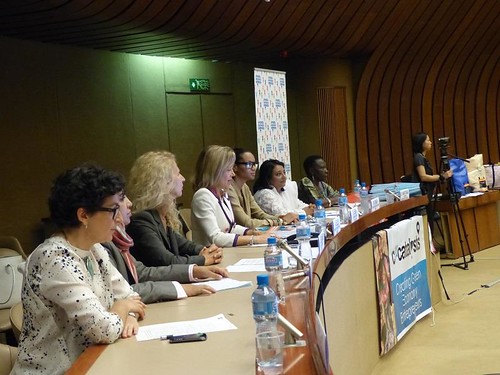
She argued that while the UN has done a good job of providing aid to those affected by poverty and conflict, they must focus on training so that women can lift themselves up to provide for their families. Benedicta shared a quoted a proverb on the significance of empowering women stating, “If you give me a good woman and I’ll give you a good world.”
UN High Commissioner for Human Rights, Navy Pillay, delivered the closing remarks for the conference asserting, “We need strong female role models to convince girls they’re as good as boys.” Benedicta and KIWOI certainly do this on a daily basis by working with women and girls to provide not only income, but also a sense of importance and accomplishment.
[content-builder]{“id”:1,”version”:”1.0.4″,”nextId”:3,”block”:”root”,”layout”:”12″,”childs”:[{“id”:”2″,”block”:”rte”,”content”:” <\/a>My first week at Kinawataka Women Initiatives (KIWOI) proved to be a big moment for the organization. Last week KIWOI\u2019s the Executive Director, Benedicta Nanyonga, traveled to Geneva to present at the Power of Empowered Women Conference<\/a>. The Group of Women Ambassadors in Geneva and the International Trade Centre hosted the conference, which was attended by an estimated 600 officials from the UN, NGOs and several multilateral organizations.\n\nThis was a significant experience for the organization and Benedicta who has never spoken at such a large-scale event. She participated in an interactive panel discussion focused on women\u2019s empowerment and economic development, which included speakers from Afghanistan, Haiti and India. Benedicta delivered a speech on how the Kinawataka Women Initiatives turns \u201ctrash into cash\u201d to support local women and promote recycling.\n\nThe days leading up to the conference were hectic. Benedicta and the women of KIWOI were diligently pressing, weaving, trimming and stitching the 100 clutch purses for UN ambassadors and small shopping bags for co-sponsors of the conference, which delighted conference participants.\n\nThe event provided significant exposure to the essential work of KIWOI. Benedicta told me, \u201cThe conference was a major opportunity for the Kinawataka Women Initiatives to share how our organization creates jobs, empowers vulnerable women and conserves the environment in the slum areas in Uganda.\u201d\n\n
 <\/a>\n\nShe argued that while the UN has done a good job of providing aid to those affected by poverty and conflict, they must focus on training so that women can lift themselves up to provide for their families. Benedicta shared a quoted a proverb on the significance of empowering women stating, \u201cIf you give me a good woman and I\u2019ll give you a good world.\u201d\n\nUN High Commissioner for Human Rights, Navy Pillay, delivered the closing remarks for the conference asserting, \u201cWe need strong female role models to convince girls they\u2019re as good as boys.\u201d Benedicta and KIWOI certainly do this on a daily basis by working with women and girls to provide not only income, but also a sense of importance and accomplishment.\n\n
 <\/a><\/span>\n”,”class”:””}]}[/content-builder]
-
Preparing for take off
3 CommentsOne week to go before I head oversees to Uganda. I have traveled to East Africa for work before, but this will be the longest I’ve stayed in another country. I will be leaving for the capital of Kampala to work as a Peace Fellow with the Kinawataka Women Initiatives (KiWOI). While I’ve worked with women from marginalized communities before, it has mostly been from the comfort of my desk in Washington, DC. This time it will be on their turf in the Kinawataka slums in the capital city.
KiWOI collects drinking straws and recycles them to create crafts such as bags, baskets and mats. The eco-friendly work empowers local women from Uganda by helping them gain new skills and income. In addition to my clothing, bug spray and boots, I will be transporting a straw-pressing machine. Pressing straws by hand is a difficult process. Women use knives to press the straws flat, however this is time consuming and very labor intensive. The new straw-pressing machine will save the women enormous amounts of time. The machine flattens around 15 straws in 25 seconds, which will enable KiWOI to increase their production of bags, mats and other crafts from the straws. I can’t wait to deliver this machine and myself to Kampala.
The past few days I have been going through training with the Advocacy Project to prepare the 2014 peace fellows for the field. It has been a great experience meeting the other 11 fellows and hearing about their backgrounds and interests. We are being trained in videography, photography, IT, NGO management, communications and media and fundraising. Once in our host countries, we will use these skills to train our partner organizations on two of the modules they think will be most beneficial for their work. I am looking forward to using these skills to help support the work of KiWOI in Uganda!
[content-builder]{“id”:1,”version”:”1.0.4″,”nextId”:3,”block”:”root”,”layout”:”12″,”childs”:[{“id”:”2″,”block”:”rte”,”content”:”One week to go before I head oversees to Uganda. I have traveled to East Africa for work before, but this will be the longest I\u2019ve stayed in another country. I will be leaving for the capital of Kampala to work as a Peace Fellow with the Kinawataka Women Initiatives (KiWOI). While I\u2019ve worked with women from marginalized communities before, it has mostly been from the comfort of my desk in Washington, DC. This time it will be on their turf in the Kinawataka slums in the capital city.<\/span><\/p>
<\/span> [content-builder]{“id”:1,”version”:”1.0.4″,”nextId”:4,”block”:”root”,”layout”:”12″,”childs”:[{“id”:”2″,”block”:”rte”,”content”:””},{“id”:”3″,”block”:”rte”,”content”:”In less than three weeks I\u2019ll be departing from Maine to Northern Uganda. I\u2019ll be working with the <\/span>Gulu Disabled Persons Union (GDPU)<\/a> , a union of several organizations, including the Gulu Blind Association and the Gulu Women with Disabilities, promoting human rights for persons with disabilities. Through the Advocacy Project my fellowship mission will be to support the work done by the fellows before me in building handicap accessible toilets and also to begin lobbying the local government on behalf of disability rights.<\/span><\/p>\n\n
In the interview for this fellowship I was asked, \u201cWhat is your goal for the program?\u201d My personal goal is simple, to support the Gulu Disabled Persons Union (GDPU) in any way possible. For me the most important aspect of development is that fine line between supporting the community, and harmfully overstepping. I certainly don\u2019t have answers, in fact for someone with a Master\u2019s of International Development I rarely feel as though I could ever \u201cmaster\u201d development, but rather I am a person full of questions. Yet, my expectation is to actively contribute. From the discussions I\u2019ve had via email with staff at the GDPU, the areas they are looking for support in primarily surround funding opportunities and nonprofit management. I believe I can prove to be beneficial in these areas.<\/span><\/p>I know many challenges will present themselves as I work to support the GDPU and those they represent. As persons with disabilities are often marginalized within their communities in Northern Uganda, I want to work to challenge the viewpoint towards those with disabilities. I don\u2019t expect to reverse longstanding norms within the community, but instead, chip away and work towards the ultimate goal of the GDPU, \u201cempowering persons with disabilities to lead dignified lives.\u201d<\/span>
<\/span><\/p>\n