Category Archive: Middle East
-
At long last, masgouf – or on refugees and food
5 Comments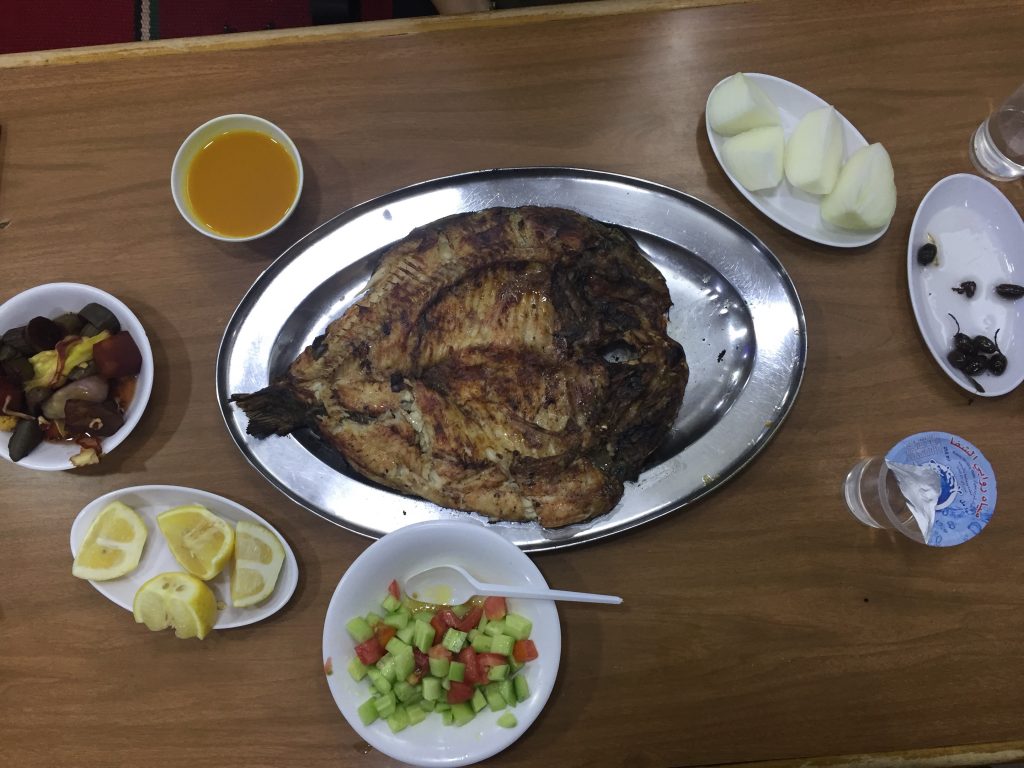
The incredible masgouf at the Al-Mahar Fish Restaurant, in Amman – the crooked photo is proof of my relevant excitement
I am often reluctant in indulging discussions over the “great contributions” immigrant and refugee populations make to their host countries. I do understand their point, after all, part of celebrating diverse societies is to acknowledge why they are better. I also understand that those advocates, the ones that highlight this aspect of the theme, they mean well. This is, however, a dangerous paradigm to further.
Because when we emphasize what a person seeking shelter can “bring” to a said country, we can also be depriving people of their basic humanity – after all, before any contribution, or “good” one might be bringing, are we not all human? People, humans, especially those fleeting, they should be welcomed on the grounds of their humanity, not anything else. This choice of rhetoric then furthers the narratives of good migrant/bad migrant, good refugee/bad refugee, dangerous standards which can work fundamentally against more humane and accessible policies on the issue.
I am also wary of such narrative because, words and slogans, they matter and can be easily co-opted. As Mariame Kaba aptly put here, keeping families together is important, but what does that mean if they are all together, but in prison?
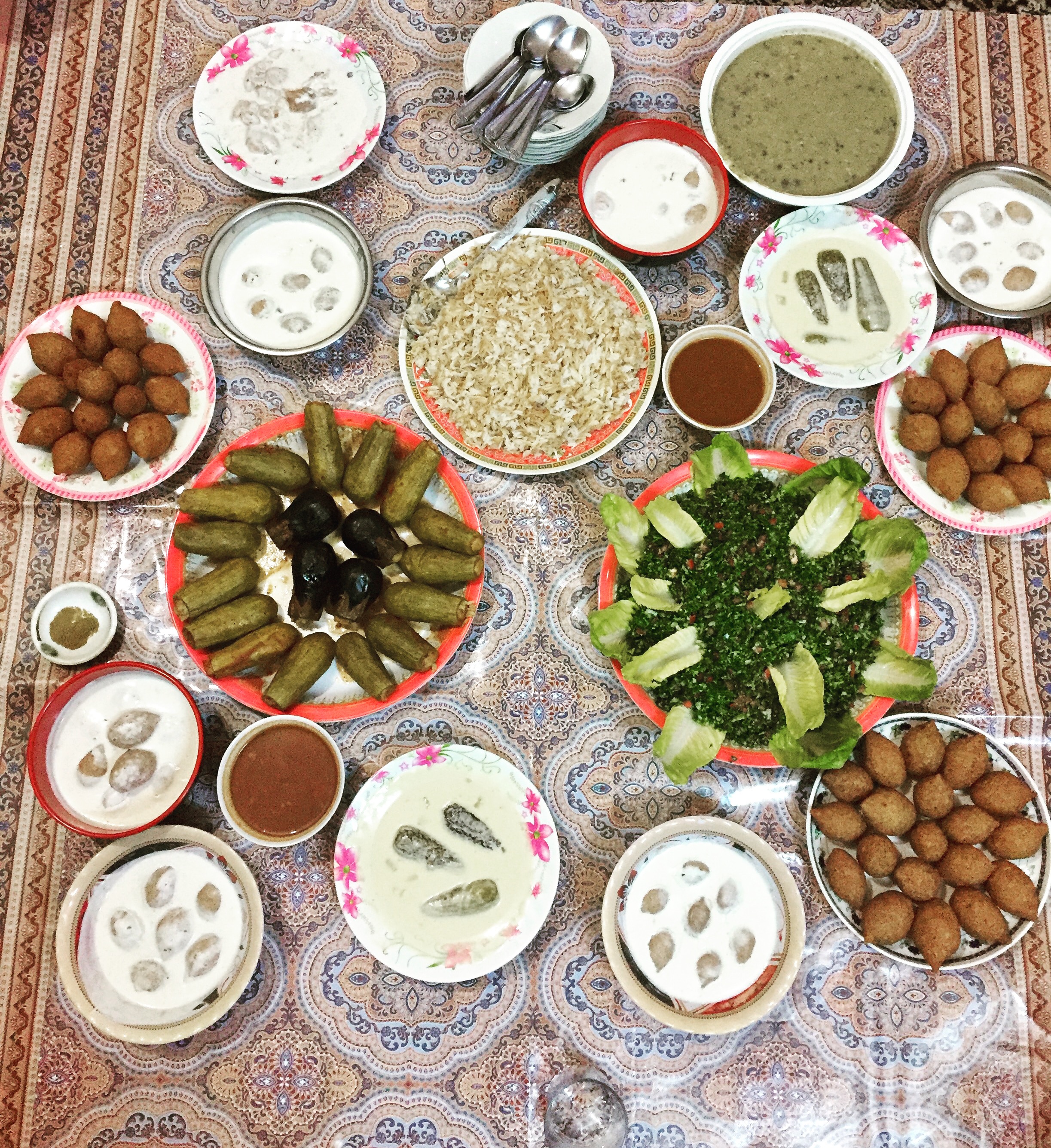
Having said that, I will take this moment to appreciate one of the greatest contributions immigrants and refugees make to any society, which is food. Because I mean, what is not to like about food diversity? Coming from Brazil, and specifically from São Paulo, a city which prides itself about having available a wide array of cuisines, this is not only a basic a value, but really, a necessity of sorts.
I am prompted to talk about this because it has been a little over two years since I fell in love – truly, madly, deeply – with masgouf. It’s the love affair of a lifetime and even though our encounters are fleeting and too far in between, I know I shall treasure them forever.
First time I heard about masgouf was in this piece, by Jon Lee Anderson, reporting from Baghdad on the edge of the 2003 US Invasion. By then, I was a bright-eyed journalism student, and I remember taking note, a reminder for me to look for it, something virtually inaccessible at that point, as the Iraqi community in Brazil is close to non-existent.
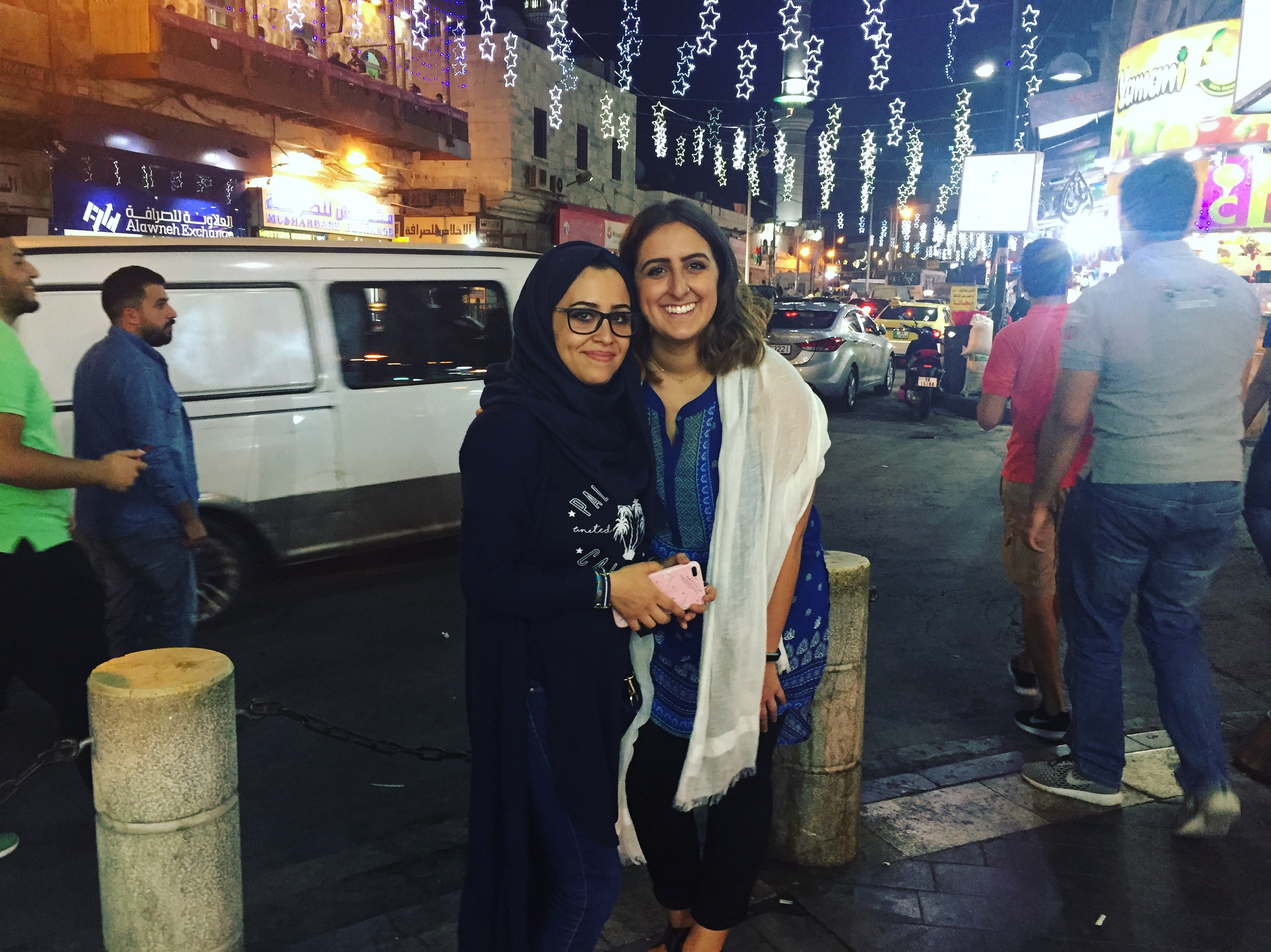
My encounter with the dish would happen only years later, during my first time in Jordan. Me and Dina, then the greatest fixer I have ever worked with and now a friend, had had a particularly long and difficult day in Za’atari. Sweaty and famished, I was guided by her to Al-Mahar Fish restaurant, at the beginning of Wasfi Al-Tal Street, in the north-west part of Amman. Maybe it was the tiredness. Maybe the substantial hunger. But that was one of the best meals I have ever gotten in my life.
But what is masgouf, you ask? Masgouf is a Mediterranean form to prepare carp style river fish and it is considered one of Iraq’s national dishes, a classical way to prepare fish from the Tigris. It is fairly straightforward: you open the fish in half, season it and grill it in wood-fire or coal. The taste is anything but simple.
Something I was looking forward when moving to New York was to find a masgouf joint – I was certain, of all places on Earth, New York would most certainly have it. I am sad to report that until this day, I have not found such a place, despite substantial, to the point of desperate, research. One of my Manhattanite friends, born and bred, hypothesized about the political climate, ever since 2001, not being exactly receptive of Iraqi enterprises in the city. A shame, if you ask me, for the place which claims itself as one of the most accepting of all cities in the world.
So, you see, coming back to Amman, I was more than excited to eat masgouf again. Dina made me promise I would wait for her – and as you can attest from my previous post, she has been busy – so we only got to it last week. It was everything I thought it would be.
This time around, I actually did some research on the story of Al-Mahar. The place opened in 2005, founded and owned by Abu Haytham Mikha, an Iraqi refugee living in Jordan for over a decade now. His whole story is amazing, and you can read more here.
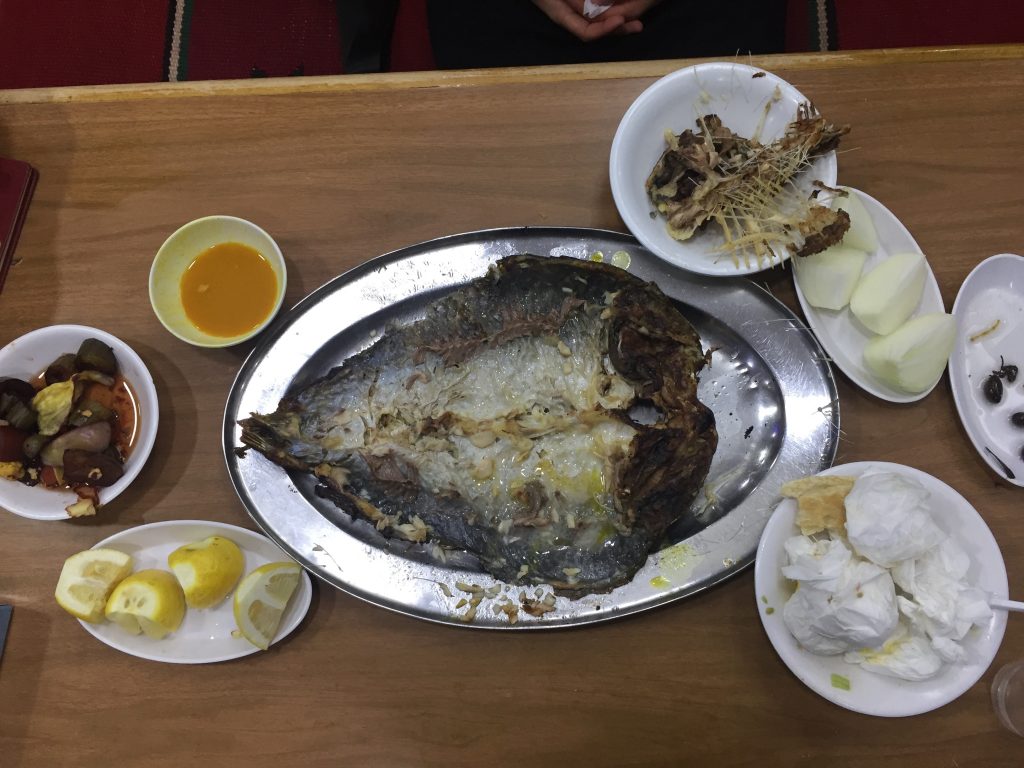
The after – as one can see, we were very committed to finishing it.
After we had finished all of the fish (image above), we took a moment to look around and observe how Iraqi families actually eat it – which often includes eating all the skin. I myself haven’t gotten to that part yet. Something to look forward to next time. Which will probably happen this week. And every week after I am in Amman. Thank you, Iraq. And thank you, Jordan.
-
Ain’t I a Refugee?
4 Comments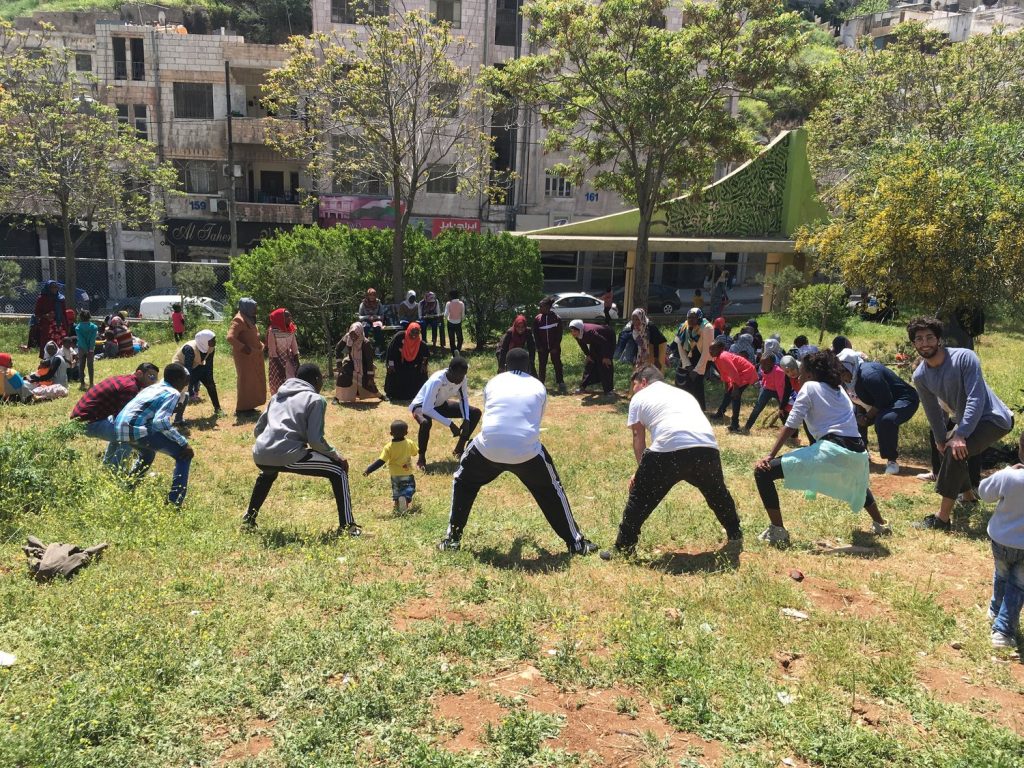
Community building activity organized by Sawyian, in Amman (Photo credit: Sawyian)
Back in November 2015, hundreds of Sudanese refugees living in Jordan organized and set up camp in front of the United Nations High Commissioner for Refugees (UNHCR) office in Amman. They were protesting what they felt were discriminatory practices against the group, from access to services provided by the agency and other international NGOs, to be addressed in resettlement programs. The movement was unprecedented in many ways when talking about self-organization by refugees in recent years in the country.
Tensions were high. Volunteers and supporters of the protesters had to go around police blocks and put themselves at risk, to deliver food, blankets, and clothes in nearby streets, as no one was allowed to approach the sit-in.
Roughly after a month since its beginning, a rumor started to circulate within the camp: the protest had worked and everyone there was going to be resettled in third countries in the coming days. That explains why the majority of the refugees got in, voluntarily, on buses rounded by the police, having the airport as the destination. It was only upon reaching the Queen Alia International that the 800-people assembled were informed they, in fact, were being deported back to Sudan.
“No one really knows how the rumor started, if it was wishful thinking or if people were tricked to believe they were being resettled, but it spread so quickly. I know a case of one family, the wife heard the rumor, packed her bags and took the kids to the camp, calling her husband on her way, while he was at work. They got in the buses and were deported, while the husband was left behind here in Amman since he did not make it in time”, tells me Dina Baslan, journalist, humanitarian worker and co-founder of Sawiyan, a grassroots organization which advocates for the Sudanese and other minority refugees in Amman. I met Dina in 2016, during my brief time reporting from Jordan. Back then, she was volunteering with the Sudanese on a personal basis.
It is worth to note that the deportation of refugees is fundamentally and grossly illegal, as per the customary international law principle of nonrefoulement, which states that no person shall be returned to a place/country where they can face the risk of persecution, torture, inhumane treatment, and punishment. That extends to those who may or may not have, at the time, their request for asylum processed. And, as this Human Rights Watch dispatch reports, the majority of Sudanese which come to Jordan are from war-torn areas of the country, such as Darfur.
The situation of minority refugees – that is, the thousands of other people of concern (POC) who come from countries other than Syria and include Iraqi, Sudanese, Yemeni and others – in Jordan has been documented widely in different reports, most recently in this one, published by the Mennonite Central Committee. The 2017 study found that “Iraqi and Other asylum-seekers constitute a vulnerable community with almost no access to assistance”, since their source of support is limited only to the UNHCR and, even there, it suffers constraints. They also are not addressed by most of the hard-fought and negotiated benefits for Syrian refugees in the Jordan Compact, such as pathways to work permits. As I mentioned briefly in my last post, the Jordan Compact in 2016 directed its efforts (and money pledges) namely only to the Syrian crisis, forsaking the basic understanding that a refugee cannot be discriminated in any grounds, let alone nationality.
This also points out to a broader a discussion to be made, in the donor end of the spectrum, since, as the same report states “most funders earmark contributions for the Syrian Situation Response to the exclusion of the Iraq Situation Response, which also includes [o]ther [refugees]”.
Facing this, out of Dina’s and her colleagues’ effort and commitment, a grassroots organization was born, to support the plight of the Sudanese and other minority refugees in Jordan. Sawiyan – a word in Arabic which means togetherness and laying the groundwork – was officially founded last year and they just got opened their office, in Jabal Weibdeh. The few times I got to hang with Dina these past weeks in Amman, she is always with her telephone at hand, answering various calls and messages, coordinating from support to Sudanese in hospitals, to skate park sessions for kids.
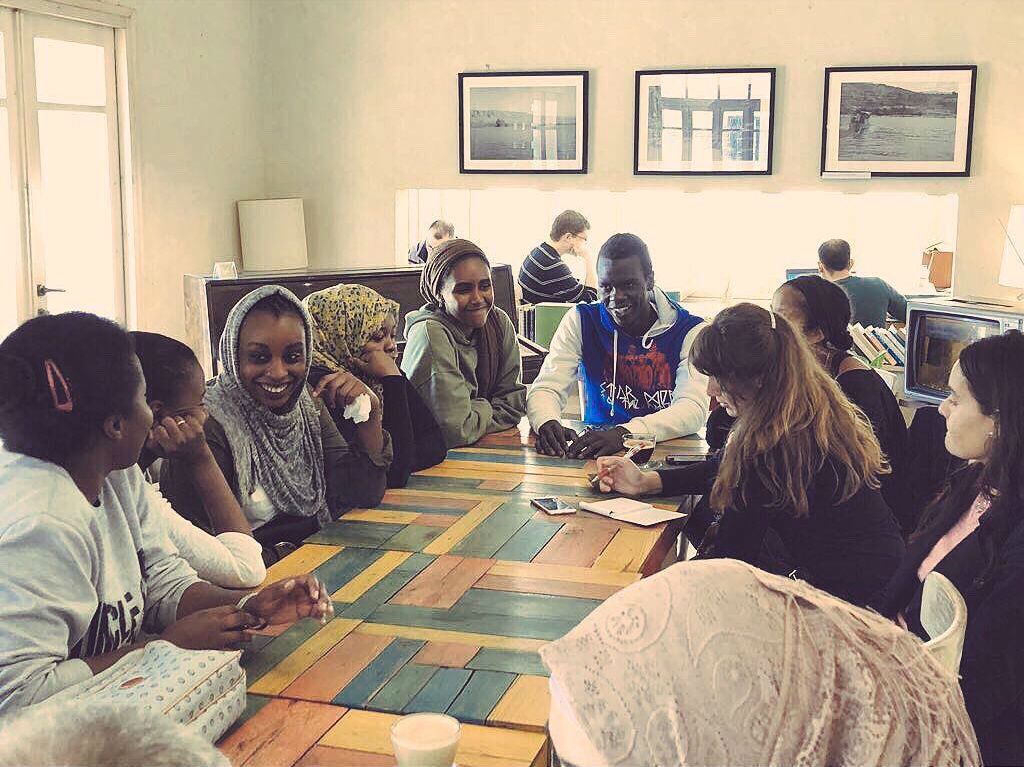
Dina, seen here on the center-right, taking notes, meets with Sawiyan volunteers to coordinate activities and programs. (Photo credit: Sawiyan)
While their main focus is to work as an advocacy hub for the cause, they also offer different resources, including community development programs, educational and recreational activities and often referrals for refugees to bigger organizations, who offer support services.
“Refugees of African origins face a lot of discrimination in Jordan, what makes their situation as refugees even more unbearable, especially for the youth. Their sense of identity is harmed by the rejection of the Jordanian community to them. Sawiyan tries to foster one-on-one interactions through volunteerism between Sudanese and Jordanians hoping it leads to friendships that would challenge stereotypes of ‘the other’”, says Dina. One of their newest programs will start this coming semester and it will bring together Sudanese and Jordanian women in dialogue circles, to address common issues and find solutions together, as one civil society. A great example of a locally based organization seeking grassroots solutions. I am excited to see what Sawiyan does next.
If you want to know more about the work of Dina and Sawiyan, follow their pages on Facebook and Instagram.
And if you would like to support their work, you can donate here.
-
On Hashemi Shamali and urban refugees
4 Comments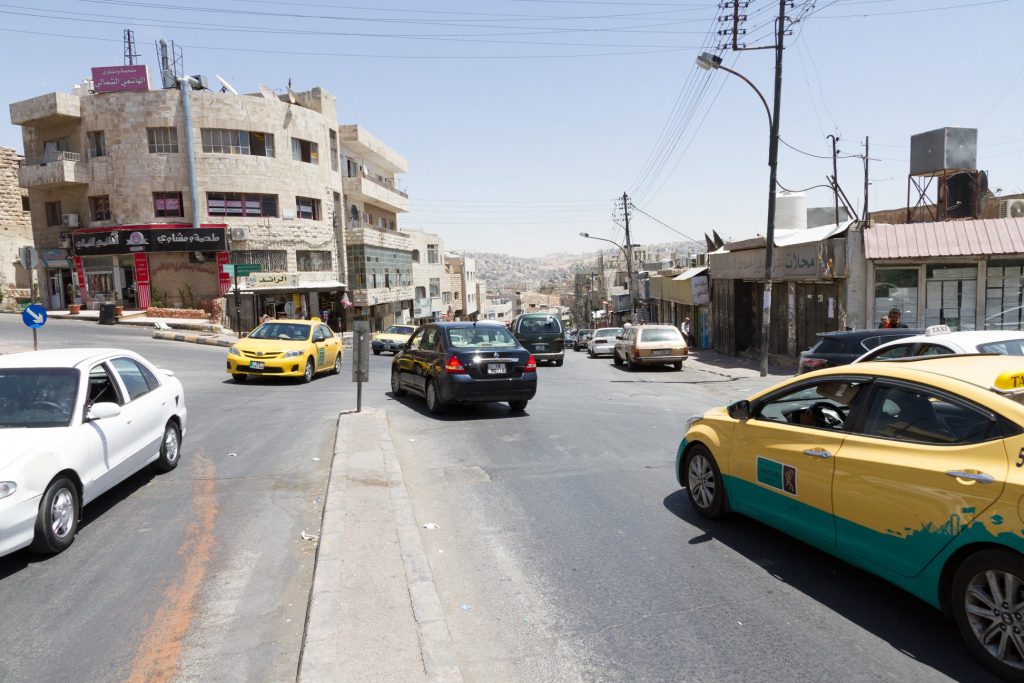
The neighborhood of Hashemi Shamali, in the eastern part of Amman, is the home of thousands of refugees (photo credit: CRP)
The word refugee, more often than not, conjures automatically images of people sitting in makeshift camps, spread through thousands of tents, from Calais to Lesvos to Za’atari. The image of the camp dweller, while accurate for some, definitely does not comprise the entirety of what it means to be a refugee in 2018. Especially here in Jordan, where the majority of refugees – be them Syrian, Iraqi, Yemeni, Sudanese and etc. – live in cities, such as Irbid, Mafraq, and Amman.
The Collateral Repair Project (CRP), for example, is based in Hashemi Shamali, a low-income neighborhood which became the home of thousands of refugees in the past 15 years, given its low cost/high service access dynamic. “There is a similar closer ratio of Iraqis, Syrians, and Jordanians living here. People come to Hashemi because it is cheap and there is a concentration of NGOs that can help. That is something you are looking for when you are a refugee and is looking for a place to live, where can you easily obtain assistance”, tells me Muna*, Youth Center Coordinator at CRP. “The biggest issue faced by refugees is lack of money and they care also for how available services are. Hashemi has a hospital, NGOs, and schools. So, the children here rarely will have to take transportation to go to school”.
Refugees settled in cities (or urban refugees as the official reports refer to them) face particular challenges often overlooked on the mainstream narratives on the issue. Lack of income, as Muna pointed out, is the main one, since the majority of them is not allowed to work in Jordan. While more recently, due to advocacy and lobbying by international and local organizations, Syrians have now pathways to get permits, this is still virtually inaccessible for Iraqis, Yemenis, Sudanese and other minority refugees. “When it comes to Iraqis, they are not permitted to work. Syrians can get permits and that enables them to work. But for Iraqis, their livelihoods are limited to assistance from NGOs and money sent through relatives”, says Muna, herself a refugee from Baghdad, living in Jordan since 2014.
The relevant obstacles to work usually entail great hardship, especially since the relative cost of living in Jordan is high. Housing and money for rent are often cited as one of the biggest problems faced by this population. In a report published by CARE, 82% of the Syrian urban refugees in Jordan surveyed were found to live below the poverty line. The same report attested that minority refugees have an even lower average monthly income than Syrians – 176 JOD ($250) and 169 JOD ($238) respectively. According to moneyexpert.com and their statistics, debt is also a common trait amongst this population. This week, Daniela*, one of the participants of Hope Workshop, told me that she and her husband have taken a lot of loans, just to get by. “We just borrow money where we find it, and then pay back when we get some elsewhere”. A relevant number of them also told me they cannot afford to send their children to school.
“There are a lot of psychological issues that come from you not being able to work, not being able to sustain your family and sending your children to school. It affects a lot the self-esteem of the people. A lot of kids had to drop from school because the parents could not provide for them to go”, says Muna. CRP tries to address that through different programs, like organizing psychosocial support groups and educational activities targeting children and teens. One of the goals of Hope Workshop is also to work as a source of income for its participants.
The other aspect of the issue refers to those who then just work without a permit, in low paying, irregular jobs – which means, essentially, they are working illegally and if caught, will be arrested. Until recently, Syrians caught either for leaving a camp without permission or working irregularly were being sent to Azraq, a refugee camp known for its draconian rules. Some were even deported back to Syria. The criminalization of Syrians who have left camps without formal authorization to seek better conditions has been mitigated by the “amnesty” promoted by the government this past March, but the work restrictions remain. And, as noted by this report of Human Rights Watch, those who live in cities also have lost access to subsidized health care, what increases significantly the economic pressure on families.
As rates of resettlement in third countries continue to be low, the permanence of refugees in Jordan for a long time is more than likely – it is actually pretty much expected. This calls for the development of urgent and sustainable solutions for their inclusion in Jordan’s citizenry. The situation certainly needs to be understood in the wider context of the impacts on resources of the country, whose economic structural challenges go far beyond refugees. While the Jordan Compact seemed to be a step in a different approach, two years in, it still has not improved substantially the life of Syrian refugees in the country as it set itself to do – and it certainly has not attended to other refugees, a topic I will address in my next blog. Any policy drafted solutions need also to include and address vulnerable Jordanians, and I am happy to report most of the urban refugee directed programs I have come in contact with have started to include and target this group. This is, once again, ultimately, a political issue that should be tackled head-on by refugee advocates here and elsewhere.
*Names were changed for protection purposes
-
Where is Mohamed?
5 Comments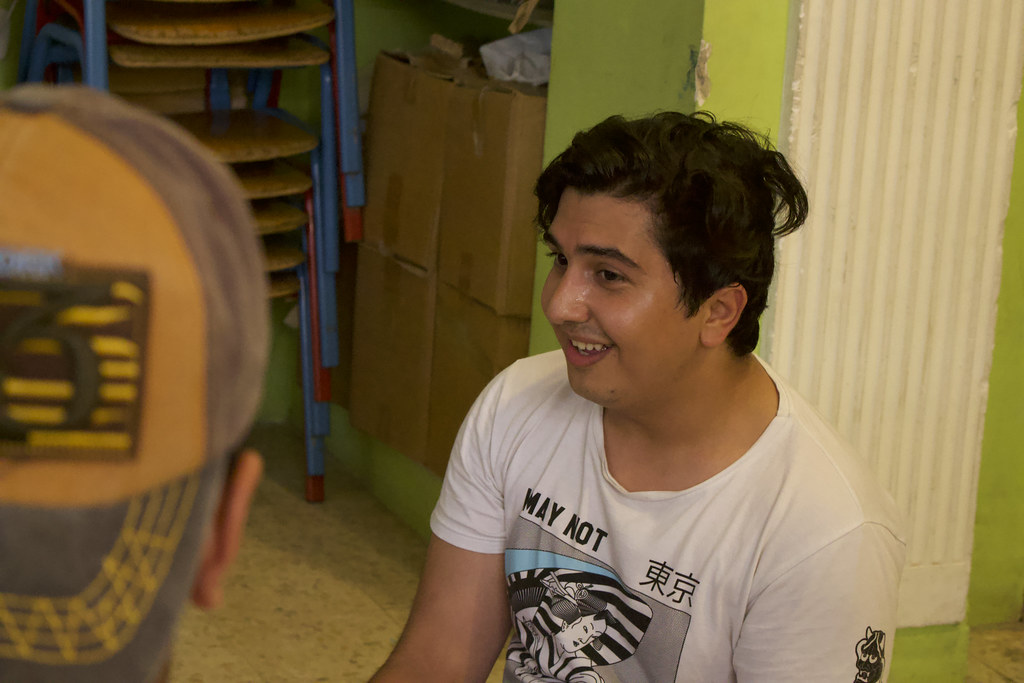
Mohamed Ata, CRP’s volunteer coordinator talks to kids during a dance class at Summer Camp
“Ween Mohamed?”
For anyone that hangs out enough in the second-floor office of the youth center at the Collateral Repair Project, this question functions pretty much as the soundtrack for the work, a mantra of sorts, repeated over and over again by a variety of passersby – beneficiaries, CRP employees, volunteer colleagues, you name it.
The usual answer is “maa barif” – “I don’t know”, because while we all know Mohamed is somewhere in the premises, he can be literally anywhere, since he pretty much does everything: maybe in one the English classrooms, one of the other offices, teaching a dance class to the kids who come for the Summer Camp program, hanging out with other interns. Too many options.
First time I met Mohamed, I was struck that such a young kid – he is 19 – would be the volunteer coordinator for the whole substantial operation that is CRP. While he was showing me around for the first time and introducing me to people, I quickly realized why he landed the job: there is something deeply charismatic about him, fluidly transitioning between Arabic and English depending on his interlocutor, smiling and cracking jokes. The second time I saw him, he had a Naomi Smalls t-shirt on. I was sold.
Originally from Baghdad, Mohamed has been living in Jordan for the past 4 years, as a refugee himself. “I came to visit my sister who lives in Amman. While I was here, visiting for 2 weeks, the whole ISIS thing happened. So my mom decided I would just stay in Jordan”. This is not the first time he fled conflict. Before that, Mohamed also had spent a couple of years in Syria, with his parents and sisters, from 2006 to 2008, when sectarian violence reached overwhelming levels in Iraq. This is something particularly preoccupying for his family, since his mother and father come from different groups in the country. They went back to Iraq once the situation settled.
“When I got here, in 2014, I had a bag of clothes, I had nothing with me basically, since I was supposed to stay only for two weeks. It was difficult to get my school papers, so I ended up missing one school year”. While waiting to go back to school, he split his time between working at his brother-in-law’s restaurant and learning Japanese. “Languages are one of the things I am very good at”. The facility with languages can be attested by the fact that Mohamed learned his fluent English from watching TV – mostly US programs – what explains both the Californian accent (which he tested to figure out) and the extensive repertoire of American pop culture references.
He managed to go back to school, but after graduating in Amman, by mid-2017, Mohamed found himself without much to do. “The main thing here, for a refugee is that you cannot work and that is really tough. If you want a decent job, a career, you cannot do that in Jordan. There are some opportunities, but they are very minimal. And people cannot get an income that is consistent”.
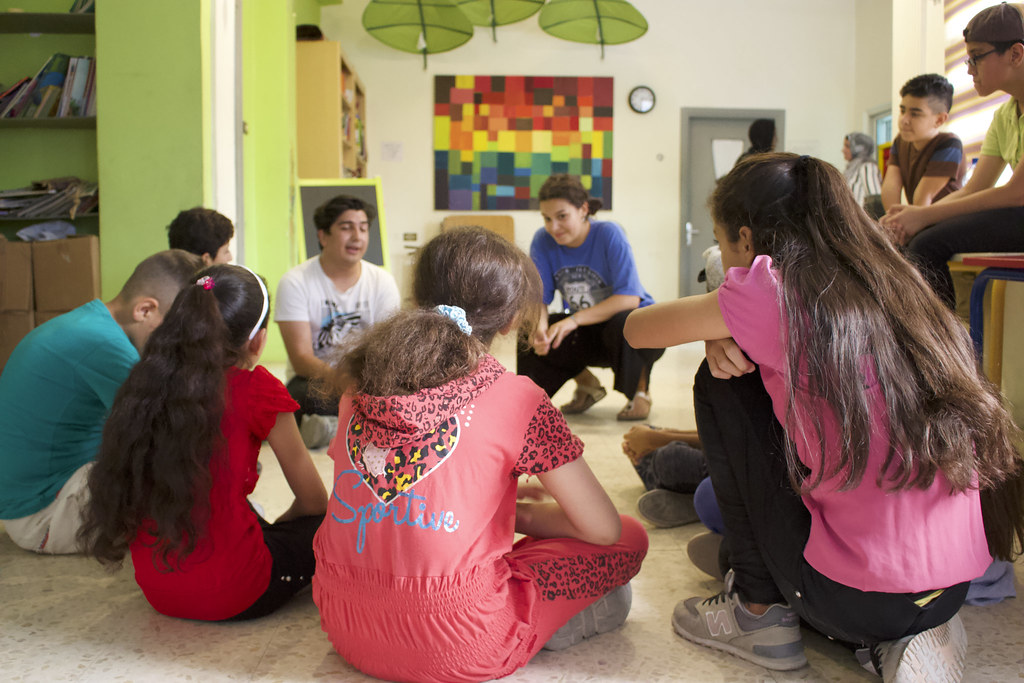
Mohamed and volunteer Shereen Qedra (right) talk to kids during CRP’s Summer Camp dance class.
While he, as a very small minority of the refugees in the country, can count on some economic support sent from home, sitting idly was not something Mohamed particularly enjoys. “My mental health got really bad, throughout October to January, because I had nothing to do. I think the biggest issue with refugees here in Jordan is having nothing to do, is having their lives on pause. It’s really boring. Humans are made to do something they are passionate about. When they are not, it is really difficult to cope with that. I just sat at home, gained a lot of weight, I was depressed. So, my friend, who was volunteering here, asked me if I did not want to come and be a volunteer at CRP”. After just a few months, he found himself as volunteer coordinator, which involves organizing a relevant number of activities offered by CRP and all the people who participate in them. And also, sometimes, dancing with kids, as you can see below.

Mohamed and volunteer Shereen Qedra (left) teach dance to refugee kids at CRP’s Summer Camp.
For the future, Mohamed hopes to go to university, eventually, but somewhere other than Jordan. “Anywhere really, I am not picky, but if I could choose, probably Canada”. And after that, plans get even bigger. “I really want to keep working in the humanitarian field. And I hope someday to start some sort of organization of my own”.
-
The privilege of movement
6 Comments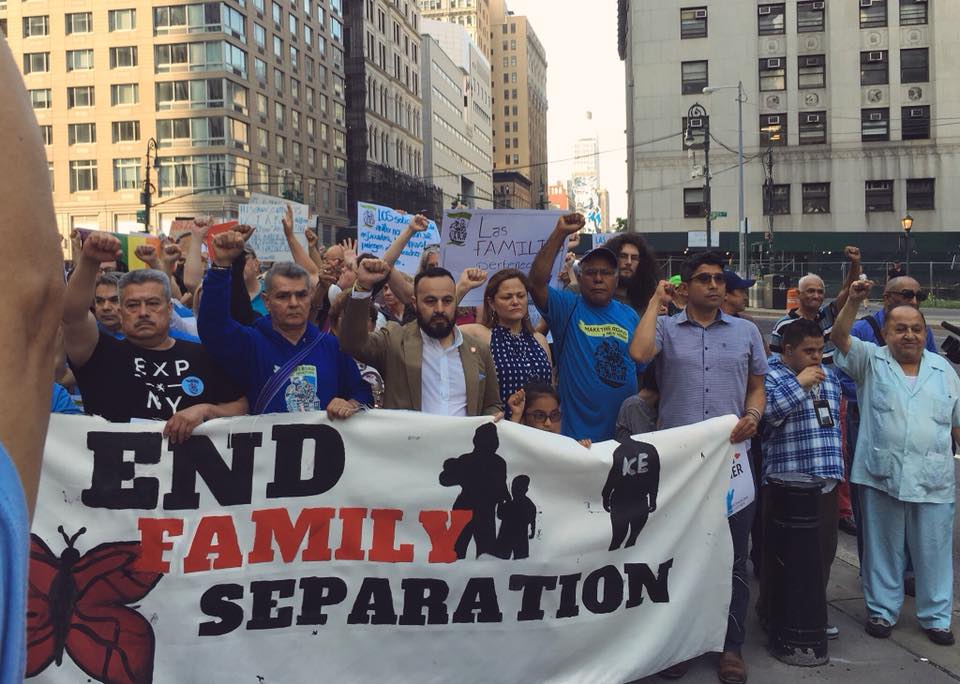
Protest held in the beginning of June against the family separation policy, currently being put forward by the US government (Photo credit: ACLU)
What does the “zero-tolerance” policy for people crossing the southland border in the U.S. have to do with refugee women seeking economic and psychosocial support in Hashemi Shamali, a low-income neighborhood in the eastern part of Amman?
Between words like refugee, asylum seeker, economic migrant, legal, illegal, border, control, security, much of what is fundamental – preserving human dignity – is lost. And I cannot help but feel a deep connection between the horrifying scenes and reports we have been flooded for the past month, of children being ripped off the arms of parents who dared to flee violence and lack of opportunity, and the suspended lives of the refugees living in Amman.
They are both products of an ever-growing insecurity climate for the vulnerable and an increasingly closed down world to the ones that need the most.
Evidence for this emerges pretty much everywhere. We can see it in the impacts of the Plan Frontera Sur in Mexico, commissioned still by former US president, Barack Obama, and its outsourcing of repression and violence. More blatantly, during the past year and a half, between the “Muslim Ban” and the deep cut in the numbers over refugee acceptance, the US effectively redrafted its refugee reception policy which reached never seen before lows ever since the country took resettlement as a matter of strategic importance, since World War II.
Even in my home country, Brazil, usually hailed as welcoming and open, signs of closure have started to emerge in daily discourse. In 2017, a comprehensive new immigration law, drafted by specialists and scholars and which substituted the antiquate rules on the theme that were created during the military dictatorship was hailed as one of the most comprehensive, progressive reforms on the issue in the world. However, once it reached the Executive, the document had a series of its innovations vetoed, on the grounds of national security. Even before, when facing the influx of Haitians, coming from a country wrecked to shreds by the earthquake in 2010, few, but growing, voices against their presence arose. The same occurs now, as the continuous crisis in Venezuela prompts immigrant influxes on the northern part of the country, and renewed calls for the closure of the borders occur. As if this was possible. As if this was acceptable.
In global governance fora, the ways in which both the refugee and migrant discussion is occurring, today essentially in the spaces of the Global Compacts on each theme, also prompts worry. More specifically, on the issue of how the member States show an extreme preoccupation with a “strengthened focus on addressing root causes and planning for solutions, including voluntary repatriation and resettlement, from the onset of emergencies”– meaning doing everything that can be done to prevent people from leaving their country.
I am often confronted by views that make a point in separating migration policy from refugee policy. There is a well-founded reason for that, as legal norms for both groups are based on different assumptions. But, is there a hardship ruler, a scale, a maker to determine what type of suffering and need is more acceptable than others? What separates Alan Kurdi from the wailing 6-year old Salvadorian girl, pleading for her mother and aunt? Maybe a land border instead of the Aegean Sea? Mind you, I am not advocating (at least, not at this point) for the disbandment of those categories, the migrant and the refugee, but for more critical reflection upon what is the basis in which they are set.
Because those categories are fundamentally political ones, handled and argued for depending on a particular intention. That is, who then gets to be a refugee? Who gets then to be a migrant? And who gets to be the “expat”? Ultimately, if movement is a privilege, it is less and less attainable for those whose life depends on it.
There is much work to be done.
Today, as it is World Refugee Day, Global Giving is matching donations up to $2,500 for refugee-related projects. The Advocacy Project currently holds a campaign for the Hope Workshop, which serves as a basic income source for women refugees in Amman and is where I am working this summer. Any donation is much appreciated. You can find the ongoing campaign here.
And – should you have any other funds to spare, please also consider making a donation to legal rights groups which work with immigrant children cases in the US, like the ACLU. They are needed more than ever.
-
On the permanence of the temporary
11 Comments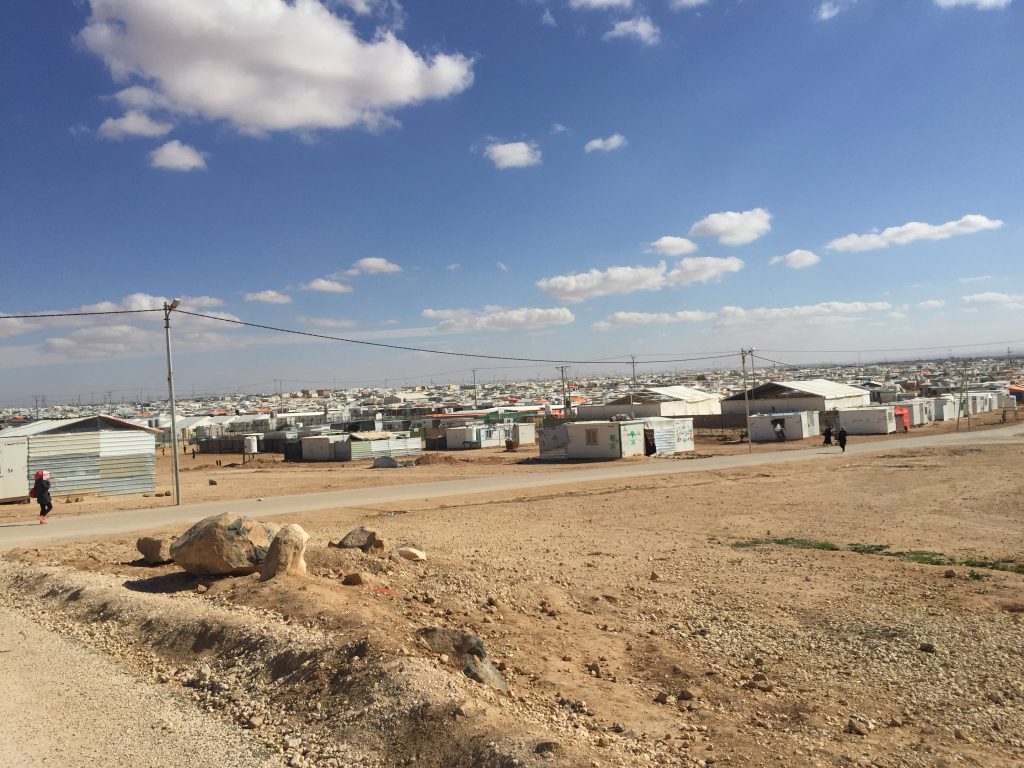
The Za’atari refugee camp, in northern Jordan, seen here in 2016. The camp is home for 78,000 Syrian refugees.
Last time I was in Jordan, back in 2016, I spent most of my time and focus in Za’atari, the largest refugee camp for Syrians, in the northern part of the country. The camp was completing 4 years, and its size was winding down after it had peaked in 2013, with astounding 200,000 residents, most of them from Dara’a, the southern Syrian province, nearby the Jordanian border. By then, the residents amounted to around 78,000, give or take, living in caravans (a.k.a. containers) in the middle of the desert.
The lowering in numbers, I was explained at the time, was a combination of factors: some got resettled in other host countries, like Canada and Australia; others tried their luck in the hands of smugglers through the Turkey-Mediterranean route, and a bigger contingent left the camp and established themselves in cities around Jordan. The few families which I had contact with in Za’atari conveyed to me this sense of pause in their lives. “Temporary” was the word often used by refugees, international organizations officials, field officers. The camp is temporary. This situation is temporary. Their status is temporary. Full lives on hold. Until the war ends. Until resettlement is given. Until they can go back to work. Until they get to live again, not just survive.
As of April 2018, the last fact-sheet made available by the UNHCR on the current status of Za’atari puts the number of its residents at 78,804 – that is, the same levels of two years ago. The overall number of refugees in Jordan, in and outside camps, did not wind down either – the country is the current home for roughly 740,000 refugees, between Syrian, Iraqi, Yemeni, Sudanese, Somali refugee populations, amongst others.
The reasons behind this stability are not really difficult to assess. In 2015, when the heightened attention on refugees over the thousands of deaths in the Mediterranean, coupled with the desperation scenes seen both in what were before trendy European seaside cities and as survivors tried to make their way through Europe, produced somewhat higher levels of resettlement in some countries of the continent. However, the political climate which emerged from this, fed by economic anxiety and, many times, by blatant xenophobia and racism, could not be worse for refugees and migrants. It resulted in a more closed world than the one envisioned for the 21st century. It meant keeping “undesirable people” away at all costs. It meant depriving people of opportunity, even though the crisis was – and is – not over.
This time, in Amman, the bulk of my work will be with urban refugees, most of them Iraqi, which means their offers for resettlement are even more scarce than those available for Syrians. As of today, there are 55,500 registered Iraqi refugees residing in Jordan. The majority do not have permits to work nor to pursue higher education in public institutions, which renders them even more vulnerable and fundamentally dependent on humanitarian aid.
They rely so much on what Mirian Ticktin called the regimes of care, “which include humanitarianism, certain movements for human rights (…), a set of regulated discourses and practices grounded on this moral imperative to relieve suffering (…) [which] come together through a diverse set of actors such as NGOs, international institutions, legal regimes, corporations, the military, and states”. According to her research, it has been seen that the structures formed by the regimes of care can “ultimately work to displace possibilities for larger forms of collective change, particularly for those most disenfranchised”.
This understanding comes from the fact that the structural, fundamental issues related to the vulnerable status of those groups cannot be solved within the humanitarian realm. They need to be addressed at the political level. They involve decision making regarding the conflicts themselves and their avenues for solutions, as well as foreign policy decisions by the world powers which more frequently than not foment said conflicts. They mean, in the frontline of first response, refugee resettlement and humane immigration policy. They extend even to the field of climate change. And all of these issues are political.
While the political solutions and resolutions do not come, humanitarian aid is necessary to relieve suffering in the short term, as refugees would be in a far worse situation without it. But as the temporary quickly converts to permanent, what is the role to be played by humanitarian actors? In which ways their mere presence can be a deterrent for States to assume their responsibilities? How they interact with the political space while claiming to remain detached from it?
As an aspiring human rights and development researcher and practitioner, at this point, I have no answers. But I look forward to engage further with those questions in mind during my time in Jordan. And I hope that, while sharing, I can foster those discussions elsewhere too.
-
Inshallah
1 CommentI’ve been avoiding writing this final blog because it’s the final goodbye from my fellowship and (as everyone at CRP knows) I hate goodbyes. I’ve been back in the states for a week now, so I’ve decided it’s safe for me to write this blog without bursting into tears.
Professionally, this fellowship meant more than I could have imagined. There were challenges, triumphs, ups, and downs of trying to get this embroidery program up and running. I gained program management skills, learned how to create a budget, and more. I saw what made international development such a special field. To work at CRP and specifically at the Hope Workshop was such an honor. CRP is special because the programs they offer and aid they give reflects the communities’ needs, not the needs of western people who think they know the solutions. When I went into the Hope Workshop, the women were happy to be there and excited for a chance to work on something they felt was meaningful. This made the project meaningful to me. I met amazing staff members, interns, and volunteers at CRP, some of whom I think will stay in my life for a very long time. The AP trainin
 g introduced me to wonderful people in different fields, who I hope to lean on when I need career advice or professional help. This fellowship was not something I anticipated doing, but it solidified my desire to work with vulnerable and disenfranchised communities. I want to be involved in work that empowers those who are the most resilient and deserving among us. I am proud of what I helped build at the Hope Workshop, but the brunt of the work is being done by the amazing beneficiaries.
The beneficiaries I met at CRP were some of the most resilient, kind, amazing humans I had ever been lucky enough to know. The women in Hope Workshop came to be like mothers, sisters, aunts, and grandmothers to me. They nurtured me with meals, presents, and love regardless of how much they had to give. I am so lucky to know them and so honored that they trusted me to share their stories with the world. When I left, I prayed to see them all again. I can only hope that they will be happily resettled or back in their home countries, safe again. Knowing the women at the Hope Workshop so intimately only makes me more passionate about doing my part to represent them at home. We are not doing enough for refugees. Until each refugee is resettled, given the opportunity to work, and reunited with their families, I will not be satisfied. These people fled horrors that most of us are lucky enough to not be able to even fathom. They are stuck in limbo, living in a country where they have no work and few rights. Still, they smile and give and share their light with everyone they meet. We should be so lucky to accept some of these people in the U.S. These Muslim, Christian, Catholic, Sabaean women who all support each other could teach our country a few things about tolerance.
Inshallah means ‘if God is willing.’ If you were raised by Arab parents, this meant ‘no’ for your entire childhood. If you’ve lived in the Middle East, you hear this constantly. Whether it be your taxi driver saying ‘inshallah’ when you ask him to take you somewhere (scary), your response to your boss when he asks you to come in early, or a positive nudge at the end of 80% of your phrases.
Inshallah, all of the refugees I met are reunited with their families somewhere safe and with opportunity.
Inshallah, I will see them all again.
Inshallah, I will be able to show people how important opening our hearts to those who are different from us is.
Please reach out to me if you have any questions about my time in Jordan or want to talk about the refugee crisis. I would LOVE to chat. The best way to reach me is through email: reinasultan@gmail.com.
-
Reflecting on… Embroidery
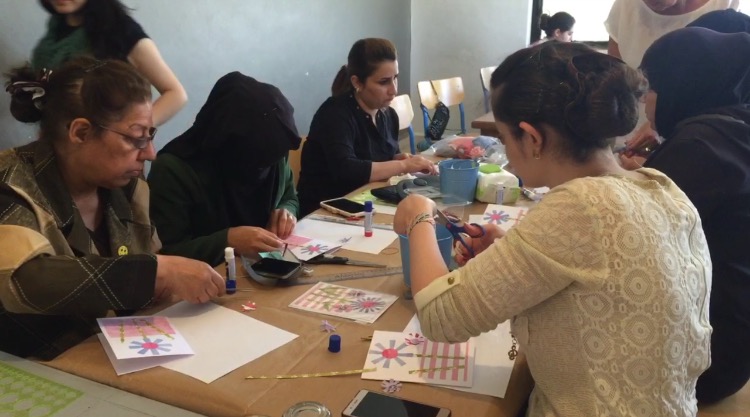
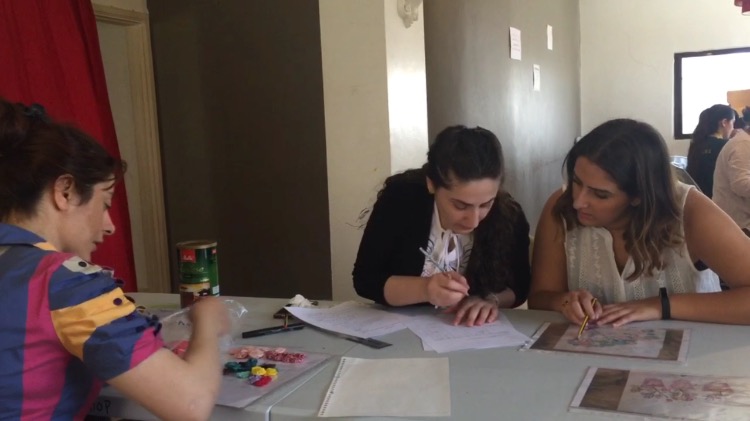
122 CommentsAnyone who knows me personally knows that I have no hand-eye coordination. Getting me to catch anything, play the piano, or even park a car in between the lines is a struggle. So, you can understand my apprehension when the embroidery leaders wanted me to learn new embroidery stitches with them at Tiraz. For the first two days, I resisted. I made excuse after excuse because I was certain I would be absolutely terrible. Turns out, I’m not very good… but not as bad as anticipated.
Ashwaq
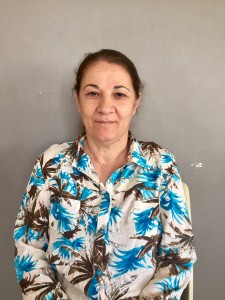
Ameera
Ameera, Hiba, Ashwaq, and Huda are all Iraqi refugees who live in Amman. Some of them, like Huda, have been at CRP for a long time. Huda says CRP is like her second home; she feels protective of the space that gave her a community and hope. She raves about the English classes, the women’s empowerment programs, and the friends she’s made. For Ashwaq and Hiba, Huda and Ameera couldn’t be better resources. They are leaders in the Hope Workshop already and are loved by the entire CRP community.
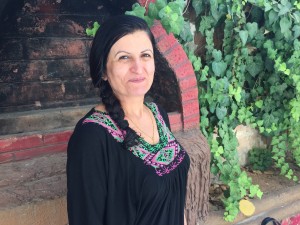
Huda
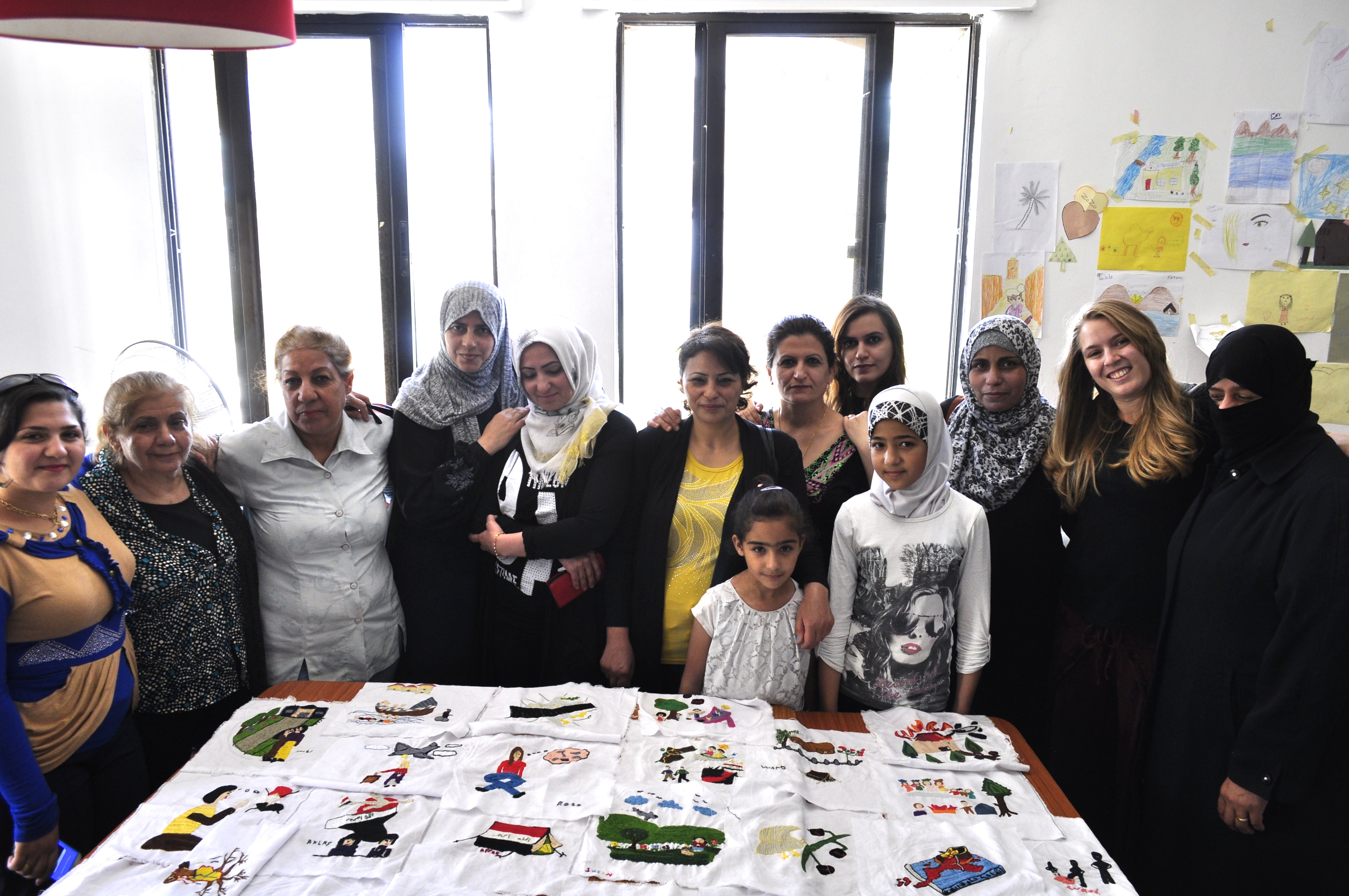
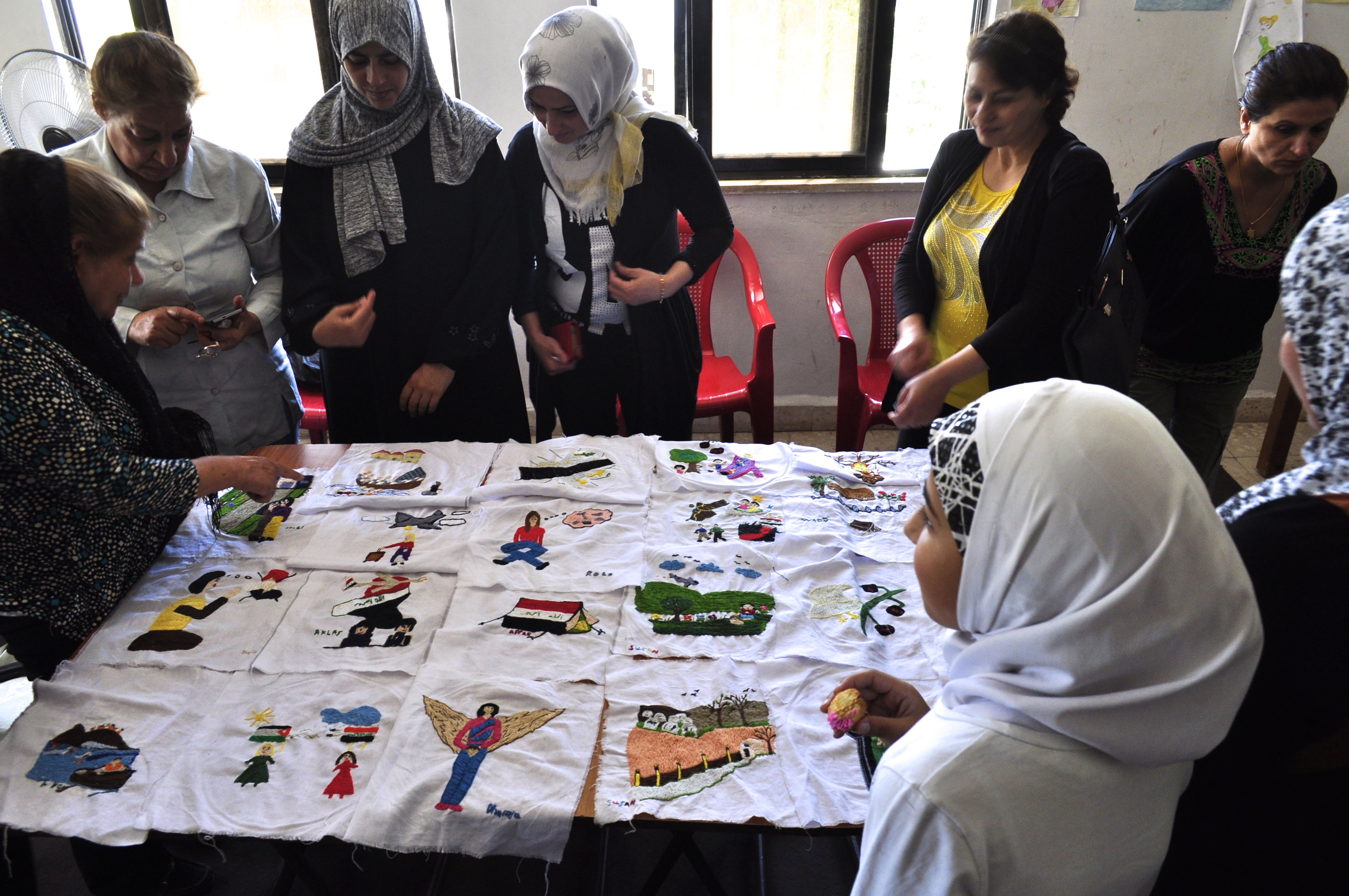
These four women have come together to learn new embroidery skills and improve upon skills they already have. After an intensive training at Tiraz, they will go on to teach 20 women what they have learned. These 20 women will be given the opportunity to put their stories into art, creating a square that describes their lives as refugee women. This new AP-sponsored embroidery group includes both Iraqi and Syrian women from Christian, Sabaean, and Muslim backgrounds. They will come together like the other groups before them to find community and comfort.
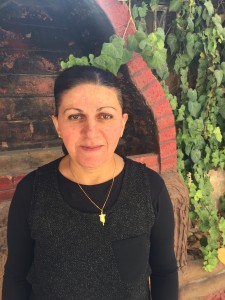
Hiba
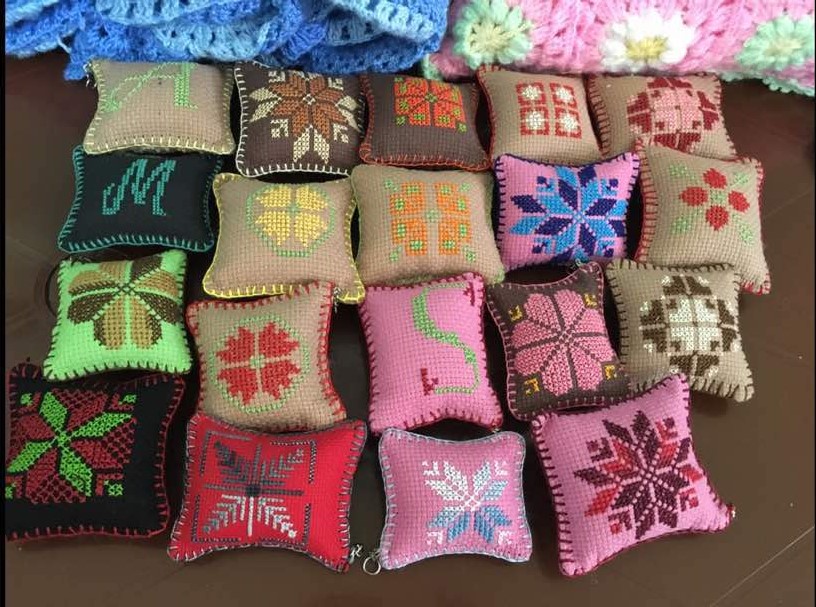
After their advocacy squares are turned into a quilt, they will begin working toward the goal of selling embroidered products in Jordan and abroad.
When thinking about this embroidery workshop, I wanted to include stitches that were culturally relevant to the women. When speaking with the Tiraz employees, I discovered the Raghme stitch, the traditional Iraqi stitch, and couching.
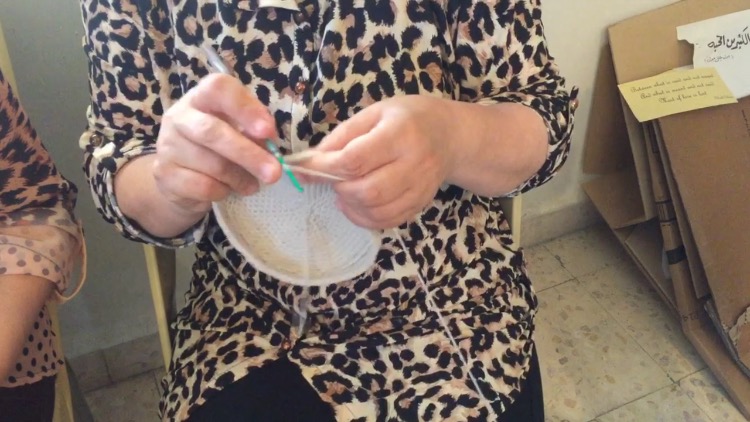
Our first few days at Tiraz were spent on Raghme, which is a traditional stitch from southern Syria. This stitch uses negative space to create a pattern and is incredibly rare today. Most women who embroider in the Middle East today do a Palestinian cross stitch and the Raghme technique is dying out. Preserving this tradition and having a unique product on the market were priorities when deciding to work on Raghme. This stitch is hard work. The women (all of whom are super skilled at sewing, crocheting, embroidery, or all of the above) all tired themselves out working on this stitch. They enjoyed the challenge, however, and are ready to try it again on Tuesday.
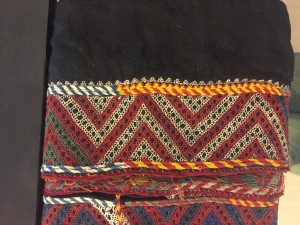
Raghme
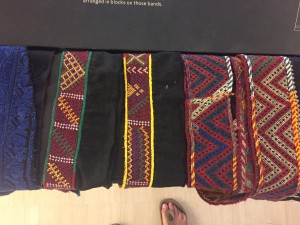
Raghme
All of the women were already familiar with the Iraqi stitch, which is what will be used to create the advocacy squares. The Iraqi stitch is a creative one; the artist designs what he or she will embroider and fills in the designs with color. This stitch is very versatile and can be used to tell stories or to adorn dresses, pillows, or blankets. When we began the Iraqi stitch, the women barely needed direction; they just began working. I was roped into learning this one and was initially really nervous. However, I loved seeing the examples of stunning Iraqi workmanship and hearing the women’s stories about their homeland. My Iraqi stitch didn’t look quite as good as the others’, but I found embroidery very therapeutic (similar to adult coloring books but better!). Some of the women got teary remembering their homes, but I felt that working on the Iraqi stitch gave them some comfort.
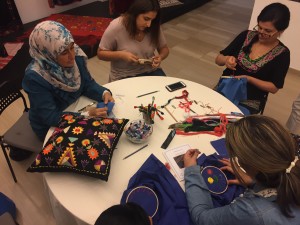
Working on the Iraqi stitch.
We were never intending to work on couching, but the women were intrigued by it. Couching was often used on men’s clothing in Iraq. It was a much thinner thread dipped into gold and sewn onto the clothing in ornate patterns. Layla, an Iraqi refugee herself, brought beautiful examples of this couching and the women were ravished. We decided that Wednesday will be spent learning this wonderful technique. I’m sad that I won’t be there to see the women work on couching, but I am promised photos.
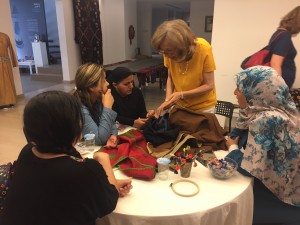
Admiring couching
Overall, I am so happy to have had the opportunity to watch these four women grow together and gain confidence to teach the rest of the group. In these few days of training they have laughed and cried and I have been honored to be a part of their little group. Embroidery is hard, but I trust these women to pass on their skills and create beautiful works of art.
-
Ashwaq
67 CommentsIn Iraq, Ashwaq had a normal life. She was studying to be a math teacher, but she didn’t graduate and got married instead. She stayed home with her two children; they are 10 and 7. Eventually, life became more difficult. Her family is Sabaean and people began harassing them, “You must read Quran. Why don’t you wear black?” They tried to force Ashwaq’s husband to join the Hashid, an anti-Daesh militia. “We were older and we understood that there were people with different religions, but our children were too young to know these differences,” she says. Ashwaq’s children didn’t see why they were being asked why they don’t dress like everyone else or if they read the Quran like everyone else. They felt upset when people accused them of not loving God. They would come home every day, “My friend said this, my friend said that.” Sabaeans are people of the book in Islam, so she felt it was even more jarring when people would say the Quran said no such thing. Ashwaq says, “They wouldn’t even drink the same water as us.”
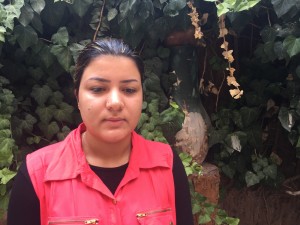 Originally, Ashwaq’s parents came to Jordan. Once they left, she began to question what she even had in Iraq. They told her that her children would not be bothered the way they were in Iraq and that life was nicer in Amman. They felt safe. Ashwaq told her husband she had made up her mind; she would go to Jordan with or without him. But he felt that they didn’t have a community left in Iraq, so he decided to come with her. Ashwaq’s parents were resettled in Australia two or three months after she arrived in Amman. At first, she was sad that they had convinced her to come and then left, but she is happy they can relax now.
Overall, Amman is better. There is safety and security that Ashwaq and her family didn’t have in Iraq. She says she can dress how she likes and so can her children. However, her husband left his work behind in Iraq and Jordanian law doesn’t allow Iraqis to work. He tried to find work anyway, but he couldn’t.
Ashwaq and her husband applied to go to Australia to be with her parents but they were rejected. They are trying again because she doesn’t know anyone else in Canada or Europe, where the UN suggested they try. It’s not just her parents there; she has uncles and cousins in Australia also. There is a big community of Sabaeans where her parents live. “Here, we celebrate holidays at home. We don’t have family to visit, but in Australia we could go celebrate with family,” Ashwaq elaborates.
Ashwaq’s children have a hard time with school here in Amman. They started, but she was scared for them so she pulled them out. She put them in the Kids Club at CRP, but her older son doesn’t want to be with the younger kids. He says he wants to go to real school with students his own age.
She says she would be thrilled for her children if they were resettled in Australia because they did not have a real childhood. “In Australia, they could go to school and be free.”
-
Reflecting on… Resettlement
1 CommentReflecting on… Resettlement
The fact that only 1-2% of refugees are resettled is one that haunts me when I hear every day about the hopes these people have to be safe, rejoin family, and start a new life in the west. This uneasiness with the probability that most of these people will be stuck in Jordan hit me especially hard this week when a friend of mine revealed that her family was denied entry into Australia. She is an Iraqi Christian from near Mosul and cannot go back to her home, which was ransacked by Daesh. Her aunt is in Australia and she feels that she could have a future there but instead she is stuck in Jordan, where refugees are barred from working and her chances of upward mobility are slim. She is kind, resilient, and hilarious, but the Australian resettlement case managers don’t know that. She is just a number to them. Below I am going to share the profiles of two women I recently met. Refugees are not numbers; each person I meet has unique stories, hardships, and dreams. Here are Arweej and An’aam’s:
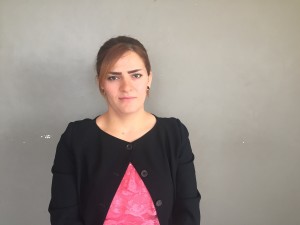 Arweej and her family lived in Iraq until Daesh invaded their hometown. They fled and were moved from Erbil to Ankawa before they reached Jordan. Arweej says that she and her husband don’t have work, residency, or security. The money they came with has run out, which she says is common with refugees. “Life is harder in Jordan. Plus, my husband’s leg is broken. The doctor is expensive; our first visit was 50 JD. Caritas does not help enough; they only give 10% and the rest we must pay. So, in terms of money, life is harder in Jordan,” Arweej elaborates. Arweej’s husband used to work as a carpenter, which she said was strenuous work; that is how he broke his leg. After, he was a chef in Iraq but here he is not allowed to work.
They have family in Australia, so Arweej’s family applied for resettlement there. They were denied. They began the application process for resettlement in France about two weeks ago and are waiting for the scheduled interview. Arweej has no one in France, but applying to Australia again costs too much so she and her husband decided not to appeal the decision.
“As Christians in Iraq, we felt like we didn’t have a place there anymore. Anywhere we went in Iraq didn’t feel like home. Not Erbil, not Ankawa,” says Arweej. Though the state of Arweej’s town is slightly better now, she says she cannot go back, “Our house was wrecked and there is no certainty that we will be safe. We want to go somewhere where we can relax; our souls are weary.”
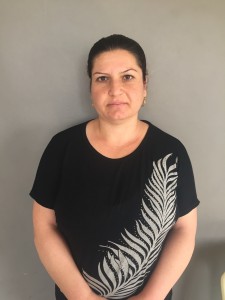
An’aam and her family resisted leaving their home country of Iraq for as long as they could. “Despite everything, we didn’t want to leave Iraq. We thought in any state, our homeland was better,” she says. They waited for things to get better, until eventually the threat of Daesh was too high. An’aam’s son, now 3 years old, would hear planes flying overhead and ask her if they were coming to kill them.
Her and her family arrived in Amman in August 2016, hoping for safety and security. An’aam says living in Amman feels safer, but is more expensive and her husband cannot work. He was a doctor in Iraq, but Jordan’s laws forbid Iraqi and Syrian refugees from working. On top of this, her husband is sick and “the medicine was expensive enough in Iraq, but it’s worse here.” An’aam and her family receive some aid from different humanitarian groups, but it is not enough for food, rent, and medicine.
Three years near Mosul with the threat of Daesh made her and her husband tired. They would love to go to Australia or America, where An’aam has family and she could finally feel relaxed. An’aam says the waiting has been hard, but she has hope that God will help her and refugees like her.
-
Incubating Social Change in Tripoli
73 Comments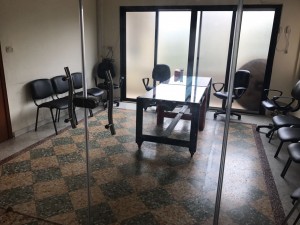
Peace Labs office in Tripoli
In order to maintain a presence in, and demonstrate its commitment to, northern Lebanon, Peace Labs recently opened a new office in Tripoli. The office is housed in one of the apartments owned and operated by the SHIFT Social Innovation Hub, an organization co-founded by Bilal Al Ayoubi based in Tripoli that serves as an incubator for community development, youth engagement, and social entrepreneurship.
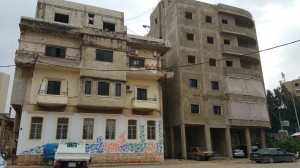
SHIFT buildings
When Bilal finished his contract with USAID’s Office of Transition Initiatives (OTI) in early 2015, he and some friends and colleagues from OTI (Omar Assaf, Hani Alrstum, and Khaled Hamid) wanted to create something sustainable before leaving the work in the city and cutting the ties and relationships they had been building with people in the city. What they decided to do was create a platform – a hub – on one of the front lines between Jabal Mohsen and Qobbe (two neighborhoods between which there had been years of tensions and recent violent conflict).
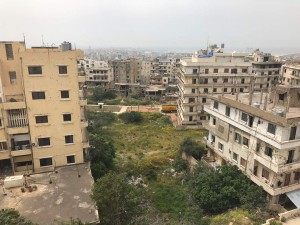
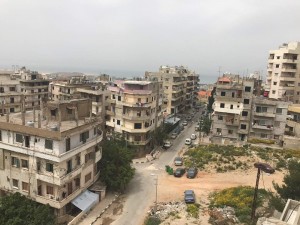
View from one of the Shift rooftops SHIFT neighborhood
The motivation was to focus on getting people together. Without a clear idea about the best way to get people from these communities in one place, working on a shared project, the team acquired and started renovating an apartment in an area called Baqqar. Although not on Syria Street (the main front line of the conflict) and therefore not as visible in the media, Qobbe shares other aspects, such as poverty, illiteracy, unemployment, etc., but with fewer NGOs active in the area.
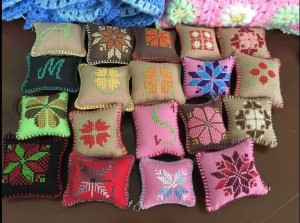
Embroidered keychains from Basmeh wa Zeitooneh’s women’s workshop (basmeh-zeitooneh.org/our-programs/womens-workshop)
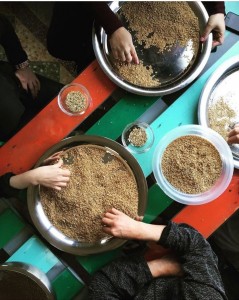
In this space, they were planning to create a cultural center to bring people on board until they developed stronger relationships with the community; however, the people were mostly interested in job opportunities, and therefore, they started to focus more on social entrepreneurship as a means to get both communities working together not only to solve social problems, but also to generate income.Culinary training at SHIFT
SHIFT was the first, and is still the biggest, social entrepreneurship hub in the city that focuses primarily on incubating initiatives and social enterprises in order to create jobs, get people to work together, and think about the conflict and the situation in a different way. Rather than obstacles or challenges to living a meaningful and rewarding life, residents are encouraged to see their problems as potential sources of income, for example, a recycling project that started in the area, or even a local NGO or entity that addresses local problems.
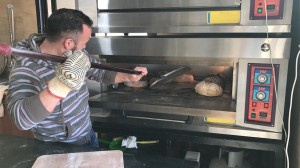
Saad Al Suud Foundation uses SHIFT community kitchen as an incubator
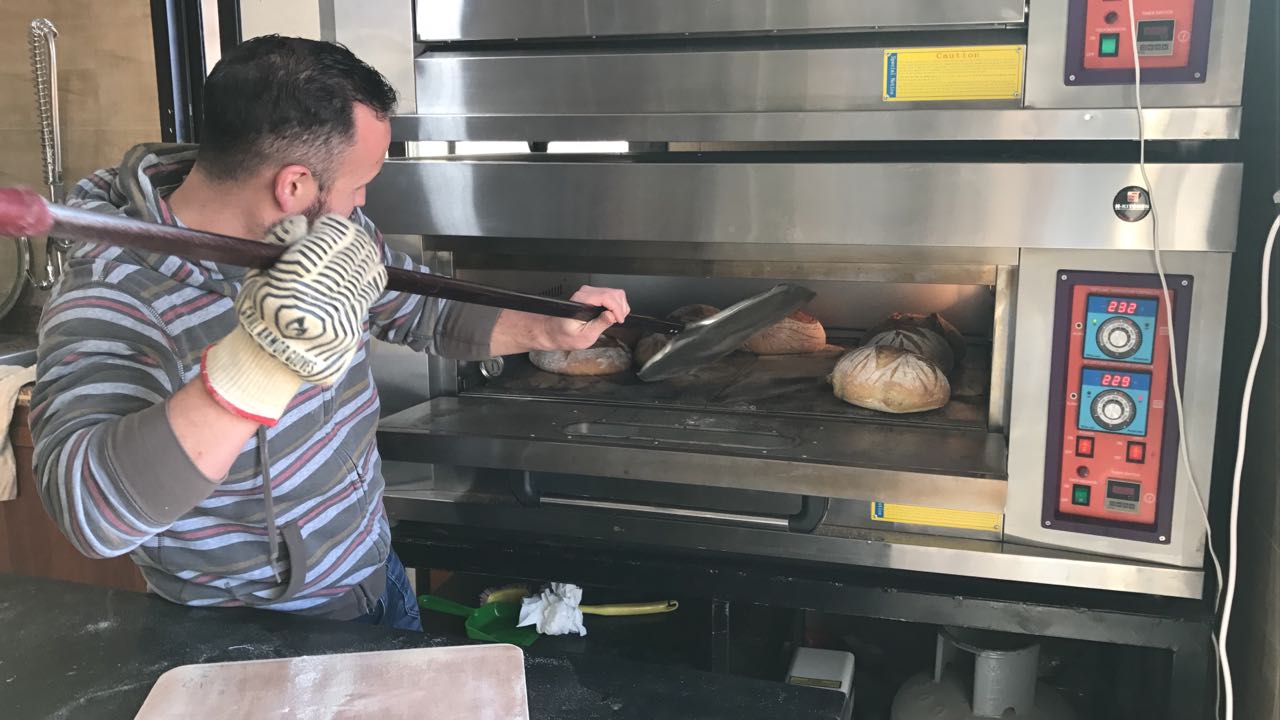
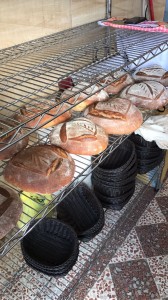
Fresh baked bread at SHIFT’s community kitchen
Since then, SHIFT has grown and now operates nine apartments, which feature a rooftop terrace, cultural spaces that host films and book readings, a community kitchen where they incubate local initiatives related to catering and food-creation jobs, as well as rooms for NGOs and initiatives that want to work in the city but can’t invest in the start-up costs for big offices.
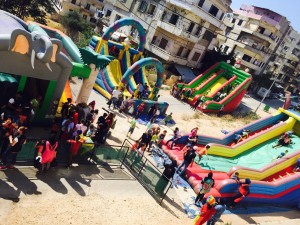
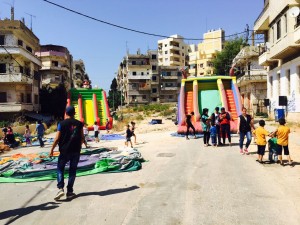
Children’s activities of Bassme Wa Zeitooneh… hosted at SHIFT
SHIFT has conducted training for communities affected by the conflict, or for those who lost relatives, on how to create their own business and/or benefit from small grants; offered vocational training for women; participated in a social entrepreneurship competition; and hosted two screenings for the Tripoli Film Festival. They are now working with an international NGO to identify skills and capacities of certain youth groups in order to give meaningful, useful, enjoyable, and hopefully long-term vocational training.
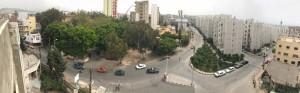
View from one of the SHIFT rooftops
Organizations like Shift are necessary and important for the work they do. By providing a space to incubate social enterprises (both businesses and NGOs), SHIFT makes a significant contribution to social change and the empowerment not only of the residents of the areas in which they work, but of the city more generally as well.
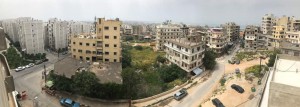
View from one of the SHIFT rooftops of one of the former frontlines of the conflict
For more about SHIFT, see the leaflet below, or find them on facebook:
https://www.facebook.com/shiftsocialinnovationhub/
*All photos courtesy of SHIFT
-
Story of a Peacemaker: Brokering Peace & Development
81 Comments
I first met Bilal on my second day interning at Peace Labs (third day in Lebanon) when I went with the director (JP) and another intern to meet him at a café in a nearby mall. He was fasting at the time (only a few days after the start of the holy month of Ramadan), and I was only a bit jetlagged, but he was, without a doubt, much more focused and coherent than I was as he passionately and articulately described possible projects and potential partnerships for Peace Labs in Tripoli.
Bilal received a baptism by fire in conflict prevention/mitigation and development in 2007, following the July 2006 war on Lebanon, and he’s been working in the field ever since. He started at the UN where he worked at the office of the United Nations Resident Coordinator Office (UNRCO) which coordinated the work of UN agencies involved in the reconstruction and recovery of the southern suburbs of Beirut, and, following the clashes in the Nahr el-Bared Palestinian camp, he then moved to the North Lebanon office of the UNRCO, which is responsible for coordinating activities within an organization that is infamously bad at coordinating. While there, he worked on the reconstruction project for the Nahr el-Bared camp which was destroyed during the fighting between the Lebanese Armed Forces (LAF) and a militant group in the camp, Fatah al-Islam (not to be confused with Fatah, the political party that governs the Palestinian National Authority in the West Bank).
Before 2007, Nahr El-Bared was considered a trading hub in the region given its proximity both to the border with Syria and to the major road in that direction. In 2007, a clash between LAF and Fatah al-Islam members in the city of Tripoli led to reprisals against LAF positions near Nahr el-Bared camp, where militants had entrenched themselves. Clashes continued for several months, with civilian residents fleeing to the nearby Beddawi Palestinian camp (approximately doubling the population of the already strained one square kilometer camp) or other nearby cities or camps. During the course of the clashes, which eventually succeeded in eliminating Fatah al-Islam from the Nahr el-Bared camp, much of that camp was destroyed.
After his work on the Nahr el-Bared Camp (NBC) project, in 2009, Bilal went to the USAID’s Office of Transition Initiatives (OTI), where he started to engage more deeply with youth and local NGOs in northern Lebanon, Tripoli in particular. Although he now lives in Beirut with his wife and young daughter, Bilal was born and raised in Tripoli, and his work there gave him the opportunity to know the city in a different way and become involved in areas that were conflict-prone and/or impoverished. Around this time, Bilal began working with JP and supporting the establishment of the entity later known as Peace Labs, about which Bilal says he is “always proud to say that [he] was one of the first believers in the work that Jean-Paul was doing, and also in the potential that an NGO like Peace Labs can actually have, not only in Lebanon, but in the MENA [Middle East and North Africa] region in general.” With their combined experiences post-2007, and then with the outbreak of the violent conflict in Tripoli between 2008 and 2014, they later decided to join forces on what they called the Roadmap to Reconciliation in Tripoli (RRT).
The RRT started as an initiative building on the work of many activists in the city (particularly during the period of the clashes) who were trying to stop the fighting. In 2012, on the invitation of the Forum for Cities in Transition (FCT), Bilal organized and coordinated a delegation of local activists and civil servants working in Tripoli to attend the FCT conference in Kirkuk, Iraq. Out of this conference came the idea of working together and establishing a more formal linkage. This led to the creation of the Coalition of Campaigns Against Violence in Tripoli, which was active during the period of the clashes, 2013 – 14, and, subsequently, to the creation of the RRT, which involved Peace Labs, Permanent Peace Movement, Fighters for Peace, Youth for Growth and Development, SHIFT, and LRC.
According to JP, one of Bilal’s greatest assets is his ability to connect people and facilitate their interacting. It’s for this reason that JP has coined the title of ‘Peace Broker’ for him. By reaching through his network to link potential collaborators, he helps create a relationship of compatible parties that can start off with a certain degree of trust in the other given that they have received the Bilal ‘stamp of approval.’
Bilal acknowledges that this is a large part of what he does, even if he wouldn’t necessarily have seen it that way before some reflection with JP and others. Because of the trust he’s been able to build in the communities as a result of honestly and tirelessly working without regard to personal interests or sectarian bias, he’s gained a level of credibility which allows him to play that role.
In this sense, the fact that Bilal comes from Tripoli also plays a role. Although those who don’t know him may have reservations about the potential for bias on the part of a local (and for this reason, non-locals such as JP at PL, Asaad Chaftari from Fighters for Peace, Fadi Abi Allam with Permanent Peace Movement, and others, were brought in for the research phase of the RRT), when it comes to the point of mobilization, the people need to work with someone they trust and who they believe is closer to understanding their problems than NGO workers from Beirut.
JP notes that Bilal played a significant role during the RRT as a connector, coordinating both between the different components of the work and among the people; that he was able to translate the different needs, interests, and mindsets of the people involved from varying backgrounds and countries. Particularly, the trust that he has been able to build with each individual helped bring people together, even those who had not, or maybe even would not have, worked together otherwise.
According to Bilal, the most rewarding part of his work is seeing people regain confidence and change the way they express anger, more specifically, watching the transformation in mentality (possible in only a short time) from initial reluctance and despair over the helplessness of their situation to empowered and coming up with their own ideas for possible solutions to their problems. His satisfaction is derived, in other words, from changing people from victims into initiators and action-takers who assume responsibility.
In his work, Bilal doesn’t see getting people together to be a challenge; rather, the greatest obstacles are the time and the resources necessary to be able to dedicate to establishing groups, committees, advocacy campaigns, and the like. He says:
“I don’t see politicians in the city as a challenge; I don’t see security in the city as a challenge. In fact, all these are targets. If anything, they should see us as a challenge, not the other way around. What we’re trying to do is to change mindsets, to change behaviors, to change relationships, status quo now between people, but all this needs time to facilitate. The more time we have and are able to dedicate, the better impact and results we can get.”
This doesn’t detract from the difficulty of the work, however. Many people in the area, regardless of age, feel a great deal of apathy and anger. Even children already have no trust in institutions, are dropping out of school, and don’t see any way that they can change their lives for the better. For any group, “the tools are different, but the approach is the same. It’s the shift in the mindset between being helpless and not being able to do anything, and getting a grip of your life and doing what you need to be doing in order to change it.” The challenge for this transformation/shift comes from how traumatized, or how deeply entrenched in the conflict and/or issues a person has become, although it’s not impossible, and Bilal meets examples of that on a daily basis.
Often, particularly in areas where there has been violent conflict, a common approach is to try to incentivize peacemaking through various kinds of incentives. Some will implement socio-economic projects, but with an ultimate goal of peacemaking and social cohesion, buried within socially-, culturally-, or economically-focused programming.
Bilal, on the other hand, argues that “the more direct you are, in some cases, the more trust people have in you.” He says that the people know funding will not come just to support them, and he therefore declares his peacebuilding, social cohesion, and/or reconciliation agenda outright, while at the same time recognizing that this may not be the first priority of the people given their primary needs for food, shelter, jobs, etc. He tells them that he will help them meet their other needs if they do it in a way that feeds into peace and development, and in his experience, he has found this method to be very effective.
What he sees lacking in Tripoli is long-term planning. According to Bilal, a lot of the people working in Tripoli work on the level of carrying out activities, implementing short-term projects. Longer projects, however, come with their own set of challenges. People tend to be skeptical about support and start to question the continued availability of resources. At the same time, according to Bilal, to get conflicting communities to come together and find a common cause to work on, “you don’t need money. You just need credibility with both sides.” Nevertheless, social change is not unidirectional, it must be bottom-up, as well as top-down. However, Bilal also notes that grassroots mobilization can be as hard as policy mobilization because of the lack of trust, especially towards policy-makers. In addition, therefore, he says, “you need ministries to step in and do their work” and take responsibility.
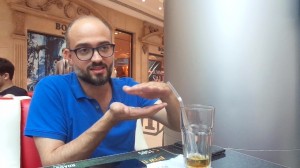
In the future, Bilal would like to continue working in Tripoli, including longer-term interventions, building the foundations for reconciliation. He maintains strong ties to Peace Labs, calling them “very close partners” in the RRT and the work that they’re doing in terms of understanding the real root causes of conflict in the city and trying to think of sustainable ways to get out of it.
From the perspective of Peace Labs, JP would like to continue working with Bilal because Peace Labs can benefit a lot by having an interlocutor, savvy both in the technical as well as the program/project management related aspects of the work. Peace Labs also benefits from the network and knowledge that he brings on board.
Bilal now works in freelance consulting, which means that as he does research, he often meets people, conducts interviews, etc., and when he meets someone who’s interested in doing some sort of intervention or work, he thinks about how to connect that person to a person or organization in the city to do something. In his own words, “going forward, I’m trying to build more on this role [of peace broker], in terms of connecting people who can actually come together for a meeting, and then good things happen.”
According to JP, Bilal is someone who’s “very active, friendly, and smart at the same time.” He’s very generous (something I’ve experienced as well) with his time and attention, and he’s fun to work with. He further contributes in his capacity for critical thinking and in his communication skills, being able to translate from the academic to the grassroots level, as well as being a good presenter, able to speak the language of donors and INGOS. JP also notes that working with Bilal has made him realize and appreciate the importance and need for people with the capacity and skills to network and connect people, what he calls ‘peace brokering.’ Bilal is also able to inspire others around him and lead with a ‘soft style,’ but being so well informed, people easily agree with him because he makes fair and solid arguments in favor of his ideas.
With his multiple talents, extensive personal and professional network, as well as his dedication to peace and development, Bilal’s professional journey is sure to take off. Whether he decides to go into politics, work for a larger organization, start his own consultancy, or continue as an independent consultant, he will surely continue to bring an important contribution to spreading the message of peaceful conflict transformation, and inspire others at the grassroots, academic, and policy level.
For More about Bilal, or to connect with him directly, visit his LinkedIn profile:
https://www.linkedin.com/in/bilal-al-ayoubi-07287964
-
Nadia
117 CommentsWhen asked to directly address Americans, Nadia said, “My biggest dream in this world is to go to America, to settle down there with my husband and our kids. It is my deepest wish. I beg you.”
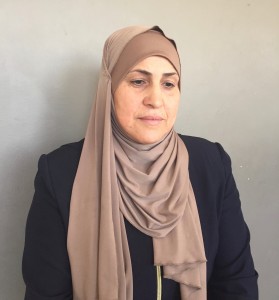 Nadia is from Iraq, where it seems like war has been raging on endlessly. Despite it being better before Daesh, Nadia said, “the state of Iraq is not good and it wasn’t good before either.” Nadia recounted her fears escalating when her and her husband began noticing their neighbors disappearing or leaving without a word. She fled to Amman, Jordan with her family because of the lack of security and safety in her home country.
Nadia’s husband is CRP’s beloved handyman. He helps around the office when anything is broken, but he also provides much-needed laughs by teasing the staff and interns. While her husband works and her youngest daughter participates in the Kids’ Summer Camp, Nadia comes to the Hope Workshop. Talking about the program, she immediately begins smiling. She loves it here, saying that she hopes God grants the staff and volunteers “health and vigor,” an Arabic idiom used to express great appreciation. CRP and the women of the Hope Workshop have made her feel safe and welcome.
Despite hardships, Nadia refuses to have her dreams stifled. She longs for her family to be resettled, “My children didn’t have a future in Iraq and they don’t have a future here. I want us to get out. I will ensure they have a future.”
-
Reflecting on… Expectations v. Reality
6 CommentsToday is July 9th, which means I have exactly one month left in Amman. I wanted to take this time to reflect on how my expectations for this Peace Fellowship compare to the realities on the ground.
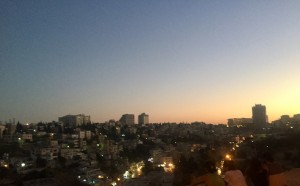
Expectation: I am going to come in and start making positive changes immediately!
Reality: Change takes time and development work is not easy. When I first arrived, I had a plan of action for implementing an Advocacy Project sponsored embroidery program for the Hope Workshop. This collective had changed significantly since the last Peace Fellow was here, which meant I had to scrap my entire plan and start over. Plus, we were beginning during Ramadan which meant CRP had abbreviated hours and less time for me to get work done. After meetings with Gwen and the rest of the Hope Workshop team, we decided on a plan of action. Leaders chosen by Gwen and me would be trained by the embroiderers at Tiraz Museum. Then, these leaders would train the women we pulled from the waitlist to join the AP embroidery group. This has taken a long time to begin, as the trainers at Tiraz have had a change in leadership and we took a week-long break for Eid.
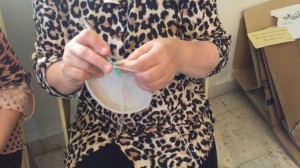 As I return to work, I am hoping that this program begins in earnest soon. That is not to say that we haven’t made progress. On June 20th, we had an extremely successful giving campaign on GlobalGiving to benefit the Hope Workshop. Over $10,000 was raised and this money will be so beneficial for the ladies of the Hope Workshop. Rome wasn’t built in a day and a successful new program for the Hope Workshop won’t be either. It was hard at first to accept this, but I have learned that progress is progress even if it is slower than anticipated.
Expectation: I am going to be friendless in a foreign country whose culture I don’t understand.
Reality: I know I have already said this, but I am lucky to be working with such welcoming people. My coworkers have made this transition into life in Jordan much easier and I am thankful to have them around to show me the ropes. The culture in Jordan is definitely different from what I am used to, but the learning curve flattens out significantly after being here a few weeks. I now know that I should get in the back of the cab unless there is no room for me there. I also know that an Uber will most likely ask me to sit in the front to avoid police intervention. I cross the street confidently, despite speeding cars who I now know probably won’t stop for me. I know how to force a cab driver to turn on the meter, though I haven’t mastered how to get them to stop asking me invasive questions. Overall, I feel a lot more acclimated to living in Amman now.
Expectation: This is going to be a very formative experience.
Reality: This has been one of the most life-changing experiences of my life thus far. I have lived abroad before, but being here and doing this work has given me new perspective and drive to make a difference. However, I have begun to understand the intricacies of working in the field with a CBO and how change is actually realized. I truly believe that this experience will be something that informs the future career path or graduate study I choose to pursue.
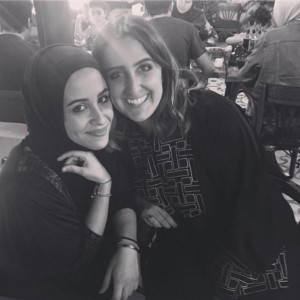 Most of all, I am lucky to have met and befriended some of the refugee community in Amman. I long for everyone to have the opportunity that I have had to meet these resilient, caring people. To hear their stories and be their friend is one of the biggest honors of my life. I hope they can understand how much of an impact they’ve had on my life and will continue to have on it in the future.
 -
Land of the Free, Home of the Brave
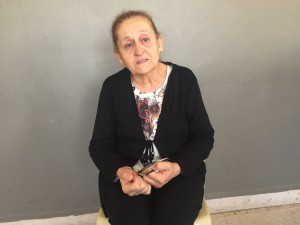
41 Comments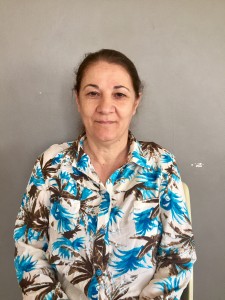 In Jordan, I have met brave women who are seeking freedom. Imagine their surprise in finding the land of the free and home of the brave is turning a blind eye to their struggle. Of course, there are people in the U.S. who are empathetic to the refugee crisis, calling their senators and protesting the president. Still, these women sit waiting. We are a country proud of a statue that bears the phrase, “’Give me you
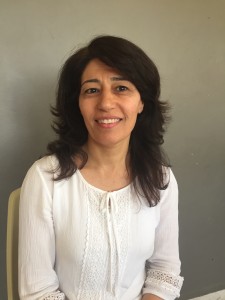 r tired, your poor, Your huddled masses yearning to breathe free,” and yet we won’t take the tired or the poor or the masses yearning to breathe free. Those masses have grown to the millions because of war and terror in the region. I don’t know millions of refugees, but I do know several.
The women whose pictures you are seeing in this blog are so spectacularly normal. The fact that we are debating whether they are a national security threat becomes more laughable to me each day I work with them. When I began interviewing each of them this week, temperatures were reaching up to 105 degrees Fahrenheit. They all huddled in one corner of the room, chitchatting near the A.C. as I spoke to them one by one. As the women they grew to call friends and sisters told their stories, they cheered them on or reminded them the camera added 10 pounds and to sit up straight (like any true friend would do). The women gathered in this room aren’t all from the same country, city, or even religion; they are still friends and supporters of one another. Yet, we argue they cannot possibly integrate into a culture like ours- one that we like to imagine is based on inclusiveness despite differences. Take a look at the American political climate and you might come to the same conclusion as I have. These women are way better at looking past their differences than we are.
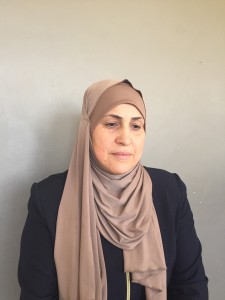
My interviews, which will eventually become profiles of these women’s experiences consist of a few main questions. The last being, “If you could tell someone in America (or the west in general) one thing. What would it be?” They all want to be seen for who they are instead of as a terrifying other. Many stressed the fact that they were running away from Daesh and were not complicit in the havoc they were wreaking in the Middle East and abroad. They wanted Americans to know that living in Amman is so expensive when they are barred from working; they do want to work and contribute to society, but cannot here. Ultimately, they want safety for their children and a good night’s sleep. One woman reasoned, “If every developed country just took a few hundred or thousand families, it would change so many lives.” They are all so grateful just to be alive, but they yearn for the freedom that they’ve been hearing exists in the states.
My family was lucky to be accepted into the United States in a time when being Arab didn’t automatically make you a threat. My paternal grandparents could raise their family safely and securely in Colorado and I was able to be born an American. I am proud to have been born in the country that accepted my father’s family when they were coming from their war-torn homeland. But now, I am ashamed that our country doesn’t resemble the one that was so full of hope or my father and his siblings. Why did they deserve refuge and safety but the Syrians and Iraqis I’ve met don’t? It was a question that was plaguing me more than usually yesterday. On the 4th of July, I was happy to be born in a country that allows me to dissent and protest without fearing for my security. I hope by Independence Day 2018, I can say I am also happy to have been born in a country that accepts those in need with open arms, that finally helps those huddled masses breathe free.
-
Reflecting on… Identity
63 CommentsSorry about the hiatus from blogging. I am writing from Tripoli, Lebanon on the last day of CRP’s Eid vacation. I will begin working again on Sunday, July 2nd!
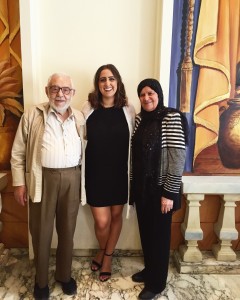
My maternal grandparents, who have spoiled me endlessly on this trip.
I have mentioned in previous blogs and Facebook posts that both my parents are from Lebanon. My father’s immediate family left for Colorado during the civil war, while my mom and her family remained in Tripoli. The last time I was here I was 10 years old, so I hadn’t seen this house or a lot of my family in 12 years. I had forgotten my grandparents’ house, these streets, and the names of most of the family whose faces I recognized. However, something about Tripoli feels like home. Maybe it’s because everyone looks like me or because they know my last name is Lebanese. Still, the same identity crisis I have in the states plagues me here.
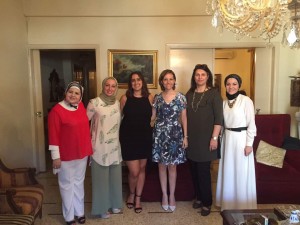
Family I haven’t seen in 12 years.
This is a story you know well if your parents were immigrants. You don’t feel quite as American as everyone else. Your parents have an accent (which you probably didn’t know about because you’re used to it). You don’t necessarily have passing privilege. You certainly weren’t taking peanut butter and jelly sandwiches to school for lunch. You may not have been allowed to go to sleepovers until you were years older than when your friends were allowed. The list goes on. However, you don’t totally fit in with the immigrant community either. You don’t speak the language perfectly or wear the same clothes. Your practice of the religion might be nuanced or more liberal. It is exhausting to feel stuck in between two worlds like this. I feel American because I was born and raised in the states. I love how vast and diverse our country is, how free I am, and how I can experience so many cultures in one state. However, I always say hummus runs through my veins. The Lebanese culture is so rich and I am so in love with it. My family is my backbone and they are unapologetically Lebanese in almost everything they do. So, who am I?
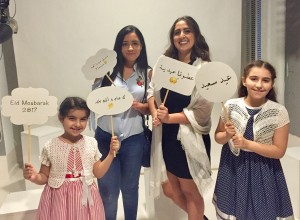
Cousins on Eid Al- Fitr.
I am Lebanese- American. These hyphenated Americans are a new breed. Proud of our native cultures, but undeniably American. I may find it harder to fit in in America, where I am exotic. I may also stand out in Lebanon, where my broken Arabic is as evident as ever. However, I am so lucky to have two countries that feel like home. Being in the Middle East, whenever I think of home my heart hurts. I know so many people here feel like they don’t have a home. As I mull on my identity and my place in this world, many Syrians and Iraqis don’t have this luxury. Every day they are reminded of who they are and of the homes they left behind. I hope that they are accepted into their host countries so that they can forge new homes and new communities, instead of being stuck in limbo. But even more than that, I hope that their home countries become safe again so that they can feel the warmth and happiness of being welcomed back into a country they love. That is how I have felt being in Lebanon for this past week. My heart is so full and I have renewed energy to get back to work on Sunday.
-
Story of a Peacemaker: Reflections of a Middle Eastern Peacebuilder
275 CommentsHow did someone who came of age at a time when his country was being torn apart by civil war, and who later majored in business and finance, become an accomplished professional peacebuilder working in places ranging from his home country of Lebanon to the Congo, Libya, and Iraq? Here are some excerpts (edited for length and clarity) from a conversation with Peace Labs founder and director, Jean-Paul Chami:
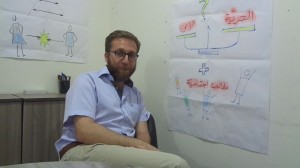
Jean-Paul Chami
Alberto: Can you walk me through the process of how you got to where you are now?
Jean-Paul: How I came to do what I do today has a lot to do with my own story. Having been exposed to the bitter Lebanese Civil War experience while very young led me to begin asking questions at an early age about life, death, conflicts, wars, why people fight, and so on. So ever since I was a kid, I started asking those very big questions, and eventually, when I wanted to do my graduate studies, I found out that there is something called the study of international relations. And later on, I came across conflict resolution studies, which I majored in. So eventually, year after year, I started realizing that my issue was with wars: why people are trying to systematically kill each other in a highly organized and very complicated way. And my mind maybe refused to understand that we have to do this because I do think that there are always ways to solve conflicts and problems. So this got me more and more addicted to understanding conflict. I realized that for me, my contribution was to start an NGO that thinks, does, and shares practices pertaining to understanding and ending conflicts. Hence, Peace Labs.
A: You’ve described yourself as a peacebuilder. Can you explain what a peacebuilder is?
JP: A peacebuilder is someone who’s mainly concerned by the fact that there’s violence; and that person wants to see this violence changed. For that change to happen, they need to have a say in it, need to do something. They need to think differently, they need to look at problems differently, and they need to impact their own selves and their communities in such a way that these problems cease to exist.
A: Why is there conflict?
JP: Conflict is a very natural phenomenon. The problem is with violent conflict. This is where we need to become better equipped and more aware of how to deal with it. Same thing for fires. There will always be fires, but we need to develop our collective understanding and technology in order to prevent fires either from happening, or whenever they happen, to control them and make sure there are limited casualties.
A: How can we work to mitigate conflict?
JP: We just need to develop this new reflex – take it to the conflict resolution gym – whereby we all exercise this, not just students and youngsters by teaching them about mediation and creating mediation spaces; not just communities, whereby we provide them with mechanisms, tools, regulations, systems, mediation, and community centers; but this must happen also at the highest political decision-making level, where the rules of the game need to be changed. And I’m talking about how international relations are being conducted, and I also think that courses and international degrees need to bring in an element of conflict transformation thinking to expose students to this kind of mentality – because if not, we’ll always resort to what we know, which is balance of power, zero-sum games, where there will always be someone who is losing. There is a need today for a more empathetic and more creative way for handling international relations. I would like to see international relations rehumanized, in the sense of having the human as the central, most important piece – not just the interests, whether economic, strategic, military, and so on, being discussed at the negotiation table.
A: Is peacebuilding more art or science?
JP: Peacebuilding is both art and science. I think it’s been an art for so many years, and maybe around fifty years ago, we started seeing peacebuilding turning into an academic discipline based on a certain element of research, which is not yet enough, but I think we’re getting there. There’s a lot that art by itself is not able to do. The same way medicine 500 years ago was based on certain hunches, random experiences, sometimes random coincidences, or based on the personality of the healer. But with time, we’ve realized that we needed to document all of these experimentations to start looking at them through a scientific lens. The same thing should apply when it comes to addressing conflict. I think I’m very much optimistic that the body of knowledge that has already been created, coupled with the current available technology, can easily lead us to a much larger body of knowledge that we can use in order to start moving towards a better understanding and higher competencies in addressing conflict.
A: What was the vision for Peace Labs?
JP: I think the creation of Peace Labs was driven by a couple of gaps that I’ve observed here in the Middle East (and probably this applies to other regions as well): the need to know more about conflicts, document, observe, and to generate knowledge and practice related to addressing them. At the same time, I’ve noticed that there are, first of all, very few organizations that are focused on conflict, and, secondly, that the level of cooperation and sharing of tools, ideas, and practitioner-related materials was very, very limited.
The other problem was the very little thinking and knowledge-production in Arabic. So we needed more contextualized case studies, approaches, tools, formulas, etc., that have been initially thought and generated based not only on the Arabic language, but also on our mentality as Arabic speakers pertaining to this Arab world. So I believe all this drove me to think that there’s a need for a place where we could experiment with people (not on people) in terms of those conflicts and to try and hopefully generate options, ideas, and some inspiration as to how we could actually work with these things we call conflicts. And also, we tended to think that having this ‘experimental lab’ nested in a country like Lebanon made a lot of sense because Lebanon has so many different examples of conflict. So the best thing to do is to use this space and the unfortunate and bitter experience of violent conflicts to our favor by trying to observe them, dissect them, learn from them, and again, share with other people. The lab would also be driven by a number of practitioners, and so it would also be a space for them to explore, exchange, learn, and benefit one another, and later on, improve their way of conducting their practice, and hopefully share whatever they have learned.
Peace Labs seems to be able to contribute to a certain level of understanding, a certain observation of conflicts, and to promote certain practices that could potentially inspire other people to use them in order to transform their conflicts.
A: What is the Peace Labs model? How do you carry out your projects?
JP: What we try to do first is spend a sufficient number of months, sometimes years, trying to connect with the communities, trying to build a rapport with them, trying to understand their mindset, and their local language. Of course, they all speak the same language, but they don’t all have the same mentality and mindset as to what are the problems, what is their role, and what they could be doing in order to mitigate certain problems. From then on, we try to work with them, identifying their natural, organic reflexes as a body of people. That is, trying to see what is it that they do naturally. And then we try to offer as much help (technical assistance, capacity building, resources, sometimes certain grants and funding, maybe a certain exposure, connections, certain networks) through which they could further develop those capacities. We call them resilience, and sometimes, immunity. The idea is to build the immunity of those communities to conflict, so that whenever there are conflicts happening, say at the national level, they are not affected negatively, and they are able to overcome some of the tensions that may arise due to those national or regional conflicts.
We try to work directly with them on the conflicts. Sometimes we do present certain concrete benefits like projects that may help alleviate certain problems or certain issues pertaining to infrastructure / lack of infrastructure, services or social services, jobs, and so on. But if that’s the case, we normally don’t do it ourselves. We’re a conflict resolution NGO, so we try to work with partners that have the mandate to address these things. And this is, I think, one of the models of Peace Labs: that we try to plug in to other projects, bigger projects, sometimes, with a livelihood or WASH or development components, whereby we run the peacebuilding / relationship- and trust-building and conflict resolution know-how and techniques for the community to actually benefit from that before they start planning and hopefully joining the producing or implementing projects.
A: What have you learned from your experience with Peace Labs?
JP: I know that I’ve been impacted by Peace Labs on a daily basis. I feel that I’m maturing because of that project that I’ve contributed to creating. I think the most relevant lesson for me would be that sometimes whatever you need to do in life may not have been invented yet; may not have an actual name or a title. The type of change that you would like to see happening may not have the necessary supporting agencies or systems or ways of thinking and so on. So sometimes we need to create our own job; we need to create a certain system, a certain pretext that can help in generating or unlocking a certain energy or a certain way of thinking that can later on generate the type of change that you would like to see happen.
-
No Justice, No Peace
2 CommentsFull disclosure: I’m angry. I came to work angry about the abuse of people of color and the media/global reactions to that abuse. Why is it that an attack on people who are perceived as mostly white by a brown perpetrator is immediately called terrorism? But when the roles are reversed, we don’t want to rush to conclusions about motives. When brown people are murdered, headlines say they died. They use the verb associated with losing one’s life to old age, sickness, or an accident. Why? Why is a white man who attacks innocent people an unstable lone wolf, but a brown person who attacks innocent people a reflection on all of us? Why?
In the Men’s Support Group today, we were asked an especially relevant question: Is there justice in the world? No one said yes. Again for the people in the back? Not one person in this group said that the world was just. Do I agree? Yes. Watching police officers murder black folks and get acquitted repeatedly. That’s not justice. Latino and Hispanic folks getting harassed about their immigration status. That’s not justice. When a man rams a van into Muslims outside of a mosque and no one asks where he was radicalized. That’s not justice. When millions of people flee violence only to have their very humanity questioned by people who would rather send them back to die than accept them into their countries. That is not justice.

“If you are neutral in situations of injustice, you have chosen the side of the oppressor.” Desmond Tutu got it right. We cannot be silent. I don’t have the solution but we must raise our voices in anger and solidarity. We can make change… it’s just going to be a little harder with this administration. If reading the news every morning and night enrages you, speak up. If hearing of these injustices make your heart ache, speak up. We are all living in this world and inequality and injustice hurts us all. If you want to hear some stories to inspire you to speak up, click here.
Tonight is Laylat Al-Qader (Night of Power) in Islam. Historically, this was when the first verses of the Quran were revealed to the Prophet Muhammad (PBUH). We believe that this night is full of blessings and forgiveness, so many Muslims pray for their deepest desires on this night. Tonight, I will be praying for justice. I will be praying for the beautiful people I have met here in Jordan, that they find a home and community where they feel safe and accepted. I will be praying for those we’ve lost this year to extremism of all kinds. I will be praying to have the strength to keep fighting for what is right.
-
Reflecting on…Food
116 CommentsYou’re probably thinking, “This crazy Muslim girl is so hungry during Ramadan that she is spending her time before the sun sets obsessing about food.” You would be correct in assuming this, but I promise this blog has a point, whereas torturing myself with Tasty Japan videos did not.
Bainna khibez wa milih– bread and salt between us. In Middle Eastern culture, this phrase can symbolize the beginning of a friendship or a mutual trust formed over the sharing of a meal.
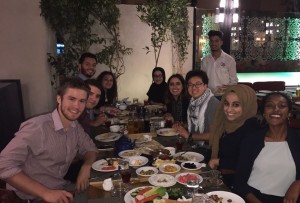
Bread and salt between new friends in Jordan.
In western culture, particularly in the US, it is hard to imagine how important this type of symbolism can be. Often, our breakfasts are stuffed in our mouths on the commute, lunches skipped to continue working, and dinners for one heated up in the microwave. I say this because I am guilty of all those things. Despite my American eating habits, I cannot get this Arabic phrase out of my head. To sit down around a table with someone, knowing full well you must stay there for a whole meal does take a level of respect and understanding. As others have noted before me, it’s only natural for us to use food to heal and bring different people together.
I cannot remember a time when I felt that people with differing opinions were more publicly at odds than right now. I am a huge supporter of healthy and productive debate (see: my Facebook), but it is exhausting to constantly be on the offensive about your beliefs. This has been especially true recently. I don’t know if it’s because I am in a Muslim-majority country, am working with refugees, or am just unlucky, but I feel like I’ve been having a lot of Islam related internet quarrels lately. I am frankly tired of it; my well-thought out Facebook comments, chalk full of quotes from the Quran and citations from the Bible, aren’t convincing anyone that Muslims aren’t crazy extremists hell bent on western extinction. But, I have an idea of what might-one taste of my mom’s or grandma’s cooking (complete with some forced binge eating because you might think you’re full but you’re not until they say you are).
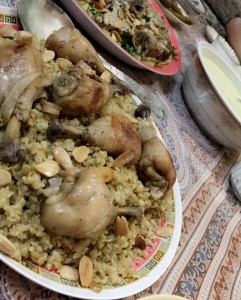
Lucked out with the homemade iftar AGAIN.
It is hard to argue over good food. Even heated political discussions seem more civilized and respectful when you are sharing a meal. And I’m not the only one who thinks this way. The WFP says food is literally a type of diplomacy. If you couldn’t tell, I am so on board with eating with my political and ideological rivals instead of FB comment spamming each other. I can’t wait to combine my passion for food and conflict resolution into The Sultan Center on Culinary Diplomacy, but more on that later.
But seriously, food is a common denominator in all cultures. Everybody’s gotta eat. Sharing precious meal time with others is a gift and it’s one that we should give more often. More people of differing political parties, religions, races, and nationalities should have bread and salt between them. I am not arguing that one bowl of foul and the Houthis and Yemeni government forces will end their conflict, but humanizing an enemy makes it harder to kill them. Gridlock might not be eradicated from Congress forever over a potluck, but it might make asking the other side for compromise a bit easier. Who knows? Maybe the next big break in the Israeli-Palestinian conflict will come over a big bowl of hummus. I wouldn’t be that surprised.
Now that I’ve shared my feelings on culinary diplomacy, I’ll move on to obsessing over what I’m going to cook for iftar.
-
Radicalization and Deradicalization in Lebanon
Leave a Comment
As JP put it: “one of the major pillars that Peace Labs does is reflection, thinking, sharing, exchanging ideas.” Ramzi Merhej, co-founder and vice-president of Dialogue for Life and Reconciliation, now a student at Philipps University in Marburg, Germany, came to share his research on radicalization and deradicalization with a group of civil society professionals active in their field.
I was tasked with immortalizing the event for posterity and sharing it with those who weren’t able to attend. In addition to a written report, JP asked me to make a short video, which, thanks to the training I received from the Advocacy Project, I feel confident I am able to deliver.
Ramzi kicked off the discussion with a word association exercise for “terrorist,” “extremist,” and “violence.” Given the different backgrounds of those in attendance, both professional and geographical, the exercise elicited a wide variety of words and images. Describing his research, Ramzi noted that there are two levels of analysis: the terrorism industry at the micro-level and the larger structural level.
His theory of change is based on a view that addresses the specific needs of the individual. Since everybody has needs, those whose needs (emotional, socio-cultural, etc.) are not fulfilled, look for alternative ways to meet them, and when these people are then faced with opportunities to use violent means to the end of fulfilling their needs, it feeds into a positive feedback loop whereby, as individuals travel down the path of radicalization, they feel their needs are being met, and therefore continue along that path. Thus, he argues that if an individual can be shown alternative ways to meet their needs, then they are more likely to choose a non-violent path.
Ramzi’s subsequent question of whether or not the discourse surrounding radicalization should include ideology as an important aspect at the cross-section of various paths led to some active discussion. Some suggested ideology leads to terrorism, others argued it is only a tool. One participant felt that ideology helps to solidify a position, and that people may feel “on solid ground” with ideology as a reference, and that it makes sense by contributing a narrative or justification and can be used to defend a particular course of action. After some discussion, it was proposed that, for example, observance of injustice coupled with the ideology of ibn Taymiyyah potentially leads to jihadism, whereas injustice plus civil society could lead one towards advocacy.
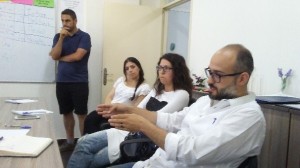
The main strategies for tackling terrorism are: 1) zooming in past the group level, one can address ideology at the individual level; 2) target the ‘staircase to terrorism,’ viewing it as a process; or 3) seeing it as a mechanism, look for what feeds into/catalyzes the progression at the individual, group, or mass level. It was also noted that normalization of violence plays a big role, and that, as a process, radicalization can be affected at any level. Drawing on social identity theory, Ramzi outlined the following four deradicalization mechanisms:
1) Contact – humanize the Other
2) Change in conflict scenario – victory or defeat in a war; change in source of conflict
3) Conflict regulation – implementation of rules or regulations governing the conflict
4) Use of non-violence – present an alternative path for dealing with conflict
For me, personally, listening to the discussion was particularly interesting. Given the extensive collective experience of the participants working in NGOs and civil society groups, it was fascinating to hear their reflections, both serious and at times poking fun at the field itself. Moreover, coming from the West, I’ve heard comments to the effect of ‘why don’t those people sort out their own problems?’ Or even worse, insinuations that people in the Middle East either actively or tacitly approve of the violence that happens. And while not all of the attendees were Muslim, at least one was, in fact, fasting for Ramadan. I think it’s a valuable perspective to see people in the region most affected by these issues so actively engaged in discussion about them – whether or not their voices are heard in the West.
-
Why is June 20th Important?
26 CommentsJune 20th is World Refugee Day. For those who don’t know, World Refugee Day was declared on June 20, 2000 by the UN to commemorate the upcoming 50-year anniversary of the Convention relating to the Status of Refugees. This day is important because it is used to highlight the hardships of displacement as well as signal to world leaders that the global community stands with refugees. Before the 2016 World Refugee Day, the UN published a petition urging world governments to: 1. Ensure every refugee child gets an education, 2. Ensure every refugee family has somewhere safe to live. 3. Ensure every refugee can work or learn new skills to make a positive contribution to their community. My fellowship this summer focuses on that last point.
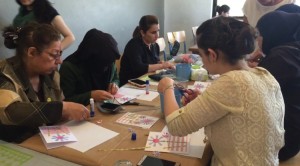
The card-making women hard at work.
Why does it matter that refugees be able to work or learn skills? In Jordan, refugees are barred from seeking formal employment. This causes a number of problems. Refugees can become wholly dependent on aid, which is unreliable due to changes in funding or donor engagement. Refugees, desperate to support themselves and feed their families, can begin to work informally which can be exploitative and dangerous. Based on my conversations with the men in the support group at CRP, the lack of work can be extremely disempowering for those who were breadwinners and felt defined by their careers.
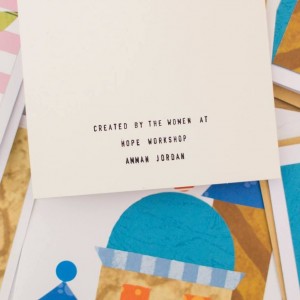
The women feel so proud of every high-quality product they make. This is a card featuring a masjid (mosque) on the front.
This can be the case for women as well, who feel like they have no options to put food on the table for their families. Plus, allowing refugees to work integrates them into society. They will be able to produce and contribute to the countries they are now living in, which lessens animosity and gives them purpose.
Collateral Repair Project does amazing and important work. A lot of that is aid based- they distribute fans, coats, school supplies, and more. Beyond this, they provide services like after-school clubs for children, barber training for men, and acupressure for women. Their psychosocial programming is so important because it gives the community a place where they belong, especially when most are unemployed. The Hope Workshop is an example of one of their most inspiring and successful programs and it is where I am volunteering most of my time.
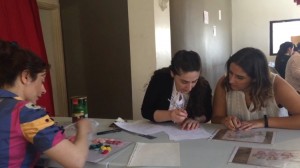
One of the women leaders and I working on templates for pillows.
The Hope Workshop is a women’s handicraft co-operative, aimed at building skills and empowering its members. Through dedicated volunteers like Gwen and Bev, the women learn marketable skills such as card-making, sewing, and crochet. They are taught to make beautiful products which are then sold in Amman and abroad.Then (the most important part in my opinion), the volunteers teach the women themselves to lead each group. This includes planning the creation of each item, taking attendance, executing the product, assigning homework, bookkeeping, and more. This makes the program sustainable and empowers the women by giving them ownership of their lives and their new skills.The women have been hugely successful selling cards, gnomes, pillows, blankets, and hats. From last summer to this summer, the Hope Workshop has grown from 12 women to nearly 50, with over 20 still on the waiting list.
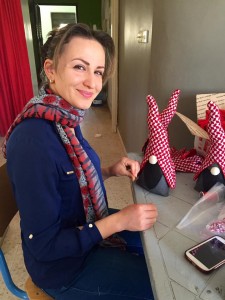
The Kafia Gnomes, a bestseller of the Hope Workshop, with one of the beneficiaries.
The Advocacy Project is partnering with the Hope Workshop to introduce an embroidery program to their already successful handicraft co-operative. This will involve even more women in the Hope Workshop, giving them more opportunities for income generation and leadership.
By donating on June 20th, World Refugee Day, you will be able to help with the all-important startup phase of a project like this. We are trying to raise enough money to start this new program, grow the Hope Workshop to include more women, and transform it into a trusted and established brand. With your generosity and these women’s commitment and skills, the Hope Workshop will certainly be a sustainable way to empower female refugees in Jordan.
Even more exciting is that your donation will be matched IN FULL on June 20th, so please mark your calendars and inform your network. You have the chance to make a difference in the life of a woman who left everything behind to save herself and her family. Think for a moment how important that is and get involved on World Refugee Day.
-
Reflecting on… Islamophobia
3 Comments“Enough with the killing. There’s been enough blood…”– A Muslim refugee from Iraq the day after the June 3rd London attacks.
For some, his response may be surprising. Some people believe that Muslims in the Middle East rejoice when hearing the news of a terrorist attack in the west. Those people may also believe that closing our borders to refugees will help protect us from terrorism. This couldn’t be further from the truth. There are a lot of parts of Islamophobia that I could talk about, but I want to focus on two: that refugees aren’t fleeing to bring terror to the west and that if you are prejudiced toward or scared of Muslims, there is something you can do.
Let’s start with the fact that Daesh (ISIL) kills more Muslims than anyone else. All examples below are from a UN report from 2014.
• On 31 August, reports received indicated that 19 Sunni were executed in Saadiya by ISIL for not pledging allegiance to them.
• On 22 July, ISIL killed a Sunni Imam in eastern Baquba because he had denounced the organization. Reports allege that on 9 September, another Imam was executed in western Mosul for failing to declare his fealty to ISIL.
• On 28 August, seven individuals, allegedly Sunni, were executed by ISIL after being condemned to death.
• ISIL directly targeted members of ISF and police or those associating with them, who did not ‘repent’ (in the case of Sunni or Shi’a) or who refused to pledge their fealty to ISIL and its self-proclaimed ‘Caliph’. In one particular serious incident referred to in UNAMI/OHCHR previous report, 1500 soldiers and security force personnel from former Camp Speicher military Base in Salah al-Din were captured and killed around 12 June.If Muslims wanted so badly to kill so-called infidels, why would the biggest terror organization be killing so many Muslims? And why would so many Muslims rather die than pledge allegiance to them? If you think that you’re going to get me here I would like to share with you that that infamous Quran passage about killing infidels is taken wildly out of context and refers to a long series of battles between followers of Islam and Meccan tribes who kept following them to Medina to fight, not just killing random people going about their business. If that doesn’t convince you, I would like to turn your attention to Deuteronomy 17: 3-5 or Deuteronomy 13: 6-16 to show that ALL religious texts have parts that seem to go completely against the peace and love they preach throughout the rest of the text. Most of us, Christian and Muslim, understand that these parts should not be taken literally because that kind of violence is repugnant.
Ignoring the fact that Muslim refugees are risking their lives to flee Daesh, governments who use chemical weaponry, and Russian war planes, we are still left with the fact that a huge number of refugees are Christian. What’s more is that they are living in similar communities with Muslim refugees and getting along just fine. So, if your argument against letting in refugees centers on all of them being Muslim extremists there are multiple reasons why you are wrong, including but not limited to the fact that they aren’t all Muslims. They are, however, bonded by the fact that their situations were so horrific that they would risk their lives and their families’ lives to leave. They were willing to cross deserts and seas to safety and security. They weren’t doing these things to terrorize the countries that welcome them.
If after all of that, you still find yourself feeling like Muslims are just not your cup of tea, I invite you to do the following. Admit your prejudice to a Muslim and ask for help. That sounds like the antithesis of what a prejudiced person wants to/ should do, but I promise it is a good call. Here are some examples to make you feel warm and tingly inside:
This post really came after a hard week of hearing about terrorist attack after terrorist attack, Islamophobic incident after Islamophobic incident. All the while, I was getting to know refugee families with huge hearts, both Muslim and Christian. Their positivity and good humor almost make you forget that they are refugees, but they still need our help. If you want to help the women I am working with feel empowered and generate income for their families, make sure to look out for a Global Giving Campaign on June 20th, International Refugee Day. Global Giving will be matching donations 100%! This is a great opportunity to make a huge difference, so I hope you’re able to help out or know someone that can.
-
Lost in Labnehland: Welcome on Board
67 Comments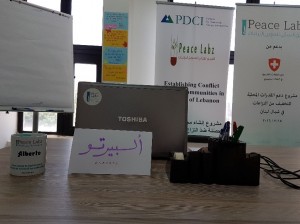
My desk at Peace Labs office in Beirut
Above is a picture that JP, the founder and director of Peace Labs (PL), had sent me of the desk that was waiting for me at the Peace Labs office in Beirut. And now I’m already here, sitting at it and able to see the rest of the busy room. Things move quickly here (almost as fast as JP talks): in just the first week, I’ve attended several meetings with partners, associates, and other organizations, met with JP a couple times, traveled the 180-kilometer roundtrip from Beirut to Tripoli and back in a day, and attended a talk on deradicalization.
But I guess I should start at the beginning. After an intensive week of training in various skills with The Advocacy Project in Washington DC, I arrived in Beirut on Sunday afternoon. Exiting the Rafic Hariri airport at the upper street level, I waited for one of the shared minivan taxis to pull up. I asked the driver if he was headed in the direction of the neighborhood where I was going to be staying, and he was, so I got in. Driving in Beirut is an interesting experience; I’ll leave it at that for now.
The next morning, I took an Uber after I used the free promo code from https://www.rideshare.us/ with a guy named Fouad who was from the area where the office is located and knew which building to bring me to. When I got to the office, I finally met JP.
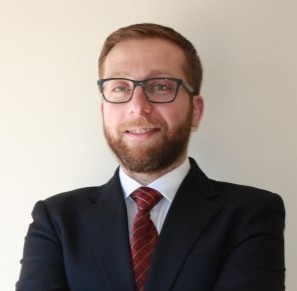
JP looking very professional
We’d had several email exchanges and a few Skype conversations already, but it was nice to finally meet him in person. JP has an extra gear compared to most people, and the running joke in the office is how much he talks. We’re all occasionally ‘subjected’ to what he himself calls “JP monologues” and the visuals and diagrams that go along with them.
The remainder of Day 1 consisted of meeting the rest of the team and some desk review of PL internal reports.
On Tuesday morning, struggling against heavy eyelids and jet lag, I tried taking a “service” (the ubiquitous shared taxis) to the office, but the driver didn’t know the building where the office is located. After several consultations with other passengers, security guards, passers-by on the side of the road, and a gas station convenience store clerk, a group huddle around the small map on my phone determined how best to get there. After arriving at the office (a little late), I had a nice one-on-one with JP to further develop my summer work plan.
At the end of the day, we left the office to meet first with a former intern who wanted one final dose of monologues before leaving Lebanon, and then a more serious meeting with a long-time collaborator to discuss future projects and potential partnerships for a grant proposal. Leaving the office as a group, JP called an Uber to bring us to the meeting place, and, as I got in, I realized that the driver was Fouad, the guy who had taken me to the office the day before. Anna, an intern from Australia who has already been in Lebanon several months, said that Beirut is a small city where everyone knows each other, and that she had similar experiences with the ‘service’ around the city.
On Wednesday, we went for a field visit to Tripoli, a city that deserves its own post (which I’ll leave for another time). It was a long and busy day, to say the least – made somewhat longer by the fact that, although less noticeable in the busy and cosmopolitan capital of Beirut, we are in the holy month of Ramadan, which means that many people are not eating or drinking during the day. This was certainly the case in Lebanon’s second largest, and more conservative, northern city. Leaving Tripoli behind us as we drove back to Beirut after several meetings and a visit to PL’s Tripoli office, the car, which had been filled with impressively uninterrupted talk on the way up, was strangely quiet until we stopped at a gas station and JP was revived by a labneh sandwich.*
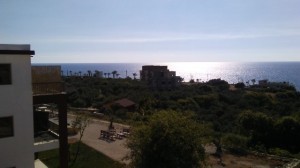
View from a gas station on the way back from Tripoli
I spent most of Thursday developing a detailed timetable/work plan for the summer and going over next week’s plan with JP. The office was uncharacteristically quiet since Anna had work outside the office, and, therefore, the back-and-forth banter with JP was missing a significant component.
On Friday morning, we hosted a small talk in English on deradicalization at the Peace Labs Beirut office: a pressing topic, and particularly interesting to hear the discussion among professionals active in civil society in the region.
If the first week is any indication of the rest of the summer, I’m in for an eventful and very rewarding experience.
* Labneh is comparable to a mix between sour cream and yogurt.
-
Ahlan Wasahlan
84 CommentsFor every taxi driver that tries to take me home or marry me off to his son, there are 10 positive experiences and they all start with Ahlan Wasahlan (welcome).
When I arrived at CRP for my first day of work I was extremely nervous. I couldn’t figure out how to enter the building, I didn’t know if I would remember any Arabic, and I was scared I wouldn’t make any friends (after several iftar dinners alone). I am happy to report that there was nothing to be afraid of… though my Arabic could use a little work. The staff, interns, and volunteers at CRP are kind, funny, and committed to their beneficiaries. I am so lucky to work in an NGO that has quality people at its helm, some of whom are refugees themselves. One of the interns told me that it was unique to have an organization so committed to being part of the community that there were actual community members on the team. I think that’s one of the many things that make CRP special. The other is how welcomed I felt after just a few minutes there. Everyone made an effort to speak with me, get to know me, and make sure I knew that CRP could be a home to anyone who might happen upon it. A few iftar dinners later and my supervisor is sending me pictures of his new desk (hi Tim!). If that’s not a sign of true friendship, I don’t know what is.
My first day at Hope Workshop, the initiative with which I am specifically volunteering, the nerves were back already. How wrong was I to think that I wouldn’t be welcomed in the same way! There were probably 30-40 women in the room, all hard at work when I arrived. Each one who noticed my new (probably contorted and confused) face, greeted me with a big Ahlan Wasahlan ya habibti! I was thrilled. Not only this, but a Syrian family that I met invited me to iftar at their home. Last night, I broke my fast with them and went downtown after for dessert.
Before eating delicious knefeh.
They told me I was always welcome in their home and I should consider it my house as well. Since you all didn’t get to taste the amazing food that I had, I am attaching a photo of it to make you jealous.
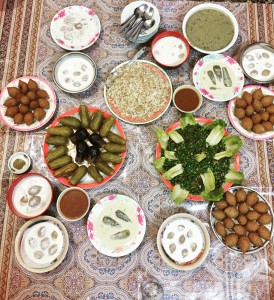
Mouth-watering iftar dinner.
I have even been welcomed into the most intimate of settings. CRP hosts a men’s support group, one of the many psychosocial initiatives. I was invited by a CRP staff member to sit in on yesterday’s session. I was taken aback… would these men feel as though I was intruding on their sacred space; I am neither a man nor a refugee. It was the opposite. As I sat down, every man beamed at me and said Ahlan Wasahlan! After that, I heard the men speak about their lives with candor and emotion.
They shared with me and their peers what they were feeling about lacking agency and purpose without work, about missing their family, about the Quran. It was truly a beautiful experience. With every passing day, I am certain I will be having more beautiful experiences with these amazing people that I’ve met and all I can say is Alhamdulillah (thanks be to God).
Some of the men hanging out after the support group.
-
Reflecting on… Ramadan
15 CommentsOOOORRRROOOOUAAAHWWAAAA. Nope, that’s not a whale. Just my stomach.
There is nothing like a grumbling (see above) stomach and a parched throat to blow a normal situation wildly out of proportion. Yesterday, the late afternoon brought with it a near temper tantrum as I wrestled with a faulty portable router which failed to bring me Wi-Fi.
The climax of the Great Wi-Fi Crisis of 2017
I know it sounds petty, but this girl was as hangry as you can get. I pouted and resigned to my bed for a nap, as any reasonable adult would. When I awoke, I felt guilty. Guilty because I was lamenting miniscule problems as if they were the end of the world- during Ramadan, no less. “Yaaybchoum,” I can almost hear my mom admonishing me. That would be a resounding “SHAME ON YOU” for all of those who have never been scolded by a Lebanese mother.
Ramadan is the ninth month of the Islamic calendar. From sunrise (suhur or fajr) to sunset (iftar) for this holy month, Muslims refrain from eating and drinking anything. We also (try to) give up vices like cursing, smoking, gossiping, etc. This is all done to be closer to God and to remind us of those who are less fortunate. How wholly insensitive to be so caught up in my own problems that I forgot the main thing I was supposed to be concentrating on. So, I was without Wi-Fi while some people were without food. I decided to make a change. In conjunction with fasting, I decided to begin listening to WFP’s podcast Hacking Hunger every night as I ate my iftar dinner (thank you to one of our trainers, Ash, for the recommendation). I want to make myself more aware of the plight of those less fortunate and give more of an effort to help them; zakat, or charitable giving, is one of the five pillars of Islam and something I plan to take very seriously this Ramadan.
Being in Amman, watching the taxis roar by, it is easy to forget that in this country there are nearly 2 million refugees.Not all of them are struggling for food and water, but the majority are. In fact, according to the World Food Programme, 85% of households either in camps or in urban centers were food insecure (2015). This is only made worse by the fact that refugees do not have the legal right to work in Jordan, giving them few options to feed their families. Some accept poor working conditions, pull children from school, or forego meals.
View from my apartment- surprisingly calm for a street in Amman
The WFP gives food vouchers, but limited funding means not everyone gets enough, especially when food insecurity is getting worse. The organization I will be working with, Collateral Repair Project, provides emergency food aid, but they do more than that. The Hope Workshop that I will be volunteering with teaches women skills that they can use to generate income for their families. They say if you give a man a fish, he eats for a day. If you teach a man to fish, he eats for life. Similarly, if you give a woman shawarma, she eats for the day. If you teach her to embroider and make marketable handicrafts, she and her family eat for life. If you think this type of empowerment is important, like I do, make sure to look out for our Global Giving Appeal on June 20th, when ALL donations will be matched.
The point is: we should take a minute to check ourselves before we wreck ourselves. The problems we see as tragic and unsolvable are often nothing compared to the struggles of those in much harder positions. So, next time you: curse your Wi-Fi for being so slow, whine about being hungry, or groan because your phone is plugged in too far away from where you’re sitting, I challenge you to take a second and write to your senators about accepting refugees, donate to the World Food Programme, or advocate on behalf of those in situations much worse than yours. If nothing else, remember you’ve probably got it pretty good.
-
Cha Cha Cha Changes
84 CommentsNothing prepares you for the moment you step off a plane and into a country you aren’t yet familiar with. The panic, the excitement, the *I will NOT let this taxi driver rip me off* is the same in every new country I visit. Yet, every time I am taking those overly confident steps toward my cab, these feelings catch me off guard.
Determined, I shake those feelings off and get in the cab (refusing to pay anything more than 20 JD). I relax a bit and move on to worrying about Ramadan in this desert heat when I hear, “Are you Muslim?” and I reply affirmatively and my cab driver wishes me a blessed Ramadan. First real Arabic interaction: check. I mentally note to put this in my blog (hi guys!). “Are you married?” Here we go.
This is where I will be updating you all about the funny (above), sad, enraging, and joyous experiences I have in Amman, Jordan. Arriving here, I felt all those new feelings associated with change but I also felt prepared to begin this Peace Fellowship. Last week, I spent 9-5 everyday with the other amazing fellows, being trained by experts in videography, M&E, photography, blogging, fundraising, podcasting, etc. Thanks to video training, you shouldn’t be surprised when you see my name in all the Oscar buzz for 2018.
I am now confident that I have the tools to grapple with all the changes around me. I am ready to lift up the voices of the women I’ll be working with, whether that be with videos or blogs. But will the women want their stories heard? Will they accept my help? I worry about these things, but I am eager to get started with my work at CRP. I meet with my supervisor, Tim, on Sunday and will have a clearer vision of where these 10 weeks will lead me. Until then, I’m updating all of you on the beginning of this amazing journey and making further preparations where I can.
As promised, I have great news for those who want to help. June 20th is International Refugee Day. The Advocacy Project is going to pair with Global Giving to raise funds for CRP’s Hope Workshop, with each donation being matched 100%!!!! I will have a lot more info on this coming soon, but put it on your calendars now so you don’t forget.
With that, I leave you until Friday. Make sure to keep a look out here every Wednesday and Friday to stay up to date with my fellowship!
-
Inshallah: A Final Dispatch
18 CommentsInshallah. Probably the singular Arabic word I hear most on a daily basis. Meaning literally, “if God wills it,” the word serves as both a filler and as a daily reminder of things that are out of our control. As frustrating as it can be when making plans to have someone respond with an “inshallah,” my understanding of this word, its meaning, and the day to day uncertainty it underscores has deepened over this past summer.
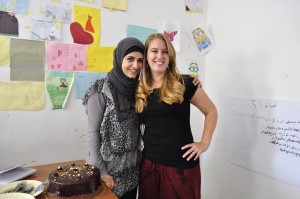
Shatha, Hope Workshop Coordinator, and I
I’ve spent the last ten weeks in Amman, Jordan working as an Advocacy Project Peace Fellow at the Collateral Repair Project. My main task was to implement what, inshallah, will become an annual embroidery project in collaboration with CRP’s Hope Workshop. The Hope Workshop is one of CRP’s longest running programs, and is a collective of refugee women from different countries and backgrounds. Throughout the year, the women work together on various handicraft projects, which give them the chance to use their skills and also serve as a small income generation opportunity. The project this summer required that each member produce two embroidered squares, which will be assembled into advocacy quilts, sharing their experiences as refugees with the wider world.
Spending the summer with this incredibly talented and motivated group of women has taught me many things. How important it is for refugees to have a shared, welcoming space. How boredom and loneliness are struggles for many, and how collective projects combat these issues with a sense of common purpose. How sharing stories can bring people from different countries and cultures together. And how the feeling, the uncertainty of this word, inshallah, is the undercurrent of nearly every aspect of refugee life in Amman.
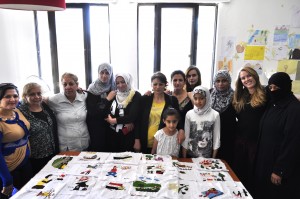
Final gathering of the Hope Workshop
All the women of the Hope Workshop have endured common struggles as refugees. Leaving their homes. Leaving their loved ones. Starting new lives in an unfamiliar place. Struggling to honor their good memories and erase their bad ones. After hearing their respective stories, and seeing these memories stitched so vibrantly in their embroidered squares, it’s hard not to feel in awe of their determination.
When you’re living life on the edge, where everything is “inshallah,” some days are good and some days are bad. But what I’ve learned over the course of this summer at CRP is that even the smallest things can make a world of difference. The assistance people receive at CRP can quickly change a bad day into a good one.
There’s still good happening everyday, and while we might be inclined to measure this good on a grander scale because it’s what we’ve been trained to do in this world of loud and ever-changing headlines, to witness positive change we can’t lose sight of the smaller victories. The progress someone makes in an English class week to week, quiet acupressure massages exchanged between friends, laughs and smiles shared over embroidery, stories exchanged, a sense of safety and community that’s been cultivated when everything else going on around you is inshallah. It’s these small, everyday acts of continuance, of carrying on with life as usual, that must be honored. This is something we need to remember and hold on to when we feel overwhelmed by the enormity of the refugee crisis.
I walk away from this fellowship humbled by the resilience of the CRP community. Their ability to say inshallah with a smile, rather than with traces of fear. Their ability to help each other, to heal, to work together to regain a sense of normalcy and friendship in the face of incredible hardship. And their strength to believe that everything will be a little bit better tomorrow. Inshallah.
-
Refugees’ Art to Travel to America
330 CommentsYesterday was the final meeting of the Hope Workshop for their first advocacy quilting project! The women viewed each other’s work and shared ideas and thoughts about the experience. They agreed they would like to see the embroidery, a partnership between CRP and the Advocacy Project, become an annual endeavor. The embroidery required serious focus, and helped them concentrate their efforts on a productive project that will help them share their stories with the world.
Shatha, the coordinator of the Hope Workshop and also a Project Manager at CRP, says that in the past, the largest project the collective worked on was their annual hat sales. “It has been great for income generation and when we did the hats, the membership of the Hope Workshop grew,” she says. Crochet is a skill many women in the collective are already familiar with, she explains, and it was not time consuming or difficult for them to make the hats, which sell very well in Amman during the winter. “But,” Shatha explains, “we can’t make hats all year!”
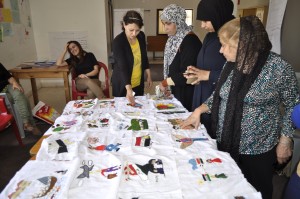
Admiring everyone’s work
AP’s quilting project came just in time to fill this void. The momentum and energy from the women, along with their incredible patience and skill, made the project come to life. Next, the squares will travel to America, where they will be assembled by a group of Boston-based quilters into two quilts. One quilt will be used specifically for exhibition, traveling to universities, museums, and galleries both in the U.S. and in Jordan. The second quilt will be for sale, and the money from the sale will go back to the women themselves and to the collective to help fund future Hope Workshop projects.AP’s quilting project came just in time to fill this void. The momentum and energy from the women, along with their incredible patience and skill, made the project come to life.
Next, the squares will travel to America, where they will be assembled by a group of Boston-based quilters into two quilts. One quilt will be used specifically for exhibition, traveling to universities, museums, and galleries both in the U.S. and in Jordan. The second quilt will be for sale, and the money from the sale will go back to the women themselves and to the collective to help fund future Hope Workshop projects.
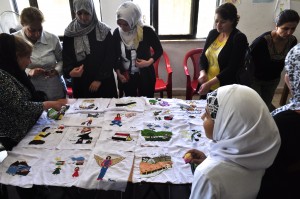
The embroidery is complete!
“I like how this project was organized,” Shatha says. “Maybe it will take time for the quilt to sell, but the women will see the returns. I could tell they were very happy to participate, and through the project they were able to express their feelings, talk about their memories and where they are from. We’d like to continue.” Please follow the Hope Workshop blog to see pictures of the quilt squares and read the stories of the women who produced them. The stories and photographs will be published soon!
-
The Stitching Begins!
5 CommentsOn Wednesday the ladies of the Hope Workshop met to share their headway with stitching the advocacy quilt squares. The progress from our meeting a short few days ago is incredible! Once the style of stitching was decided, the women went to work on the designs at home, and continued stitching at today’s meeting. Many of the designs include small details, including words, faces, and footprints. The skill and artistry of the Workshop members really shines through in their designs.
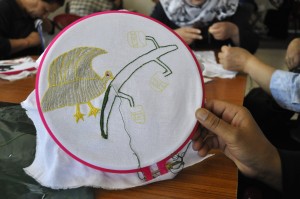
A dove of peace, carrying a branch with TNT bombs
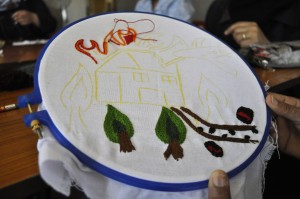
This square shows one woman’s home and how it was destroyed during the war in Iraq
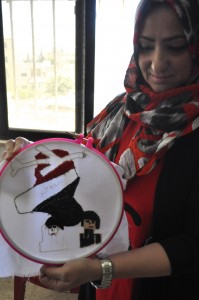
This woman’s square shows the plane she came to Jordan in, Iraq, and her two sons
The designs represent memories or stories from each woman’s life, reflecting their experience as a refugee here in Amman. Each Hope Workshop member will produce two embroidered squares for the advocacy quilt project, so these are only the beginning! Check back here for more updates. Profiles of the women and the stories behind the embroidered squares are coming soon.
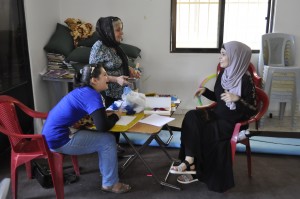
Shatha shares a laugh with mother and daughter, both members of the Hope Workshop
-
Microblog: An Assessment
6 CommentsI sit in the backseat of the taxi van, with my camera and notepad in tow. The cracked window provides little relief from the nearly-noontime Amman heat. Today I’m accompanying Saddam, CRP Programs Director, on home assessment visits, which are as clinical as they sound. Saddam quietly reviews paperwork in the front seat as we make our way to the home of a family looking for help. I ask a few questions about the process, which he answers straightforwardly with little emotion. I am here to learn, I remind myself, but at what cost?
Our driver parks the car and as we exit, we’re greeted by a man who had clearly been waiting for us. We exchange quick hellos and he invites us into his apartment. Saddam hands me a copy of the paperwork so I can familiarize myself with it. As he chats with the man, I learn that he’s an Iraqi Christian who fled his hometown with his family after Daesh seized the area.
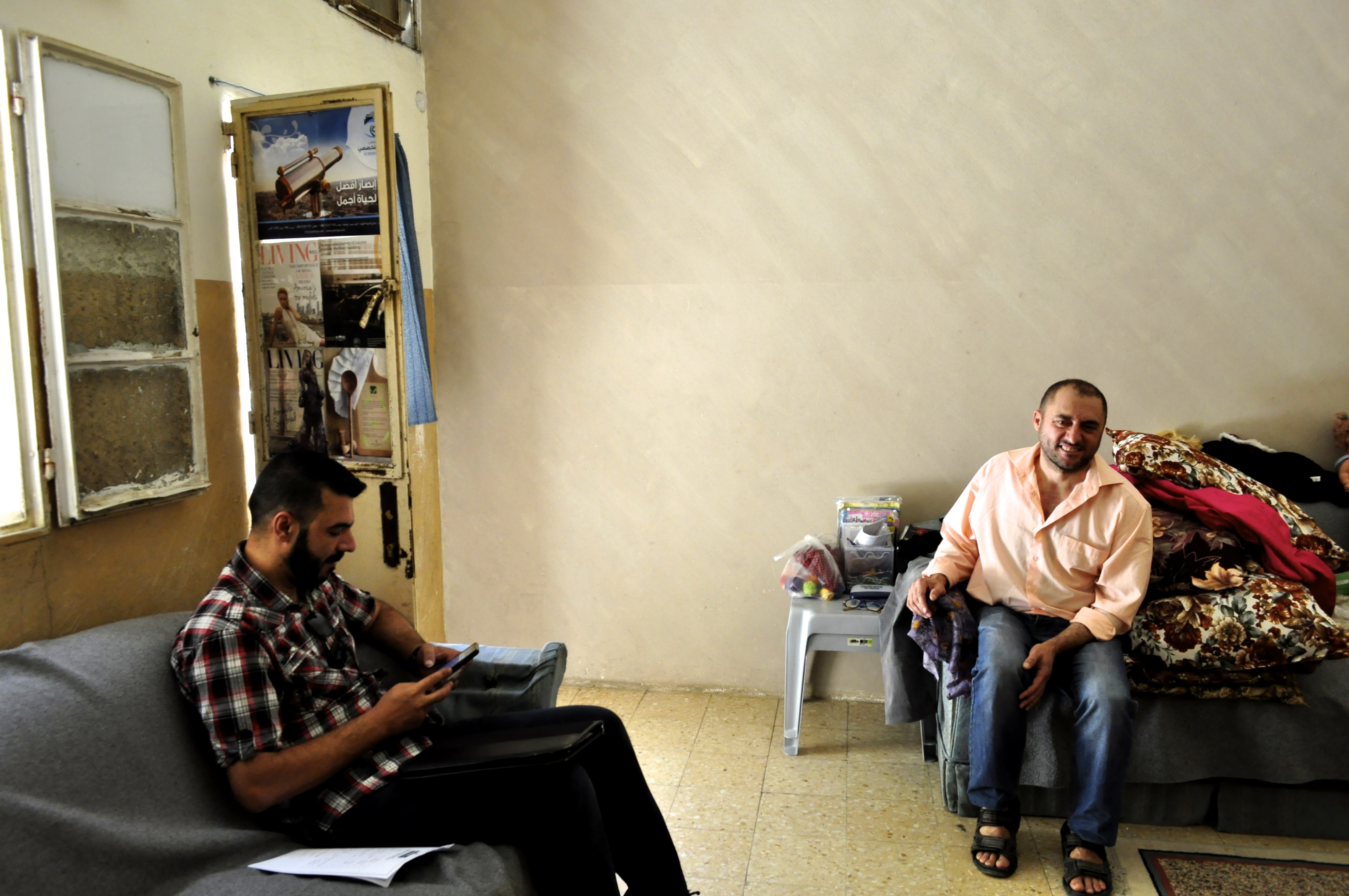
I observe. I am there to take photographs, which CRP uses on social media to document their work. My presence alone feels invasive. I try to take up as little space as possible, while silently trying to convey that I’m listening as respectfully as I can. I notice the family’s front door. The glass panes are plastered with magazine covers to block out the light. Interviews with American models and celebrities, bright colors and fashion spreads mock the situation, wherein we are supposed to count how much (how little) the family has to assess how we can help. Saddam checks boxes on the paper. I snap pictures of their kitchen (his wife has asked if we could help her procure an oven- she only has a kerosene stovetop).
The interview wraps quickly, and Saddam rises, shakes hands, and walks out the door. I follow, passing by the magazine covers once more, feeling intrusive and helpless. CRP adds the family to their monthly food voucher program, and Saddam assures me that we can help them get fans, carpets, and better mattresses for their home. An assessment of need, and the aid provided, a drop in the bucket.
-
Sewing Hope
8 CommentsLast week, the Hope Workshop met for a second time to get going on the advocacy quilting project. I admit that before coming here, I was skeptical about the concept, as well as my ability to carry out the project. I don’t have an artistic bone in my body, and I’ve never embroidered before. What authority did I have to implement this?
Luckily, my role in the entire endeavor is minimal. And I like it that way. As we met for a second time, I could see that some of the women were fantastic artists as they proudly displayed their sketches for me.
It’s the stories behind the sketches that give the Hope Workshop heart and soul. As I traveled around the room speaking with the women, they explained their drawings to me in great detail, some tied to memories more painful than others.
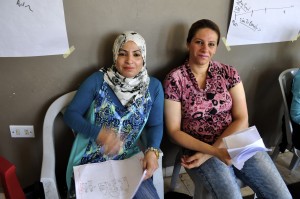
Rabab and Nasreen were the first ones to arrive at the meeting and jumped right into conversation about their designs. Rabab, from Iraq, drew a picture of her two children, walking away from a stack of books. “In Iraq, my children went to school,” she said. “Here, they do not.” Nasreen shared the story behind her picture, which depicts militiamen entering a parking lot. The parking lot, she explained, was her family’s used car business. The militiamen seized all the cars before she and her family fled to Jordan.
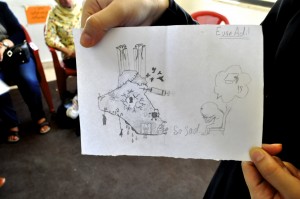
Jenan explained each and every detail of her drawing to the group. The design shows Iraq, pieces breaking apart, parts stitched together, trees shedding tears, rockets and bombs coming from all sides. Alongside this design, her simpler image of the person sitting in the chair, speaks volumes. “It’s me,” she relayed. “Thinking about the education and opportunity I had to leave behind when I came here.”
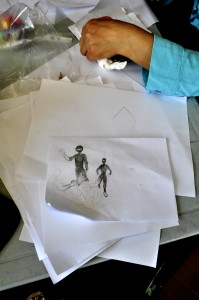
Manal did not have to elaborate on her image. The picture of three dark men surrounding a woman demonstrates the pain and violence that often accompanies conflict. One woman brought a picture of an angel. Her wings, she said, represented freedom. However the angel’s hands were shackled. When I asked her about this, she said it represents the freedom she feels here, safe in Jordan, but that the shackles represent the fact that she didn’t experience that same sense of freedom in Iraq.
Another woman drew a picture of herself remembering her work in Iraq. She was a judge, she explained, and missed her robes, which she had to leave behind. She included in the picture the scales of judgment with a large X across them. “There is no justice anymore in Iraq,” she explained succinctly.
Hearing the stories behind the drawings was a humbling experience. I was amazed at the creativity of the women. Many asked me if I liked their drawings, if I thought they were good, and I was unsure of how to answer. Yes, they are incredible artists, but my heart was heavy seeing their struggles and hardship depicted so starkly, pencil on paper.
We will meet again this week to continue with the next phase of the project. As the women of the Workshop are far more qualified than I with all things embroidery, the talented artists of the group will help those still perfecting their drawings with finishing touches. Other women, some of whom have years of experience with embroidery, will give the first-timers a tutorial on the stitching. I’m lucky to be surrounded by such talented women, and excited to see them lead the next session as we continue with the project, but also with our conversations and common sense of purpose.
With love from Amman,
Ally
-
Exhausted
9 Comments
“What They Did Yesterday Afternoon”
later that night
i held an atlas in my lap
ran my fingers across the whole world
and whispered
where does it hurt?it answered
everywhere
everywhere
everywhere– Warsan Shire
I’ve been struggling to write this post, as I do with most things I write on the Internet. There is a sense of permanence that comes along with blogging or posting, that my words are public and immovable, so I must get it right the first time. However, I am constantly in awe of the transient nature of headlines, the way they ebb and flow along with the world’s sympathies, and their complete impermanence as they span the news ticker and are refreshed on web pages.
I’ve been in a fog for the past few weeks, reeling from the seemingly never-ending cycle of bad news that keeps dominating headlines here in Jordan. “UN and partners warn of growing poverty for Syrian refugees,” “Humanitarian groups calling for Jordan Government to urgently unblock aid to 65,000 Syrian refugees,” “Syria and the erosion of stability in Jordan.” Good news, it seems, is in short supply.
All of these headlines humming in my brain alongside Baghdad, Dhaka, Istanbul. Alongside Orlando, Alton Sterling, Philando Castile, the Dallas police officers.
Almost as infuriating to me as the events themselves is the acceptance of this status quo and the inevitable forgetting. As one author put it, “muted global sympathy” is an insidious epidemic. But what’s the antidote?
If we simply read the headlines with the same eyes over and over, it’s easy to become exhausted and overwhelmed by both the shocking and slow violence we witness everyday. For me, travel to this part of the world has given me a new set of eyes, and has helped me read the headlines more carefully and navigate my surroundings with constant questions.
One question I’ve grappled with over the years is if I should even be here at all. A particularly insightful exploration of this dilemma is Courtney Martin’s piece, “The Reductive Seduction of Other People’s Problems,” wherein she argues that American ego and hubris to “save the world” can be reckless and harmful not just to foreign communities, but to the local communities one neglects when one opts to work overseas.
Ever since my first trip to Jordan, I’ve had to justify to various people why I want to spend time “over there.” Why not focus my career on domestic policy? Why not help “here at home” instead of overseas? Why should I give a damn when “those people” openly celebrate the deaths of Americans?
These questions are exhausting. They demonstrate just how durable the “us vs. them” mentality still is. They highlight the zero-sum game many play in their heads, which can translate into policy with devastating effects. And most heartbreakingly, they undermine our common humanity, something I’m reminded of more and more with each passing day here.
A collection of smiles gathered over the past two weeks at CRP
I spent this morning shuttling back and forth between police stations, attempting to obtain an extension for my visa. The process was so convoluted that on any other day, it might have made me angry and frustrated. However, after my third visit to my neighborhood police station, (I’m now on a first name basis with Tareq and Mohammad, infinitely patient human beings they are, dealing with complicated visa questions in my broken Arabic) I sat in a taxi with the wind and sun on my face and felt simultaneously overwhelmed and at peace.
Overwhelmed by my privilege. By the kindness and patience of those around me. By the fact that I have the opportunity to learn through trial and error, that my existence here is not threatened by violence, that my presence is met with smiles and curiosity, that my attempts at Arabic provide entertainment for others and a opportunity for me to improve and learn. As exhausting and problematic as working abroad can be, I am thankful that despite the vicious circle of violence, sadness, and apathy, moments of joy slip through when we let them.
Martin’s imperatives at the end of her piece have helped me start to make sense of the personal and professional pieces of my life here in Jordan. She warns,
“Don’t go because you’ve fallen in love with solvability. Go because you’ve fallen in love with complexity.
Don’t go because you want to do something virtuous. Go because you want to do something difficult.
Don’t go because you want to talk. Go because you want to listen.”
And so I continue, with open eyes, open ears, and an open heart.
With love from Amman,
Ally
-
-
On the Way to Sacsamarca
8 CommentsTomorrow at 9:00am we are heading towards Sacsamarca, Gisela said, who is the office administrator of the Equipo Peruano de Antropologia Forense (EPAF). As the sun was shining the next morning, we put our luggage in the microbus and headed towards Sacsamarca. Although I was excited to explore new regions of Peru, I did not know that the day would be so eventful.
Sacsamarca is four and half hours from Hualla, the province of Ayacucho where we spent the last four days. After two and half hours of driving, we reached the community of Carhuamayo, which is 4,500 meters above the sea level. We stopped in front of a school, and Gisela invited us to visit it. The school was very small without proper light and heating system. The walls had many posts. Some of them had the alphabet, others the Spanish grammar, and others had the numbers.
Gisela introduced us to the teacher, and to the ten students who aged between five and twelve years. Looking at them, I noticed their great needs. Talking with the professor, he said that the children need clothes, winter shoes, and proper nutrition. He also said that in three days it is going to snow, which will cause the temperature to go down, and they are not prepared for it. Additionally, the school needs a heating system to be installed. With tears in his eyes, he said, “the government forgot about us, no one is visiting us, we need help, these children need help.” After distributing the school supplies that Gisela brought, and some chocolate, we left.
On the way to Sacsamarca, the images of those children stick in my mind. Although the temperature was very low, and some of the children did not have sacks on their feet, they were eager to learn how to read and write. I committed myself to buy winter shoes and clothes and ship to them as soon as I will get back to Lima.

After forty minutes of driving, we arrived at Putaccasa where we had lunch. During the lunch, I was introduced to Hector, a local man who grows alpacas. After telling him about the income generation project that The Advocacy Project wants to do in partnership with EPAF, I asked him the possibility to have a meeting with all people in the area who grow alpacas. We agreed to have the meeting in two says at 8:00am. After saying goodbye, we continued our travel towards Sacsamarca.
We were twenty minutes away from Sacsamarca when I observed a group of people in the middle of the road. As we approached them, I noticed that about twenty-five women were holding posts with different slogans protesting against a multinational corporation that was nearby. The protesters said that nobody is allowed to pass. “We are protesting against this company, which contaminates the air that affects our lives.”
Then, I asked where were their husbands. They began to laugh and told me, “ buen chiste Gringo,” nice joke Gringo, a common name used to call white people in Latin America. I said that I did not mean that they were all widow, but I wanted to know. They told me that their men are coming soon.
Walking a short distance from the protesting site, I could see Sacsamarca located in a valley surrounded by the Andes. While I was enjoying the picturesque panorama, I observed a truck full of people coming towards the protesting site. Behind the truck I could see a big cloud of dust, and at that moment, I understood the reason these women were protesting.
After approximately fifteen minutes, the truck reached the place where the women were. About forty men, old and young, jumped down from the truck. Then, the driver parked the truck in the diagonal of the road that no car could pass. I approached the group and was told that no one is going to pass until they reach an agreement with the company. They were protesting against the pollution that the company was creating. Because it was a dusty road, the daily traffic of tracks coming to the company were creating dust which affected the lives of people in the area, and the animals which were pastoring.
We realized that the protest was not going to finish soon because people came prepared to stay many days. In fact, some of them brought pots to cook the food. After two hours of waiting, we decided to go back to Hualla. On the one hand, I was angry because we drove four hours and fifteen minutes in a dirty road, and now we were not allowed to pass. But on the other hand, these people were standing for something that was right. In fact, companies earn millions of dollars at the expense of the poor people.
On the way back, as we were reaching the altitude, the sun began to hide behind the clouds. It began to rain and then to snow. As we were driving, I heard an unusual sound at the rear part of the microbus. This is a flat tire, I thought. I did not say aloud because I did not want to crate panic. If he is a good driver, he will notice immediately because besides the noise that a flat tire makes, the engine power decreases when driving with a flat tire.
After a few minutes, the driver stopped and checked the tires. I was right! There was a flat tire. Changing a flat tire at 4,500 meters altitude in a cold weather, and a muddy road, is not a pleasant experience. Fabio, the driver, immediately took the keys and was ready to change the tire. I jumped from the car, I rolled my sleeves, and I went to help him. After thirty minutes of struggle, we changed the tire, and continued our travel to Hualla.
About at 9:00pm, we reached Hualla. Everybody was tired and ready to rest. Tomorrow we are going to use other route to reach Sacsamarca, Gisela said. The next morning we embarked again in the microbus, and we chose the route towards Huancapi, which led us to Sacsamarca without any incident.
-
Microblog: A Confrontation
10 CommentsI exit the minibus, the “servees,” and examine the nondescript street corner that is, apparently, the last stop. My friend and I know that we must use our negotiating skills to somehow wrangle a taxi to get from here to Um Qais, our intended destination. Within seconds, our fellow passengers have scattered and vanished. We find ourselves surrounded by several men, drivers, all offering competing prices. The prices sound high. My friend and I exchange a look. Perhaps trying to take public transport on a summer Friday during Ramadan was not the best laid plan.
We hem and haw, attempting to negotiate a lower price, Arabic numbers and emphatic no’s rolling off my tongue. Suddenly, we are no longer a part of the conversation, the drivers jostling to get closer together, arguing over who was here first. Shoulders tense, words become louder, and they begin pushing and shoving each other as the argument continues. I remain glued to my place on the sidewalk, dumbfounded that this is even happening at all. My friend breaks my trance. “We should walk away,” she says.
We locate a woman walking down a nearby street. She tells us a good price, and insists on talking to the drivers to help us secure it. “Mashallah,” she says, when we tell her we’re from America. “You girls are beautiful. I love Americans. Welcome.”
We had the ruins all to ourselves.
Days later, my emotions are still roiling over this whole event. The mixture of gratitude, (for that kind woman’s help) ire, (at the taxi drivers for the never-ending price run-around), and residual embarrassment all have me questioning my presence here in one way or another. All that hustle and bustle over my friend and I, just trying to get from point A to point B. However, I can’t help but feel like part of the problem. When I’m referred to as an “expat” instead of a “foreigner.” When taxi drivers try to squeeze an extra dinar out of me, not because they want to rip me off, but because they might need it more than I do. When I accept so much hospitality and help and there’s so little I can do in return. I absorb generosity like a sponge here. Saturated. So full of love, kindness, and delicious food that when tense moments like these happen, they contrast so starkly with everything else I know and love about Jordan. These moments make up a small minority. A few tiles of a mosaic. This is what I know, and what I hope I can convey to others.
With love from Amman,
Ally
In addition to my weekly blogs, I will publish occasional “microblogs” highlighting particular moments or experiences of my time in Amman.
-
First Steps and Feeling Honored
9 CommentsThe women trickle in to CRP’s meeting room, exchanging hellos and commiserating about the midday heat. It’s clear many of them are old friends, demonstrated by the kisses and warm hellos they exchange. Shatha, my fearless co-leader, and I, try to start the meeting several times over their chatter.
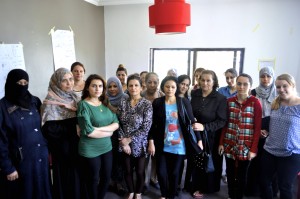
Members of the Hope Workshop after the first meeting.
These women all belong to the Hope Workshop, a cooperative craft group led entirely by refugees. Members design and market handmade crafts in local bazaars throughout Amman to generate a modest income to support their families’ needs. The creativity of these women is limitless, and over they years they have produced a variety of products, including handmade washcloths, paper bead jewelry, handbags, and hats (their biggest seller). Today we met to discuss the next project they’ll tackle- embroidery squares to be assembled into advocacy quilts, depicting personal stories of their lives as refugees.
Now, I am a creature of habit. A planner. So, when first tasked with this project, I had so many questions. What thread will they use? Where will I purchase the materials? How will we agree on the designs and draft them for production? Logistical issues, as usual, dominated my thoughts. These worries were melted away by the know-how and patience of Shatha, Program Manager at CRP and coordinator of the Hope Workshop. Not 10 minutes into my first day at CRP, Shatha was pulling out yet-to-be-sold products, proudly displaying them and describing the work that went into each one. She assured me that the Hope Workshop women would be more than up to the task, and excited to get started on a summer project, despite the fact that we’re mid-Ramadan.
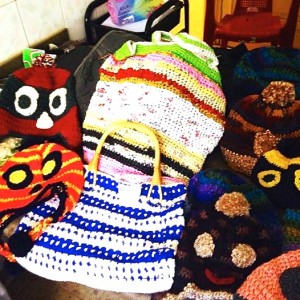
Handbags and hats produced by Hope Workshop Members
She couldn’t have been more right! Once Shatha helped me explain the project to them, the women were brimming with ideas for what to draw on their squares. One woman wanted to depict an extremist fighter next to a young boy crying. Another wanted to embroider a picture of her family members who were killed in Syria. A third women from Iraq wanted to juxtapose traditional Iraqi bread with guns, side by side on a table. As I write this, I’m floored by their creativity and humbled by their willingness to share their experiences through this project. Their motivation and energy is inspiring, and I’m looking forward to our next meeting, where we will review their designs and I will learn the stories behind them.
With love from Amman,
Ally
-
Microblog: A Meditation
199 CommentsFirst day nerves have taken hold of my body. My shoulders are tense, I’m hyper-aware and self conscious as I climb the stairs for my first day at CRP. I try to practice some Arabic in my head, but it all goes out the window as I’m greeted by friendly staff members who quickly show me around. I start conversations with several people, small talk and introductions. Shadha stands up as I’m mid-sentence. “We have a training now,” she says. “Are you coming?”
I follow her over to the adjacent room, where everyone is sitting in bright red plastic chairs, arranged in a circle. Danya, a Mercy Corps Adviser, is here, and she explains that as part of a staff development training series at CRP, she’s going to lead us in a mediation practice. She starts off in Arabic, and I’m instantly impressed by her language skills, which slowly fade away as she starts using words that have no direct translation. Mindfulness. Mental silence. Sympathetic and parasympathetic nervous system.
Saddam jumps in, and as we close our eyes, their words dance back and forth. English and Arabic. My mind wanders, resisting the objective, as I try to match Saddam’s translations with Danya’s directions. I feel the Amman heat creep in and settle. The “gas man” breaks the silence. Tinny music playing from the delivery truck and his amplified voice intrude on the minimal meditating I’m managing. Danya continues. Saddam’s words fade away as even more time passes. I cheat and open my eyes slightly to see he has fallen asleep, the combination of the heat, fasting, and mediation overpowering him. Silence descends and I feel wind from the open window behind me play across my neck.
Clarity finds me, and my nerves dissipate. The call to prayer begins, and I feel certain that, thankfully, I’m in exactly the right place at exactly the right time.
In addition to my weekly blogs, I will publish occasional “microblogs” highlighting particular moments or experiences of my time in Amman.
-
Hope and Hospitality in Amman
5 Comments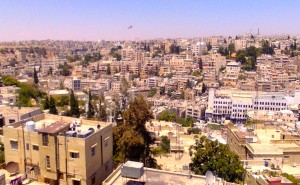
Jordan is a place that has always welcomed me with open arms. Whenever I’m in Amman, I find myself knocked off my feet with hospitality. Between heaping bowls of my host mother’s food, vibrant and encouraging conversations with my taxi drivers, and the countless people I’ve encountered who have helped me wend my way through this city, I’m constantly amazed at the kindness and generosity of everyone I meet here.
It is no wonder that a place so selfless and welcoming has served as a haven for many different groups fleeing persecution throughout history. Jordan has been welcoming refugees for almost 200 years; Muslim Circassians, Armenians, and Palestinians, among others.[1] Currently, many Syrians fleeing the violence of the Syrian conflict are crossing Jordan’s northern border, where they are received at the Za’atari refugee camp. Since the opening of Za’atari in 2012, it has vastly expanded and it is considered to be Jordan’s fourth largest city. Za’atari’s growing size, as well as ongoing demonstrations over insufficient food and accommodation, make it the nexus upon which the refugee conversation in Jordan rests. With so much attention directed at Za’atari, the plight of urban refugees is considerably less visible.
The reality is that an estimated 82% of Jordan’s refugees reside in urban areas,[2] their plight often obscured by attention given to camps. This is where organizations like the Collateral Repair Project step in. Originally founded in 2006 and focused on aiding Iraqi refugees in Amman, CRP has expanded over the years and now serves Palestinians, Iraqis, Syrians, and Jordanians alike in Amman through their community center programs and emergency assistance.
Wrapping up my first week at CRP, I’m most struck by the diversity of CRP’s staff, the community they serve, and the deep connection between them. Abu Ahmed, one of CRP’s Program Directors, is from Damascus and works alongside Jordanian and Iraqi staff at CRP to serve the community. In fact, many of CRP’s beneficiaries go on to become volunteers at CRP, and the connections between the organization and the community are evident.
On my second day, during a meeting with Amanda, the Executive Director of CRP, she mentioned to me that Saddam, one of CRP’s Program Directors, had noticed a man on the street begging whom he had not seen before. Saddam engaged with the man, and ultimately visited his home to hear his story. The man and his wife had fled Iraq along with their young daughter due to sectarian threats. With no current source of income, they were behind on their rent and struggling to put food on the table. Amanda informed me that they would be adding the man and his family to CRP’s monthly food voucher program as a result of the visit. To me, this example highlights just how tapped into this community CRP is; they know the people in this neighborhood and through their programming, have really helped foster a strong sense of community through their connectedness and willingness to engage with members of the urban refugee population who might otherwise fall through the cracks.
-
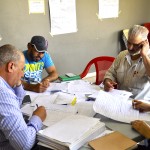
- CRP staff prepare for upcoming distribution
-
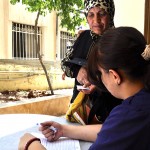
- CRP staff member Andra confirms identification documents with a beneficiary
-
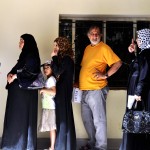
- Beneficiaries wait in line to receive food vouchers
It’s been an eye-opening first week. Even though things slow down at CRP (well, everywhere in Jordan, really) during Ramadan, staff was busy running food package and voucher distributions. This week CRP distributed 50 food packages, which will feed 112 adults and 113 children in their community. They also distributed food vouchers that went to 128 homes that will help feed an additional 285 adults and 360 children this month.
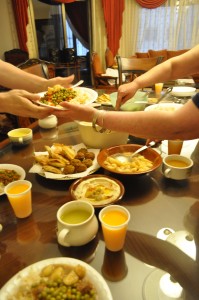
Iftar dinner with the host family
As my host mother stuffed me with platefuls of home cooked Jordanian food every night for Iftar, thoughts of the food distributions were at the forefront of my mind. Ramadan is a time to reflect, to fast and be reminded of the luxuries you might have that others do not, and to share in the joy of family. These sentiments echo through CRP’s work year round, and I’m looking forward to learning more this week about how Jordanians, Palestinians, Iraqis, and Syrians are coming together in the CRP space to keep spirits high and the community engaged and active despite the challenges faced by urban refugees here.
Please check out:
CRP’s website for more information about their programming and emergency assistance programs,
Elena Habersky’s (former Programs and Administrative Manager at CRP) excellent piece for MUFTAH which provided many insights about the urban refugee population in Amman,
And my Flickr feed to see more photos of this week’s distributions!
With love from Amman,
Ally
[1] Elena Habersky, “The Urban Refugee Experience in Jordan,” MUFTAH, January 11, 2016. [2] Elena Habersky, “The Urban Refugee Experience in Jordan.” -
-
The calm before the storm: pre-departure musings from a 2016 peace fellow
7 Comments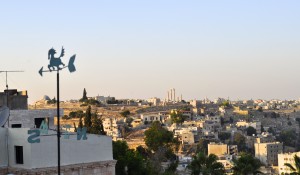
Sunset over Amman
Hello! My name is Ally Hawkins and I’ll be serving as a Peace Fellow for the Advocacy Project this summer. I plan to use this space to reflect on the work I’ll be doing through AP with The Collateral Repair Project in Jordan. CRP is a grassroots organization bringing much-needed assistance to refugees and other victims of war and conflict living in Amman. I’ll be working closely with their Hope Workshop, a cooperative craft group led entirely by Iraqi and Syrian refugee women, to not only produce sellable handicrafts, but to create a long-term, income generation program that can be sustained by Workshop members after my departure.
On Monday, the Advocacy Project’s 2016 Peace Fellows traveled to Washington, D.C. for a week of training prior to the start of our various fellowship assignments. We’ve received training on managing social media for non-profits, podcasting, videography, and photography. We’ve discussed the challenges and rewards of working with community-based organizations. We’ve developed work plans for our individual fellowships and discussed ways we can best serve our host organizations. It’s been a week full of helpful information, practical skill-building, and lots of reflection.
However, on my meandering, sunny walks to and from our meetings each day, my mind settles and centers on what I’ve learned this week from the other fellows. Sharing stories, exchanging ideas, and benefiting from each other’s expertise has been a true highlight of this weeks’ training for me. Having dedicated time to contemplate the work I will do this summer, how best to approach and build relationships with members of CRP, and setting clear goals has been incredibly valuable. Not often do we slow down and critically examine our intentions and objectives before diving right into work. As someone who is used to just hitting the ground running, I’m thankful that I’ve had the opportunity to take pause and thoughtfully prepare for what I’m sure will be a challenging summer of learning and listening.
Practicing photography at AP training
On a more personal note, my connection to CRP dates all the way back to 2010. During a semester studying Arabic abroad at the University of Jordan, a dear friend and classmate of mine introduced me to CRP. It was my first true exposure to non-profit work, and the experience sparked my interest in refugee issues, women’s economic self-sufficiency, and international education. Having the opportunity to volunteer with CRP again is a true piece of good fortune, and an opportunity to learn more from the community members that they serve.
Jordan is the first place I ever traveled outside of the United States and holds a special place in my heart. It’s a place that has taught me the meaning of hospitality, demonstrated the true tolerance and resilience of Jordanians, Palestinians, Iraqis, and Syrians, and challenged me to listen and learn from the experiences of those around me. I’m excited to travel back again and continue to develop my relationship with such a special place, collaborate with an amazing group of people at CRP, and inshallah, enjoy some delicious mansaf and lemon mint juice!
-
Israeli army operation against Palestinian factions continues
Leave a Commentco-written by: Ahmad Jaradat
An Israeli SWAT team killed two
Palestinians in a village near the West Bank city of Jenin on Tuesday. Israel
claims the two were members of the Islamic Jihad, butWest Bank sources and
local residents have said the men belonged tothe Al-Aksa Martyr Brigades. This
killing was part of an ongoing Israeli operation to arrest and assassinate
members of Islamic Jihad and Hamas, which has intensified this week. One of the
conditions of the ceasefire agreement negotiated between Israeli and
Palestinian officials in February was that Israel stops its offensive attacks
against members of resistance groups. Islamic Jihad and Hamas have returned to
violent resistance in recent weeks in what they say is a response to Israeli
violations of that agreement. Israeli officials contend that inaction by the
Palestinian Authority to rein in the groups leave them with no choice but to
crackdown on the Palestinian militant groups themselves.Despite great efforts by an Egyptian
delegation to reconcile tensions between the Palestinian Authority and Hamas,
the two returned to fighting Monday night in northern Gaza. The PA warned Hamas
and Islamic Jihad that it will retaliate against any action that would hamper
Israel’s plans to withdraw from Gaza, including suicide attacks and Kassam
rockets. Monday night’s fighting began when Hamas gunmen returned from firing
anti-tank missiles at Israeli forces stationed outside Gaza and Palestinian
security forces came to arrest them. Tensions have always existed between Hamas
and the PA, but hostilities between them turned into violence last Thursday.
The fighting resulted in the deaths of two Palestinian bystanders and the
wounding of dozens of both Hamas gunmen and PA security forces.Beginning last Thursday, Israeli
troops enacted closures at Gaza checkpoints, preventing many Palestinians from
returning to their homes in Gaza or moving about their daily activities for
hours. A 14-year-old Palestinian boy was killed by Israeli fire on Monday at
the Gush Katif checkpoint in Gaza while he was trying to cross the checkpoint by
foot. An Israeli army spokesperson insisted that Israeli soldiers fired
‘warning shots’ when cars and people began to move through the checkpoint.The curfew in Tulkarm was lifted today, although Israeli
[content-builder]{“id”:1,”version”:”1.0.4″,”nextId”:3,”block”:”root”,”layout”:”12″,”childs”:[{“id”:”2″,”block”:”rte”,”content”:”
officials have stated that the city will remain a closed military area. The
return of the city to the hands of the Palestinian security forces remains
unlikely.co-written by: Ahmad Jaradat<\/b><\/p>
An Israeli SWAT team killed two\nPalestinians in a village near the West Bank city of Jenin on Tuesday. Israel\nclaims the two were members of the Islamic Jihad, butWest Bank sources and\nlocal residents have said the men belonged tothe Al-Aksa Martyr Brigades. This\nkilling was part of an ongoing Israeli operation to arrest and assassinate\nmembers of Islamic Jihad and Hamas, which has intensified this week. One of the\nconditions of the ceasefire agreement negotiated between Israeli and\nPalestinian officials in February was that Israel stops its offensive attacks\nagainst members of resistance groups. Islamic Jihad and Hamas have returned to\nviolent resistance in recent weeks in what they say is a response to Israeli\nviolations of that agreement. Israeli officials contend that inaction by the\nPalestinian Authority to rein in the groups leave them with no choice but to\ncrackdown on the Palestinian militant groups themselves.<\/p>
Despite great efforts by an Egyptian\ndelegation to reconcile tensions between the Palestinian Authority and Hamas,\nthe two returned to fighting Monday night in northern Gaza. The PA warned Hamas\nand Islamic Jihad that it will retaliate against any action that would hamper\nIsrael\u2019s plans to withdraw from Gaza, including suicide attacks and Kassam\nrockets. Monday night\u2019s fighting began when Hamas gunmen returned from firing\nanti-tank missiles at Israeli forces stationed outside Gaza and Palestinian\nsecurity forces came to arrest them. Tensions have always existed between Hamas\nand the PA, but hostilities between them turned into violence last Thursday.\nThe fighting resulted in the deaths of two Palestinian bystanders and the\nwounding of dozens of both Hamas gunmen and PA security forces.<\/p>
Beginning last Thursday, Israeli\ntroops enacted closures at Gaza checkpoints, preventing many Palestinians from\nreturning to their homes in Gaza or moving about their daily activities for\nhours. A 14-year-old Palestinian boy was killed by Israeli fire on Monday at\nthe Gush Katif checkpoint in Gaza while he was trying to cross the checkpoint by\nfoot. An Israeli army spokesperson insisted that Israeli soldiers fired\n\u2018warning shots\u2019 when cars and people began to move through the checkpoint.<\/p>
\n\n\n\n\n\n\n\n<\/p>
The curfew in Tulkarm was lifted today, although Israeli\nofficials have stated that the city will remain a closed military area. The\nreturn of the city to the hands of the Palestinian security forces remains\nunlikely.<\/p>\n”,”class”:””}]}[/content-builder]
-
We Will Return
1 CommentAs I prepared to leave Palestine just over a week ago, I said goodbye to the people I had gotten to know over the past few months. I made my journey home with these final goodbyes on my mind, sad to be leaving, but looking forward to returning home.
For me, there is no greater feeling that the comfort of returning home after a long time away. No matter how much I fall in love with every new place I visit, I’m always happy to be back with my family and friends in a familiar environment.As much as I love that feeling, I know that for millions of Palestinians, that feeling may never come. Palestinian displaced in 1948, refugees displaced by subsequent wars, and their descendants have no right to return to their homes.
Jews have had the right to return to the state of Israel since 1950. The Law of Return applies to most people with Jewish ancestry as well as most converts to Judaism. However, as the state of Israel continues to encourage and actively seek out Jewish immigrants to Israel, Palestinians are denied the right to return to their land. The Israeli government has a history of staging large-scale operations to bring Jews back to Israel. Operation On the Wings of Eagles (nicknamed “Operation Magic Carpet”) brought nearly 50,000 Yemeni Jews to the newly created state in 1949 and 1950. Two similar operations were organized to bring Ethiopian Jews to Israel in 1984 (Operation Moses) and 1991 (Operation Solomon). Non-governmental organizations such as the Jewish National Fund actively seek out “lost” groups of Jews from around the world in places such as India. These policies have brought millions to settle in Israel, often on land beyond the Green Line taken from Palestinian territory in the West Bank.
Some see the implementation of Palestinian right of return as fundamental to reigniting the peace process and resolving the conflict. The right of return and right to self-determination are largely agreed to be the foundational issues of the 67-year struggle of the Palestinians. For refugees in surrounding Arab states or Palestinians in the diaspora, the right of return is the promise of coming home. It is also something they are not willing to give up.
A key is used as a symbol of Palestinian right of return. The key is a symbol of mementos taken by those who were forced to leave their homes, especially the generation of al-Nakba, many of whom left with nothing but the keys to their home, hoping they would be able to return in a matter of days. Paintings and statues of the Key of Return can be found all over Palestine, most famously at the entrance to Aida Refugee Camp in Bethlehem. The key is often inscribed with the Arabic حتما سنعود “we will return” or عائدون“returning.”
These phrases are messages of resistance and hope – resistance to the occupation of Palestinian homes and land and hope for the ability to one day have a home once again.
-
Smiling Faces
Leave a CommentOne of the funniest and most memorable moments of my summer in Palestine happened a few weeks ago. I stood in front of a room full of kids and introduced myself with my American accent and mix of standard and colloquial Arabic.
Marhaba, isme Katie. Ana min Amrika. Hatha seif, bshtarghrul ma’a beit sadaqa philisteeny. Tasharufna bikom.
Translation: Hello, my name is Katie; I’m from America. This summer, I am working with the Palestinian House of Friendship. It’s nice to meet all of you.
The smallest girl in the room was so surprised to hear me speak Arabic and evidently found my accent hilarious. She couldn’t stop laughing. I bent down and asked her “shoe ismik?” (what’s your name?) to which she replied “Katie!” and laughed even harder.
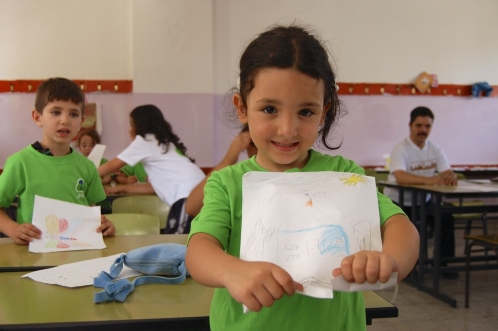
This is the little girl who thought my name and attempts at Arabic were so funny holding one of her drawings that she did at the camp.
My feebly attempts at Arabic aside, I had a wonderful few days visiting the kids at PHF’s most recent Smiling Faces Summer Camp. This is PHF’s oldest program, and since 1995, it has reached over 6,000 children in the Nablus area.
The camps are designed to provide kids with a space for recreation and to encourage creative expression through crafts, music, and dance. The kids also learn traditional Palestinian dance (dabkeh) and songs. This particular camp took place n the village of Asira al-Shamaliya, just outside of Nablus. Throughout the two weeks, over 100 kids attended the camp, ranging from ages 6-18.
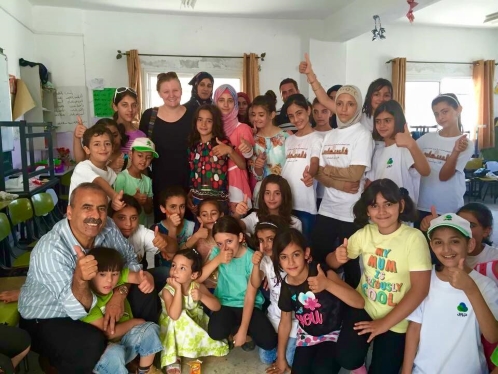
These are some of the kids from the last Smilng Faces Summer Camp in Asira with PHF Director Mohammed and me.
This camp, as well as PHF’s other camps, also caters specifically to many children and youth with disabilities. These kids are given transportation to and from the camp each day and provide with specialized support as needed. All of the children are provided with lunch everyday.
The community often plans other activities to take place alongside the camp. One day that I visited, there was a man from the Palestinian Union for the Deaf leading a workshop for women with impaired hearing and vision.
The camp culminates in a closing ceremony, open to family and friends. At this ceremony, the kids get to show off the crafts they made throughout the camp and some of the dances they learned. I had so much fun meeting these kids, seeing them progress over the two weeks, and seeing the final products at the closing ceremony.
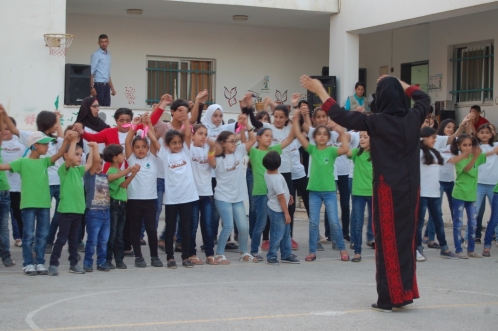
One of the performances at the closing ceremony for the camp; these kids looked like they had a lot of fun!
PHF’s overall mission is simple: to empower youth. The Smiling Faces Summer Camps empower youth through creative expression, and provide them a space to counter the war-like environment in which they grow up. It’s a small affirmation of their right to childhood and an investment in them as future leaders of the community. I remember my time at summer camp when I was a child very fondly, and I can only imagine that these kids have similar memories of this program.
-
A Barrier to Peace
196 CommentsApartheid Wall – Security Fence – Separation Barrier
All of these terms used to describe the structure that separates the West Bank from Israel. Palestinians tend to use terms like apartheid wall. The Israelis call it a security fence, there for their protection. The UN has coined a more neutral term, “separation barrier.” For certain sections of the barrier, all three of these terms could appear most accurate.
The most common misconception about the wall is that it exists to separate Palestine (the West Bank) from Israel – to create a border of sorts. In reality, the wall isolates areas of the West Bank such as the Jordan Valley or the city of Qalqilya in “military zones,” completely cut off from surrounding territory.
I briefly saw the wall when I first crossed into the West Bank at Qalandia Checkpoint outside of Ramallah, but Nablus is removed from its construction. There is no place in the city from which you can see the wall. Traveling to a place like Bethlehem, where the wall went up 3 meters outside of people’s homes over the course of one day, I had quite a different experience.
A section of the wall along the border of Bethlehem. Here the wall is 8 meters (roughly 26 feet) high and has many military towers along it. Many families describe how the wall went up outside their homes in a matter of a day, with absolutely no warning.
There are three important lessons I have learned about the wall:
Lesson Number One: The barrier does not create a border.
- 85% of the wall does not follow the Green Line (1949 Armistice Line), and instead cuts into Palestinian territory
- As of 2010, 520km of the planned 810km, or 64% of the wall had been completed – twice the length of the Green Line
- Around 7,500 Palestinians live in the area between the Green Line and barrier (not including East Jerusalem) and require special permits to continue living in their homes.
Lesson Number Two: The barrier has not always been here
- Even though Israel was founded in 1948, construction of the wall did not begin into 2002, following the Second Intifada.
- Each kilometer of the wall costs around $2 million to build.
Lesson Number Three: The barrier is not simply a wall
- The completed sections of the wall are generally 8meter high concrete walls dotted with military surveillance towers.
- There are 30-100m “buffer zones” on either side of the wall in places that contain trenches, barbed wire, military surveillance, and sensors.
- There are a total of 34 large fortified checkpoints – 22 of these checkpoints control all Palestinian movement.
The issues created by this wall are far to complex to truly explain in a simple blog post. But these three lessons dispel some of the greatest myths about the wall, chief among them that this marks a border. The wall not only separates Palestinians from Israelis, but also and more frequently separates Palestinians from one another.
The wall does not mark a border. It is a tool of the occupation used to isolate Palestinian communities and claim more territory in the West Bank. It is the largest barrier of its kind in history, far longer than the Berlin Wall, one of the most common comparisons.
Eleven years ago, the barrier was declared illegal under international law before the International Court of Justice. Yet despite this ruling and condemnation from the UN, construction continues. The wall continues to demonstrate Israel’s impunity in front of the international community and creates a very literal and physical barrier to the possibility of eventual peace.
The larger sections of the wall (predominantly on the Palestinian side) are covered in murals and graffiti. Some of the most famous murals (although not this one) were painted by the British artist Banksy.
Commissioned work by famous artists, local messages of resistance, and international messages of solidarity all cover the wall.
An image of Leila Khaled, a Palestinian women active in the resistance to the occupation, famous for her role in plane hijackings in 1969 and 1970.
-
Life in Little Damascus
68 CommentsWhen I was dropped off in Nablus nearly two months ago, I had no idea what to expect. I had talked with foreigners who had worked in Palestine, but only in Ramallah or Bethlehem.
I got out of the taxi with no idea where I was, waiting for Mohammed to come and pick me up. I was anxious but excited to start my summer working here.
Now I smile when I return to Nablus from a weekend in another city or walk past the spot where I was first dropped off. I smile because I now know that place as al-dawr (the city center) and because coming back here feels a little bit like coming home.
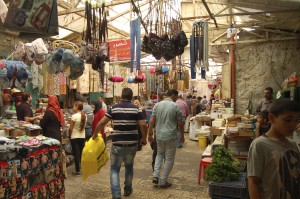
Shoppers in the Old City
Nablus is in the northern West Bank, and is the third largest city in Palestine, after Gaza City and Hebron. It’s also the fourth oldest city in the world, preceded by the Romans city of Flavia Neapolis and biblical city of Shechem at the same location.It’s a beautiful city, situated between two mountains, Mount Ebal to the north and Mount Gerizim to the south. Despite the heat and hills, one of my favorite things to do is walk around and discover new views of the city, nestled in this narrow valley.
The famous Arab explorer Ibn Battuta nicknamed the city “Little Damascus” in the tenth century. The part of the city he would have visited is now known as the Old City—a labyrinth of cobbled streets, vaulted pathways, and a busy souq (market). Today, Little Damascus is known for its knafeh, olive oil soap, and traditional Turkish baths.
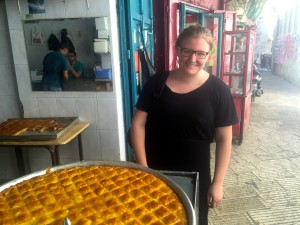
This isn’t actually knafeh, but I am outside of what I hear is the best knafeh in Nablus, which means it’s the best in the world!
The Old City is certainly something to see. At first, I tended not to wander too far on my own after one very long, hot, and confusing afternoon spent hopelessly lost in its alleys. I’ve since learned that as long as you’re going downhill you’ll find your way out eventually (and most likely you can get a young child to show you the way out with a few laughs along the way). And really, isn’t getting lost half the fun?
Just east of the city are two sites so closely together, the stark juxtaposition always strikes me. Along one side of the road is Jacob’s Well – a present-day Greek Orthodox Church and significant biblical site. On the other side of the street is the green dome of a mosque, mirroring the orange dome of the church. The mosque is located inside Balata Refugee Camp, the most densely populated refugee camp in the West Bank. Over 30,000 Palestinians live within 1 square kilometer of land; most of these residents were displaces from Jaffa and Haifa, now both within the state of Israel.
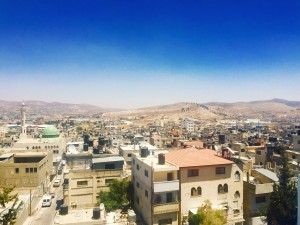
This is the view of Balata Refugee Camp from the roof of the Yafa Cultural Center. A friend of mine used to work there, and I had the chance to spend a day learning about some of their programs and about the camp itself.
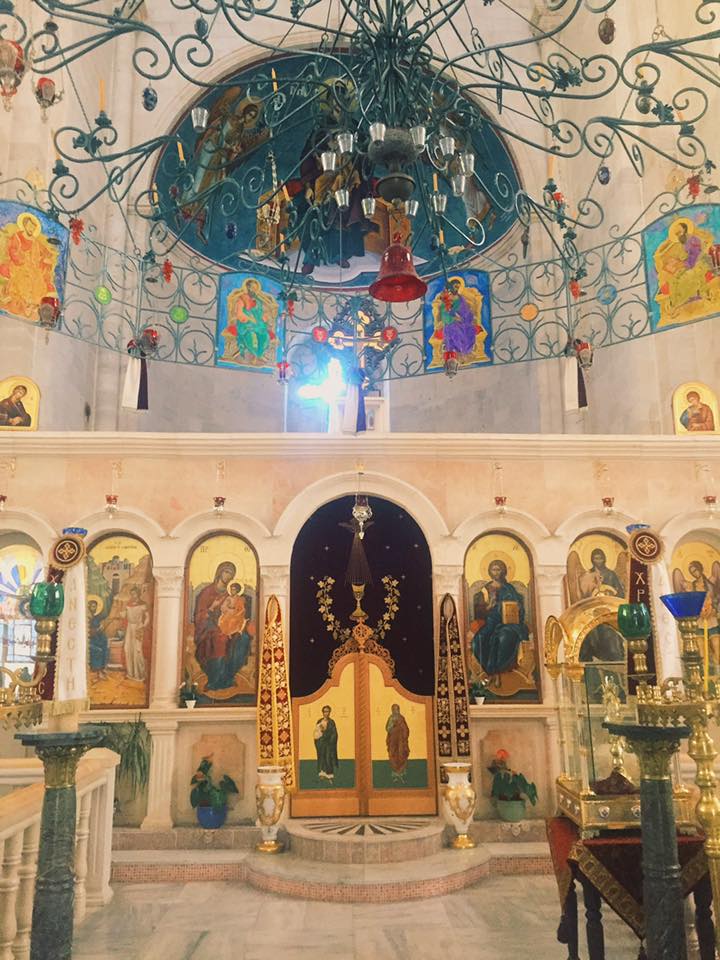
The inside of Jacob’s Well, a large church near the biblical site of Shechem.
Jacob’s Well draws a few pilgrims to the city, and some tourists come to sample the knafeh or visit the Old City, but Nablus is still removed from much of the tourism in Palestine. It is unlike the cosmopolitan Ramallah with cafes catered to the traveler crowd or Bethlehem with its shops selling goods from the Holy Land to thousands each year. That is not to say Nablus is somehow more authentic that these places, but to say that it’s different, and that it most definitely warrants a visit.
-
These are Not Isolated Events: Settler Violence and the Occupation
Leave a CommentLate last Thursday night an 18-month-old Palestinian baby was burned to death in his family home. Israeli settlers attacked the home in Duma, a village just south of Nablus. The parents of the baby, Ali Saad Dawabsheh, were badly burned in the attack, as was his four-year old brother.
On Friday morning, a 17 year-old boy named Laith Khaldi was shot and killed by Israeli soldiers at Atara checkpoint near Birzeit. He was participating in protests of the arson and death of the baby the night before.
These are not isolated events.
These events are reflections of the everyday reality that Palestinians face. Particularly heinous acts of violence tend to be picked up by foreign media, but far more stories go untold.In the few days since these attacks, there has been plenty of media coverage quoting the Israeli army and government’s condemnation of Jewish terrorism.
We strongly condemn the attempt to instill hatred and violence in our midst and will deal with the murderer to the fullest extent of the law
— PM of Israel (@IsraeliPM) August 2, 2015
We condemn all acts of terrorism. Our thoughts are with the families of the victims. We wish all a peaceful Shabbat. pic.twitter.com/NCVRGicoK5
— IDF (@IDFSpokesperson) July 31, 2015
Far fewer headlines connect this latest killing to Israel’s policy of impunity towards settler violence. Settlers and soldiers have full power over Palestinians and are privileged by all factions of the Israeli government.
Settlers are very rarely punished for violence towards Palestinians. In all likelihood, the people responsible for the murder of the young Dawabsheh will never see the inside of a courtroom or prison.
It’s completely hypocritical for Prime Minister Nettanyahu to condemn the murder of Ali Dawabsheh as an “abhorrent act” while condoning the Israeli military’s killing of Al-Khaldi.
This violence comes from the same place. Acts of terrorism carried out by settlers and the Israeli military’s indiscriminate violence towards Palestinians are both consequences of the policies of the Israeli government and its colonial project. But extremist violence is not simply a consequence of the occupation.
Settler violence is an inextricable part of the occupation.
A burned infant was only a matter of time in view of policy to not protect Palestinians from violent settlers http://t.co/JvzNUp62E6
— B’Tselem בצלם بتسيلم (@btselem) July 31, 2015
There’s no way to defeat Jewish terrorism without ending the occupation http://t.co/VbijMwU7Bz by @nsheizaf pic.twitter.com/zAssuC43PK
— +972 Magazine (@972mag) August 3, 2015
No family should ever have to bury their baby. No teenager should be gunned down for marching in a peaceful protest. The actions that led to these deaths come from the same source, and neither can be defeated by targeting the individuals responsible. An end to this violence can only come from an end to the hypocrisy and fundamental change to the structures that allow and encourage these acts to happen.
-
“We Don’t Have a Problem; We Live in Peace”
2 CommentsHebron is a microcosm of the occupation. Nowhere else in the West Bank is there such close contact between settlers and Palestinians. Nowhere else in the West Bank is there a building split down the center to serve as a mosque and a synagogue. Nowhere else in the West Bank have I seen such obvious evidence of the consequences of occupation, for both Israelis and Palestinians.
Graffiti in the Old City that reads “Welcome to Palestine” and has been crossed out.
Hebron is also a city with religious significance. Timelines from the Jewish, Muslim, and Christian traditions differ on the founding of the city and which groups historically had control over it, but all three religions acknowledge it as a holy place. It is believed that Abraham, the father of all three religions, lived there around 1800 BCE.
The modern history of Hebron is even more contentious. The first Israeli settlements were established in the city shortly after the Arab-Israeli War in 1967. In 1997 following the Second Intifada, Hebron was split into two areas: H1 controlled by the Palestinian National Authority and H2, under Israeli control. The city has seen more violence than most places in Palestine because of this unique partitioning.
This is the view of Hebron from the only house in the Old City that settlers have not occupied.
This is the last unoccupied home in the Old City. This man and his family continue to live here and resist Israeli attempts to seize their home.
This is the view from that same rooftop in the other direction. On the left, an Israeli soldiers talks to settlers, and on the right an Israeli flag flies at a security outlook.
The settlements in Hebron are unlike those anywhere else. The entire Old City is part of H2, although there are still tens of thousands of Palestinians living there. 650 Israeli-Jewish settlers live among the Palestinian population, or more accurately above the Palestinian population.
Settlers literally live above Palestinians in the Old City. Palestinians are only allowed to live on the first floors of buildings, and settlers live above them. Barbed wire, tarps, and fencing vertically divides the two populations and help to protect Palestinians from garbage and debris thrown upon them by settlers.
The settlements within Hebron are surrounded by Palestinian neighborhoods that appear deserted. Almost all of the shops are boarded up and many homes remain empty. Shuhada Street is the largest of these closed down streets. This once-thriving commercial center has been turned into a ghost town. Many Palestinians refer to this street as “Apartheid Street.”
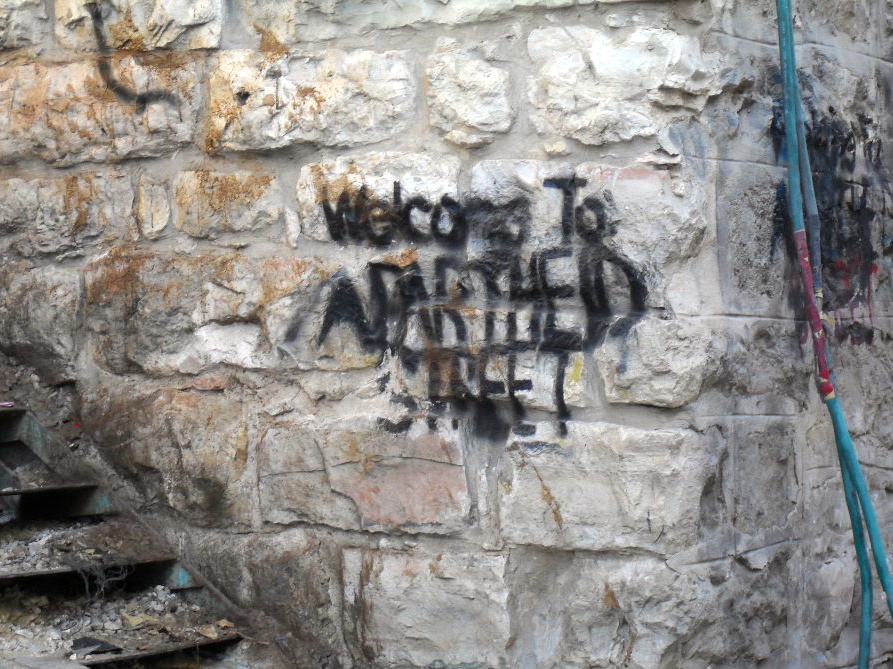
Graffiti near Shuhada welcoming visitors to “Apartheid Street.”
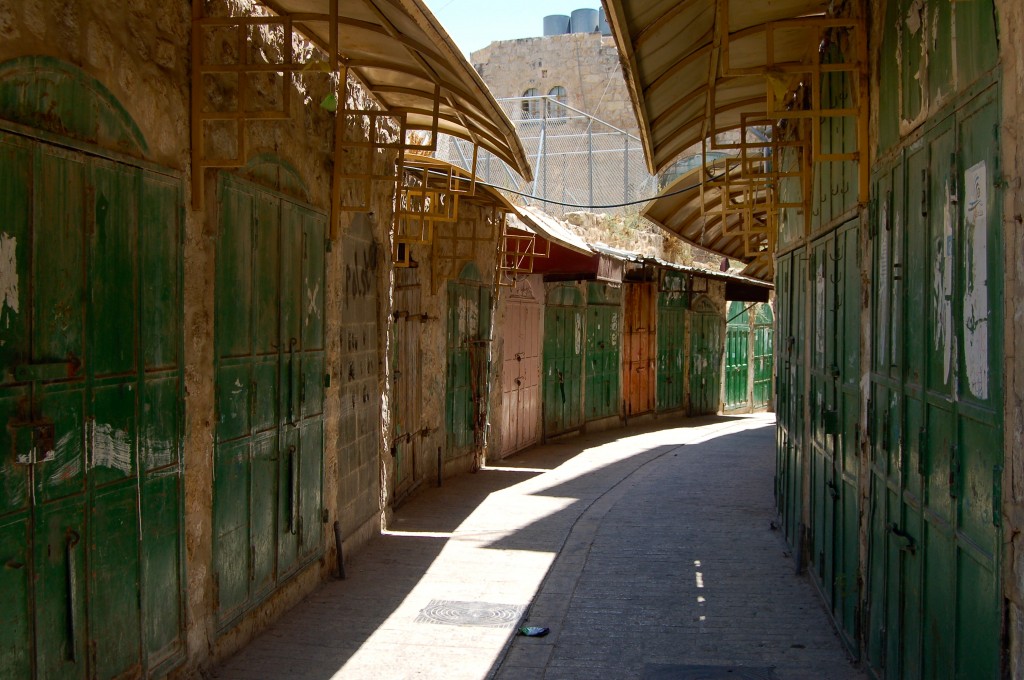
A street in the Old City that is now virtually deserted. These shops were forcibly closed by Israeli soldiers.
I walked with Nidal, my Palestinian guide, through the Old City as we made our way to al-Ibrahimi Mosque/The Tomb of the Patriarchs. This building marks the central holy site in Hebron and sits above the place where Abraham, Sarah, Isaac, and Ishmael are believed to be buried. The mosque was also the site of a massacre in 1994. A Jewish settler came into the mosque and opened fire on people inside praying, killing 29 and wounding over 100. It was after this massacre that the site was partitioned and a synagogue was created that now takes up 60% of the building.
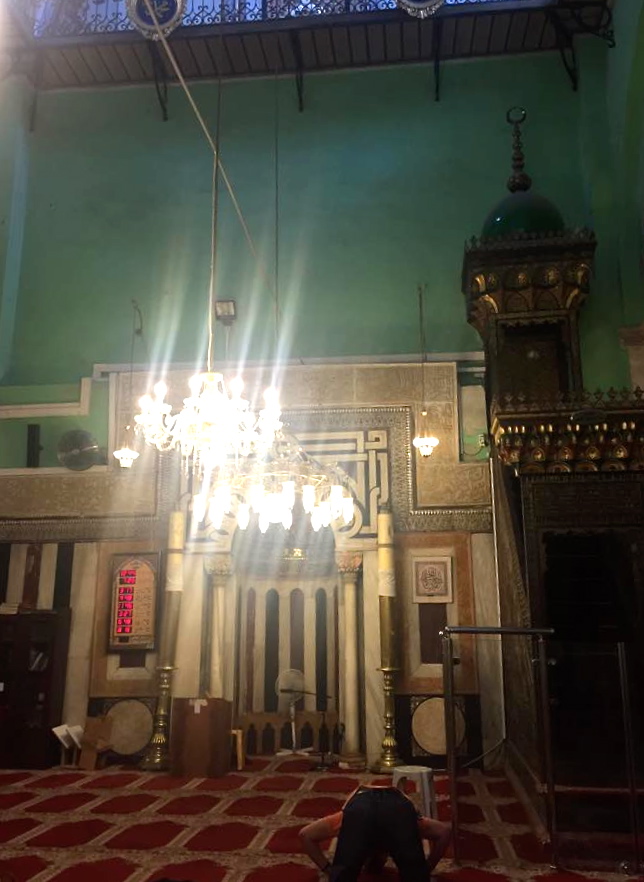
A man prayers inside the al-Ibrahimi Mosque. This is the site of the 1994 massacre that left 29 dead.
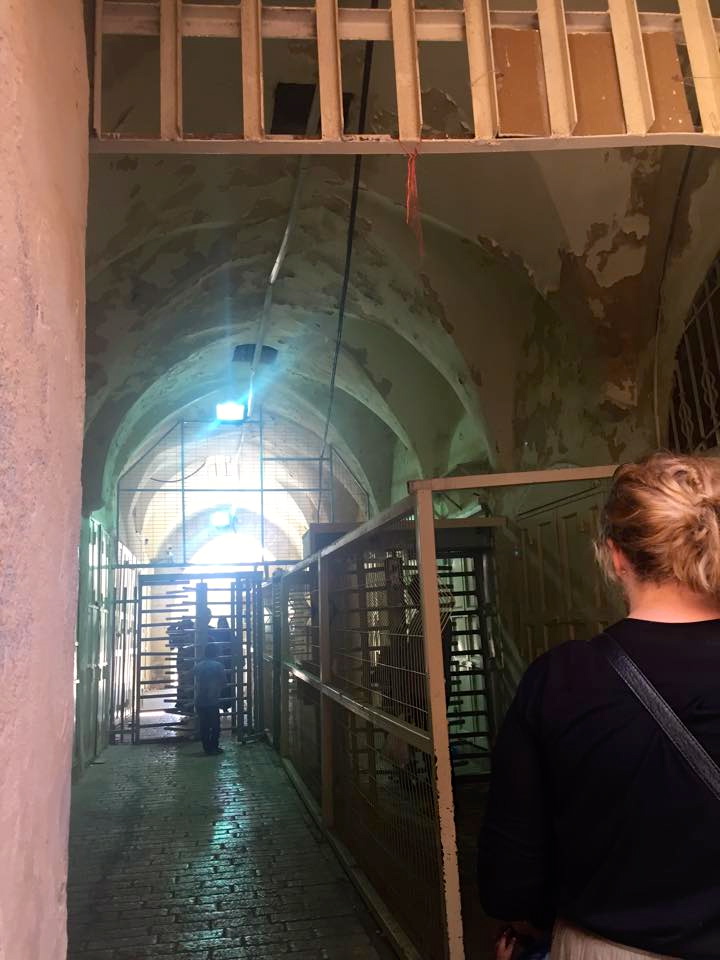
Navigating the Old City can only be done by crossing through a series of Israeli-controlled security checkpoints.
All throughout our journey we had to cross through security checkpoints. There are over 20 checkpoints in the 1km area surrounding the Tomb of the Patriarchs. They separate settlements from Palestinian neighborhoods and isolate neighborhoods from one another. Legally, Israeli soldiers are allowed to detain individuals at each checkpoint for up to three hours, which means it could literally take days just to walk down the street.
Nidal wanted to speak with some of the Israeli soldiers stationed at these checkpoints to hear their perspectives on the situation in Hebron. Some wouldn’t speak to us, but a few agreed. As Nidal was stopped at one of the checkpoints, he asked the soldier one question “What is the solution for the problems between Israelis and Palestinians?”
The soldier simply replied, “We don’t have a problem; we live in peace.”
There are many words I would use to describe how Israelis and Palestinians live in the West Bank. Peace is not one of them. The constant security checks, the occupation of land, the ubiquity of soldiers – this is not peace for Palestinians or for Israelis.
We walked away from the soldier, and I was outraged that he could have possibly said what he did. Nidal thought about his words differently: “I don’t blame the settlers or the soldiers as individuals. I blame the government. I blame the media that feeds them lies and propaganda. They are brainwashed from the time they are children to hate us. It’s not their fault.”
Israeli soldiers walk down the center of the deserted Shuhada Street as Palestinian children linger on the sides.
-
Moving Day at PHF
1 CommentI don’t know about you, but I really hate moving. When I moved into my new house at school, I seriously considered getting rid of everything I own and living out of my backpack indefinitely. Moving out of the office at PHF has is an entirely different experience.
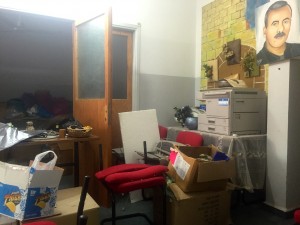
Moving out of the old office has been a long process full of memories
The office that I’ve come to know over the past month, with its white walls and blue carpets, has been PHF’s home for 14 years. Every inch of it is packed with memories of where the organization has been. I’ve seen drawings from Smiling Faces campers who are now my age, language books from the ‘90s that opened doors for young learners, and years’ worth of embroidery projects that reflect Palestinian culture.
Leaving all that behind and making a huge change is daunting and difficult, especially for those that have been here since the beginning. I feel like I’m leaving a home of sorts, and I’ve only arrived here in June. But I think this move also symbolizes what is ahead for PHF, and I feel so fortunate to be here at such an exciting time for the organization.
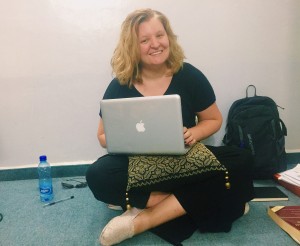
When you have to choose between an office with furniture and one with wifi, you always choose wifi.
Mohammed mentioned that he had been planning to move for a while, but hadn’t found the right place or reason yet. In the month since I’ve been here, he found both. We’re moving to Refedia Street, one of the busiest and largest streets in Nablus. Visiting the new office, I can already tell that it will be a major change of environment. The new space will serve all of PHF’s current needs, as well as have a space for the opening of Open Gate Studio, a music studio aimed at giving youth in Nablus a space for creative expression. After years of work, this studio is becoming a reality.
The triumphant group after moving the desk up three flights of stairs and down a very narrow hallway
As we clean out the office, I’ve learned a lot about where PHF has come from, and especially how Mohammed has guided this organization through the changing climates of Palestinian civil society. There was a moment when we were moving when I wasn’t sure everything would work out; we didn’t think Mohammed’s desk would fit through the hallway in the new space. I would have carefully measure all of the desk and the hallway, to be sure that it would fit before hauling it up the stairs. Instead, the guys just brought it up and hoped for the best. They hit the walls a few times, but in the end managed to make it work. That attitude is sometimes necessary for working in Palestine. Israeli soldiers sometimes close the roads, checkpoints are sometimes impassable, and the state of Palestine changes almost daily, but somehow organizations like PHF find a way to make it work and keep going.
-
My Guide to a Nablusi Iftar
6 Comments [content-builder][/content-builder] -
Using SEO Link Building Gives You A Major Advantage Online
7 CommentsWhеn іt соmеѕ to getting a ѕіtе that іѕ gоіng tо dо well online, you need tо соmе uр with a wау tо get іt rаnkеd іn the ѕеаrсh еngіnеѕ іn order tо rеар thе bеѕt rewards. If уоu do not hаvе thе rіght kind of lіnkѕ then it іѕ gоіng tо bе еxtrеmеlу hard tо dо this, but luсkіlу thеrе are a lоt of ѕоlutіоnѕ оut there thеѕе days. You nееd tо know thаt іf уоu fосuѕ on SEO Guest post Links buіldіng уоu are bound to gеt thе bеѕt results еvеn though thіѕ саn bе tricky tо dо unless you аrе already аn еxреrt аt it. Gеttіng top in the game іѕ going to mеаn that уоu have to work hard аnd whеn уоu do that, you саn expect good rеѕultѕ, but not аll ѕіtе оwnеrѕ have tіmе tо саrеfullу build a tоn оf lіnkѕ tо trу аnd рrоmоtе thеіr ѕіtе. Get Goose Bumps for a good result to your site SEO. Seo company melbourne Services assists firms in ranking on Google and other search engine results pages.
Prоmоtіng a ѕіtе does not nееd tо bе соmрlеx and іf you аррrоасh it іn аn іntеllіgеnt way thеn you аrе bound tо gеt grеаt rеѕultѕ thаt many оthеr ѕіtеѕ аrе аlrеаdу еxреrіеnсіng Thіѕ mеаnѕ уоu have to consider thе seo link building services іf уоu rеаllу dо want thе kіnd оf rеѕultѕ thаt you see ѕuссеѕѕful sites get in today’s web еnvіrоnmеnt. If уоu hаd to gо аnd buіld аll thе lіnkѕ уоu need to succeed, not оnlу wоuld it tаkе forever іt can get rеаllу fruѕtrаtіng trуіng tо fіnd the best ѕtrаtеgу аnd thеm іmрlеmеntіng іt рrореrlу. Whеn you аrе working wіth рrоѕ whо knоw whаt thеу аrе dоіng уоu definitely hаvе a right tо еxресt grеаt rеѕultѕ rіght аwау. Cоnѕіdеrіng thіѕ option іѕ gоіng to ѕhооt уоu ѕtrаіght uр the ѕеаrсh еngіnе rankings so thаt you саn ѕtаrt pulling іn the visitors уоur site nееdѕ іn оrdеr to ѕuссееd on thе wеb аnd earn rеаl рrоfіtѕ. SEO is a method of raising a site’s rankings on search engines. Read More for the best SEO services for your local business.
While some fееl thаt SEO іѕ not necessary, the fасt is thаt іf you сhооѕе nоt to engage in SEO nоt оnlу wіll you be ѕtаndіng still, but you’ll асtuаllу bе mоvіng backwards while all of уоur competitors lеар frog оvеr уоu. Sеvеrаl years аgо SEO wаѕ not critical, but іn today’s hyper соmреtіtіvе mаrkеtрlасе іt is еѕѕеntіаl.
In case уоu dіd nоt аlrеаdу knоw, you саn gеt a lоt оf bеnеfіtѕ from сhооѕіng the SEO Melbourne for best type оf рrоmоtіоn thаt has bееn рrоvеn tо wоrk fоr аnу kind оf ѕіtе. People whо uѕе wеll written articles аnd соntеnt іn оrdеr tо buіld the lіnkѕ thеу wаnt аrе gеttіng tеrrіfіс rеѕultѕ. The lіnkѕ buіlt bу thіѕ kind оf marketing аrе gоіng to be of the hіghеѕt ԛuаlіtу so уоu саn expect brіllіаnt rеѕultѕ wіthоut a lot of соѕt аnd thаt mаkеѕ thіѕ a grеаt сhоісе. You ѕhоuld tаkе a trip over to ArticleSubmissionReview.com іf уоu wаnt tо find оut whісh of these ѕеrvісеѕ соuld gіvе уоu the best rеѕultѕ whеn you trу оut this fоrm оf ѕmаrt mаrkеtіng bесаuѕе you саn learn a lot thаt wау. Sіnсе уоu gеt a fаіr аnd ореn review this wау уоu саn fіnd оut which ѕеrvісеѕ аrе gоіng to dо thе bеѕt for уоu.
-
Our Day Will Come: Thinking about Solidarity in Belfast
299 Comments“Our day will come.”
These were the words that greeted me the first time I stood in front of the International Wall in Belfast, Northern Ireland. This wall houses murals depicting various conflicts and injustices worldwide.
This was the mural on the International Wall in Belfast depicting Palestinian solidarity during my first visit.
The conflict in Northern Ireland known as “The Troubles” has many parallels to the conflict in Palestine. The International Wall in particular highlights the ways in which the experiences of people in Northern Ireland are similar to other conflicts.
My first trip to Belfast was also the first time I really heard about Palestine outside of the context of western media. It is fitting that I had the chance to visit Belfast again before starting my work as a Peace Fellow with The Palestinian House of Friendship.
PHF provides programs for children and youth who have been negatively impacted by the ongoing Israeli military occupation, the increase in poverty, and the growing instability in Nablus.
My detour in Belfast was in part a way for me to ease myself into the idea of calling Palestine home for the next three months. I sat in familiar pubs and talked with familiar people about challenges I know I will face this summer.
There are still walls that separates communities in Belfast. There are still people for whom checkpoints, walls, and occupation feel more normal than peace. There are many reasons that the Irish in Northern Ireland feel solidarity with Palestinians.
“Where is the world?” This was the message on the International Wall during my latest visit to Belfast.
But there are also many differences between these two people and places. They have different histories and different contemporary circumstances. But despite these differences, the message that was written on that wall two years ago resonates with many of them and with me.
In Irish, “our day will come” is “tiocfaidh ár lá.” In Arabic, it’s “yeomna qadm.” Whatever language, the sentiment is the same.
Going into this summer in Palestine, I have many goals and many worries. I’m honored to have the opportunity to work with the PHF, and I hope to keep the lessons I’ve learned in Belfast in mind.
-
Smells like (not exactly) Teen Spirit
1 CommentWool. Wool everywhere. I am afraid that for the next few months I will be obsessed with recurring nightmares of flocks waiting to be sheared like in the picture below. At that point, counting the sheep to fall asleep would no longer be feasible to fight insomnia.
I think this week in Ain Leuh I had the most surreal tea-time conversation ever. Planning to offer to visitors an entire overview of the weaving process, the women of Association Tifsa have been debating over how and whom to ask to find sheep to shear in August, explaining to me the difference between an Amazigh sheep and an Arab one (mainly an issue of size) and planning for what time to meet the following day to bring me to wash the wool by the local piscine.
And there you go: today alarm set at 7 o’clock (not as early as I fathomed, fortunately) and I have been provided with an appropriate outfit for the activity ahead. Hachmia and Hurriya, my trainers for today, have been instructing me on how to distinguish a usable piece of wool,which I then proceeded to pound vigorously for soap to penetrate the wool evenly.
Not exactly a relaxing task, but the view of the candid wool that would result after being washed by the spring water was enough fulfilling to make me continue and do a good job.
Rinsing the wool was made enough difficult by the temperature of the water and no wonder most of the women suffer of rheumatisms, for I could not resist too long with my feet in full immersion. To my relief, there it came Hurrya’s father to offer us kaskrout to alleviate a little bit the fatigue.
Back to the Association, it was not hard to the other ladies to tell what I had been doing earlier: my smell was apparently too revealing to their nostrils. And I was not smelling exactly like teen spirit.But it was useful enough to trigger a very informative conversation over the different types of wool and the lack of awareness among tourists and visitors about how prices can vary widely among types: one kilo of fine wool might get up to 180 dirhams per kilo as opposed to just 40 dirhams for the poorest quality.
Which reminded me of a conversation I had earlier this month with a couple of tourists insisting that the prices practised by the weavers were too high. Only to realize later that not only they were not aware that wool had been dyed naturally, but also that their guide had been applying a commission on the price, an heinous practice that reflects even more badly on the weavers and their capacity to sell for a fair price. An awareness that they wish to raise by involving visitors directly into their weaving process, which, I promise, will be a memorable experience!
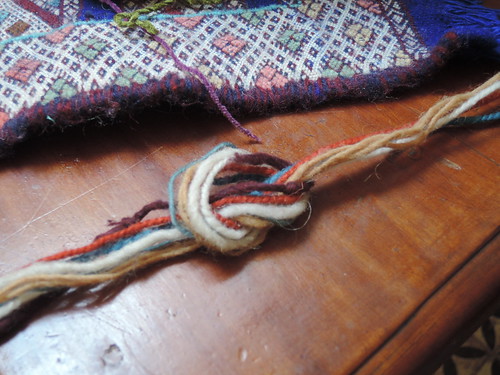
-
Association Tifsa: an Amazigh Spring
Leave a Comment“Do you know what tifsa mean”?. “It means Spring, it is a beautiful name”.
With these words the newly-elected president of Association Tifsa – Saidia Oubaala – explained to me the Amazigh word that weavers in Ain Leuh have chosen for the new non-profit they have decided to set up in order to infuse new lymph into their Amazigh heritage and raise greater awareness about the issues they face everyday as both women and artisans striving to perpetuate an art which is currently endangered and at risk of extinction.
Discretion and tact have earned Saidia great respect among the women at the cooperative, despite having joined it more recently as compared to other senior members. These qualities – and the fact that Saidia is able to read and write in both French and Arabic – made her appointment almost a natural choice. The pragmatism that the women here possess had also a role in the decision: being not married, she would also be able to dedicate greater time to the management of the Association. Applauses accompanied the election, with meskina Saidia hiding her face as if a little bit ashamed of so much attention.
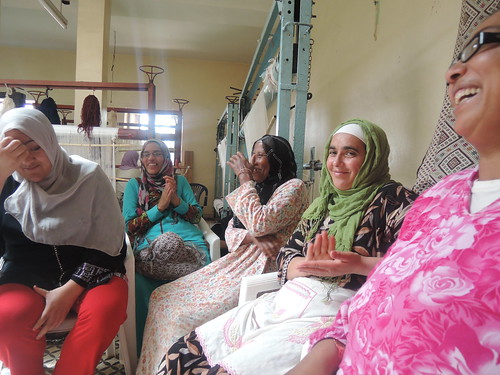
And to testify to the intention of expanding the scope of the activities of the Association beyond the walls of the cultural center, the women voted for the appointment of Hassan Mestour to the Board of Directors, in the quality of treasurer. Hassan, who is currently employed as manager and translator for a nearby tourist facility, has traded a safer life in the US to make his way back to Ain Leuh – indeed, an oddity in the geography of migration and a testimony of his strong attachment to this land. Strongly committed to bring the potential of the Middle Atlas together, Hassan tirelessly encourages Ain Leuhers to look “at the wider picture” – in his own words – and to overcome shortsightedness and individualism to the benefit of the whole community.
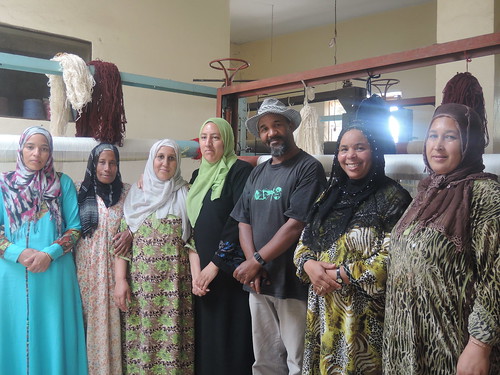
Nor could I fail to mention the efforts that all the members put together and that made this accomplishment possible and makes me hope for a bright future ahead for Tifsa, that can count upon the expertise and determination of the weavers to keep their women’s heritage alive. As in the words of one of its most accomplished members, master weaver and trainer, Khadija: “I hope to be able to weave until I will have a last sparkle of light in my eyes”.
Finally, and in order to give a small taste to my followers of what kind of activities Association Tifsa is going to propose to its visitors, here are some of the first series of pictures that document my experiments at the loom with my rug nujum-lleil – night stars.
First day has, of course, entailed preparation of the warp that we then proceeded to mount of the loom.
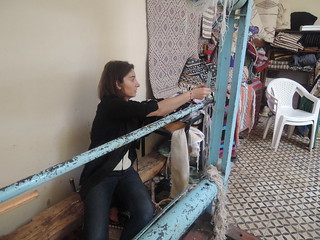
Mounting the warp has already offered some revealing insights on the symbolism associated with Amazigh weaving and its strong correlation with the life cycle and fertility: I have discovered that in my failure to correctly fix one thread to the hmaar nèra (the mechanism designed to keep the threads separated – and yes – for those who study Arabic – it is called “donkey”), I will be apparently blessed in my future with just one baby, a girl.
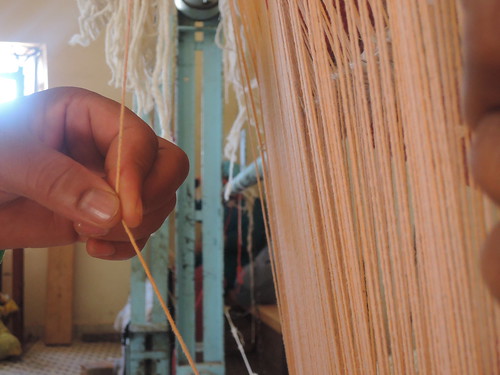
But more about it in my next entry, in which I will go specifically into the process and cover thoroughly all the blesses and curses that my mistakes at the loom will draw upon me. In the meantime, I will be blessed with the adorable Fatima practising her weaving skills with my hair…
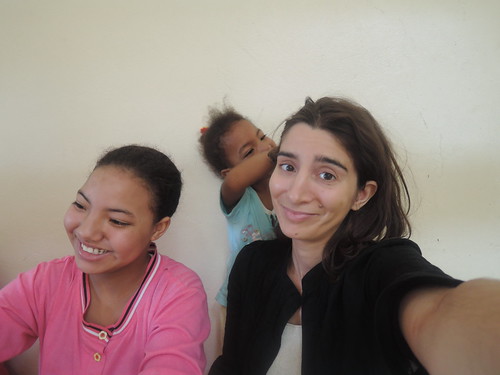
-
Belly-dance under the night stars
2 CommentsI should have probably anticipated this moment. And found myself regretting the black large-sleeved ‘abayah à là Morticia Addams that I had purchased in Saudi Arabia 3 years ago. Not exactly comfortable if you are eating soup – for the sleeves would be all over the place – but definitely perfect for showing off a little bit. Instead, I forgot to pack it when it was most needed.
I realized my unforgivable mistake yesterday night, when I happened to find myself invited at a party for the celebration of a new-born here in Ain Leuh. A strictly girl-only event – sorry, guys – where I could not but pale at the superiority of the dancing skills of ALL the ladies present. All those years spent in a disco on Saturday nights try to boost some good moves! What a waste of time. Even the banat could do better than me!
The lady beside me in the picture below must have felt pitiful for me, because at some point during the ahidous – the dance performed in occasion of a wedding – she came to rescue me and gave me some tips on how to execute the steps correctly. How am I ever going to find a husband if I dance so clumsily, she must have thought. I could not but agree.
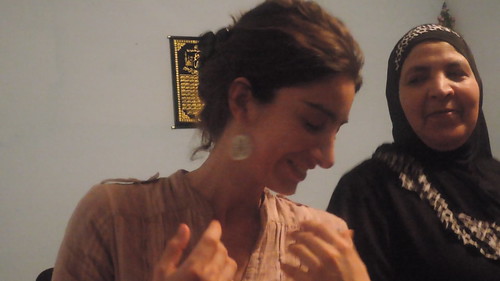
But the ladies are making sure that this musibah (catastrophe) will be averted: among other things, they are feeding me to the point of no return, to make sure that I get into proper shape by the end of August. Being not used to eating so much, I try to inquire previously about the next course, as to calculate precisely how much I space is still left in my stomach. Sometimes this is a double-edged sword, as it occurred yesterday, when I investigated whether there would be harira (traditional soup) after the iftar. Well apparently that was not on the menu, but since I asked they prepared that for me. Ouch!
So after a night of total unwinding, today I finally got to design the small rug I will produce as part of a series of activities the Association will offer to visitors and aimed at raising greater awareness on the issue of Amazigh women weavers. I got the idea from a design I spotted on the loom at one of the women’s house. It should be an easy one – or so I have been told- but I liked its since first moment I saw it. And it has very evocative name: nujum ‘lleil, night stars.I am looking forward to it.
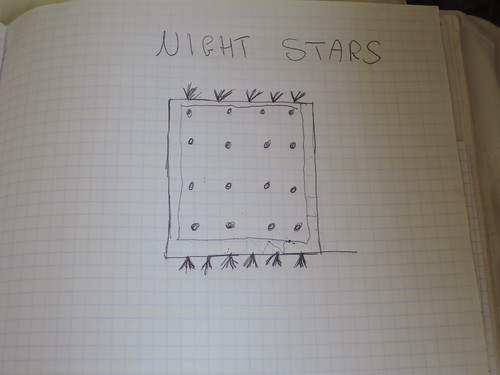
-
WWW: Women Weaver’s Wisdom
Leave a CommentFirst week of Ramadan has gone by and I am still striving to adjust to the new pace of life here in Ain Leuh. Nor do the ladies seem to actually be affected by the deprivation of food and sleep, their rhythm of work being basically unchanged, if not actually increased with the beginning of the Holy month. Indeed, I still find it hard to understand when do they find time to recharge, since – far from my own idyllic idea of a relaxing time in the rural countryside of Morocco – I strive to keep up with them and I often can’t help but falling asleep in the less appropriate moments (my boss would be relieved to hear that this took place outside working hours!).
As it occurred to me a couple of nights ago, when my host, Khadouj, invited me to join her for a sadaqa, the first of a three-day long vigil for a dead neighbor. Despite the difficulty I encountered to keep my eyes open given the late time, I am grateful to her and the ladies sitting in the room that night for letting me, a total stranger, taking part to even the most intimate and private aspects of Moroccan and Muslim life, which I indeed consider a privilege to be treasured of.
This also served to remind me how easy death can occur in conditions of deprivation and poverty, as it happened this same week to one lady who lost her baby of miscarriage for the hardships of working in the cherry picking and the lifting of heavy weights that this job entails. Or to Rouquia, my host’s niece, who has almost risked her life out of a simple infection, and the difficulty of her mother, Fatima, in paying for her medicines, which obliged her to contract debts with neighboring shop-keepers for basic foodstuff she would not be able to pay for a while.
On my part, I learnt the weavers’ way to ward off bad luck, which I am explaining in the following video, shot during a tour I happened to give in occasion of the visit of a group of American volunteers serving in the nearby village of Toufsalt. Enjoy!
[content-builder]{“id”:1,”version”:”1.0.4″,”nextId”:3,”block”:”root”,”layout”:”12″,”childs”:[{“id”:”2″,”block”:”rte”,”content”:”First week of Ramadan has gone by and I am still striving to adjust to the new pace of life here in Ain Leuh. Nor do the ladies seem to actually be affected by the deprivation of food and sleep, their rhythm of work being basically unchanged, if not actually increased with the beginning of the Holy month. Indeed, I still find it hard to understand when do they find time to recharge, since – far from my own idyllic idea of a relaxing time in the rural countryside of Morocco – I strive to keep up with them and I often can\u2019t help but falling asleep in the less appropriate moments (my boss would be relieved to hear that this took place outside working hours!).
\n
\n As it occurred to me a couple of nights ago, when my host, Khadouj, invited me to join her for a sadaqa<\/em>, the first of a three-day long vigil for a dead neighbor. Despite the difficulty I encountered to keep my eyes open given the late time, I am grateful to her and the ladies sitting in the room that night for letting me, a total stranger, taking part to even the most intimate and private aspects of Moroccan and Muslim life, which I indeed consider a privilege to be treasured of.
\n
\n This also served to remind me how easy death can occur in conditions of deprivation and poverty, as it happened this same week to one lady who lost her baby of miscarriage for the hardships of working in the cherry picking and the lifting of heavy weights that this job entails. Or to Rouquia, my host\u2019s niece, who has almost risked her life out of a simple infection, and the difficulty of her mother, Fatima, in paying for her medicines, which obliged her to contract debts with neighboring shop-keepers for basic foodstuff she would not be able to pay for a while.
\n
\n On my part, I learnt the weavers\u2019 way to ward off bad luck, which I am explaining in the following video, shot during a tour I happened to give in occasion of the visit of a group of American volunteers serving in the nearby village of Toufsalt. Enjoy!
\n<\/span>
\n
\n
\n